
VSAT vs Starlink for Ships: Full Comparison

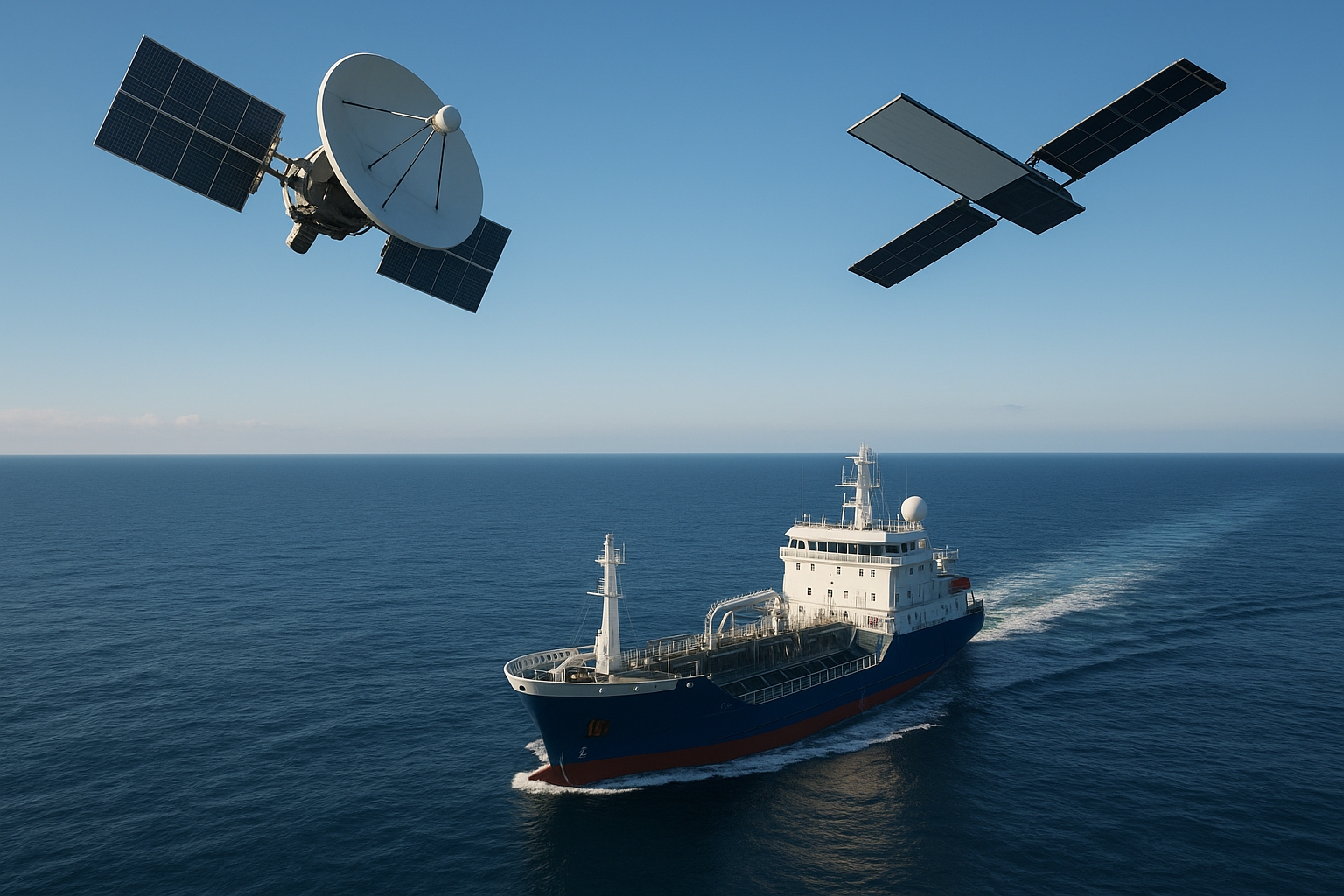
Choosing between VSAT and Starlink for maritime internet depends on your vessel’s needs. VSAT offers broad global coverage and proven reliability, while Starlink provides faster speeds and lower latency, especially near coastal regions. Here’s a quick breakdown:

  • VSAT: Reliable for global routes, with slower speeds (1–50 Mbps) and high latency (600+ ms). Costs include $10,000–$60,000 for equipment and $500–$2,000 monthly fees.
  • Starlink: Faster (100–350 Mbps), lower latency (20–40 ms), and more affordable upfront ($2,500–$10,000). Coverage is growing but limited in polar and remote waters.

Quick Comparison

Feature VSAT Starlink
Latency 600+ ms 20–40 ms
Speed 1–50 Mbps 100–350 Mbps
Coverage Near-global Expanding, limited in some areas
Cost (Equipment) $10,000–$60,000 $2,500–$10,000
Monthly Fees $500–$2,000+ $250–$500

For cruise ships, Starlink’s speed is ideal, but VSAT remains a dependable backup. Cargo vessels often rely on VSAT for its reliability on major routes. Yachts may prefer Starlink for affordability near coasts, with VSAT for global travel.

A hybrid approach – using both systems – is often the best solution for uninterrupted connectivity.

Starlink

VSAT for Maritime Communication

VSAT has been a key player in maritime satellite communication since it debuted in 1986. Over the years, this technology has transformed from a specialized solution into a critical service that enhances crew connectivity and boosts operational efficiency for global shipping. Below, we’ll explore how VSAT works, its features, and the costs involved in maritime applications.

How VSAT Works

VSAT relies on geostationary (GEO) satellites stationed roughly 22,369 miles (36,000 km) above the Earth’s equator. These satellites stay aligned with Earth’s rotation, forming a stable communication link between vessels and ground-based networks. Data is transmitted from the ship to the satellite and then to a ground station, where it connects to the internet or private networks.

A stabilized antenna on the vessel continuously tracks the satellite, ensuring a steady connection even at speeds of up to 30 knots. This precise tracking is why VSAT is known for its high reliability. The system includes two main components: the Above Deck Unit, which houses the dish, tracking mechanism, and protective radome, and the Below Deck Unit, which contains the modem, router, and control systems.

VSAT Features and Capabilities

Maritime VSAT provides coverage anywhere with a clear view of the sky, making it suitable for international shipping routes, cruises, and offshore operations. Depending on the equipment and service plan, it can deliver data speeds ranging from 4 kbit/s to 16 Mbit/s.

One of VSAT’s standout strengths is its reliability, with uptime rates often exceeding 99.9%. Service Level Agreements (SLAs) ensure minimum speeds and predictable costs, helping operators manage their budgets effectively.

VSAT operates across three primary frequency bands, each with its own characteristics:

  • C-band (4–8 GHz): Known for its resilience in heavy rain, though it offers lower data speeds.
  • Ku-band (12–18 GHz): A popular choice that balances affordability and coverage, though rain can affect its performance.
  • Ka-band (26.5–40 GHz): Offers faster speeds, making it ideal for data-heavy applications, but its coverage can be less consistent under certain conditions.

However, VSAT does have its challenges. The distance to GEO satellites introduces a latency of about 250 milliseconds, with additional delays of 300 to 500 milliseconds due to protocol processing. These limitations are worth considering alongside its many advantages.

VSAT Costs and Installation

VSAT technology comes with a notable price tag. Basic systems start at around $10,000, while advanced setups can cost over $60,000. Installation typically adds another $5,000 to $10,000 to the total expense.

The size of the antenna plays a major role in both performance and cost. Most maritime VSAT antennas measure between 30 and 47 inches in diameter, while larger C-band systems can reach up to 94 inches. Bigger antennas generally offer better signal strength and faster data rates but require more deck space and structural support.

Monthly service fees usually range from $500 to $2,000 or more, depending on the data plan and SLA. Additionally, annual maintenance costs – covering routine inspections, software updates, and minor repairs – typically fall between $500 and $1,500.

Introduced in 2022, Starlink Marine leverages a network of low Earth orbit (LEO) satellites to reshape maritime communication. Unlike traditional VSAT systems that depend on far-off geostationary satellites, Starlink’s LEO setup brings a new level of efficiency to the table.

Starlink satellites orbit much closer to Earth – around 340 miles – compared to the roughly 22,000-mile distance of geostationary satellites used by VSAT. This proximity enables faster connections. Vessels connect to the nearest satellite, which then relays data through a network of ground stations, or gateways. As satellites move across the sky, the system ensures uninterrupted service by automatically switching connections through a process called handover.

The terminals use phased array antennas, which electronically adjust their beams to track satellites. Their flat-panel design minimizes wind resistance, making them well-suited for maritime conditions. These features are key to Starlink’s performance, which stands out in several areas.

Starlink delivers lower latency, making it ideal for real-time tasks like video conferencing and VoIP calls on ships. Download and upload speeds can vary depending on location and network conditions, but they often surpass those of traditional systems.

The network is continually growing, now covering many major shipping routes. However, coverage in polar regions remains limited for now. Local regulations in certain territorial waters may require terminals to deactivate temporarily, leading to occasional service interruptions. Additionally, heavy rain can sometimes weaken signal strength.

Starlink offers a compact terminal that’s quick to install and more affordable in terms of both hardware and labor compared to conventional maritime satellite systems. The terminal’s design allows for easy mounting, which reduces setup time and expenses.

Equipped with integrated GPS and gyroscopic stabilization, the system automatically adjusts to maintain optimal positioning, ensuring reliable performance even in rough seas. For added flexibility, vessel operators can pause connectivity when it’s not needed, which can help manage costs effectively.

When deciding between VSAT and Starlink for maritime communication, the difference in performance becomes clear when you look at key metrics. The core distinction lies in the satellite technology – VSAT relies on geostationary satellites (GEO), while Starlink operates with low Earth orbit (LEO) satellites. This fundamental difference has a big impact on performance.

Performance Comparison

The positioning of the satellites is a major factor in the performance gap. VSAT’s GEO satellites are positioned much farther from Earth compared to Starlink’s LEO satellites, which significantly reduces the signal travel time for Starlink.

Latency is where the difference really stands out. Starlink offers latencies between 20–40 milliseconds in most maritime regions and can reach up to about 100 milliseconds in more remote areas. On the other hand, VSAT systems typically experience latencies of 600 milliseconds or more. When it comes to download speeds, Starlink consistently delivers between 100–350 Mbps, often exceeding 200 Mbps. In contrast, VSAT usually provides speeds ranging from 1–10 Mbps, with premium plans offering up to 50 Mbps.

Here’s a quick comparison of these performance metrics:

Performance Metric Starlink Marine Traditional VSAT
Latency 20–40 ms (up to 100 ms in remote areas) 600+ ms
Download Speed 100–350 Mbps 1–50 Mbps

Coverage and Geographic Limitations

Understanding where each technology performs best is essential for effective route planning. These coverage characteristics, combined with earlier performance differences, highlight patterns that influence connectivity reliability across various ocean regions.

VSAT’s Broad Coverage

VSAT systems offer near-global coverage through geostationary satellites, making them a reliable choice along heavily trafficked maritime routes. With consistent service across vast areas, VSAT can provide connectivity virtually anywhere on Earth, as long as the satellite remains in view.

Starlink leverages a low Earth orbit (LEO) satellite network to reach remote locations. While the network is expanding with additional satellite launches, some gaps remain. Areas such as polar regions and certain international waters still experience limited coverage. Additionally, regulatory hurdles can impact Starlink’s availability in specific ports or territorial waters.

Regional and Physical Challenges

Both technologies require a clear sky view, which can be disrupted in crowded ports or confined anchorages. For instance, connectivity may falter when vessels are docked near larger ships or in tight spaces.

VSAT shines on traditional maritime routes, particularly those with high commercial traffic, offering dependable service between major ports. This makes it an ideal option for cargo ships following predictable paths. Starlink, on the other hand, is better suited for remote areas where conventional satellite systems often struggle, though its availability in less-frequented ocean regions is still inconsistent due to its ongoing deployment.

For operations in polar regions, both technologies face hurdles. VSAT’s geostationary satellites are limited by their positioning, making coverage in these areas more challenging. Starlink’s LEO satellites hold promise for improved polar connectivity as the network continues to grow, though its current service in these regions remains limited.

For maritime operators, choosing the right communication system is crucial to ensuring smooth operations at sea. Each technology comes with its own strengths and weaknesses, so understanding these is key to making the best decision for your vessel’s needs.

VSAT has long been a reliable option, offering consistent connectivity along major shipping routes thanks to its well-established infrastructure. On the downside, it comes with higher latency, which can be a challenge for real-time applications like video calls or live monitoring. Additionally, the upfront costs for installation and equipment are significant, and its slower data speeds may struggle with bandwidth-heavy activities.

Starlink, on the other hand, shines with its low latency, enabling activities like video streaming, online gaming, and real-time communication that feel similar to land-based internet. It also has a lower initial cost, making advanced connectivity more accessible. However, Starlink isn’t without its challenges. It has coverage gaps in international waters and polar regions, which could lead to service interruptions. Regulatory hurdles in territorial waters can also complicate compliance, and its limited track record in maritime settings means there’s less experience with long-term troubleshooting.

Technology Key Advantages Primary Disadvantages
VSAT Reliable connectivity, global coverage, established support systems High latency, expensive setup, slower data speeds
Starlink Low latency, fast speeds, affordable upfront costs Limited coverage in remote waters, regulatory issues, less maritime experience

Weather conditions also play a role in performance. VSAT’s geostationary satellites generally provide stable signals during storms, while Starlink’s multiple satellite connections help reduce weather-related disruptions.

When it comes to maintenance, VSAT systems often require professional technicians for repairs, which might mean a trip to port for major fixes. Starlink’s simpler hardware is easier to troubleshoot, though finding replacement parts in remote areas can be tricky. VSAT providers typically offer customizable packages with features like priority traffic routing, while Starlink sticks to straightforward pricing plans, which can appeal to smaller operators.

Another consideration is longevity. VSAT systems are known for their durability, with many operating effectively for years. Starlink, though rapidly expanding its satellite network, may require more frequent updates to keep up with its evolving technology. These differences can significantly impact long-term investment decisions.

Best Technology by Vessel Type

Each type of vessel comes with its own set of connectivity needs, shaped by factors like operational demands, passenger expectations, and budget constraints. Here’s a closer look at which maritime communication technology works best for various vessel types.

Cruise Ships and Passenger Vessels

Cruise ships have some of the highest connectivity requirements due to the sheer number of passengers expecting fast, reliable internet. These vessels need systems that can handle large bandwidth loads seamlessly.

In areas where Starlink is available, its low latency and high-speed internet can deliver a service comparable to what passengers experience on land. Cruise ships often use Starlink as their primary option for high-speed connectivity, with VSAT serving as a backup in regions where Starlink coverage is limited.

Cargo Vessels and Commercial Ships

For commercial shipping, reliability and cost-efficiency are key. These vessels rely on connectivity for essential tasks like navigation, weather updates, crew communication, and operational reporting.

VSAT remains a trusted choice for these ships, offering dependable service on major shipping routes and backed by global support networks at many ports. Its predictable costs and proven reliability make it ideal for mission-critical operations. However, for coastal cargo vessels operating closer to shore, Starlink may be a practical alternative. Its simpler setup and lower upfront costs are appealing, though its coverage is not yet suited for transoceanic routes.

Private Yachts and Leisure Vessels

Private yachts often seek a balance between performance and affordability when it comes to connectivity. Many yacht owners, especially those cruising in coastal waters or popular destinations, choose Starlink for its low latency and easy installation. Unlike VSAT, Starlink doesn’t require professional installation, making it a convenient option for many yacht owners.

For luxury superyachts that demand global coverage, VSAT is often the go-to choice. While it comes with higher costs and a more complex setup, it ensures reliable connectivity no matter where the vessel travels.

Vessel Type Recommended Technology Primary Considerations
Cruise Ships Starlink (with VSAT backup) High bandwidth demands
Cargo/Commercial VSAT Reliability and global coverage
Private Yachts Starlink (coastal) / VSAT (global) Cost-performance balance

Weather conditions can also influence connectivity choices. For instance, commercial vessels on tight schedules benefit from VSAT’s consistent performance during bad weather. On the other hand, recreational yacht owners might accept occasional weather-related interruptions in exchange for better day-to-day internet performance.

Conclusion

When deciding between VSAT and Starlink, it all comes down to the specific needs of your vessel and its operations. Each technology has its strengths, designed to address different aspects of maritime connectivity.

VSAT stands out for its global coverage and dependable performance, making it a go-to option for commercial and remote operations. While the upfront installation costs may be higher, its robust infrastructure and reliable support networks ensure consistent service, which can make it a worthwhile investment for global routes.

Starlink, on the other hand, offers low latency, impressive speeds, and simpler installation, making it ideal for vessels operating in coastal or regional areas. With its rapid network expansion and competitive pricing, Starlink is making high-speed maritime internet more accessible than ever.

For many operators, a hybrid approach works best: leveraging Starlink for high-speed connectivity where available and relying on VSAT as a backup for extended coverage. This strategy is particularly popular among cruise operators, as it combines the strengths of both systems to maintain uninterrupted service while optimizing performance.

Ultimately, the choice between these two technologies depends on your vessel’s operational scope and budget. Coastal operations may benefit more from Starlink’s cost and speed advantages, while global routes often require VSAT’s reliability and reach. It’s also worth considering the total cost of ownership rather than just the initial setup costs, as VSAT’s predictable pricing and established support can offer better long-term value for commercial fleets.

As maritime communications continue to evolve, it’s important to reassess your setup periodically. Both VSAT and Starlink are advancing rapidly, and staying flexible will help you adapt to future improvements. The best choice is one that meets your current needs while leaving room for upgrades as these technologies grow.

FAQs

When weighing VSAT against Starlink for maritime communication, there are a few critical aspects to keep in mind:

  • Speed and latency: Starlink often delivers faster speeds and lower latency, making it a strong option for activities like video calls or live-streaming. VSAT, while slower, remains dependable for tasks that don’t require real-time responsiveness.
  • Coverage: VSAT boasts global reach, even in remote waters, whereas Starlink’s coverage is still growing and might have gaps in certain regions.
  • Equipment and installation: Starlink’s hardware is generally smaller and easier to install, contrasting with the larger, more complex antennas needed for VSAT systems.
  • Cost considerations: Look at both upfront expenses (hardware and installation) and ongoing service charges. Starlink tends to be more affordable overall, though VSAT might be a better match for specific operational demands.

Ultimately, the decision should match your vessel’s communication needs, budget, and travel routes to ensure seamless and effective connectivity while at sea.

Using VSAT and Starlink together creates a powerful hybrid communication system that enhances connectivity for vessels. VSAT offers dependable, worldwide coverage via satellite networks, while Starlink delivers high-speed, low-latency internet in its coverage zones. By combining these two technologies, ships gain the advantage of VSAT’s extensive reach and Starlink’s faster speeds, ensuring reliable communication even in remote areas.

This setup is especially valuable for maritime operations that depend on uninterrupted internet access – whether for navigation, crew welfare, or passenger services. It also provides the flexibility to switch between networks based on factors like availability, performance, or cost, making it a versatile and efficient solution for today’s maritime communication challenges.

Using Starlink while navigating international waters comes with its own set of regulatory hurdles due to differing laws and agreements across countries. Although Starlink is built to provide global coverage, maritime operators must adhere to international regulations, such as those established by the International Telecommunication Union (ITU). On top of that, vessels operating close to a nation’s territorial waters may need to meet specific local licensing requirements.

To ensure compliance, it’s a good idea to consult legal or regulatory experts who can help verify that your Starlink usage aligns with the relevant rules – particularly when traveling through multiple jurisdictions. Keeping up-to-date with changes in maritime communication regulations can also help you sidestep potential complications.

Satellite vs Cellular: Best Maritime Internet?

Satellite vs Cellular: Best Maritime Internet?

When it comes to maritime internet, your choice boils down to satellite or cellular connectivity. Both have distinct advantages, and your decision depends on where your vessel operates and what kind of connectivity you need. Here’s the breakdown:

  • Satellite Internet: Best for global coverage, especially in open seas. Low Earth Orbit (LEO) satellites now provide faster speeds and lower latency, making them suitable for real-time applications. However, satellite systems are more expensive and can be affected by severe weather.
  • Cellular Internet: Ideal for vessels near coastlines. With 4G LTE and increasing 5G availability, cellular networks deliver faster speeds and lower latency than traditional satellite systems. That said, coverage is limited to 15–40 nautical miles offshore.
  • Hybrid Systems: Combine satellite and cellular networks for seamless switching based on location and signal strength, balancing cost and performance.

Quick Comparison

Feature Satellite Cellular
Coverage Global, including open seas Coastal (15–40 miles)
Speed 5–250 Mbps (LEO) 50 Mbps–2 Gbps (4G/5G)
Latency 25–600 ms 10–64 ms
Reliability Weather-dependent Coastal congestion may occur
Best For Open-ocean vessels Coastal operations

For cruise ships, cargo vessels, and superyachts, hybrid systems are often the best solution. They leverage cellular networks near shore and switch to satellite in remote areas, ensuring reliable connectivity. Choose based on your vessel’s routes, budget, and connectivity needs.

Podcast Episode: The Ultimate Guide to Data SIM Cards, Wireless Internet for Boats

How Satellite Internet Works at Sea

Satellite internet keeps vessels connected globally by using radio signals relayed through orbiting satellites. Here’s how it works: when a ship sends data, it travels from the vessel’s antenna to a satellite in space, which then relays it down to a ground station tied to the internet backbone. For incoming data, the process is reversed.

This system relies on three main components: the satellite constellation itself, ground stations (also known as teleports) that link to terrestrial networks, and the onboard equipment on the vessel. These elements are strategically positioned worldwide to provide consistent coverage and backup systems.

Maritime satellite internet operates on specific frequency bands such as C-band and Ku-band, with newer systems increasingly adopting Ka-band for higher data speeds. Each band has its own strengths, including differences in signal strength, resistance to weather, and bandwidth. These factors play a crucial role in how satellite orbit types influence overall performance.

LEO vs. Geostationary Satellites

Geostationary satellites are positioned roughly 22,236 miles above the Earth’s equator. They remain fixed relative to the planet, allowing vessels to use simpler, stationary antennas. However, the distance introduces a delay: signals take about 500–600 milliseconds for a round trip, which can impact real-time communications.

In terms of performance, traditional geostationary systems provide download speeds ranging from 1 to 50 Mbps, depending on the user’s service plan and network traffic. Upload speeds are typically slower, between 256 Kbps and 5 Mbps. Despite the latency, these systems are known for their widespread coverage and decades of reliability across vast ocean areas.

Low Earth Orbit (LEO) satellites, on the other hand, operate much closer to Earth, at altitudes between 300 and 1,200 miles. This proximity reduces latency to just 20–40 milliseconds, making them ideal for real-time applications. LEO constellations require hundreds or even thousands of satellites to ensure continuous coverage, as each satellite moves quickly across the sky.

LEO systems can achieve download speeds exceeding 100 Mbps, with upload speeds often matching or nearing the same levels. However, they come with added complexity: shipboard antennas must track the rapidly moving satellites and seamlessly switch connections as satellites pass. This requires advanced – and more costly – tracking equipment.

Weather impacts the two systems differently. Geostationary satellites, particularly those using Ku-band frequencies, can experience rain fade during heavy storms, which temporarily reduces signal quality. LEO systems may show better resilience to weather, but this depends on the specific constellation and frequency band being used.

Required Hardware and Installation

For maritime satellite internet to perform well in ever-changing conditions at sea, the right hardware is essential. The most noticeable component is the satellite antenna, which plays a critical role in maintaining connectivity. Geostationary systems typically use parabolic dishes ranging from 24 inches to 8 feet in diameter. Larger dishes generally provide stronger signals and higher data rates. These antennas are housed within protective radomes to shield them from harsh weather and reduce wind drag.

Modern geostationary antennas are equipped with gyro-stabilized systems that keep the antenna locked onto the satellite, even in rough seas. High-end systems can maintain a signal in waves as high as 15 feet, though extreme conditions may still affect performance.

LEO satellite systems, meanwhile, rely on phased array or mechanically steered antennas to track the fast-moving satellites. These antennas are typically smaller and flatter than traditional dishes, making them a good fit for smaller vessels or situations where space is limited.

Below deck, the setup includes a satellite modem, which handles the conversion of digital data into radio signals and vice versa. These modems are built to endure the tough marine environment, withstanding temperature swings, high humidity, and constant vibration. Most setups also include redundancy features and automatic failover systems to maintain connectivity in case of equipment issues.

Proper installation is key to ensuring reliable performance. The antenna must be placed in a location with an unobstructed line-of-sight to the sky, away from interference caused by the ship’s structure, masts, or other equipment. Typically, this means mounting it at the vessel’s highest practical point. Professional installers use specialized tools to model signal coverage and pinpoint the best placement.

Power needs can vary widely. Smaller geostationary systems consume 50–150 watts, while high-throughput systems may require 300–500 watts. LEO terminals tend to use less power because of the stronger signals from closer satellites, though their advanced tracking mechanisms may offset this advantage.

Finally, the system’s cabling and internal networking tie everything together. Coaxial or fiber optic cables rated for marine environments connect the satellite equipment to the vessel’s internal network. Additional components, such as network switches and wireless access points, distribute the connection throughout the ship. Proper cable routing and weatherproofing are essential to prevent signal loss and protect equipment from damage caused by saltwater exposure.

How Cellular Internet Works at Sea

Cellular internet at sea functions by connecting to land-based cell towers through technology similar to what smartphones use. As ships move away from the shore, onboard systems communicate with coastal towers using radio waves, which are routed through terrestrial networks.

Unlike satellite-based systems, cellular maritime internet relies entirely on staying within range of land-based towers. A clear line of sight to these towers is essential for maintaining a connection. However, as vessels venture farther out, signal strength diminishes due to the Earth’s curvature and the limited range of coastal towers. Additional challenges, such as adverse weather and atmospheric interference, can further weaken the signal and affect reliability.

Modern maritime cellular systems often operate on 4G LTE networks, with 5G becoming more prevalent. These technologies provide faster speeds, lower latency, and better efficiency, making them ideal for operations close to the coastline. However, the reliance on land-based infrastructure means coverage is directly tied to how far a vessel is from shore.

Coastal Coverage Range

Ships generally experience reliable cellular coverage within 3–8 miles of the coast. LTE networks can extend up to 50 nautical miles under optimal conditions, while specialized equipment can boost the range to about 18–20 miles.

Several factors play a role in determining the actual coverage range. For example, the height of a ship’s antenna and the coastal terrain can significantly influence how far the signal travels.

Required Hardware for Cellular

Hardware is just as critical as signal reach when it comes to cellular internet at sea. Maritime cellular systems utilize durable equipment designed to handle harsh conditions like constant vibrations, temperature changes, and exposure to saltwater. Essential components include core routers, omnidirectional antennas, and signal boosters.

Marine antennas, typically omnidirectional, are mounted high on the ship to maintain a clear line of sight to coastal towers. Signal boosters are also employed to strengthen weaker signals, extending coverage where possible. The right combination of rugged hardware is key to ensuring stable and consistent internet access while navigating coastal waters.

Satellite vs Cellular: Direct Comparison

When deciding between satellite and cellular internet for maritime use, it’s essential to weigh their technical and operational differences. Coverage, speed, and cost are the key factors that will help you choose the right option for your vessel.

Coverage and Reliability

Coverage and reliability are where satellite and cellular internet diverge the most. Satellite internet provides global ocean coverage, making it accessible even in the most remote areas, as long as there’s an unobstructed view of the sky.

On the other hand, cellular internet excels in coastal waters. It offers reliable connectivity within 15–40 nautical miles of shore, but its performance drops off quickly as you move further out to sea.

Factor Satellite Cellular
Coverage Area Global ocean coverage Reliable within 15–40 nautical miles of shore
Weather Impact Can degrade during heavy rain or snow Minimal, though congestion may occur
Reliability Consistent with a clear sky view Strong within the coastal coverage range

Speed and Performance

Advancements in technology have significantly improved the performance of both satellite and cellular networks, but each has its strengths. Cellular networks, especially 4G and 5G, deliver exceptional speeds when close to shore.

Steve Gorman, Field Service Engineer at Super Yacht Americas Sales, KVH, highlights this advantage:

"With cellular, I think the biggest benefit right now is that with 5G, it can actually be faster than low earth orbit (LEO) services like Starlink and OneWeb." – Steve Gorman

Satellite internet performance varies based on the type of service. Traditional geostationary satellites often struggle with slower speeds and high latency, typically around 550 milliseconds. In contrast, LEO services like Starlink Maritime have transformed satellite internet, offering speeds between 5–250 Mbps and latency as low as 25–99 milliseconds.

Performance Metric Satellite (LEO) Cellular (4G/5G)
Download Speed 5–250 Mbps (varies by plan) 50 Mbps – 2 Gbps
Upload Speed 2–25 Mbps 8–80 Mbps
Latency 25–99 ms Under 64 ms (often single digits)
Performance Conditions Requires clear sky; weather-dependent Best within 15–40 nautical miles; may face congestion

The next step is to determine which option aligns best with your vessel’s needs based on these factors.

Best Solution by Vessel Type

The connectivity needs of vessels vary based on their operations, size, and travel routes. Choosing between satellite, cellular, or a hybrid system depends on these factors. Here’s a closer look at the best connectivity options for different types of vessels.

Cruise Ships

Cruise ships face a unique challenge: providing reliable, high-speed internet to thousands of passengers who expect seamless streaming, social media access, video calls, and more. To meet these demands, many cruise lines use hybrid connectivity systems. These systems tap into cellular networks when near the coast and switch to satellite networks farther out at sea. Modern satellite technology can deliver download speeds of up to 220 Mbps, ensuring smooth operations and keeping passengers connected.

Cargo and Commercial Vessels

For cargo and commercial vessels, the focus is on operational efficiency and cost-effectiveness rather than passenger entertainment. These vessels rely on dependable connectivity for tasks like tracking, communication, and receiving weather updates. Near shorelines, cellular networks offer an affordable solution. However, for long journeys into open seas, satellite connectivity becomes essential, enabling real-time monitoring and navigation to keep operations running smoothly.

Superyachts and Leisure Vessels

Owners of superyachts and leisure vessels expect internet connectivity that rivals the performance of high-end residential or business setups. These vessels often use premium hybrid solutions, which combine high-speed satellite and cellular services. The technology supports activities like video conferencing and streaming, all while maintaining low latency. Additionally, low-profile antennas are often installed to preserve the vessel’s sleek design without sacrificing performance.

Below is a quick comparison of the ideal connectivity solutions for each vessel type:

Vessel Type Primary Need Recommended Connectivity
Cruise Ships High-capacity, high-speed internet for many users Hybrid system: coastal cellular + offshore satellite
Cargo/Commercial Reliable communication for operational tasks Coastal cellular with satellite for deep-sea connectivity
Superyachts/Leisure Premium, multi-device support with low latency Premium hybrid: high-speed satellite + low-profile antennas

What’s Coming Next

The maritime internet is undergoing rapid changes, with new technologies set to reshape how ships stay connected while at sea. These advancements aim to tackle current challenges and unlock new opportunities for maritime operations.

Expanding LEO Satellite Networks

Low Earth Orbit (LEO) satellite networks are making waves in maritime connectivity. Unlike traditional geostationary satellites that orbit much farther away, LEO satellites operate at altitudes between roughly 340 and 1,200 miles. This closer range dramatically reduces signal travel time, cutting latency to under 50 milliseconds – compared to the 600 milliseconds or more typical of geostationary systems.

LEO networks rely on vast constellations of satellites, often numbering in the hundreds or thousands, to provide seamless global coverage. This means fewer dead zones and more reliable connections, even in remote ocean regions.

Speed is another area where LEO networks shine. Current systems already deliver download speeds exceeding 200 Mbps, with potential to approach 1 Gbps in the near future. Meanwhile, hardware is evolving rapidly – next-generation antennas are becoming smaller, lighter, and easier to install. Features like automatic tracking and self-alignment are simplifying maintenance, making these systems more accessible for vessels of all sizes.

As LEO technology advances, cellular networks are also stepping up to enhance maritime connectivity.

5G and Emerging Cellular Networks

5G technology is extending reliable connectivity for vessels operating near coastlines. Early deployments are already providing coverage up to 15–25 miles offshore, a significant boost for vessels navigating busy shipping lanes, harbors, and fishing zones.

Under optimal conditions, 5G-enabled ships can reach download speeds of up to 1 Gbps and upload speeds around 100 Mbps. Features like network slicing allow operators to prioritize critical tasks – such as emergency communications or navigation – ensuring that essential data gets through, even during high-traffic periods.

A key development is the integration of 5G with satellite systems, creating hybrid connectivity solutions. These setups enable vessels to switch seamlessly between 5G and satellite networks based on their location and signal strength. Additionally, edge computing within 5G networks is enabling local data processing for time-sensitive tasks like autonomous navigation or real-time weather monitoring.

Looking further ahead, research into 6G technology is already underway. While specifics are still emerging, early signs suggest that future networks could offer even better offshore coverage, faster speeds, and lower latency through enhanced integration and optimization techniques. The horizon for maritime connectivity looks more promising than ever.

Final Recommendations

Choose between satellite and cellular internet based on where your vessel operates, what kind of connectivity you need, and how much you’re willing to spend.

Key Points

Satellite internet offers worldwide coverage, making it perfect for vessels traveling in remote areas or open oceans. Modern low-earth orbit (LEO) satellites provide faster speeds and lower latency, supporting advanced communication systems onboard. That said, satellite services tend to be pricier and may experience interruptions during severe weather.

Cellular internet is a fast and efficient option for vessels operating near the coast. With the rollout of 5G, cellular networks are becoming even more capable, but their range is still limited to areas close to shore.

Hybrid solutions combine the strengths of both satellite and cellular networks, automatically switching between them based on location and signal strength. This setup balances performance and cost but requires more advanced hardware to function seamlessly.

Connectivity options continue to improve. LEO satellite networks are expanding their coverage and boosting speeds, while cellular networks are extending their reach offshore. These evolving technologies provide a foundation for making connectivity decisions tailored to your vessel’s needs and budget.

Choosing by Vessel Type and Budget

Your vessel’s size, operational zone, and budget will guide the right connectivity mix.

  • Large vessels like cruise ships and commercial fleets often benefit from hybrid systems. These systems combine the speed of coastal cellular networks with the global reach of satellite coverage.
  • Coastal cargo operations can rely primarily on cellular networks, with satellite as a backup for areas with poor coverage.
  • Superyachts and leisure vessels can choose based on their typical routes. Coastal vessels are better suited for cellular services, while those traveling internationally will need the broader coverage offered by LEO satellites.

Make sure your connectivity solution matches your operational needs. For example, global satellite coverage is unnecessary for vessels that operate mainly near the coast, but reliable communication is essential for mission-critical operations.

FAQs

What should I consider about costs when choosing between satellite and cellular internet for maritime use?

When it comes to maritime internet costs, satellite services tend to be on the pricier side. Monthly fees can fall anywhere between $40 and over $500, depending on the provider and the speed you’re after. On top of that, the initial setup can be steep due to the specialized equipment and infrastructure required. On the other hand, cellular internet is often a more budget-friendly choice, offering flexible data plans and lower upfront costs – especially when you’re using SIM card-based options.

Satellite internet works best if you need global coverage or have high data demands, but it might not make sense financially for short-term use or less intensive needs. Cellular solutions are a more affordable alternative if you’re operating near shorelines or in areas with dependable network coverage. To choose the right option, think about what you need most – whether it’s coverage, data capacity, or staying within a specific budget.

How does 5G technology improve the speed and reliability of maritime cellular internet?

The arrival of 5G technology has transformed maritime cellular internet, offering blazing-fast speeds, reduced lag, and dependable connections. With data rates climbing to an impressive 20 Gbps and latency dropping to as low as 5 milliseconds, 5G delivers the kind of connectivity needed for high-demand tasks like real-time communication and rapid data sharing.

What’s more, 5G extends its reach even to remote maritime zones by leveraging advanced tools such as vessel-based relay stations and multi-hop connections. This ensures reliable service across critical shipping routes, enhancing safety, boosting efficiency, and meeting the growing connectivity demands of modern maritime operations.

What should I consider when choosing between a hybrid system and a dedicated satellite or cellular system for my vessel?

When choosing between a hybrid system and a dedicated satellite or cellular system for maritime connectivity, it’s essential to weigh factors like coverage needs, technical complexity, and cost-efficiency.

Hybrid systems work well for vessels that operate in both coastal and remote areas. By combining satellite and cellular networks, they deliver more consistent connectivity. That said, managing multiple communication channels in hybrid systems can require advanced coordination and expertise.

Cost is another key consideration. While hybrid systems often come with higher upfront costs, they can save money in the long run by enhancing reliability and minimizing downtime – especially in remote or weather-challenged regions. On the flip side, dedicated systems are simpler and might be more budget-friendly for vessels with predictable routes or minimal connectivity demands. Ultimately, your decision should reflect your vessel’s specific operational needs and financial priorities.