
IMO Cyber Risk Guidelines: Key Requirements

The IMO Cyber Risk Guidelines are essential for safeguarding modern ships from digital threats. These guidelines integrate cyber risk management into existing safety systems, ensuring ships remain secure and operational. Here’s what you need to know:

  • Focus Areas: Identify, protect, detect, respond, and recover from cyber threats.
  • Compliance: Since January 2021, shipowners must include cyber risk management in their Safety Management Systems (SMS) as part of annual audits.
  • Key Systems: Navigation, propulsion, and communication systems are critical areas of focus.
  • Training: Crew and shore-based staff need regular training to handle cyber risks effectively.
  • Secure Networks: Communication systems must be hardened against threats, with measures like firewalls and network segmentation.

The guidelines align with frameworks like the NIST Cybersecurity Framework and emphasize integrating cybersecurity into daily maritime operations. Ships built after July 1, 2024, must meet stricter requirements under IACS Unified Rules.

These measures aim to reduce vulnerabilities, ensuring safe and secure shipping in an increasingly connected world.
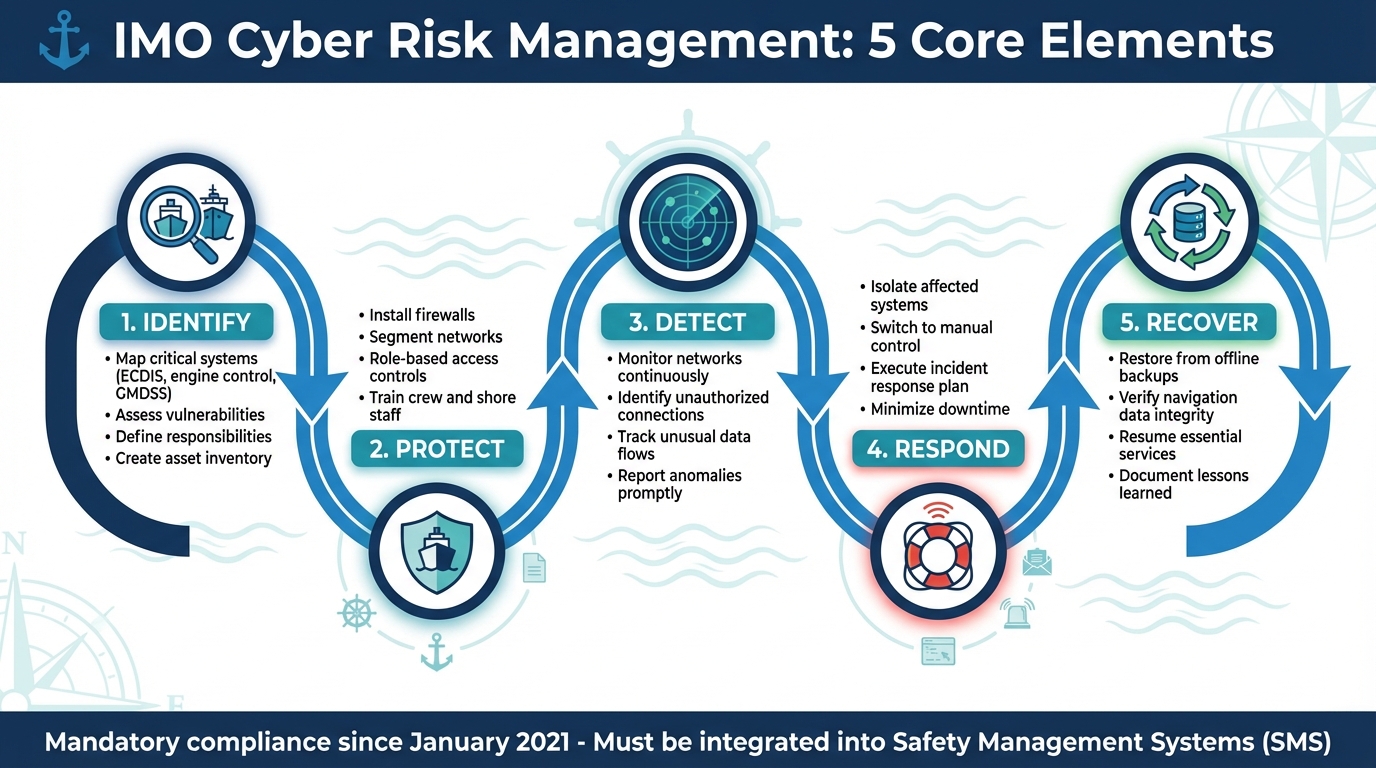
IMO Cyber Risk Management Framework: 5 Core Elements for Maritime Security

IMO Cyber Risk Management Framework: 5 Core Elements for Maritime Security

Port IT – Compliance with IMO 2021 cybersecurity rules
IMO

Core Elements of Cyber Risk Management

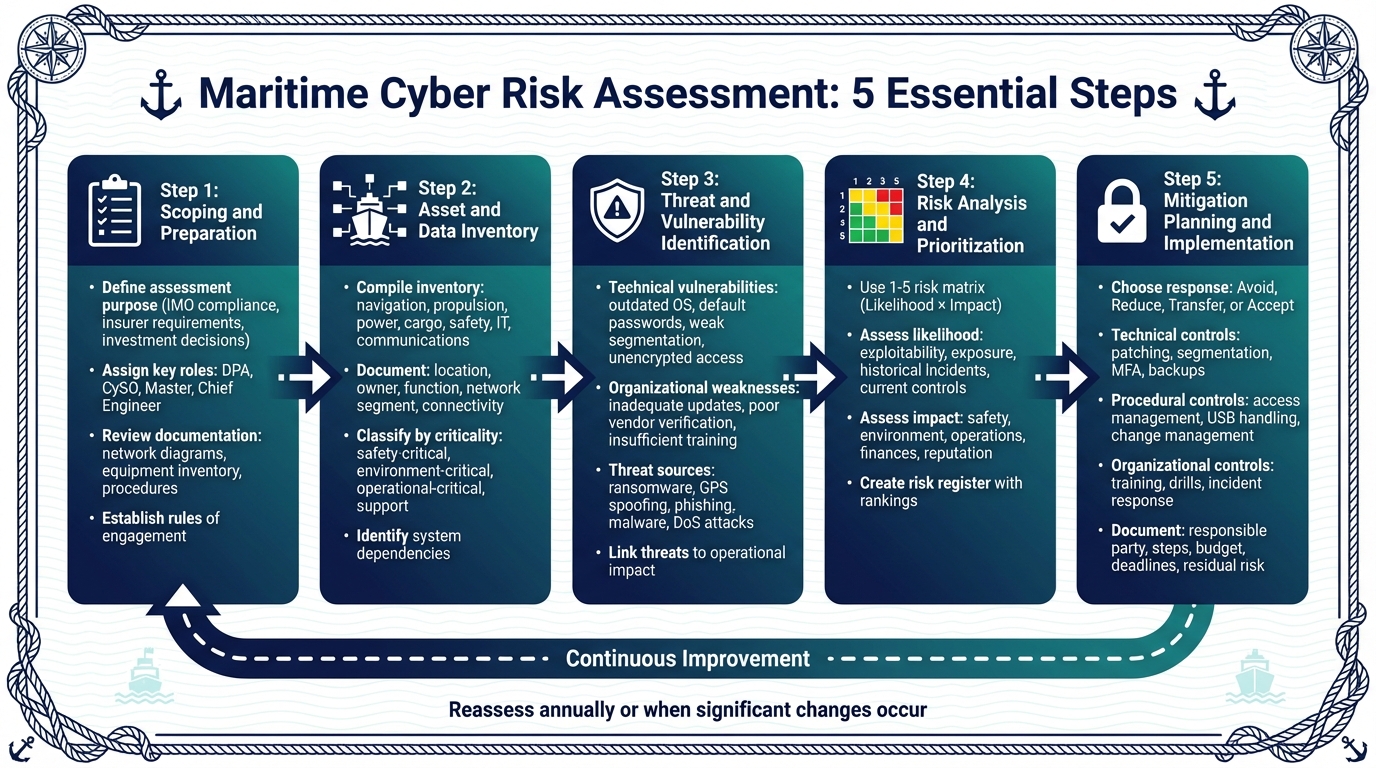
The IMO framework is built around five key elements: Identify, Protect, Detect, Respond, and Recover. Together, these elements form a structured approach to tackling the specific cyber risks faced by maritime operations. In this environment, even a single cyber incident could jeopardize critical systems like navigation, propulsion, or communications – systems essential for crew safety and vessel security.

"Cyber risk management means the process of identifying, analysing, assessing and communicating a cyber-related risk and accepting, avoiding, transferring or mitigating it to an acceptable level, considering costs and benefits of actions taken to stakeholders." – IMO

To be effective, these elements should be seamlessly integrated into the vessel’s existing Safety Management System, rather than treated as standalone requirements. This ensures that managing cyber risks becomes a natural part of daily operations. Below, we break down how these elements translate into practical steps onboard.

Risk Identification and Assessment

The first step is identifying all critical assets that, if compromised, could disrupt a ship’s operations. This includes evaluating vulnerabilities in key systems such as navigation (ECDIS), propulsion (engine control), and communications (GMDSS). Operators also need a clear understanding of who is responsible for managing these risks and how interconnected systems might amplify the impact of a breach. For instance, a vulnerability in one system could trigger cascading effects, leading to operational, safety, or security issues.

Protection and Detection Measures

Protection centers on putting technical safeguards in place to block unauthorized access. These measures might include installing firewalls, segmenting networks to isolate critical systems, and setting up role-based access controls. For example, keeping navigation systems separate from general-use networks can help prevent malware from spreading across the vessel.

Detection involves real-time monitoring to identify unauthorized connections or unusual data flows. Establishing procedures for continuous monitoring and prompt anomaly reporting is essential to reduce potential damage. While preventive measures aim to stop breaches, detection ensures swift identification of threats, helping to minimize their impact.

Incident Response and Recovery

When a cyber event occurs, having a well-defined response plan is critical to reducing downtime and ensuring the safety of the vessel. Response steps should include isolating affected systems and switching to manual control of critical functions, such as engine operation. Recovery efforts focus on restoring systems using offline backups and verifying the integrity of critical data, particularly for navigation systems. Quickly resuming essential services is key to maintaining operational resilience.

Functional Element Maritime Application
Identify Map critical systems: navigation (ECDIS), propulsion (engine control), communications (GMDSS).
Protect Install firewalls, segment networks, implement role-based access controls, train crew.
Detect Monitor networks for unauthorized connections and unusual activity.
Respond Isolate affected systems and maintain manual control of essential functions.
Recover Restore systems from offline backups and verify navigation data integrity.

Compliance Requirements

Meeting IMO guidelines involves embedding cyber risk management into your Safety Management System (SMS), training your team, and strengthening your infrastructure. Building on the basics of risk management, compliance requires thorough documentation, focused training, and robust network security.

Cyber Security Plan Documentation

Cybersecurity documentation must be integrated into your SMS under the ISM Code. This documentation should address the five core elements: Identify, Protect, Detect, Respond, and Recover.

  • Identify: Clearly outline personnel roles, responsibilities, and maintain an inventory of critical systems, assets, and data essential to ship operations.
  • Protect: Detail risk control measures, mitigation strategies, and contingency plans.
  • Detect: Include steps to identify cyber incidents quickly and effectively.
  • Respond: Provide plans for restoring compromised systems to ensure safe operations.
  • Recover: Define backup and restoration procedures to minimize downtime.

"The resolution encourages administrations to ensure that cyber risks are appropriately addressed in existing safety management systems… no later than the first annual verification of the company’s Document of Compliance after 1 January 2021." – IMO Resolution MSC.428(98)

Shipowners must not only document cyber risks but also analyze and address them. Guidance from organizations like BIMCO and frameworks such as the NIST Cybersecurity Framework can serve as useful templates to structure these elements. This documentation forms the foundation for effective training and operational resilience.

Training and Awareness Programs

Human error plays a significant role in cybersecurity incidents. To address this, your training program should be built into the SMS and cater to two groups: shipboard crew and shore-based personnel. Just as technical defenses safeguard systems, well-trained individuals are crucial for identifying and responding to threats.

Training for the crew should cover recognizing system vulnerabilities, understanding attack methods, implementing preventive measures, and executing incident response protocols. Shore-based staff should focus on identifying sensitive information and applying general mitigation techniques. Flexible learning options, such as computer-based training (CBT), can help seafarers stay up-to-date with evolving threats.

An effective training program should evolve continuously, incorporating lessons learned from past incidents or near misses. This ongoing process ensures that crews remain prepared to tackle new cyber challenges.

Secure Communication Networks

Securing communication networks is the final step in turning your documented controls and trained responses into a resilient operational framework. Communication systems are critical for safe ship operations, and IMO guidelines emphasize the need to harden these networks against cyber threats while aligning with the five core elements of risk management. For ships with contracts signed after July 1, 2024, communication systems must comply with IACS Unified Requirements E26 and E27, ensuring secure integration of both Operational Technology (OT) and Information Technology (IT) equipment.

"The URs (maritime cyber security regulations) will apply to everything computer-based on board such as… communications systems including public address systems, and navigation systems – anything that is integral to making the ship move, navigate and operate safely." – DNV

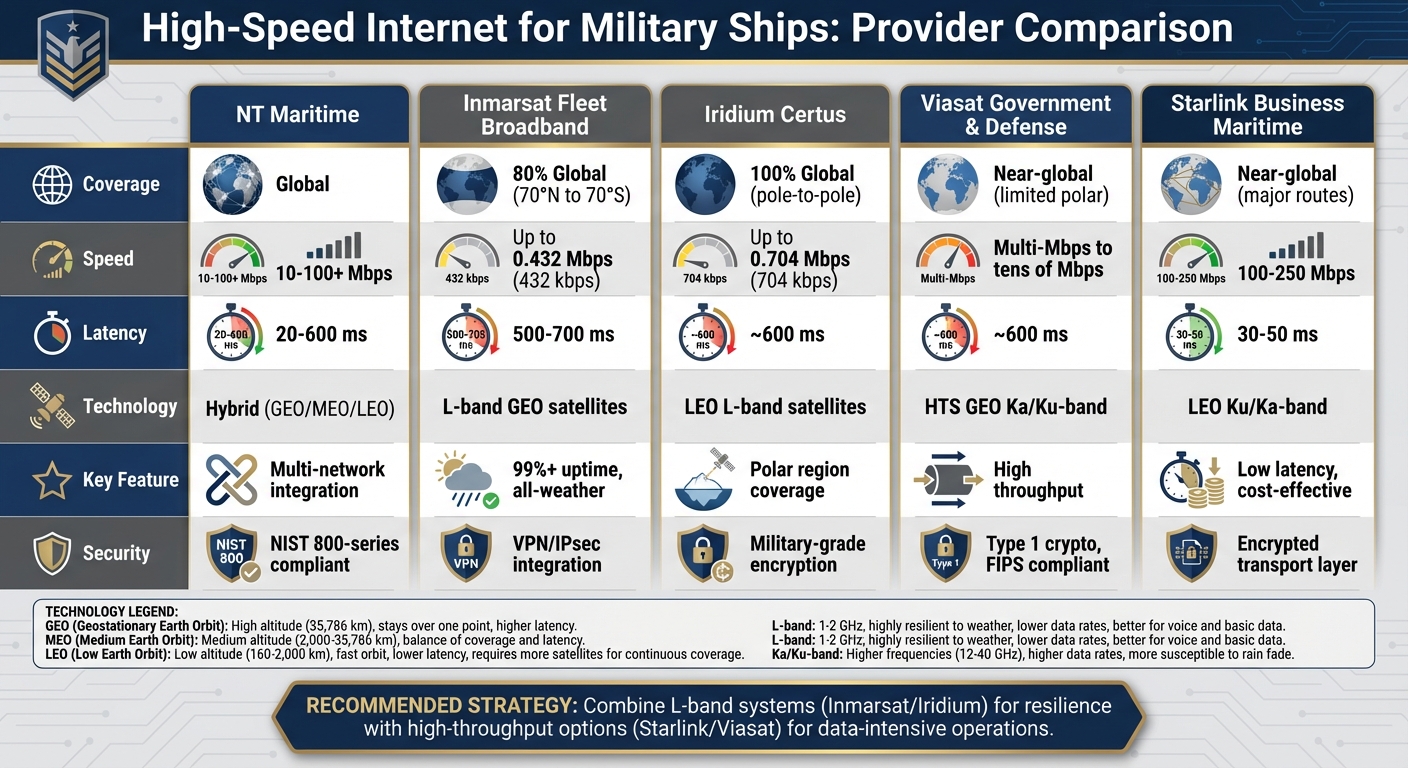
As data exchange increases, secure communication networks are becoming indispensable. NT Maritime provides advanced IT and communication solutions tailored for maritime needs. Their offerings include encrypted onboard calling, secure messaging, and high-speed internet with download speeds of up to 220 Mbps. These solutions not only help operators meet compliance standards but also ensure reliable connectivity.

To maintain secure networks, operators should embed security measures into systems from the design phase through daily operations. Third-party suppliers must also play a role in ensuring network integrity. A multi-layered security approach should be applied to critical communication and navigation systems.

Alignment with Industry Standards

The IMO guidelines are rooted in core cybersecurity principles and are designed to work seamlessly with other maritime standards, simplifying the process of managing cyber risks. By understanding these connections, operators can adopt effective security measures without duplicating efforts. Let’s explore how these standards come to life in practice.

NIST Cybersecurity Framework Alignment
NIST Cybersecurity Framework

The IMO Guidelines align closely with the five core functions of the NIST Cybersecurity Framework – Identify, Protect, Detect, Respond, and Recover. This alignment allows operators to embed cyber risk management directly into their Safety Management System (SMS). Here’s how each function translates into actionable practices:

  • Identify: Classify systems based on their impact on safety and maintain a risk register within your SMS.
  • Protect: Use technical measures like asset management and vulnerability assessments to safeguard systems.
  • Detect: Deploy monitoring tools to identify anomalies in real time.
  • Respond: Establish clear incident response plans with defined roles and responsibilities.
  • Recover: Develop a Plan of Actions & Milestones to quickly restore operations after a cyber incident.

"The recommendations can be incorporated into existing risk management processes and are complementary to the safety and security management practices already established by IMO." – International Maritime Organization

ICS Cyber Security Top 10

While the IMO guidelines provide a broad framework, organizations like the International Chamber of Shipping (ICS) and BIMCO offer detailed technical guidance for implementation. The IMO emphasizes that its recommendations complement existing practices and should be used alongside resources like the ICS "Guidelines on Cyber Security on board Ships."

The ICS guidance dives deeper into technical controls and compliance procedures, ensuring a more tactical approach. Collaboration among key maritime organizations – such as BIMCO, WSC, INTERTANKO, and INTERCARGO – fosters a unified strategy for addressing cyber risks. This collective effort also enhances the integration of cyber risk management into Ship Security Plans, bolstering overall operational resilience.

Integration into Ship Security Plans

Incorporating cyber risk management into Ship Security Plans requires a tailored, risk-based approach. This involves assessing your specific technology assets and adapting measures accordingly. In June 2017, the Maritime Safety Committee adopted Resolution MSC.428(98), formally linking cyber risk management to the International Safety Management (ISM) Code. This shift has embedded cyber risks as a core element of operational safety, rather than a separate concern.

Operators should conduct a gap assessment to evaluate their current security measures against IMO and NIST standards. This evaluation lays the groundwork for a mitigation roadmap, pinpointing areas that need improvement. Focus on systems within your SMS, categorizing them by their potential impact on safety and the marine environment. Update your documentation to include Cyber Risk Management procedures directly within your SMS and Ship Security Plans. The ultimate aim is operational resilience – ensuring vessels can continue safe operations even under cyber threat.

Meeting Compliance and Building Cyber Resilience

Adhering to IMO cyber risk requirements is not just about ticking regulatory boxes – it’s about safeguarding operations against threats that could jeopardize safety, security, and business continuity. Compliance with IMO Resolution MSC.428 is mandatory, requiring companies to integrate cyber risk management into their Safety Management System (SMS) by the first annual verification of their Document of Compliance. But compliance alone isn’t enough. To truly protect modern vessels, both Information Technology (IT) and Operational Technology (OT) must be addressed.

Modern ships are highly connected, relying on integrated systems for everything from bridge control and propulsion to power management and communication networks. These systems often exchange data with shore-based infrastructure for purposes like decarbonization tracking and improving operational efficiency. While this connectivity boosts performance, it also opens the door to potential cyber vulnerabilities.

Secure communication systems are a critical line of defense in this interconnected ecosystem. As cyber technologies underpin systems essential for safety and security, robust protocols are needed to shield critical functions – like navigation, propulsion, and emergency response – from data breaches or corruption. NT Maritime offers advanced secure communication networks tailored for maritime operations, ensuring compliance and operational resilience through encrypted ship-to-shore connections that meet stringent federal and military standards.

Beyond secure communication, operators must address internal vulnerabilities to build true resilience. While network security is foundational, proactive measures such as regular assessments and implementing technical safeguards are key to ensuring uninterrupted operations. Cyber resilience involves more than meeting regulatory requirements; it’s about maintaining continuity even under threat. This includes conducting gap analyses to uncover weak points, creating formal risk registers within the SMS, and deploying safeguards like network segmentation and firewalls. Increasingly, Port and Flag States are enforcing these practices during inspections, and non-compliance can lead to legal and operational setbacks.

"The overall goal is to support safe and secure shipping, which is operationally resilient to cyber risks." – International Maritime Organization

The maritime industry is shifting its perspective on cybersecurity, moving from treating it as a standalone IT concern to embedding it within the broader safety culture. Aligning with established frameworks like the NIST Cybersecurity Framework and IACS Unified Requirements (UR E26 and E27, mandatory for vessels contracted for construction on or after July 1, 2024) allows operators to streamline compliance while fortifying their defenses. As the industry evolves, integrating cybersecurity into daily operations and safety management systems is no longer optional – it’s essential.

FAQs

What are the main components of the IMO Cyber Risk Management Framework?

The IMO Cyber Risk Management Framework provides a structured approach to strengthening cyber defenses within maritime Safety Management Systems. It’s built around five essential components:

  • Identify: Take inventory of all digital systems, both on ships and onshore. Evaluate potential threats and pinpoint vulnerabilities that could disrupt operations, compromise safety, or weaken security.
  • Protect: Put safeguards in place to reduce risks. This includes measures like access controls, encryption, secure communication protocols, and crew training to prevent cyber incidents.
  • Detect: Keep a close watch on systems with continuous monitoring and anomaly detection tools to quickly spot any signs of cyber threats.
  • Respond: Have a clear plan ready for addressing incidents. This should include steps for containment, communication, and mitigation to limit the impact.
  • Recover: Focus on restoring systems to normal as quickly as possible while using the experience to improve future risk management strategies.

These steps align with internationally recognized standards such as ISO/IEC 27001 and the NIST Framework for Critical Infrastructure. For U.S.-based maritime operators, tools like NT Maritime’s secure communication solutions – offering encrypted voice and video calls – play a key role in supporting the Protect and Detect stages by ensuring data security and enabling real-time threat monitoring.

How do the IMO Cyber Risk Guidelines align with the NIST Cybersecurity Framework?

The IMO Cyber Risk Management Guidelines closely mirror the NIST Cybersecurity Framework by emphasizing five core functions: Identify, Protect, Detect, Respond, and Recover. This shared structure makes it easier for maritime operators to align key practices – like maintaining asset inventories, conducting threat assessments, and creating incident response plans – with NIST’s well-established framework.

For fleets operating in the U.S., this alignment streamlines compliance with both federal and industry cybersecurity standards. It allows operators to leverage familiar tools, metrics, and reporting formats. Companies like NT Maritime offer solutions such as secure onboard networks and real-time monitoring systems that meet the requirements of both IMO and NIST, ensuring a strong and cohesive approach to managing cyber risks.

What are the cyber risk compliance requirements for ships built after July 1, 2024?

Ships built on or after July 1, 2024, will need to comply with the International Association of Classification Societies’ (IACS) Unified Requirements E26 and E27. These rules focus on implementing onboard cyber risk management and resilience strategies to safeguard the safety and security of newly classified vessels.

The goal of these requirements is to tackle the increasing cybersecurity challenges faced by the maritime industry while aligning with updated international standards for secure operations.

How Scalable Networks Improve Ship Connectivity

Modern ships demand reliable connectivity for safety, efficiency, and crew welfare. However, maritime environments present unique challenges:

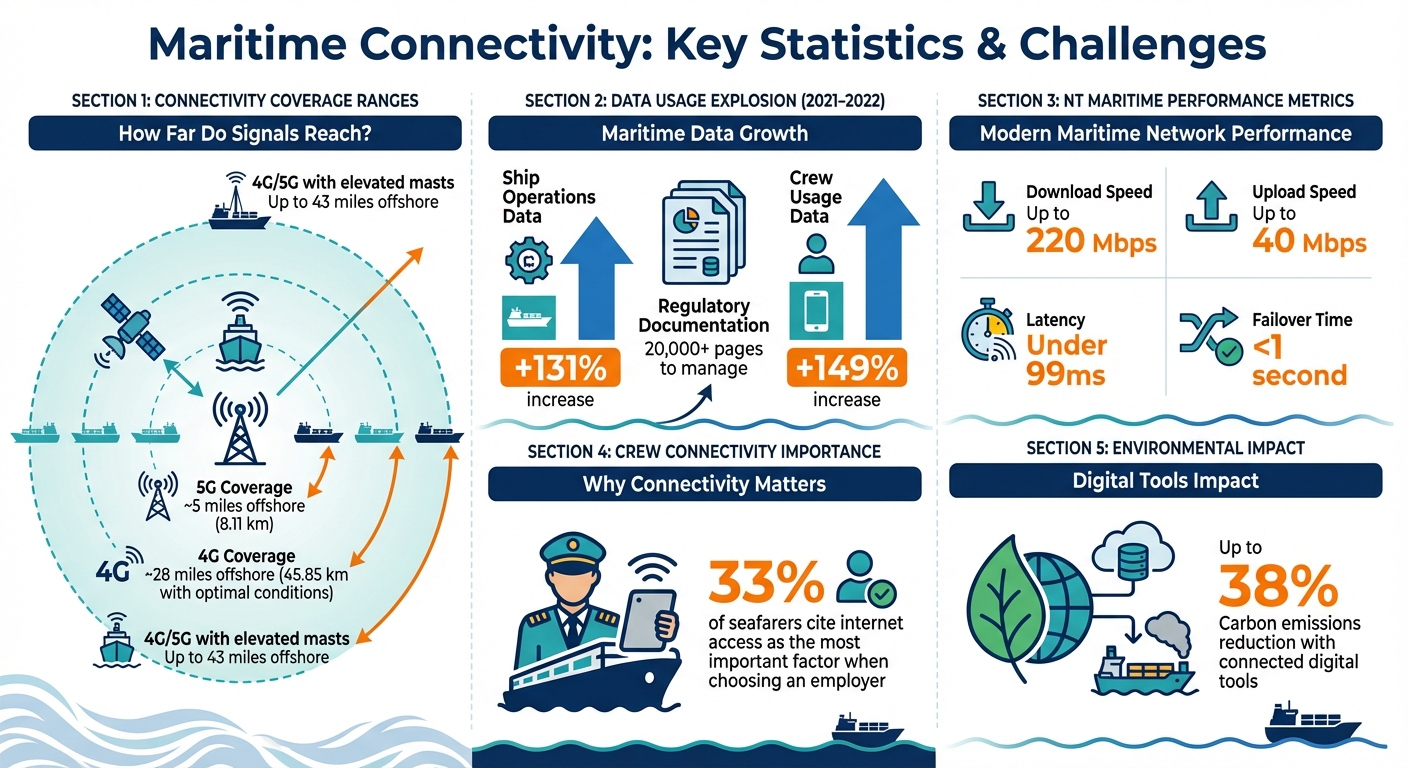
  • Limited terrestrial coverage: 5G signals fade ~5 miles offshore; 4G reaches ~28 miles.
  • Satellite issues: High latency and limited bandwidth.
  • Growing data needs: Ship operations and crew usage increased by 131% and 149% (2021-2022).
  • Regulatory pressures: Ships must manage increasing operational data to meet over 20,000 pages of regulations.

Scalable networks address these problems by combining technologies:

  • Hybrid connectivity: Integrates 5G, satellite (LEO, MEO, GEO), and vessel-to-vessel relays.
  • Network slicing: Prioritizes critical operations over less urgent traffic.
  • Edge computing: Processes data onboard, reducing satellite dependency.
  • Modular designs: Allow cost-effective upgrades without overhauling systems.

NT Maritime leads with solutions offering:

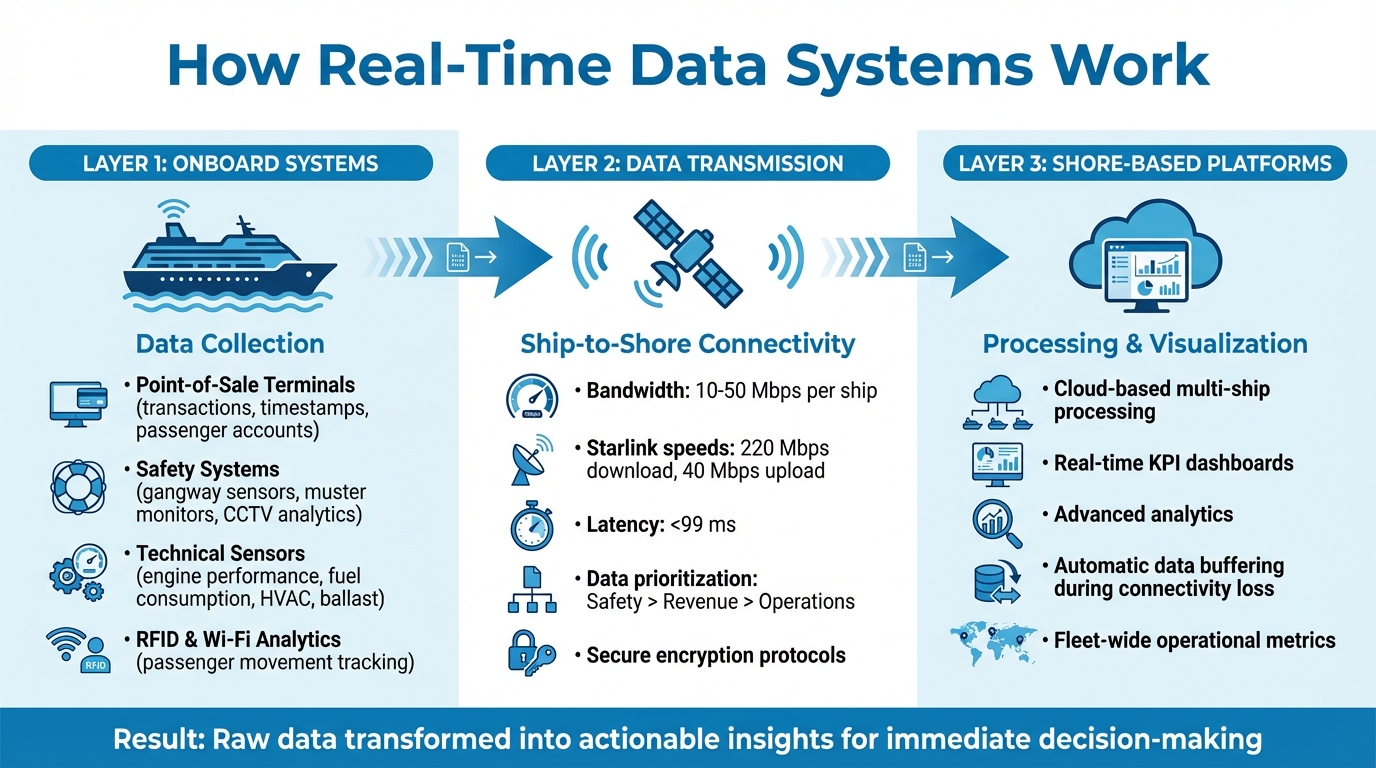
  • Speeds up to 220 Mbps (download) and 40 Mbps (upload).
  • Latency under 99ms.
  • Crew welfare tools like video calling and Telehealth.

Key takeaway: Scalable networks transform ships into connected hubs, ensuring efficient operations, better crew experiences, and compliance with modern demands.

Maritime Connectivity Statistics: Network Coverage, Data Growth, and Performance Metrics

Maritime Connectivity Statistics: Network Coverage, Data Growth, and Performance Metrics

Marlink

Assessing Current Ship Connectivity Needs

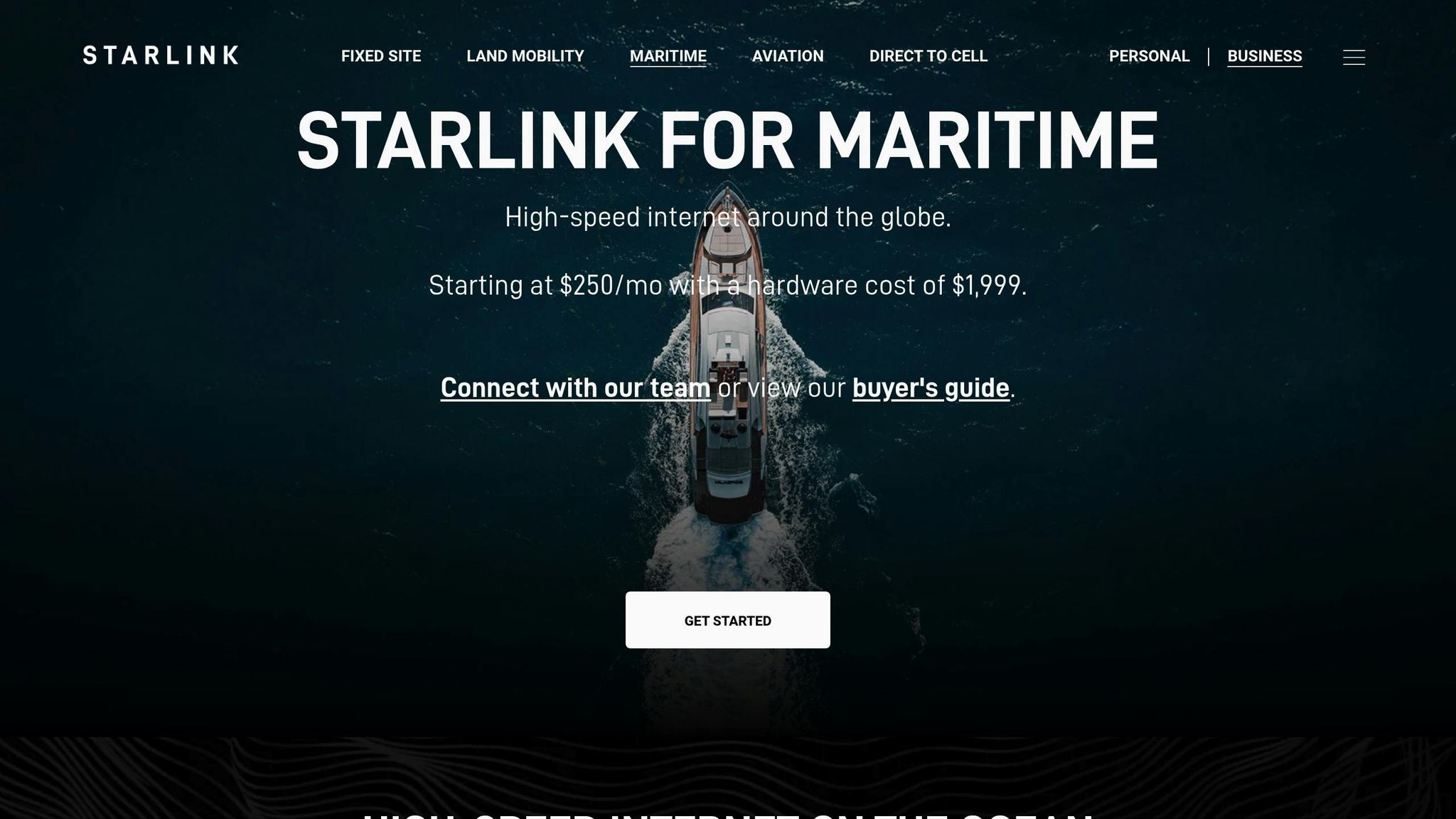
Before upgrading any ship’s connectivity, start by documenting all existing onboard assets. This means taking stock of every piece of connectivity hardware, from satellite terminals to Wi-Fi access points. Your inventory should include VSAT (GEO) systems, newer LEO constellations like Starlink or OneWeb, and L-Band safety backups such as FleetBroadband or Iridium Certus. Don’t overlook terrestrial components like 4G/5G cellular setups, which, when paired with marine-grade antennas and signal boosters, are vital for coastal operations. These systems typically provide coverage up to 19 miles offshore, but with higher masts, this range can extend to 43 miles. A thorough inventory of all hardware types will lay the groundwork for a scalable connectivity strategy.

Inventory Network Components

Go beyond basic hardware and include specialized maritime systems that handle critical data. This means cataloging systems such as AIS (Automatic Identification System), GNSS (Global Navigation Satellite System), GMDSS (Global Maritime Distress and Safety System) equipment, Dynamic Positioning computers, industrial Ethernet switches, routers, and ship gateways that connect various systems. High-bandwidth devices like radars, cameras, and LiDAR sensors generate large files, which can put significant strain on your network’s transmission capacity. Additionally, emerging technologies such as unmanned surface vehicles (USVs), autonomous underwater vehicles (AUVs), and tethered UAVs may act as mobile relays or data collectors.

During your audit, pay close attention to antenna heights. Raising mast height is one of the simplest and most effective ways to extend the range of non-satellite connections. Also, identify any single points of failure – like a lone router or gateway – that could disrupt connectivity for the entire vessel.

Classify Applications and Traffic

Once your inventory is complete, assess how each asset supports different network demands. Divide traffic into four main categories: Operational (navigation and safety), Business (machinery analytics and logistics), Situational Awareness (sensor data), and Crew/Passenger welfare. Safety-critical data, such as GMDSS communications, should take top priority, followed by low-latency control and business applications. Crew and passenger traffic generally operates on a "best effort" basis unless specific retention goals require otherwise. Welfare services, such as NT Maritime’s Telehealth and onboard calling, are increasingly important, with 33% of seafarers now citing internet access as the most important factor when choosing an employer.

Set Scalability Goals

Establish clear objectives for bandwidth, latency, and resilience to meet both current and future demands. For example, autonomous ship operations require latency under 0.5 milliseconds to support real-time collision avoidance. High-throughput ship-to-shore uplink connections – ranging from 1 to 10 Mbps – are critical for transmitting sensor data, high-definition video for remote surveys, and situational awareness feeds. Your network should also be capable of switching between active and standby links (e.g., LTE to satellite) in under one second to avoid service interruptions. Additionally, ensure compliance with updated Maritime Labour Convention (MLC) requirements, which mandate internet access for seafarers.

As Neil Giles, Chief Technology Officer at Petredec Pte. Limited, explains: "The ultimate goal is to provide [crews] with the same level of connectivity that they get at home".

Designing a Scalable Onboard Network Architecture

Creating a network that can grow and adapt to the ever-changing demands of maritime environments requires a thoughtful and flexible design. By combining modular frameworks, hybrid connectivity, and onboard technology, ships can achieve reliable and efficient communication systems.

Use a Modular Network Design

A modular network structure divides the ship’s system into three layers: access, distribution, and core. This setup allows for seamless upgrades or expansions in specific areas without disrupting the entire network. Introducing an abstraction layer between OSI Layers 2 and 3 makes it possible to reroute, duplicate, or prioritize traffic across cellular, satellite, and Wi-Fi networks without interrupting active sessions. This ensures uninterrupted application performance, even when the network switches from LTE to VSAT mid-session.

Software-Defined Networking (SDN) takes this modularity further by replacing traditional hardware with programmable software. This flexibility allows adjustments to radio frequencies and modulation in real time, adapting to changing maritime conditions. For example, a Multi-RAT Gateway (MRGW) can handle multiple Radio Access Technologies, enabling dynamic traffic management between LTE, 5G, and VSAT based on current availability. Additionally, modern 5G systems use "splits" between the Radio Access Network (RAN) and the core, allowing lightweight user planes to operate onboard while centralizing control functions.

Integrate Hybrid Connectivity Solutions

Combining satellite, cellular, and Wi-Fi mesh technologies creates a robust network with redundancy and automated failover capabilities. A centralized gateway can monitor real-time wireless metrics – like RSRP and RSRQ – and automatically select the best connection based on location and signal quality. For example, in coastal areas, 4G at 700 MHz can cover distances up to 45.85 km from shore, while 5G at 3.5 GHz offers higher bandwidth but typically covers only about 8.11 km. Bonding multiple WAN sources, such as Starlink and LTE, boosts speed and ensures high availability. If the primary connection fails, a backup can take over in less than a second.

For vessels navigating open waters, a multi-hop architecture can extend 5G coverage by using other ships as relays. This approach reduces reliance on costly satellite bandwidth while maintaining connectivity, especially for fleets following the same routes. Chris Sepp, Vice President of IT at Atlas Corp. (Seaspan), highlights that breaking the perception of maritime connectivity as bandwidth-limited opens the door to scalable digital solutions for fleets with over 200 vessels. NT Maritime also uses hybrid connectivity to sustain crew welfare services.

Plan for Onboard Wireless and Edge Computing

Wi-Fi mesh networks onboard distribute satellite or mobile connections throughout the ship, supporting crew welfare, passenger needs, and IoT devices like sensors and beacons. Edge computing, which processes data locally on the ship, reduces reliance on satellite or cloud connections. This setup is critical for real-time applications like AI-driven navigation and IoT-enabled engines, minimizing latency for safety systems and engine monitoring.

Modern edge infrastructure uses modular nodes, making it easy to upgrade RAM, CPU, or storage without disrupting operations. Zero-Touch Provisioning (ZTP) simplifies deployment, allowing non-technical crew members to plug in hardware that configures itself via the cloud, cutting installation time by up to 90%. Running communication gateways as virtual machines enhances compatibility and ensures consistent performance from shore-based labs to onboard edge clusters. This approach also prepares the network for future advancements, such as 6G or additional Low Earth Orbit (LEO) satellite constellations.

Feature Function Onboard Wireless Role
Edge Computing Local data processing & storage Connects devices & distributes data
Connectivity Operates autonomously (offline) Links users/IoT to backhaul
Scalability Modular hardware upgrades Expands mesh & increases access points
Benefit Zero latency for critical systems Improves crew welfare & IoT mobility

Implementing Security, QoS, and Reliability in Scalable Networks

In scalable networks, it’s essential to secure critical systems and maintain performance, even during failures. For maritime environments, downtime isn’t just inconvenient – it can jeopardize safety and disrupt operations. By integrating security measures, Quality of Service (QoS), and redundancy from the outset, networks can grow without sacrificing reliability. Let’s explore how to implement these elements to create a resilient maritime network.

Prioritize Traffic with QoS Policies

Certain types of traffic, like telehealth video calls, need to take priority over routine updates. That’s where QoS comes in – it determines which data packets get transmitted first, reducing packet loss, jitter, and latency during peak usage. By categorizing traffic (e.g., VoIP, video, telemetry), the network ensures critical services maintain high performance, even when bandwidth is stretched.

Use 802.1Q CoS tagging for Layer 2 and DSCP markings for Layer 3 to classify and prioritize traffic based on importance. Scheduling algorithms can further optimize performance: reserve Strict Priority for emergency traffic while using Weighted Round Robin (WRR) for general traffic to balance resources. Abstraction layers can also reroute or prioritize traffic seamlessly across satellite, cellular, and Wi-Fi interfaces without interrupting active sessions.

PCP Value Priority Traffic Type Recommended Use Case
7 7 (Highest) Network Control Routing protocols and network management
6 6 Internetwork Control Critical network signaling
5 5 Voice (VO) VoIP; Telehealth voice calls (<10ms latency)
4 4 Video (VI) Real-time surveillance; Telehealth video (<100ms latency)
3 3 Critical Applications Shared Situational Awareness (SSA) data
0 1 (Lowest) Best Effort General internet and non-critical updates

Source: IEEE recommendations for Priority Code Point (PCP)

For the most critical functions, like routing protocols, assign the highest priority (PCP 7). Telehealth voice calls should use PCP 5, while video traffic like surveillance or telehealth video calls can be prioritized at PCP 4. Routine internet browsing or background updates should remain at the lowest priority (PCP 0).

Build Redundancy into the Network

Redundancy is key to avoiding single points of failure. A hierarchical network design – divided into Core, Distribution, and Access layers – ensures predictable traffic patterns and simplifies troubleshooting. Redundant Layer 3 interconnections can recover from failures in as little as 60–200 milliseconds.

Technologies like EtherChannel or 802.3ad combine multiple physical links into a single logical path, boosting resilience. To further enhance reliability, terminate links on separate hardware. For endpoint connectivity, use redundancy protocols like HSRP or GLBP, which can converge in under a second.

Additional safeguards include redundant power supplies, CPUs, and supervisor engines. Stateful Switchover (SSO) and Non-Stop Forwarding (NSF) technologies maintain Layer 3 forwarding during supervisor failures, typically recovering in 1–3 seconds. For backhaul connectivity, combine multiple technologies like satellite (LEO/MEO/GEO), 5G/LTE, and vessel-to-vessel relays. Bandwidth bonding can aggregate these connections, ensuring both failover and increased throughput. Backup links can take over in less than a second if the primary connection fails.

Avoid daisy-chaining fixed-configuration switches, which can create routing issues. Instead, use stacking technologies like VCStack or StackWise, or deploy modular chassis to reduce complexity. For the fastest failover performance, rely on hardware-based link failure detection rather than software timers.

Enforce Security and Compliance Standards

While redundancy ensures connectivity, robust security safeguards your network from threats. Maritime networks face unique cybersecurity challenges due to their operation in international waters, connections to multiple networks, and the mix of operational technology (OT), crew systems, and passenger services they host. Traditional perimeter-based defenses are no longer enough. Instead, adopt a Zero Trust Architecture to protect resources regardless of their location.

"Zero trust assumes there is no implicit trust granted to assets or user accounts based solely on their physical or network location (i.e., local area networks versus the internet) or based on asset ownership."

NT Maritime’s systems align with federal and military cybersecurity guidelines to reinforce these principles. Network segmentation plays a critical role by isolating essential maritime operations from other traffic. For example, separate LANs can be used for business systems (e.g., email, PMS), crew services (prepaid internet), and M2M/custom services (e.g., ECDIS, VDR). This ensures that a compromised device cannot access critical navigation or engine control systems. Role-Based Access Control (RBAC) further limits access to sensitive areas, granting permissions only to authorized personnel.

To secure data in transit, use Virtual Private Networks (VPNs) between vessels and shore, protecting communications across various WAN links (VSAT, cellular, satellite). For remote access to OT systems, deploy secure firewalls and robust remote access solutions to safeguard both port and ship infrastructure.

Comply with NIST SP 800-207 standards to protect individual resources rather than entire network segments. As remote users and cloud-based assets grow in number, this approach becomes increasingly critical. Automate failover processes using network management devices capable of switching between hardware and multiple WAN links (VSAT, 4G/5G, L-band) without manual intervention, eliminating single points of failure. Lastly, ensure compliance with NIS2 standards to maintain comprehensive visibility and security across all industrial network components.

Scaling and Monitoring the Network Over Time

Once your network is up and running, the focus shifts to maintaining its performance, scaling operations effectively, and integrating emerging technologies. The demand for maritime data continues to grow, and without vigilant monitoring and adaptable infrastructure, networks can quickly become overwhelmed.

Centralized Monitoring and Management

Centralized platforms streamline fleet connectivity by offering a single dashboard to manage everything. These systems provide real-time insights into data usage, hardware performance, and SIM connectivity. They also enable automated traffic management. For instance, Multi-RAT Gateways (MRGW) can dynamically switch between LTE and VSAT networks based on current channel conditions, ensuring each application gets the best possible connection.

A notable example comes from January 2023, when researchers from Gachon University and SyncTechno Inc. tested an MRGW on the Korean Autonomous Surface Ship (KASS) testbed near Ulsan, South Korea. The system seamlessly switched between LTE and VSAT networks within one second of detecting a disconnection, maintaining uninterrupted real-time video streaming. This was achieved using REST APIs and SNMP for wireless monitoring, verified through the DX Ocean remote monitoring platform.

Centralized systems also bring significant cost savings. Techniques like Delta Synchronization reduce data usage by transmitting only the changes in files. High-quality connectivity enables shoreside technicians to troubleshoot remotely, cutting down on expensive physical interventions.

Chris Sepp, Vice President of IT at Atlas Corp. (Seaspan), explains: "All of our ships are deployed to generate revenue. We don’t have the luxury of having regular physical access to them in drydock, so the majority of shoreside interventions need to be performed remotely".

This kind of centralized management provides the foundation for scaling your network in a data-driven way.

Use Metrics and Automation for Scaling

Making informed decisions starts with tracking the right metrics. Key indicators like latency (measured in milliseconds), jitter, packet loss, throughput (Mbps), and total data consumption help you stay ahead of potential issues. For example, Starlink’s maritime plans, which range from 50 GB to 2 TB, require careful monitoring to avoid overage fees or throttled speeds. Metrics also ensure that critical tools, such as ERP systems or video conferencing, continue to perform well even during times of high usage.

Metric Category Key Parameters Purpose
Performance Latency (ms), Jitter (ms), Packet Loss (%) Maintain stability for real-time apps like VoIP and video
Utilization Throughput (Mbps), Load per Carrier Optimize hybrid network routing
Consumption Total Data (GB/TB), Usage per User/App Control costs and prevent throttling
Reliability Uptime (%), Signal Strength (dB) Ensure SLA compliance and link stability

Automation is another game-changer. In November 2025, Northern Marine Group, a division of Stena, cut its fleet software compliance time by 92%, reducing it from six months to just two weeks. Led by DevSecOps Manager Scott Mungall, the team replaced manual CD-mailing with the Resilio Platform‘s automated data distribution over VSAT. This enabled multi-gigabyte updates to reach vessels even in low-bandwidth regions like the Indian Ocean.

Automation also supports proactive scaling by setting thresholds for CPU, memory, and storage usage. These thresholds can trigger alerts or even auto-scaling before performance suffers. SD-WAN orchestration further enhances efficiency by routing traffic based on application priority and link quality, ensuring critical services always get the best connection.

By leveraging these tools and metrics, you can ensure your network remains scalable and resilient.

Future-Proof with Modular Upgrades

To keep up with changing demands, modular upgrades make it easy to expand your network without overhauling the entire system. Node-based clusters combine compute, storage, and networking into units that can be added incrementally as capacity needs grow. Software-Defined Infrastructure (SDI) adds another layer of flexibility by abstracting hardware, allowing resources to be dynamically allocated across the fleet without relying on cloud services. This approach eliminates the need for costly system replacements – new nodes simply integrate into the existing setup.

Tools like Terraform and Ansible automate provisioning, ensuring consistent configurations across multiple vessels and reducing the risk of manual errors. Zero-touch provisioning takes this a step further, allowing for hardware replacements or network expansions without requiring on-site IT staff. Standardizing hardware and software across the fleet simplifies troubleshooting, reduces training time, and speeds up deployment through pre-configured templates.

Tore Morten Olsen, President of Maritime at Marlink, highlights: "The maritime industry is on the brink of a technological step change, driven by low Earth orbit (LEO) satellite connectivity, cloud-based platforms, and artificial intelligence".

With modular designs, your network can easily adapt to new technologies, whether that’s next-generation satellite systems, 5G-Advanced, or AI-powered applications, without starting from scratch.

Conclusion

The importance of scalable networks in maritime operations cannot be overstated – they drive efficiency, enhance crew well-being, and provide a competitive edge. Recent trends highlight this shift: between June 2021 and June 2022, crew-related data usage skyrocketed by 149%, while business application usage grew by 131%. These numbers reveal how ships are transforming into hubs of connectivity, reshaping life and work at sea.

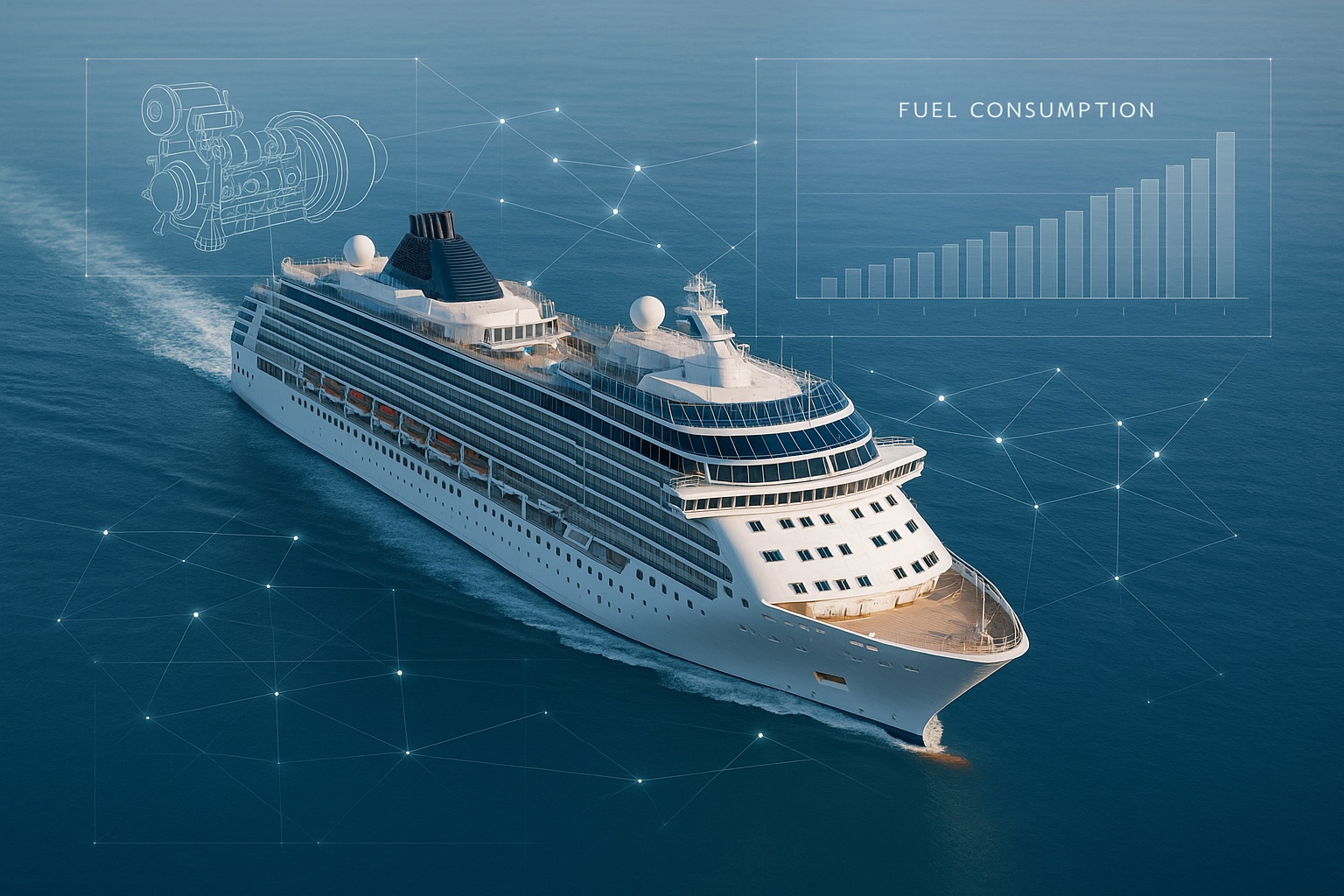
Scalable network architectures play a key role in optimizing voyages, cutting down port waiting times, and reducing fuel consumption. Connected sensors further enhance operations by enabling predictive maintenance, which prevents costly equipment failures before they occur. Additionally, digital tools integrated into these networks can significantly lower carbon emissions – by as much as 38% – helping the maritime sector meet IMO 2030 goals. For seafarers, connectivity is no longer a luxury but a necessity. In fact, 33% of seafarers now prioritize internet access over pay and leave when choosing an employer, underscoring its role in crew retention.

NT Maritime’s communication solutions are at the forefront of this transformation. Offering secure, high-speed internet (up to 220 Mbps download and 40 Mbps upload with latency under 99ms) and integrated communication systems, their technology supports both commercial and government/military needs. These solutions enable everything from crew video calls with loved ones to real-time HD surveillance and telemedicine services. With NT Maritime, vessels are equipped to tackle today’s challenges while preparing for tomorrow’s opportunities.

FAQs

How do scalable networks improve connectivity and crew well-being on ships?

Scalable networks transform ship connectivity by seamlessly integrating satellite, LTE, and land-based links, delivering fast, dependable, and cost-efficient internet access. This means crew members can enjoy smooth video calls, streaming services, and social media, making life onboard more connected and comfortable.

Beyond personal use, these networks play a critical role in supporting essential services like telehealth consultations, real-time weather updates, and cloud-based tools, all of which enhance safety and operational efficiency. NT Maritime takes this a step further by providing secure, unified communication systems that adapt to fleet size, ensuring both crew well-being and operational priorities are met.

How does edge computing enhance ship connectivity?

Edge computing transforms ship connectivity by handling data processing directly on the vessel. This approach reduces the need to depend on high-latency satellite links. Tasks such as AI-powered navigation, predictive maintenance, and passenger services can be managed locally, which helps cut delays, saves bandwidth for essential communications, and keeps sensitive data securely onboard.

By pairing edge computing with flexible network setups, ships can maintain critical services like crew communication, onboard calls, and telehealth applications – even when shore-based cloud connections are disrupted. It also enables real-time decisions for improving fuel efficiency, optimizing routes, and enhancing safety systems. NT Maritime incorporates edge-enabled infrastructure into its offerings, ensuring ships have dependable, high-speed internet and communication tools, no matter the conditions.

What are the benefits of hybrid connectivity for ship communication networks?

Hybrid connectivity blends satellite networks – such as LEO, GEO, and L-Band – with terrestrial 4G/5G cellular connections. This setup allows vessels to automatically select the most efficient and cost-effective network available at any given moment. By dynamically switching or dividing traffic between networks, it ensures a stable connection without interrupting user activity.

Near shore, this system reduces latency by prioritizing faster cellular signals. Once the vessel moves into open waters, it seamlessly transitions to satellite networks. This not only keeps costs down by favoring cheaper options when possible but also guarantees consistent internet access. For ship operators, this means smoother video calls, reliable crew-to-shore communication, and continuous telemetry for navigation and safety systems.

NT Maritime leverages hybrid connectivity to deliver secure, high-speed internet, onboard calling, and integrated communication services – keeping passengers and crew connected regardless of their location.

GMDSS: Secure Communication for Maritime Emergencies

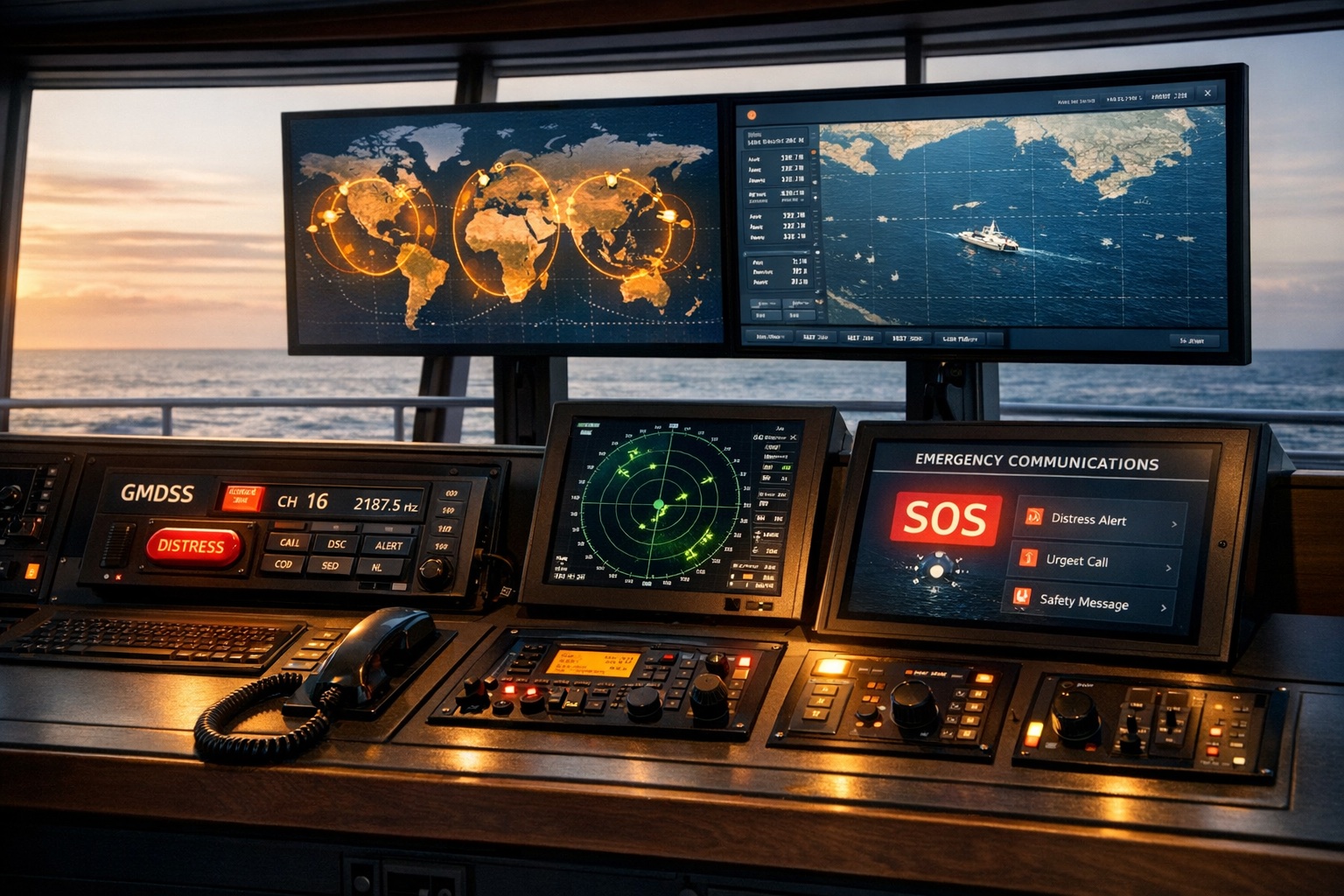
The Global Maritime Distress and Safety System (GMDSS) is a critical communication network designed to ensure safety and coordination during maritime emergencies. It connects vessels with shore-based Rescue Coordination Centers (RCCs) using satellite and radio technologies to send automated distress alerts and safety information. Mandated by the International Maritime Organization (IMO), GMDSS applies to passenger ships and cargo vessels over 300 gross tons on international voyages.

Key Features of GMDSS:

  • Automated Distress Alerts: Sends a ship’s location and identification instantly.
  • Redundancy: Requires at least two independent methods of distress communication.
  • Safety Information: Provides weather updates, navigational warnings, and search-and-rescue coordination.
  • Equipment Requirements: Includes Digital Selective Calling (DSC), EPIRBs, NAVTEX, SARTs, and backup power systems.
  • Sea Area Coverage: Divides the oceans into four zones (A1–A4) with tailored equipment needs.

Recent updates (effective January 1, 2024) introduced modern satellite services like Iridium, ensuring global coverage, including polar regions. Companies like NT Maritime support GMDSS with advanced IT solutions, offering encrypted communication, high-speed internet, and real-time system monitoring for safer maritime operations.

GMDSS remains a cornerstone of maritime safety, enabling fast, reliable, and secure communication during emergencies.

What is GMDSS (Global Maritime Distress and Safety System)

GMDSS Functions and Components

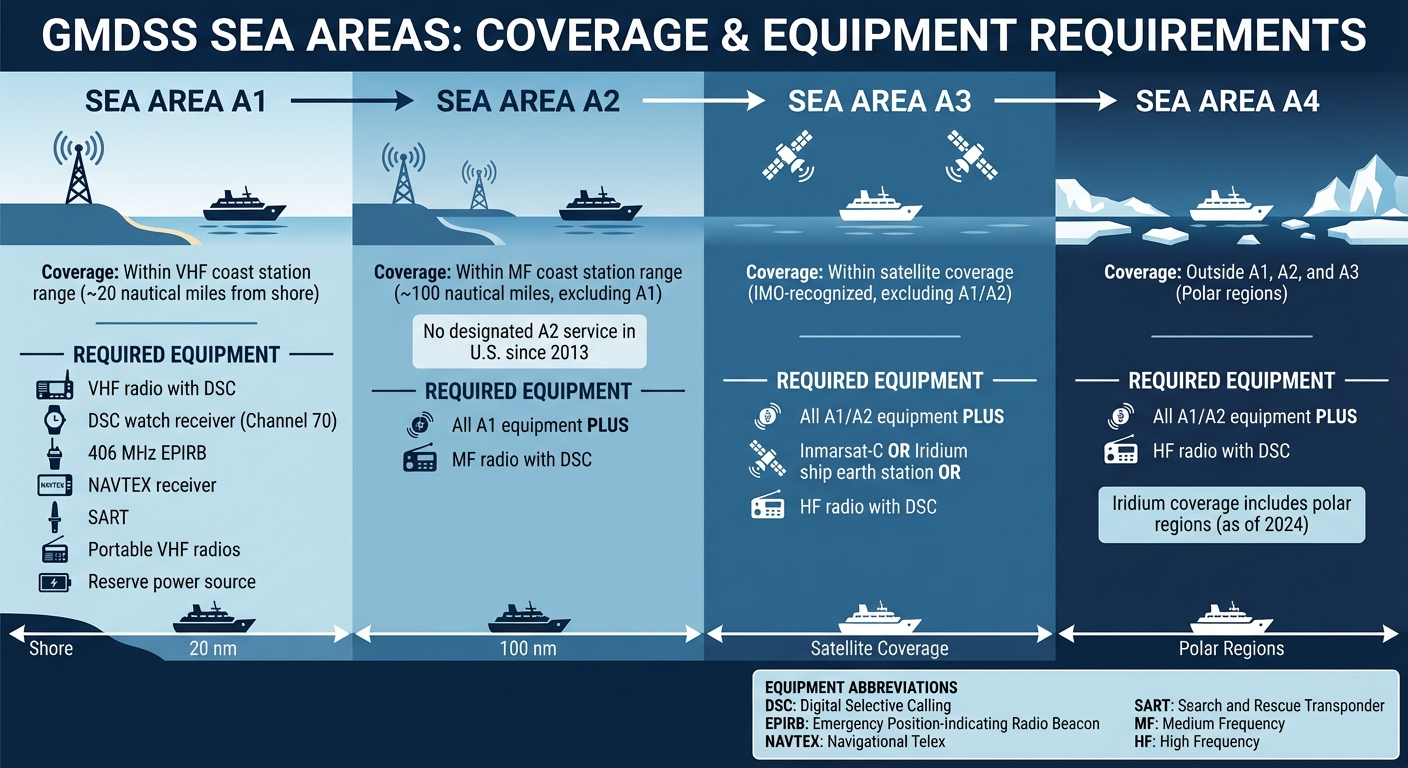
GMDSS Sea Areas and Required Equipment by Maritime Zone

GMDSS Sea Areas and Required Equipment by Maritime Zone

Primary Goals of GMDSS

The Global Maritime Distress and Safety System (GMDSS) was designed to handle nine key communication tasks that all equipped vessels must perform. These include sending and receiving distress alerts (both ship-to-shore and ship-to-ship), coordinating search and rescue (SAR) efforts, facilitating on-scene communications, transmitting locating signals, sharing maritime safety information (MSI), and enabling general and bridge-to-bridge communications.

One of the major shifts introduced by GMDSS was moving distress alerting from a ship-to-ship system to a direct connection with shore-based Rescue Coordination Centers (RCCs). These centers are responsible for managing and coordinating rescue operations.

"The GMDSS became inextricably linked with the parallel implementation of the International Search and Rescue Convention (SAR Convention) and the development of shore facilities within the structure of the World‐Wide SAR Plan."

  • International Mobile Satellite Organization (IMSO)

In addition to distress alerts, GMDSS provides automated broadcasts of navigational warnings, weather updates, and safety notices. These are delivered through terrestrial NAVTEX systems or satellite-enhanced group call services.

The following sections delve into the equipment and operational protocols that make these functions possible.

Required GMDSS Equipment and Systems

At the heart of GMDSS is Digital Selective Calling (DSC), a technology designed for automated distress alerting. Think of DSC as a "dial and bell" system that allows mariners to send distress alerts – including location and identification details – instantly to authorities and nearby ships without needing to monitor a radio loudspeaker constantly. Channel 70 (156.525 MHz) on VHF is exclusively reserved for DSC distress, safety, and calling purposes.

"Digital selective calling also allows mariners to initiate or receive distress, urgency, safety and routine radiotelephone calls… without requiring either party to be near a radio loudspeaker."

To include precise location data, DSC systems must be linked to GPS receivers using the NMEA 0183 protocol.

GMDSS regulations require all vessels under its scope to carry specific equipment, regardless of their operating area. This includes:

  • A 406 MHz Emergency Position Indicating Radio Beacon (EPIRB) for satellite-based distress alerts.
  • A NAVTEX receiver for automated maritime safety information.
  • A Search and Rescue Transponder (SART) to help locate survival craft.
  • Two-way portable VHF radios for on-scene communication.
  • A reserve power source to ensure radio functionality even if main and emergency power systems fail.

For satellite communications, IMO-recognized services currently include Inmarsat C, Fleet Safety, and Iridium Safety Services. The BeiDou Message Service System (BDMSS) is awaiting full implementation. The introduction of Iridium as a GMDSS provider ended Inmarsat’s monopoly and extended global coverage to include polar regions.

GMDSS regulations apply to cargo ships of 300 gross tons or more, as well as passenger ships carrying over 12 passengers on international voyages. These vessels must also have at least two licensed GMDSS radio operators, with one specifically assigned to handle communications during emergencies.

These systems and technologies are critical for ensuring reliable emergency communication, which remains a cornerstone of maritime safety.

Sea Areas and Equipment Requirements

GMDSS divides the world’s oceans into four sea areas (A1 through A4), with equipment requirements tailored to the vessel’s operating area rather than its size.

  • Sea Area A1: Covers areas within VHF coast station range, typically up to 20 nautical miles from shore, where continuous DSC alerting is available. Since January 20, 2015, the U.S. Coast Guard has officially designated certain coastal regions as Sea Area A1. Vessels in this area must carry a VHF radiotelephone with DSC and a DSC watch receiver tuned to Channel 70.
  • Sea Area A2: Includes regions within medium frequency (MF) coast station range, usually up to 100 nautical miles from shore (excluding A1). However, with the U.S. Coast Guard discontinuing its 2 MHz infrastructure in 2013, there is no designated Sea Area A2 service in the United States. For U.S. vessels, leaving A1 effectively means entering Sea Area A3.
  • Sea Area A3: Encompasses areas covered by IMO-recognized mobile satellite services, such as Inmarsat or Iridium, excluding A1 and A2 zones. Vessels operating here need either an Inmarsat-C or Iridium ship earth station, or an HF radiotelephone with DSC, in addition to the equipment required for A1 and A2.
  • Sea Area A4: Covers polar regions and other areas beyond A1, A2, and A3. Ships in this zone must have an HF radiotelephone with DSC, along with the equipment required for A1 and A2. The inclusion of Iridium as a satellite provider has significantly improved coverage in these previously underserved areas.
Sea Area Definition Primary Equipment Required
A1 Within VHF coast station range (~20 nautical miles) VHF radio with DSC, DSC watch receiver (Channel 70)
A2 Within MF coast station range (~100 nautical miles, excluding A1) MF radio with DSC, plus A1 equipment
A3 Within satellite coverage (IMO-recognized, excluding A1/A2) Inmarsat‑C or Iridium ship earth station, or HF radio with DSC, plus A1/A2 equipment
A4 Outside A1, A2, and A3 (Polar regions) HF radio with DSC, plus A1/A2 equipment

Operators have three options for maintaining their equipment: shore-based maintenance, at-sea maintenance (requiring a licensed maintainer), or duplicating equipment. To avoid overloading the system, live testing of DSC distress and safety frequencies with coast stations should be limited to once per week.

Security and Reliability in GMDSS Operations

Regulations and Standards for GMDSS

The Global Maritime Distress and Safety System (GMDSS) operates under a framework of international and national regulations, including SOLAS Chapter IV, ITU Radio Regulations, and U.S. FCC 47 CFR Part 80. These guidelines ensure consistent and reliable performance. SOLAS Chapter IV is the cornerstone for ships on international voyages, while ITU Radio Regulations define the technical standards for maritime communication systems .

"The GMDSS is mandated for ships internationally by the International Maritime Organization (IMO) Safety of Life at Sea Convention (SOLAS), 1974, as amended, and carries the force of an international treaty."

To ensure compliance, FCC-licensed technicians and the U.S. Coast Guard conduct inspections, checking documentation, operator proficiency, and log records. Ships must carry essential documents such as the Cargo Ship Safety Radio Certificate (CSSRC), a Record of Equipment (Form R), and maintain radio logs for at least two years – or three years if related to distress incidents.

As of January 1, 2024, updated GMDSS regulations have taken effect, phasing out outdated requirements and paving the way for modern communication technologies.

Backup Systems and Reliability Features

GMDSS reliability hinges on a robust system of redundancies. Ships must be equipped to send distress alerts through at least two independent methods. Additionally, reserve power systems are mandatory, providing one hour of backup for vessels built after February 1, 1995, or six hours for older ships without specific emergency power setups.

In Sea Areas A3 and A4, vessels must implement two of three maintenance options: duplicate equipment, shore-based maintenance contracts, or at-sea maintenance capabilities. For Sea Areas A1 and A2, only one option is required. Digital Selective Calling (DSC) plays a critical role by automating distress alerts with preformatted digital messages, minimizing the risk of human error. Position accuracy is further ensured with automatic updates from GPS/GNSS receivers, or manual updates every four hours when necessary.

These layers of redundancy not only strengthen reliability but also enable seamless integration with advanced IT solutions.

How Advanced IT Solutions Support GMDSS

Modern IT solutions complement GMDSS by integrating it with onboard systems, enhancing both performance and reliability. Companies like NT Maritime offer secure communication platforms that link GMDSS equipment with other vessel systems. This integration allows for real-time monitoring of system health, automated position updates, and ensures backup systems are always operational.

For ships navigating global routes, particularly in remote Sea Areas A3 and A4, high-speed satellite connectivity from providers such as Inmarsat and Iridium is a game-changer. These satellite networks work in harmony with onboard systems, ensuring that critical components like VHF/HF radios, satellite earth stations, and backup systems operate as a unified whole. This level of integration is especially valuable during inspections, where crews must demonstrate compliance with SOLAS Chapter IV, including the functionality of reserve power and redundant equipment systems. By leveraging these advanced IT solutions, vessels can ensure seamless communication and operational readiness under all circumstances.

Installing and Managing GMDSS on Vessels

Selecting and Integrating GMDSS Equipment

Choosing the right GMDSS (Global Maritime Distress and Safety System) equipment depends on where your vessel operates. For vessels in Sea Area A1 – within VHF range of coastal stations – you’ll need a VHF with DSC (Digital Selective Calling), a 406 MHz EPIRB (Emergency Position Indicating Radio Beacon), NAVTEX, SART (Search and Rescue Transponder), and portable VHF radios. In Sea Area A2, add an MF (Medium Frequency) installation with DSC to this setup. For Sea Area A3, you’ll need either an MF/HF (High Frequency) installation or a mobile satellite service through providers like Inmarsat or Iridium. Vessels in Sea Area A4, which covers polar regions, must carry MF/HF equipment in addition to the A1 gear.

All GMDSS equipment must be FCC-certified, except for 406 MHz EPIRBs. Any DSC-capable devices must be programmed with your vessel’s unique nine-digit Maritime Mobile Service Identity (MMSI) number. To ensure accurate distress alerts, integrate communication equipment with a GPS receiver so that your vessel’s position is automatically included. If automatic integration isn’t an option, set up a strict manual protocol to update the position and time every four hours while underway.

Power systems are equally important. Vessels built after February 1, 1995, must have at least one hour of backup power, while older vessels require six hours. Maintenance strategies should align with approved plans tailored to your operating area.

Once the equipment is installed, training your crew on emergency operations is the next critical step.

Crew Training and Emergency Procedures

It’s mandatory for masters and mates to hold a GMDSS Radio Operator’s License, which involves completing a two-week training course and demonstrating proficiency with the equipment.

Crew training should include standardized distress protocols, such as DSC operations, satellite communication procedures, and the use of SAR (Search and Rescue) equipment like 406 MHz EPIRBs and SARTs. Additionally, they must know how to monitor Maritime Safety Information (MSI) using NAVTEX or SafetyNet systems.

To maintain operational readiness, equipment testing is vital. Crew members should conduct daily, weekly, and monthly checks, including battery voltage tests and DSC test calls. According to the U.S. Coast Guard, each vessel must have at least two licensed radio operators, with one designated as the primary operator:

"One of the operators shall be designated as the primary operator. But, they all must be capable of performing distress, urgency and safety communications."

Using NT Maritime Solutions for Emergency Communication

NT Maritime

Beyond hardware, NT Maritime offers advanced IT solutions to strengthen emergency communication. Their secure platforms integrate seamlessly with GMDSS equipment, providing real-time system health monitoring and ensuring that backup systems remain functional. During emergencies, Telehealth technologies enable vessels to connect with shore-based medical professionals through video calls and secure messaging, offering critical medical guidance when needed.

NT Maritime’s high-speed internet services also support data-heavy emergency coordination, ensuring smooth internal communication among crew members during crises. For government and military vessels, the company provides encrypted communication networks that meet federal standards, adding an extra layer of security for sensitive operations. These integrated systems work hand-in-hand with GMDSS equipment to keep crews informed and prepared in challenging situations.

Conclusion

The Global Maritime Distress and Safety System (GMDSS) has revolutionized maritime safety by creating a direct link between vessels and Rescue Coordination Centers. This system ensures that distress alerts are immediately relayed to authorities, enabling swift mobilization of rescue efforts and significantly reducing response times during emergencies. Thanks to Digital Selective Calling (DSC) technology, vessels can automatically transmit precise location and identification details – even in situations where crew members are unable to respond promptly.

The U.S. Coast Guard highlights the importance of GMDSS in maritime safety:

"GMDSS is a worldwide coordinated maritime distress system designed to provide the rapid transfer of distress messages from vessels in distress to units best suited for providing or coordinating assistance".

Recent advancements have further strengthened GMDSS capabilities. As of January 1, 2024, the system now integrates advanced satellite services alongside traditional Inmarsat technology, ensuring full global coverage – including the once-elusive polar regions. Whether navigating coastal waters within 20–30 miles of shore or venturing into remote polar seas, vessels can rely on dependable emergency communication.

In addition to these upgrades, NT Maritime has introduced innovative IT solutions to enhance maritime emergency communication. Their offerings include secure networks, real-time monitoring, and Telehealth services, which bolster GMDSS equipment. High-speed internet enables seamless coordination during emergencies, while encrypted networks provide an added layer of security for government and military vessels. Together, these advancements work hand in hand with GMDSS, creating a robust and reliable safety framework when lives are on the line.

To maintain this high level of safety, vessel operators must prioritize GMDSS compliance. This includes regular equipment testing, comprehensive crew training, and the integration of modern communication technologies to ensure the system functions flawlessly when it matters most.

FAQs

What equipment is required for vessels to comply with GMDSS regulations?

To comply with GMDSS requirements, vessels must have specific communication tools onboard to prioritize safety at sea. These tools include:

  • A VHF marine radio with Digital Selective Calling (DSC) for reliable short-range communication.
  • An MF/HF radiotelephone or satellite telephone for long-distance communication needs.
  • An Emergency Position Indicating Radio Beacon (EPIRB) to send distress signals and provide location data in emergencies.
  • A secondary VHF radio or cellular radio as a backup communication option.

This equipment is essential for sending and receiving distress alerts, coordinating search and rescue (SAR) operations, sharing maritime safety information, and ensuring seamless bridge-to-bridge communication. Proper installation and regular maintenance of these systems are crucial to meet regulatory standards and ensure safety at sea.

How does Iridium enhance GMDSS coverage?

Iridium’s network of low-Earth-orbit satellites offers worldwide coverage, even reaching remote and polar areas that were once hard to access. This expanded reach enables the GMDSS to deliver dependable distress communication from virtually anywhere on the planet, boosting maritime safety and improving emergency response efforts.

What certifications and training are required for crew members to operate GMDSS equipment?

To use GMDSS equipment, crew members need a U.S.-flag GMDSS Radio Operator endorsement along with the appropriate STCW endorsement. These certifications are granted after successfully completing a U.S. Coast Guard-approved training course and passing the necessary exam. This training ensures that operators are skilled in handling communication tools such as VHF and MF/HF radios, satellite EPIRBs, and NAVTEX systems.

The certification details are documented on the mariner’s STCW endorsement and must be kept current through periodic refresher courses to stay in line with Coast Guard regulations. NT Maritime offers customized training solutions to help vessels meet these regulatory requirements effectively.

Voicemail Features for Cruise Passengers

Cruise ship voicemail systems are designed to keep you connected and informed throughout your trip. From receiving important updates to managing messages conveniently, these systems integrate with onboard services and modern technology to enhance your experience. Here’s what you need to know:

  • Message Storage: Voicemails are stored only during your trip and cleared upon disembarkation for privacy.
  • In-Stateroom Playback: Phones feature message indicators and keypad commands for easy voicemail management.
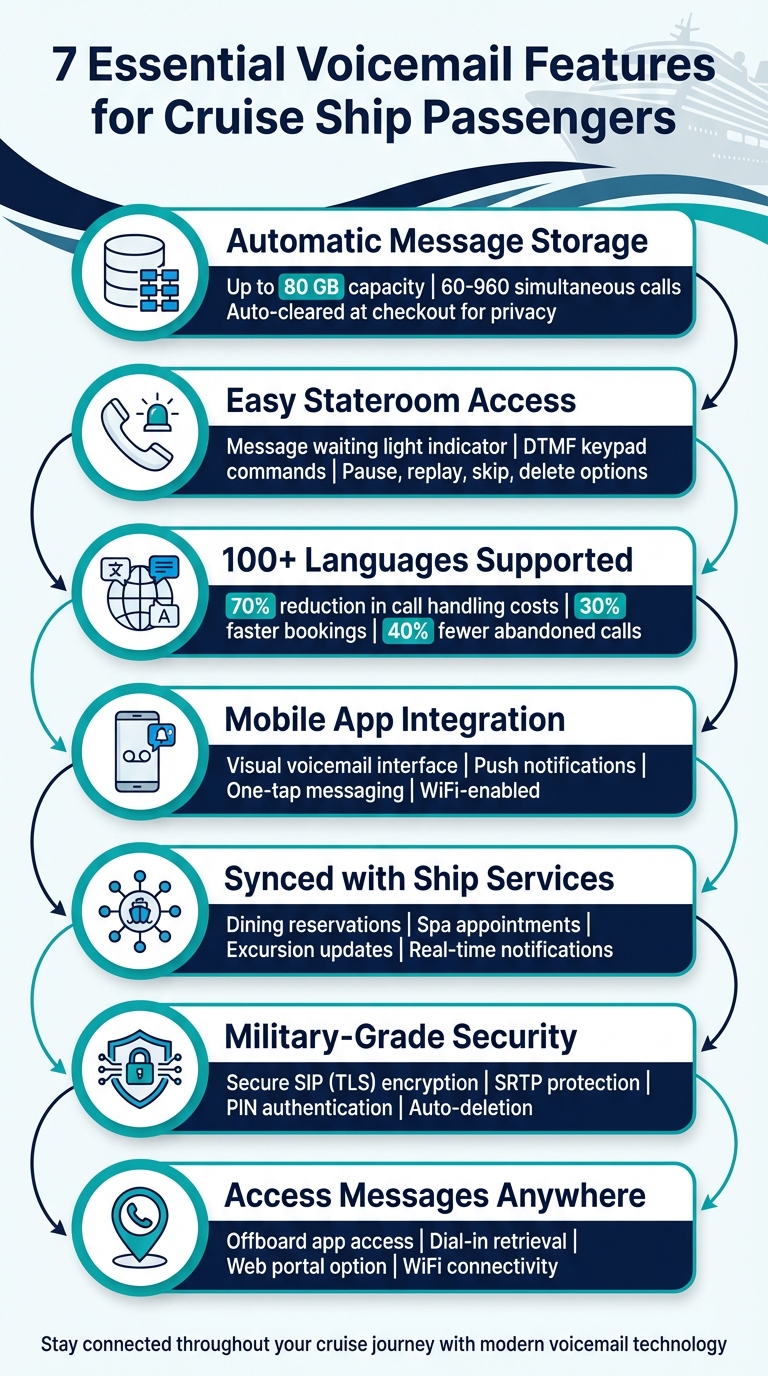
  • Multilingual Options: Supports over 100 languages, allowing personalized greetings and full menu access in your preferred language.
  • App-Based Access: Check voicemails directly from your smartphone using the cruise app, with push notifications for new messages.
  • Service Integration: Syncs with dining, spa, and other reservations for timely updates.
  • Security: PIN protection and encryption ensure message privacy.
  • Remote Access: Retrieve messages offboard via app or dial-in methods.

These features ensure you stay connected whether onboard or ashore, making communication simple and efficient during your cruise.

7 Essential Voicemail Features for Cruise Ship Passengers

7 Essential Voicemail Features for Cruise Ship Passengers

1. Message Storage and Retention

Cruise ship voicemail systems are designed to handle high volumes efficiently, offering unlimited mailboxes and up to 80 GB of storage. Depending on the system’s size, they can manage between 60 and 960 simultaneous calls.

Voicemails are stored only for the duration of your cruise. Once your trip ends, the system – integrated with the ship’s Property Management System (SPMS) – automatically clears your mailbox upon check-out. This ensures that your privacy is maintained for the next guest.

"Cruise VoiceMail is seamlessly integrated with each cruise line’s check-in/out procedures to ensure these shipboard operations are efficient." – CTModule

You can manage your voicemails conveniently from your stateroom phone by saving or deleting individual messages. Alternatively, you can use a web interface at the reception desk or the cruise line’s app. These tools display caller information and message length, helping you prioritize which voicemails to address. These features work hand-in-hand with other onboard communication systems, adding to the ease and enjoyment of your cruise.

2. Playback Options in Staterooms

Your stateroom phone works much like a hotel phone, featuring a message waiting light that either flashes or stays on when you have a new voicemail. The system relies on DTMF keypad commands, allowing you to pause, replay, skip, or delete messages as needed. Since keypad commands can differ between cruise lines, it’s a good idea to check the Ship’s Directory in your stateroom for specific instructions. You can also tweak playback settings for a better listening experience.

To adjust the volume while listening to a voicemail, use the physical volume buttons on your phone’s handset or base unit. On ships equipped with Cisco XML-enabled phones, you might have access to on-screen menus that make navigating your voicemail even easier. Some cruise lines also provide a web-based interface at the reception desk, allowing for visual message management.

While listening to internal voicemail is free, making ship-to-shore calls can be expensive. For example, Carnival charges $1.99 per minute, while Holland America rates go up to $7.95 per minute .

3. Multilingual Support

Cruise voicemail systems now cater to over 100 languages, making them accessible to a global audience. Setting up voicemail is straightforward, using ISO codes like "en" for English, "es" for Spanish, or "fr" for French, with English as the default option. This broad language coverage complements the user-friendly design mentioned earlier.

What makes these systems even smarter is their ability to adapt to cultural differences – like understanding idioms, context, and regional variations. Some advanced setups even greet callers in their preferred language by using data from caller profiles or cabin information. For instance, Costa Cruises uses GlobalLink technology to tailor its digital content into 12 languages across 20 markets. Similarly, Royal Caribbean employs GlobalLink Applanga for real-time localization of their mobile app.

The benefits of multilingual support go beyond convenience. It can slash call handling costs by up to 70%, speed up bookings by 30%, and reduce abandoned calls by 40%. Passengers also enjoy the option to record personalized greetings and access a full voicemail menu in their chosen language, enhancing their overall experience.

4. App-Based Voicemail Access

Cruise communication has taken a leap forward, allowing passengers to check their voicemail right from their smartphones or tablets. No need to return to your stateroom – just connect your device to the ship’s WiFi network and use the cruise line’s official app. These apps feature a visual voicemail interface, neatly organizing messages in a list for easy access and management.

By integrating with the ship’s PBX system, these apps work seamlessly alongside traditional stateroom phones. Passengers can view their messages on-screen, then tap to play, delete, or organize them in any order. Some apps even include a patented "one-tap" feature, making it simple to record and send voice messages with just a single press.

"NT Maritime’s robust technology allows guests to enjoy a cruise vacation with the ability to enjoy communication and connectivity among friends and family on their cruise just as they would if they were on a land-based vacation." – NT Maritime

Push notifications make this system even more convenient, ensuring you’re alerted to new messages no matter where you are on the ship. Plus, the app syncs with the ship’s management system, so your voicemail inbox is ready to go from the moment you check in until your trip ends. To avoid any delays, it’s a good idea to download your cruise line’s app before boarding.

Thanks to advanced maritime technology, these apps deliver reliable performance throughout your journey. You can manage your messages from anywhere on the ship, eliminating the need to rely solely on stateroom phones. This modern approach keeps passengers connected and informed, offering a level of convenience that complements the freedom of cruising.

5. Integration with Ship Services

Modern voicemail systems now work seamlessly with SPMS (Shipboard Property Management Systems) to deliver instant notifications for dining, spa appointments, excursions, and other guest services. By syncing with platforms like Oracle Hospitality Cruise SPMS, these voicemail systems automatically update guests about reservations and appointments across all onboard services. This centralized connection simplifies communication, ensuring guests stay informed throughout their journey.

The system operates through the ship’s SIP network, connecting directly to stateroom phones, mobile apps, and crew devices. For instance, if you book a specialty dining experience or schedule a spa treatment, you’ll receive an automatic voicemail reminder or a push notification. And if a restaurant is fully booked, the system can alert you the moment a table becomes available.

Each service operates on its own dedicated channel, allowing for efficient management. Concierge teams can track guest comfort requests, while catering staff handle meal planning and dietary preferences – all through the same integrated platform. This setup ensures that messages, such as housekeeping requests, are sent directly to the right department, cutting down on unnecessary follow-ups.

Cruise lines can also use Open Applications Management to customize notifications, like real-time weather updates, without interfering with existing communication channels. These added features ensure guests receive timely and relevant updates throughout their trip.

With NT Maritime’s integrated communication solutions, every voicemail notification ties directly to onboard services, making it easier for passengers to enjoy a hassle-free cruise experience.

6. Security and PIN Protection

Beyond the ease of onboard integration, voicemail systems on cruise ships prioritize passenger privacy with strong security measures. These systems rely on secure PIN codes and automatic message deletion to protect your information. When you check in, a secure mailbox is created and linked to your reservation. Once your trip ends, all messages are erased to ensure no one else can access them after your departure.

To safeguard voice data, modern systems employ Secure SIP (TLS) and SRTP encryption – the same protocols used in military-grade systems to defend against cyber threats. These encryption methods add an extra layer of protection, ensuring that only authorized users can access the system.

The ship’s communication platform also incorporates advanced rights management and single sign-on (SSO) to control feature access. For example, accessing voicemail through a cruise line’s app requires secure login credentials. Some apps, like Carnival HUB ($5 one-time fee) or Royal Caribbean ($1.99 per day), charge for this service. This added layer of authentication ensures your messages remain private.

"Pursuant to the United States’ Stored Communications Act (the SCA), We may be considered a provider of electronic communication services for certain services We offer through the Digital Platforms… In such instances, We will not turn over records or other information pertaining to you unless compelled to do so by a Court of competent jurisdiction." – Royal Caribbean Group

For added security, change any default PIN assigned at check-in to a unique code immediately. If you lose your room key or wearable device (like a Medallion), notify the reception desk right away. These items are connected to your communication services, and deactivating them promptly helps maintain your privacy and security.

7. Remote Voicemail Access

Staying connected while on a cruise doesn’t have to stop when you step off the ship. Thanks to remote voicemail access, you can check your stateroom messages even when ashore, using either the cruise app or a dial-in method.

With NT Maritime’s "Ship PBX to App" integration, you can access your voicemail offboard with ease. Simply download the app while onboard and sync it to your profile. Once you’re in port, connect to a local Wi-Fi network – like the one at a nearby café or restaurant – to listen to your messages without racking up cellular roaming charges.

Prefer the old-school approach? You can also retrieve messages by calling your stateroom number from an external phone. When the voicemail greeting begins, press either the * or # key to enter your PIN. Just make sure you set up your PIN before leaving the ship, as most systems won’t allow remote access without it. Keep in mind, though, that these calls might come with hefty charges.

To avoid roaming fees altogether, switch your phone to airplane mode and enable Wi-Fi only. Some cruise lines also provide a web-based option, allowing you to log into the ship’s guest portal from any browser to manage and listen to your voice messages. For specific details, check with guest services to confirm which remote access options are available on your ship and whether the system uses the star or pound key for dial-in access.

These remote voicemail features make sure you’re always connected, whether you’re relaxing in your stateroom or exploring the port. It’s all part of creating a seamless communication experience for cruise passengers.

Conclusion

Voicemail features play a key role in enhancing the cruise experience, ensuring passengers stay informed without missing important updates. With capabilities like message storage, multilingual options, app-based access, and remote retrieval, modern voicemail systems align perfectly with today’s communication needs.

What’s even more impressive is how these systems integrate with onboard services. Whether it’s a message from housekeeping, a dining update, or a service notification, voicemail keeps guests connected to everything they need for a smooth and enjoyable vacation. Crew members can leave personalized updates, ensuring everything from dinner reservations to special requests is handled efficiently.

NT Maritime powers these advanced communication systems, offering cruise lines the tools to deliver everything from quick voice messages to staying in touch with loved ones via video messages. With high-speed connectivity and a BYOD (Bring Your Own Device) approach, these systems make communication onboard flexible, seamless, and cost-effective – even in the middle of the ocean.

FAQs

How do I check my voicemails after leaving the cruise ship?

You can check your voicemails using the NT Maritime passenger app. Just log in on your smartphone or tablet, and with an internet connection after leaving the ship, you can stream or download any saved messages.

This handy tool helps you stay in touch and ensures you won’t miss any important updates, whether you’re sailing or enjoying time on shore.

What languages are available for the cruise voicemail system?

The cruise voicemail system is built to cater to passengers from various backgrounds by providing support in multiple languages. Commonly available options include English, Spanish, French, and German, though the exact languages offered can differ by cruise line. To find out which languages are available on your specific cruise, reach out to the onboard communication team or contact your cruise provider directly.

How does the cruise voicemail system protect my messages and ensure privacy?

The cruise voicemail system prioritizes privacy and security to protect passengers’ messages. Voicemail recordings are encrypted both during storage and while being transmitted, ensuring that only those with proper authorization can access them. Each passenger sets up a unique PIN or password when activating their voicemail, adding an extra layer of protection against unauthorized access.

This system operates within a secure onboard communication network, utilizing advanced defenses such as firewalls and network segmentation to safeguard data. Regular security audits and constant monitoring are in place to identify and prevent any potential threats. These measures ensure compliance with stringent data protection standards, giving passengers peace of mind that their messages remain secure throughout their trip.

5 Challenges in Low-Latency Maritime Communication

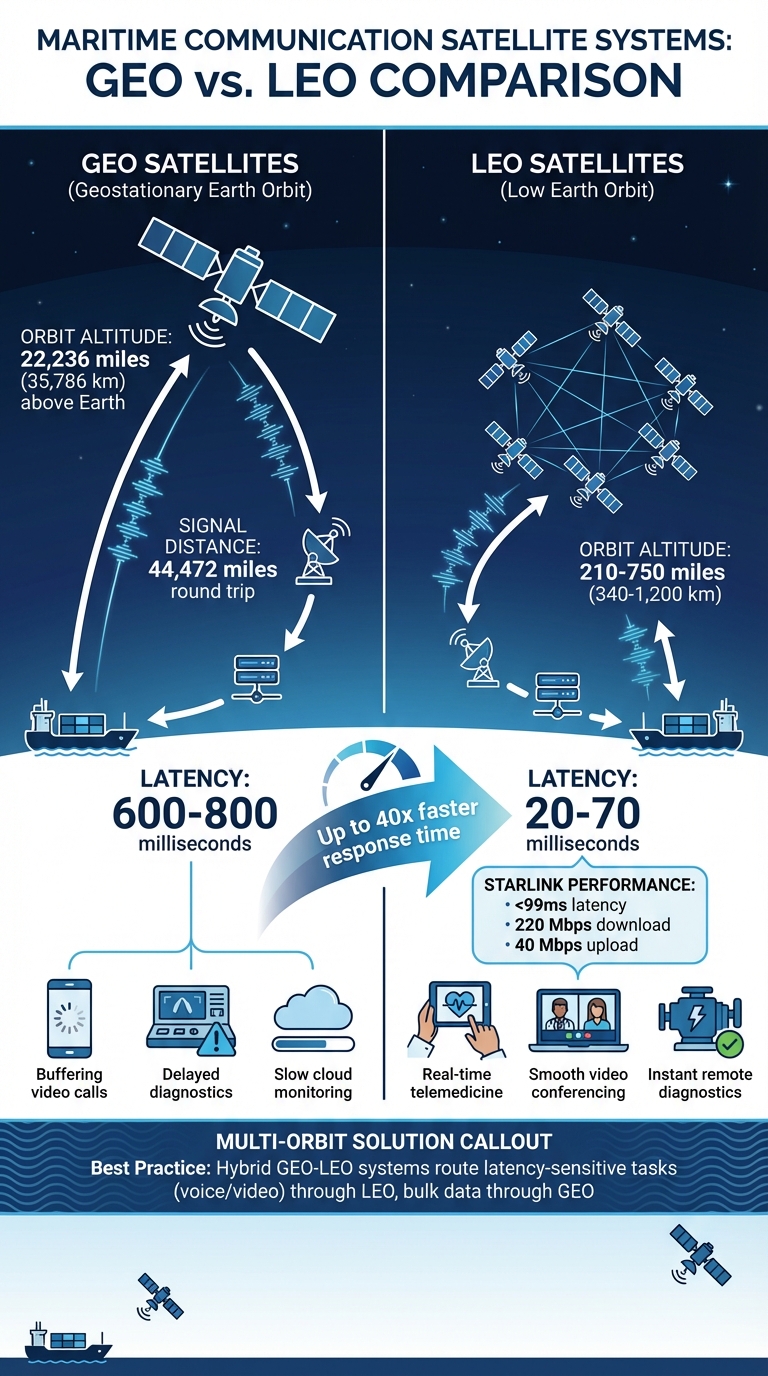
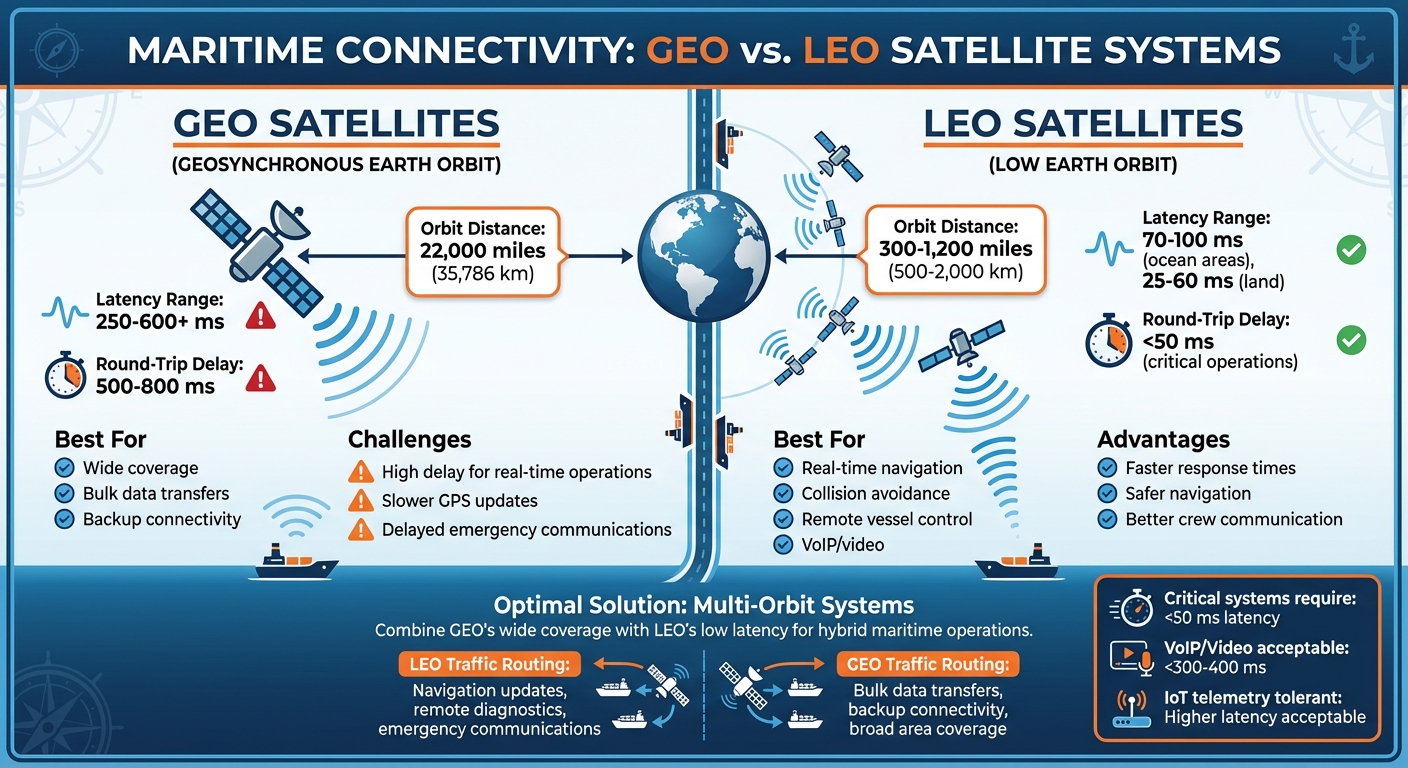
In maritime communication, achieving low latency is critical for real-time operations like telemedicine, remote diagnostics, and autonomous vessel control. While Low Earth Orbit (LEO) satellites offer latency as low as 20–40 milliseconds compared to the 600–800 milliseconds of Geostationary (GEO) systems, several challenges still hinder seamless connectivity at sea. These include:

  • Satellite Distance and Latency: GEO satellites’ high altitude causes significant delays, while LEO systems reduce this but require multi-orbit setups for efficiency.
  • Coverage Gaps: Harsh ocean conditions and high-latitude regions often disrupt signals, requiring advanced multi-bearer systems and phased-array antennas.
  • Bandwidth Limits: High data demand on ships leads to congestion; solutions like traffic prioritization and data compression are necessary.
  • Cybersecurity Delays: Security protocols can increase latency; onboard security appliances and optimized encryption help mitigate this.
  • Outdated Shipboard Infrastructure: Legacy networks and equipment create bottlenecks, requiring upgrades like VLANs, modern switches, and SD-WAN for better performance.

Starlink

Challenge 1: Satellite Distance and Latency

GEO vs LEO Satellite Latency Comparison for Maritime Communication

GEO vs LEO Satellite Latency Comparison for Maritime Communication

How Geostationary Satellites Create Latency

The delay in traditional maritime satellite communication boils down to one thing: physics. Geostationary (GEO) satellites orbit about 22,236 miles (35,786 km) above Earth’s equator. For a signal to travel from a ship to the satellite, down to a ground station, and back, it covers a whopping 44,472 miles. Even though radio signals travel at nearly the speed of light, this journey takes time – typically 600–800 milliseconds for a full round trip.

This delay impacts a range of maritime operations. Video calls experience noticeable pauses. Remote diagnostics lose accuracy. For critical tasks like dynamic positioning, collision avoidance, and remote pilotage, even a small delay can slow down responses from shore-based experts or automated systems, potentially affecting safety and efficiency.

For cruise ships, GEO VSAT systems often lead to buffering and interruptions during video calls or streaming. In commercial shipping and offshore energy, operators struggle with delays in cloud-based monitoring and remote support, making real-time decisions more challenging.

Solution: Low Earth Orbit (LEO) Satellites

Enter Low Earth Orbit (LEO) satellites, operating at altitudes between 210–750 miles (340–1,200 km). These satellites slash latency to 20–70 milliseconds, delivering speeds comparable to home broadband. For instance, NT Maritime offers Starlink services with latency under 99 milliseconds, download speeds up to 220 Mbps, and upload speeds reaching 40 Mbps – bringing high-speed internet to vessels at sea.

The difference is dramatic. Ships transitioning from GEO-only systems to LEO or hybrid GEO–LEO setups often see latency drop from several hundred milliseconds to under 100 ms. This improvement enables real-time applications like telemedicine, video conferencing, remote diagnostics, and fleet management. Many operators now rely on multi-orbit terminals that automatically direct latency-sensitive tasks, such as voice and video, through LEO satellites, while reserving GEO for less urgent bulk data transfers.

Challenge 2: Coverage Gaps and Harsh Ocean Conditions

Coverage Problems at Sea

Even with advancements like LEO satellites reducing latency, maintaining consistent connectivity at sea remains a significant hurdle. Vast stretches of ocean still suffer from poor or inconsistent coverage, especially in high-latitude regions. Since GEO satellites are positioned over the equator, ships operating closer to the poles often encounter signals that barely clear the horizon – or are obstructed entirely by the ship itself.

In remote oceanic zones far from shore-based infrastructure, signals can weaken or disappear altogether. Switching between satellite beams can cause brief but noticeable disruptions, particularly for fast-moving vessels. These micro-outages, occurring during antenna adjustments, can interrupt critical activities like video conferencing, remote diagnostics, or real-time monitoring.

Weather adds another layer of difficulty. Heavy rain, storms, and dense cloud cover interfere with high-frequency satellite bands, leading to a phenomenon known as rain fade. Meanwhile, rough seas – causing ships to pitch, roll, and yaw – force mechanically steered antennas to constantly adjust, which can result in intermittent connectivity and lower uptime. For operations like telemedicine or dynamic positioning, even a momentary signal loss can jeopardize safety and efficiency.

Addressing these challenges requires smarter, more adaptive network solutions.

Solution: Multi-Orbit and Multi-Bearer Systems

The key to overcoming these obstacles lies in redundancy and intelligent network routing. Multi-orbit systems dynamically switch between LEO and GEO satellites based on real-time conditions. LEO constellations offer low-latency, high-speed connections that fill in coverage gaps, particularly in polar regions and congested shipping lanes where GEO signals struggle. During severe weather, when one link falters, the system automatically switches to another, ensuring uninterrupted services like telemedicine or remote operations.

Multi-bearer setups further enhance connectivity by incorporating near-shore 4G/5G networks. As vessels approach ports, traffic can be offloaded to these terrestrial networks, freeing up satellite capacity for open-ocean operations. Intelligent routing ensures that time-sensitive tasks are prioritized on low-latency links, while bulk data is sent over higher-latency paths, improving overall system efficiency and reducing delays.

To complement these systems, advanced antenna technology plays a crucial role in stabilizing connections even in challenging conditions.

Advanced Antenna Technology

Modern phased-array antennas offer a game-changing approach to maintaining stable connections. Unlike traditional mechanically steered VSATs, these antennas adjust their beams electronically, eliminating the mechanical lag and reducing pointing errors. This capability minimizes disruptions during course changes and ensures more reliable connectivity.

Phased-array antennas can also connect to multiple networks simultaneously, such as LEO and GEO satellites, enhancing both redundancy and resilience. Their fast steering and multi-beam capabilities make them particularly effective in harsh maritime environments. For example, cruise ships equipped with these advanced antennas and LEO satellite links have delivered high-speed, low-latency internet to thousands of passengers, with fewer dropouts during adverse weather or sharp maneuvers compared to older GEO-only systems.

Challenge 3: Bandwidth Limits and Traffic Prioritization

Bandwidth Competition in Maritime Networks

Satellite connections at sea come with a major limitation: restricted bandwidth. Maritime operations generate massive amounts of data – think weather updates, location tracking, cargo information, and arrival schedules. When you add passenger entertainment and crew communication into the mix, the network can easily become overloaded. This is especially true for cruise ships and commercial vessels, where passengers expect uninterrupted streaming and video calls, while critical systems like navigation and telemedicine demand reliable, real-time data. GEO systems, which handle all these needs on a single link, often struggle with congestion and latency issues[2]. Managing this traffic effectively is no small task.

Solution: QoS and Traffic Shaping

Quality of Service (QoS) steps in to prioritize essential data over less critical traffic. Instead of treating all data equally, QoS ensures that vital applications – like telemedicine, navigation, and emergency systems – get the bandwidth and low-latency performance they need, even during heavy network usage. Traffic shaping works alongside QoS by capping the bandwidth available for non-essential activities, such as passenger video streaming. This approach keeps critical systems running smoothly while minimizing latency caused by packet loss and retransmissions[1]. Providers like NT Maritime integrate these strategies into their communication solutions, ensuring that crucial services always take precedence over recreational or non-essential traffic.

Network Performance Optimization

Beyond traffic management, other techniques can further boost network performance. Tools like WAN optimization, caching, and compression help reduce the amount of data sent over expensive satellite links[1]. For example, compression shrinks file sizes, while caching stores frequently accessed data – like weather reports, navigation charts, or operational manuals – locally on the vessel. This eliminates the need to repeatedly transfer the same information. These methods are especially valuable when bandwidth is limited and costs are high, allowing maritime operators to support more services without compromising performance. By reducing data loads and maintaining low latency, these optimizations play a critical role in modern maritime operations.

sbb-itb-bda822c

Challenge 4: Cybersecurity Effects on Latency

Maintaining low latency is vital for both operational efficiency and ensuring cybersecurity in maritime environments. However, safeguarding shipboard networks from cyber threats often comes with an unavoidable trade-off: increased delay. Encryption protocols like TLS and IPsec demand significant processing power from onboard routers and firewalls. These protocols handle tasks such as key exchanges, cipher operations, and packet wrapping, which inevitably add extra packet data. This additional data can boost bandwidth usage by 10–20%, a serious concern when relying on limited satellite connections.

Deep Packet Inspection (DPI) engines and intrusion detection systems also contribute to delays. These systems meticulously analyze payloads and headers against predefined security policies. Even for seemingly straightforward ship-to-cloud communications, traffic must travel from the vessel to a satellite, then to a shore-based data center, pass through security layers, and finally reach its destination. This routing effectively doubles or even triples the network segments involved, pushing round-trip times closer to those seen in GEO satellite systems, far from the 70 ms achievable with optimized LEO links.

These latency issues have real-world consequences, particularly for critical maritime operations. The signs are hard to miss: crew and passengers experience disrupted voice and video calls, fleet management applications load sluggishly, onboard telemetry and alarms face delays, and VPN connections frequently drop during periods of heavy traffic or adverse weather. The difference between raw test traffic and production traffic often highlights the problem – security processes like inspection, tunneling, and backhauling are the usual culprits.

Solution: Low-Latency Security Architectures

Addressing these delays requires rethinking how security is applied, moving toward a distributed security model. Instead of funneling all traffic through a central chokepoint, security enforcement can happen closer to the source. Deploying onboard security appliances – such as firewalls, intrusion detection/prevention systems (IDS/IPS), and secure web gateways – enables most filtering and inspection to occur locally. Only critical logs, alerts, and specific data flows need to be sent to shore-based centers. Typically, a unified next-generation firewall is installed in the ship’s main communications rack. This setup serves as the default gateway for various subnets, including crew, passenger, and operational technology networks. The onboard firewall handles local DPI, URL filtering, and threat prevention while keeping separate zones for systems like bridge controls, propulsion, hotel IT, and passenger Wi-Fi.

Optimizing encryption protocols also minimizes latency. For instance, using TLS 1.3 reduces the number of round trips needed during session setup compared to older versions. Fine-tuning settings like Maximum Transmission Unit (MTU) and Maximum Segment Size (MSS) prevents fragmentation over satellite links, cutting down on retransmissions and maintaining low latency without compromising encryption strength.

Network segmentation is another key strategy. By separating latency-sensitive systems from bulk traffic, critical operations like navigation and engine control can be placed on dedicated VLANs. These VLANs are configured with low-latency paths to shore support, limited inspection overhead, and high-priority Quality of Service (QoS) markings. Meanwhile, crew operational applications are given medium priority, and passenger internet and entertainment are assigned to best-effort segments that can handle higher latency and more extensive inspection. This proportional approach ensures that security measures don’t unnecessarily impact performance in areas where low latency is crucial.

Companies like NT Maritime have integrated these strategies into their secure communication solutions. By doing so, they ensure that essential services – such as Telehealth and onboard calling – operate smoothly with low latency, even under robust security protocols. This balance is critical for supporting the seamless operations modern vessels demand.

Challenge 5: Outdated Shipboard Infrastructure

Problems with Aging Onboard Systems

Even with low Earth orbit (LEO) satellite services offering latency as low as 20–40 ms, that advantage can vanish if a ship’s internal network is outdated. Many vessels still rely on legacy, flat shipboard networks built with unmanaged switches, outdated routers, and serial-based operational technology systems that were originally designed for low-bandwidth, high-latency traffic [7]. These aging networks introduce extra hops, congestion, and protocol conversion delays, making it impossible to fully leverage modern satellite services [3].

The main culprits? Outdated switches that max out at 100 Mbps or early 1 Gbps speeds without Quality of Service (QoS) capabilities, leading to congestion and long queuing delays when under heavy load [1]. Add to that old copper cabling (Cat5 or earlier) and poorly terminated connections, which cause errors and retransmissions. Legacy Wi‑Fi systems using outdated standards like 802.11a/b/g also struggle in environments with dense usage, causing high jitter. Servers and firewalls with underpowered CPUs further slow things down by struggling to handle modern encryption and routing tasks.

To make matters worse, many older ships have undergone unplanned network expansions, creating tangled "spaghetti networks" that are difficult to manage. Without proper segmentation between operational technology (OT), IT/business, and crew/guest networks, all traffic ends up competing within the same broadcast domain. This lack of segmentation means that heavy passenger streaming or gaming can interfere with critical services like safety systems, navigation data, Telehealth, or remote diagnostics, causing congestion and unpredictable latency spikes [6].

These outdated systems act as bottlenecks, limiting the potential of modern connectivity solutions.

Solution: Upgrading Shipboard Networks

Modernizing these outdated networks can significantly reduce congestion and restore the low-latency advantages of today’s satellite services. Ships should adopt managed, industrial-grade switches and routers capable of creating VLANs and firewalled zones to separate OT, corporate IT, and guest/crew Wi‑Fi traffic. This ensures that priority services are protected from interference [7]. Conducting a thorough network audit is a crucial first step. It helps identify unmanaged devices, single points of failure, and flat networks prone to broadcast storms and latency issues [7].

Replacing outdated equipment with managed solutions that support VLANs, access control lists, QoS, traffic shaping, redundancy protocols, and advanced monitoring tools is key. Upgrading cabling to Cat6 or Cat6a – or even fiber for backbone connections – reduces errors and supports higher data speeds with lower latency. Modern Wi‑Fi 6/6E access points, paired with redundant core network layers using ring or dual-homed topologies, ensure reliable performance even during peak usage.

Additionally, implementing SD‑WAN and multi-bearer routing enables ships to combine multiple connectivity options – such as GEO and LEO satellites, cellular networks, and port Wi‑Fi. These systems can dynamically route latency-sensitive applications like Telehealth, remote control, or VoIP to the fastest connection available based on real-time metrics like latency, jitter, and packet loss. Meanwhile, less critical tasks, such as backups or software updates, can be shifted to higher-latency channels [1][3][4][5].

System Integration for Better Communication

Once the hardware and networks are upgraded, integrating these systems into a unified architecture can further streamline operations. Centralized control mechanisms ensure consistent QoS, security, and routing policies across OT, IT, and guest domains. This approach helps optimize the use of limited satellite bandwidth [3]. Centralized platforms like SD‑WAN controllers and security systems can prioritize and schedule traffic, ensuring that operational and safety-critical data always have sufficient bandwidth, even during peak guest usage [1][5]. Shared monitoring and analytics tools also play a critical role by detecting issues like congestion or security threats early, allowing operators to make proactive adjustments instead of scrambling to fix problems after they arise.

Effective network segmentation is another must. Each domain – OT, corporate IT, and guest networks – should have its own VLAN and IP subnet. Inter-VLAN traffic should be managed by firewalls or Layer 3 switches with strict policies in place. OT networks should be given the highest priority and isolated from guest access entirely. Crew networks can have medium priority with controlled internet access, while guest networks are treated as best-effort connections, often placed behind carrier-grade NAT and captive portals. This structure minimizes unnecessary traffic, reduces vulnerabilities, and ensures that passenger streaming doesn’t interfere with critical low-latency services.

Companies like NT Maritime specialize in creating secure communication networks tailored for cruise ships and government or military vessels. Their end-to-end solutions include everything from satellite connectivity to onboard Wi‑Fi and applications, ensuring that latency-sensitive services like video calls, messaging, and remote monitoring work seamlessly once the onboard infrastructure is modernized.

Conclusion

Addressing the challenges of low-latency maritime communication requires a well-coordinated, end-to-end strategy that tackles every part of the network. By leveraging LEO and multi-orbit satellite systems, latency can drop dramatically – from the typical 600–800 ms down to just 20–40 ms. Advanced multi-bearer systems, paired with cutting-edge antennas, help maintain connectivity even in the harshest ocean environments. Additionally, QoS policies and traffic shaping ensure critical services remain prioritized over less essential data traffic, such as passenger streaming. Security systems designed for low latency safeguard data without slowing down network performance. To fully benefit from these advancements, modern shipboard hardware must replace outdated systems, enabling seamless integration with today’s satellite technologies.

Investing in low-latency connectivity is more than just a technical upgrade – it’s a strategic move. Real-time data exchange enhances operational efficiency, reduces fuel consumption, boosts crew welfare, and improves passenger experiences. These factors directly influence competitiveness and profitability. On the flip side, failing to address these challenges can lead to higher risks, slower responses to incidents, and less effective remote support, leaving fleets vulnerable as the industry evolves.

For example, NT Maritime provides secure communication networks and Telehealth solutions by combining LEO connectivity with updated onboard systems. Their approach supports cruise lines, government fleets, and military vessels, demonstrating how scalable, software-defined architectures can prepare fleets for the future. With these systems in place, operators can handle increasing data demands, adopt AI-driven analytics, and explore advanced technologies like autonomous navigation – all without constant hardware overhauls.

Achieving low latency at sea isn’t about a single breakthrough. It’s about creating a unified system – integrating modern satellite links, upgraded onboard networks, efficient traffic management, and robust security protocols – to meet the growing demands of maritime digital transformation.

FAQs

How do low Earth orbit (LEO) satellites improve latency in maritime communication compared to geostationary (GEO) satellites?

LEO satellites are changing the game for maritime communication by orbiting much closer to Earth – typically between 200 and 1,200 miles – compared to GEO satellites, which operate at a staggering 22,000 miles above. This shorter distance means signals travel faster, cutting down latency in a big way.

For the maritime sector, this translates to smoother real-time interactions, whether it’s video calls, live monitoring, or rapid data transfers, even in the middle of the ocean. LEO satellite networks are reshaping how ships stay connected, offering faster, more dependable communication where it was once a challenge.

How can coverage gaps in maritime communication be resolved?

To address coverage gaps in maritime communication, combining satellite systems with hybrid networks is key. These networks bring together various technologies to ensure smooth and uninterrupted connectivity, even in the most remote or demanding sea environments.

On top of that, tools like location-based services and Telehealth technologies play a crucial role in enhancing safety and providing essential services for both passengers and crew. By focusing on dependable, high-priority networks, maritime operations can maintain steady and secure communication across the expansive oceans.

How does outdated onboard infrastructure impact low-latency communication at sea?

Outdated onboard systems can throw a wrench into low-latency communication, leading to delays and even data packet loss. This kind of disruption weakens network reliability, making real-time activities – like voice calls, video conferencing, and data transfers – much less efficient.

Today’s maritime communication needs to keep up with high-speed data demands. Older equipment often falls short, unable to provide the smooth connectivity required by modern communication technologies, especially in the tough conditions of maritime environments.

Cyber Risk Assessment for Ship IT Systems

Cybersecurity risks in the maritime industry are growing as ships increasingly depend on interconnected IT and OT systems for navigation, propulsion, communication, and cargo handling. These systems improve efficiency but also expose vessels to potential cyberattacks, which can disrupt operations, compromise safety, and lead to financial losses or regulatory penalties.

Key points covered in this guide:

  • Rising Cyber Threats: Ships face risks like ransomware, GPS spoofing, phishing, and outdated systems.
  • Regulations: Compliance with IMO Resolution MSC.428(98) and U.S. Coast Guard standards is mandatory.
  • Risk Assessment Steps: Define scope, inventory assets, identify vulnerabilities, analyze risks, and plan mitigations.
  • Mitigation Strategies: Use tools like network segmentation, secure remote access, multi-factor authentication, and crew training.
  • Governance and Compliance: Maintain a cyber risk register, conduct regular audits, and ensure fleet-wide consistency.

This guide provides practical steps to identify, prioritize, and reduce cyber risks, ensuring safer and more compliant maritime operations.

Understanding Maritime Cyber Risks

Ship IT and OT Systems Overview

Modern ships rely on two key types of systems: Information Technology (IT) and Operational Technology (OT). IT systems manage data processing, communication, and administrative tasks, while OT systems control and monitor physical processes. These processes include navigation tools like ECDIS, GPS, AIS, and radar, as well as propulsion, steering, power management, cargo handling, and safety equipment .

The challenge arises from the increasing interconnection between these systems. For instance, route planning done on office IT networks can directly feed into navigation displays on the ship’s bridge. Similarly, shore-based teams might monitor machinery performance remotely. According to the International Maritime Cyber Security Organisation (IMCSO), ten critical OT infrastructure categories – including navigation, propulsion, and safety systems – require thorough evaluation. When IT and OT networks share infrastructure or data paths, vulnerabilities in one can cascade into the other. For example, malware originating on an administrative laptop could infiltrate safety-critical systems if proper network segmentation isn’t in place .

Modern ships also connect to external networks through satellite communications, terrestrial links in port, USB drives, remote diagnostic connections, and even crew Wi-Fi. Each of these access points introduces potential risks if not properly secured . The complexity of these systems is compounded by the fact that ships often have dozens of interconnected control systems that must operate smoothly while staying secure. While IT-OT integration improves functionality, it also creates multiple avenues for cyberattacks.

Common Cyber Threats to Ships

Maritime vessels face a range of cyber threats that can disrupt operations or jeopardize safety. One of the most alarming is ransomware, where attackers encrypt critical systems and demand payment to restore them. This could disable essential systems like navigation or propulsion, forcing vessels to halt operations .

GPS spoofing and jamming are particularly dangerous at sea. Attackers can broadcast false GPS signals, leading ships to miscalculate their position and potentially stray into restricted or hazardous waters. Similarly, manipulation of AIS data can create confusion about vessel locations and movements, complicating collision avoidance . Phishing attacks, often targeting crew members and shore staff, aim to steal credentials and gain access to sensitive systems.

Other threats include malware introduced via USB drives or email attachments, denial-of-service attacks that overwhelm shipboard or shore systems, and unauthorized remote access to OT systems. Many vessels still rely on outdated IT and OT systems, which often run on older operating systems that are difficult to patch. Weak access controls, default passwords, poor network segmentation, and limited logging capabilities further exacerbate these vulnerabilities .

The consequences of these vulnerabilities are severe. Cyber incidents can lead to navigation failures, propulsion or steering issues, cargo and ballast system malfunctions, disrupted port schedules, safety system failures, financial losses, environmental harm, and damage to a company’s reputation . Additionally, the involvement of multiple stakeholders – such as shipowners, operators, charterers, port authorities, and vendors – can create accountability gaps, making it unclear who is responsible for cybersecurity.

Regulatory and Compliance Requirements

Given the risks, robust compliance frameworks are critical. The International Maritime Organization (IMO) established Resolution MSC.428(98), which mandates that cyber risks be addressed as part of Safety Management Systems (SMS). Compliance with this requirement has been mandatory since January 1, 2021 .

In the U.S., the Maritime Transportation Security Act (MTSA) of 2002 requires maritime facilities to conduct Facility Security Assessments that include identifying cybersecurity vulnerabilities . The U.S. Coast Guard’s Maritime Cybersecurity Assessment and Annex Guide (MCAAG) provides a structured approach to identifying and mitigating cybersecurity risks, integrating cyber considerations into physical security planning.

Industry organizations like BIMCO, ICS, CLIA, INTERTANKO, and INTERCARGO have developed "Guidelines on Cyber Security Onboard Ships" to help meet IMO requirements. These guidelines cover areas such as risk assessment, network architecture, access control, incident response, and crew training. Additionally, classification societies like DNV and ABS offer their own methodologies for cyber risk management. The IMCSO has recently introduced a standardized cybersecurity assessment methodology that helps stakeholders like insurers and port authorities create consistent risk profiles across vessels.

These frameworks provide vessel operators with tools to navigate a complex compliance environment, where flag states, port authorities, charterers, and insurers may impose additional requirements beyond IMO standards.

Update on maritime cybersecurity threats and mitigation methods

How to Conduct a Cyber Risk Assessment

5-Step Maritime Cyber Risk Assessment Process

5-Step Maritime Cyber Risk Assessment Process

Scoping and Preparation

Start by defining the purpose of your assessment. Are you aiming to meet IMO standards, satisfy insurer requirements, or guide investment decisions? Clarify which vessels, operational phases (like at sea, in port, or in dry dock), and domains (such as navigation, propulsion, cargo handling, passenger services, crew communications, and shore links) will be included in your scope .

Next, assign responsibilities to key personnel. This might include the Designated Person Ashore (DPA), Cybersecurity Officer (CySO), ship’s master, chief engineer, and IT/OT vendors. According to the U.S. Coast Guard’s Maritime Cybersecurity Assessment and Annex Guide (MCAAG), the CySO plays a central role in coordinating the assessment .

Review all relevant documentation – network diagrams, equipment inventories, safety management procedures, class and flag requirements, and past incident reports or audits . Establish clear rules of engagement for the assessment. These should detail what can be tested, testing schedules, data handling protocols, and reporting formats, ensuring minimal operational impact. Following these steps not only makes the process repeatable across a fleet but also helps reduce disruptions . Once prepared, document your assets to create a comprehensive map of your cyber environment.

Asset and Data Inventory

Compile a detailed inventory of all onboard systems, including navigation, propulsion, power, cargo, safety, IT, and crew and passenger communication systems . For each system, note its location, owner, function, network segment, connectivity (including remote access), data it processes, and any backup or redundancy features .

Classify these assets by their criticality – whether they are safety-critical, environment-critical, operational-critical, or support-related. Identify dependencies, such as how an ECDIS (Electronic Chart Display and Information System) relies on GPS and accurate time sources. If passenger and crew communications share infrastructure with operational systems, detail how they are segregated. This could range from strict firewall rules to logical VLANs with varying levels of access control .

Keep this inventory updated as a controlled document, with versioning and periodic reviews as required by maritime cyber guidelines . For example, the CRASH methodology has demonstrated scalability by assessing 24 distinct cyber risks for an Integrated Navigation System with 25 components. With a well-maintained inventory, you can move on to identifying vulnerabilities.

Threat and Vulnerability Identification

Leverage a variety of resources to identify potential threats. These can include historical maritime incidents, vendor advisories, vulnerability databases, and frameworks like MITRE ATT&CK . Look for technical vulnerabilities such as outdated operating systems, default passwords, weak network segmentation, unencrypted remote access, missing patches, shared accounts, and improper USB use on bridge systems .

Don’t overlook organizational and procedural weaknesses, like inadequate update protocols, poor vendor access verification, insufficient crew training, or weak personnel management practices . Tie each identified threat to its potential operational impact, such as loss of propulsion, voyage delays, cargo damage, or service interruptions .

Risk Analysis and Prioritization

Use a 1–5 risk matrix to evaluate and rank risks by their likelihood and impact . Likelihood can be assessed by examining factors like the exploitability of vulnerabilities, exposure to external networks, historical incidents in similar fleets, and the effectiveness of current controls (e.g., patch management, system hardening, and crew training) .

Assess the impact of each risk on safety, the environment, operations, finances, and reputation. Predefined criteria, such as "loss of propulsion", "voyage delays exceeding 24 hours", or "regulatory non-compliance", can help guide this process. Record and rank each risk in a risk register, ensuring that each entry is linked to the relevant assets, threats, and vulnerabilities, along with a clear rationale for its score .

Mitigation Planning and Implementation

Based on the risks identified, create a mitigation plan that aligns with compliance requirements. For each high or medium risk, determine an appropriate course of action: avoid (change processes to eliminate the risk), reduce (implement controls), transfer (e.g., through insurance or contracts), or accept (with documented justification) .

Choose controls that align with maritime cyber best practices. These may include technical measures like patching, network segmentation, multi-factor authentication, secure remote access, and backups; procedural measures like access management, USB/media handling, and change management; and organizational measures like training, drills, and incident response plans .

When planning mitigations, consider the unique constraints of ship operations, such as limited bandwidth, restrictions on modifying OT systems, and crew workload . For each mitigation, document the responsible party, required steps, budget, deadlines, and the residual risk rating .

For communication-related risks – such as segregating passenger and crew services, securing remote access, or managing telehealth traffic – solutions like those offered by NT Maritime can be invaluable. Their services include secure communication networks, traffic segregation, encryption, and access controls, which address vulnerabilities in these areas . Documenting these measures as part of your corrective action plan not only demonstrates risk reduction but also strengthens your vessel’s overall security posture while meeting maritime cybersecurity standards.

Tools and Best Practices for Risk Mitigation

Reference Frameworks for Maritime Cybersecurity

To establish a strong cybersecurity foundation, ship operators should align their programs with recognized frameworks that address both IT and operational technology (OT). The International Maritime Organization (IMO) Guidelines on Maritime Cyber Risk Management (MSC-FAL.1/Circ.3) offer high-level guidance structured around key functions: identify, protect, detect, respond, and recover. Additionally, Resolution MSC.428(98) mandates integrating this guidance into Safety Management Systems under the ISM Code.

The NIST Cybersecurity Framework (CSF) provides a clear structure for organizing existing policies into a cohesive cybersecurity program, which is also applicable in maritime settings. For U.S.-flagged vessels and facilities, the U.S. Coast Guard Maritime Cybersecurity Assessment and Annex Guide (MCAAG) lays out a step-by-step approach for identifying cyber-enabled systems, pinpointing vulnerabilities, and developing remediation plans tailored to Facility Security Assessments and Plans.

Industry-specific resources like the "Cyber Security Onboard Ships" guidelines from ICS and BIMCO translate these broader frameworks into actionable shipboard measures. These include creating asset inventories, monitoring communication links, and conducting regular threat assessments. These frameworks collectively set the stage for implementing the technical and procedural safeguards outlined below.

Technical and Procedural Controls

With a solid framework in place, ship operators can focus on deploying layered technical and procedural defenses. Network segmentation is a must – separating operational/bridge systems, corporate networks, crew zones, and passenger areas using VLANs and firewalls ensures better control and containment. Implement multi-factor authentication (MFA) and assign unique credentials for remote access and administrative functions, steering clear of shared or generic accounts.

For endpoint security, use tools like antivirus software, firewalls, and application whitelisting. Data in transit should always be encrypted, using technologies such as VPNs and TLS. Establish centralized logging and monitoring by collecting logs from critical systems like firewalls, servers, and OT devices. If in-house resources are limited, consider outsourcing to a Security Operations Center (SOC) or managed detection service.

Backup strategies are equally important – maintain offline or hardened backups of critical systems and configurations, and test restoration processes regularly. On the procedural side, conduct cyber awareness training tailored to shipboard roles. This should cover key topics like phishing, proper handling of USB drives, and incident reporting.

Document and enforce access control and change management policies for IT and OT systems. These policies should outline how configuration changes are approved, recorded, and, if necessary, rolled back. Finally, integrate cyber scenarios into emergency drills and incident response plans. Examples include handling navigation data loss, ransomware attacks on business systems, or disruptions to satellite communications.

Secure Communication Platforms

Passenger and crew communication networks can be a vulnerable entry point for cyberattacks if not properly secured. These networks should be logically and physically separated from ship OT and critical IT systems. Routing between these zones must be tightly controlled, with no direct trust relationships. Any necessary data exchange should occur through secure, monitored interfaces.

Maritime communication platforms simplify the management of security controls, logging, and policies for passenger, crew, and operational communications. These platforms should offer encrypted voice, messaging, and video services between ship and shore. They should also support central identity management, enforce strong password policies, and implement role-based access control. Additionally, bandwidth and access policies should prioritize operational communications over high-volume passenger traffic to ensure mission-critical systems remain unaffected.

For instance, NT Maritime provides secure onboard communication solutions tailored for cruise lines and government or military operations. Their services include encrypted app-to-app calling, app-to-ship PBX calls, ship PBX-to-app calls, app-to-off-ship calls, and integrated messaging and video over ship Wi-Fi. These features allow users to securely connect using their own devices, ensuring reliable and real-time communication while protecting against cyber threats.

When specialized services like Telehealth are involved, additional privacy and security measures – such as handling protected health information – must be incorporated into the network design. Collaborating with maritime-specific providers ensures that security controls and support procedures align with the unique risks faced by cruise, government, or military vessels. Securing communication platforms is a critical part of a layered defense strategy, safeguarding not just ship operations but also the broader network ecosystem.

Governance, Compliance, and Continuous Improvement

Documenting and Reporting Cyber Risk Assessments

Creating a formal cyber risk register is a must for staying audit-ready. Each entry in this register should include essential details: the asset, associated threats, vulnerabilities, existing controls, planned mitigation efforts, the responsible party, target dates, and the residual risk level.

It’s important to maintain controlled records at both the ship and company levels. For vessels and facilities regulated in the U.S., a cyber annex should be added to your Safety Management System or Facility/Vessel Security Plan. This annex should align with Coast Guard requirements outlined in the Maritime Cybersecurity Assessment and Annex Guide (MCAAG). The annex should cover key areas such as its scope, roles (e.g., Company Security Officer and Ship Security Officer), an overview of assets, risk assessment summaries, preventive measures, incident response protocols, business continuity strategies, training requirements, and links to related checklists. Since IMO Resolution MSC.428(98) mandates that cyber risks be addressed under the ISM Code and verified during audits starting January 1, 2021, this documentation is no longer optional – it’s a regulatory requirement. This thorough documentation also serves as the foundation for fleet-wide evaluations.

Fleet-Wide Implementation and Oversight

Once assessments are documented, fleet-level oversight ensures consistency across all vessels. By standardizing risk criteria, scoring methods, and asset categories, individual ship assessments become comparable, enabling effective fleet-wide management. Consolidate ship registers into a centralized dashboard to identify systemic issues – like outdated navigation software across multiple vessels – and rank ships by residual risk. This approach helps prioritize budget allocation and technical support.

A cyber governance committee – including representatives from legal, insurance, operations, and IT/OT teams – should meet quarterly to review fleet-wide risks, incidents, and compliance. This ensures cyber risks are treated as critical safety and business concerns, not just technical challenges.

To establish a fleet-wide minimum cyber baseline, implement mandatory measures such as hardening, logging, backups, and access controls. Verify compliance through internal audits, third-party assessments, and technical checks like vulnerability scans and configuration reviews. If you’re using specialized maritime IT and communication providers like NT Maritime for secure onboard networks and high-speed connectivity, include their performance and security practices in your risk evaluations. This should cover service-level agreements for incident response and updates to communication platforms.

Periodic Reassessment and Improvement

Regular reassessments are key to keeping up with changing threats and regulations. Maritime guidelines suggest reviewing cyber risk assessments at least once a year or whenever significant changes occur, such as system upgrades, network modifications, regulatory updates, or major cyber incidents. For U.S.-regulated vessels and facilities, updates to Coast Guard guidance, MTSA requirements, or critical Navigation and Vessel Inspection Circulars (NVICs) should also trigger a review of your cyber annex and related procedures.

Track key metrics like unresolved critical vulnerabilities, average time to remediation, crew training completion rates, and the frequency of backup and recovery tests. These metrics should be reviewed by senior management to showcase ongoing improvements. Establish a structured lessons-learned process to capture insights from incidents, near-misses, drills, and external threat reports. Use these insights to update policies, the cyber annex, and training materials.

Technical monitoring is also essential. This includes log collection and review for critical systems, intrusion detection for key networks, regular vulnerability scans, and periodic penetration testing – all tailored to the unique constraints of maritime operations. Together, these efforts ensure that ship IT/OT cyber risk management remains aligned with evolving threats and regulatory demands.

Conclusion

Cyber risk assessment isn’t just a good practice – it’s a necessity for running safe, compliant, and efficient ship operations. With the International Maritime Organization (IMO) requiring cyber risk management under the ISM Code and the U.S. Coast Guard enforcing minimum cybersecurity standards, these assessments have become mandatory. Considering that over 90% of global trade relies on shipping, even a single cyber incident can send shockwaves through international supply chains.

This guide provides a clear, step-by-step approach: define the scope, inventory assets, pinpoint vulnerabilities, assess risks, and create mitigation plans to allocate resources wisely. Whether you choose to adopt frameworks like IMCSO’s Cyber Risk Registry, CRASH, or methodologies from classification societies, the secret to success lies in consistency. Using standardized risk criteria, maintaining well-documented risk registers, and assigning clear ownership ensures your efforts align with a broader cyber resilience strategy.

Particular focus should be placed on communication and network security. Ship-to-shore connectivity, remote access systems, crew Wi-Fi, and passenger services are critical for operations but also present tempting targets for cyberattacks. Solutions like NT Maritime’s encrypted networks, role-based access controls, and integrated communication tools are designed to keep these systems secure while supporting mission-critical operations. These measures not only safeguard against threats but also ensure the smooth functioning of essential maritime activities.

FAQs

What’s the difference between IT and OT systems on ships?

IT systems aboard ships are built to handle tasks like communication, entertainment, and administrative operations for both passengers and crew. Their primary focus is on maintaining connectivity, managing data, and improving the overall user experience.

On the other hand, OT systems are dedicated to the ship’s critical operations, such as navigation, propulsion, safety mechanisms, and cargo management. These systems emphasize real-time control and safety because they directly impact the physical processes and essential functions that keep the ship running smoothly.

The main difference between the two lies in their roles: IT systems manage data and communication needs, while OT systems are tasked with ensuring the ship’s core operations run safely and efficiently.

What steps can ships take to protect against GPS spoofing risks?

Ships can tackle GPS spoofing risks by adopting several protective measures. Using multi-layered authentication helps ensure the integrity of GPS signals, while anti-spoofing algorithms can identify and block questionable activities. To further strengthen security, GPS data should be cross-checked with backup navigation systems such as inertial navigation. Keeping an eye out for unusual signal patterns is also key. Additionally, providing regular training for crew members on recognizing and responding to spoofing attempts plays a crucial role in maintaining safe and secure operations.
What are the key steps to comply with IMO Resolution MSC.428(98) for ship IT systems?

To meet the requirements of IMO Resolution MSC.428(98), start by performing a detailed cyber risk assessment to pinpoint any weak spots in your ship’s IT systems. Use the results to put in place strong cybersecurity measures like firewalls, secure access controls, and encryption protocols.

It’s also crucial to have a well-defined incident response plan in place so your team can handle cyber threats swiftly and efficiently. Keep all systems up to date with regular patches to guard against new vulnerabilities. On top of that, focus on using secure communication protocols for critical IT systems to protect sensitive data and ensure smooth operations.

By following these steps, you’ll strengthen your maritime IT systems’ security and stay aligned with the resolution’s standards for safe operations at sea.

High-Speed Internet for Military Ships: Key Providers

High-speed internet is critical for modern naval operations, ensuring communication, intelligence sharing, and crew welfare. Military ships require secure, reliable connectivity in remote and challenging environments. This article compares five key providers of maritime internet solutions for military use:

  • NT Maritime: Offers hybrid satellite systems (GEO, MEO, LEO) with global coverage, high speeds, and advanced security features tailored for defense needs.
  • Inmarsat Fleet Broadband: Reliable L-band GEO satellites with 99%+ uptime but limited to 80% global coverage and slower speeds (up to 432 kbps).
  • Iridium Certus: Provides 100% global coverage, including polar regions, with LEO satellites and moderate speeds (up to 704 kbps).
  • Viasat Government & Defense: High-throughput GEO satellites delivering multi-Mbps speeds, ideal for bandwidth-heavy tasks, but with higher latency and no polar coverage.
  • Starlink Business Maritime: LEO satellites offering 100–250 Mbps speeds and low latency (30–50 ms), with near-global coverage focused on major ocean regions.

Quick Comparison

Provider Coverage Speeds (Mbps) Latency Key Features
NT Maritime Global 10–100+ Mbps 20–600 ms Hybrid networks, tailored for defense, secure
Inmarsat Fleet 80% Global Up to 0.432 500–700 ms Reliable, all-weather, L-band GEO satellites
Iridium Certus 100% Global Up to 0.704 ~600 ms Pole-to-pole, durable solid-state antennas
Viasat Government Near-global Multi-Mbps ~600 ms High throughput, encrypted, defense-grade
Starlink Maritime Near-global 100–250 30–50 ms Low latency, cost-effective, data-heavy tasks

Military planners often combine L-band systems (e.g., Inmarsat, Iridium) for resilience with high-throughput options (e.g., Starlink, Viasat) for data-intensive activities. NT Maritime excels at integrating these networks into a single, secure platform to meet diverse naval mission needs.

Military Maritime Internet Providers Comparison: Speed, Coverage, and Latency

Military Maritime Internet Providers Comparison: Speed, Coverage, and Latency

1. NT Maritime High-Speed Internet Solutions

NT Maritime

Network Technology

NT Maritime delivers reliable connectivity through hybrid satellite architectures designed for uninterrupted operations. This system combines VSAT services over Ku/Ka-band frequencies with L-band backup links, leveraging networks like Inmarsat FleetBroadband and Iridium Certus. Its multi-path design automatically transitions between GEO, MEO, and LEO satellite constellations based on changing conditions. Onboard antennas work seamlessly with modems, routers, and firewalls, ensuring smooth segmentation of mission-critical and crew communications. The system supports VoIP, secure messaging, and video conferencing via a QoS-aware IP backbone, prioritizing low-latency traffic for essential command and control tasks. This advanced setup ensures dependable connectivity across maritime operations.

Coverage

Thanks to its hybrid design, NT Maritime provides consistent coverage across a variety of maritime environments. Its dual-network approach guarantees global connectivity, spanning equatorial to polar regions. This capability is vital for Arctic and Antarctic missions, where GEO satellites often have limited visibility. U.S. Navy vessels benefit from this system, maintaining connectivity in contested waters or during polar expeditions. Additionally, terrestrial links can be integrated when ships are near coastlines or in port, reducing dependency on satellite networks and expanding overall availability.

Security Features

NT Maritime’s networks are built to meet NIST 800-series cybersecurity standards and FIPS-validated cryptography requirements, ensuring secure operations for U.S. government and defense missions. All data is encrypted using IPsec and TLS-based VPNs, safeguarding critical command and control communications. The system includes next-generation firewalls with deep packet inspection, application-layer filtering, and geo-fencing for added protection. Logical segmentation through VLANs and role-based access controls separates mission networks, administrative systems, and crew welfare Wi-Fi. For Telehealth services, encryption is paired with data integrity checks and certificate-based authentication, protecting medical consultations and records while enabling secure remote specialist access during deployments.

Performance and Latency

NT Maritime’s satellite platforms deliver aggregate throughputs ranging from tens to hundreds of Mbps per vessel – an impressive leap from older systems that typically managed just 5–10 Mbps. Latency depends on the satellite orbit: GEO links generally experience round-trip delays of about 600 ms, suitable for tasks like email and file transfers, while LEO connections bring latency down to just tens of milliseconds, enhancing real-time operations. Traffic engineering further optimizes performance, prioritizing ISR feeds and command traffic with minimal jitter, while delaying bulk data transfers during critical operations. With reliability targets exceeding 99% link availability, automatic failover mechanisms ensure uninterrupted command and safety communications, even during harsh weather or satellite disruptions. These performance improvements are crucial for supporting mission-critical activities at sea.

2. Inmarsat Fleet Broadband Solutions

Inmarsat Fleet Broadband

Network Technology

Inmarsat FleetBroadband relies on L-band connectivity via GEO satellites to provide continuous IP data and voice services. Terminals like the SAILOR 250 and 500 allow users to handle data, email, and voice communications all at once. One key advantage of the L-band frequency is its resistance to rain fade, unlike higher-frequency bands like Ku or Ka. This makes it a dependable choice for mission-critical military operations, even in poor weather conditions. FleetBroadband is commonly integrated into military and government vessels, working alongside stabilized marine antennas and onboard routers to ensure seamless communication. This setup delivers reliable global coverage.

Coverage

FleetBroadband ensures consistent satellite internet access across roughly 80% of the globe, covering regions between 70°N and 70°S. This extensive reach is essential for military missions in varied maritime environments. However, polar regions remain outside its coverage, requiring alternative solutions for connectivity in those areas. The network boasts an impressive uptime reliability of over 99%, making it a trusted option for government and military operations where uninterrupted connectivity is critical.

Security Features

FleetBroadband is designed as a commercial platform that seamlessly integrates with secure government networks, rather than being a classified system on its own. To safeguard sensitive data, defense and homeland-security users implement end-to-end VPNs and IPsec tunnels that link ships to command centers. Encryption tools, such as FIPS-validated devices, are employed to protect critical traffic. Onboard, network segmentation separates operational, administrative, and crew networks, ensuring that only mission-specific systems can access secure shore connections. Additionally, FleetBroadband’s use of the L-band provides a reliable backup for essential communications, such as command and safety systems, when higher-capacity VSAT links are unavailable.

Performance and Latency

FleetBroadband terminals, like the SAILOR 500, support broadband speeds of up to 432 kbps and can handle up to nine simultaneous voice calls. This level of performance is ideal for tasks like email, web browsing, telemetry, and mission planning. However, it’s not equipped for high-bandwidth activities like HD video streaming. As a GEO-satellite service, FleetBroadband experiences latency ranging from 500 to 700 ms round-trip, which is higher than low-Earth-orbit systems. Despite this, the latency is manageable for voice communication, messaging, and many command-and-control applications. Military users often pair FleetBroadband with higher-throughput systems like VSAT or LEO for demanding tasks, using FleetBroadband as a dependable fallback when other networks falter.

3. Iridium Certus Maritime Platform

Iridium Certus

Network Technology

The Iridium Certus Maritime platform relies on a Low Earth Orbit (LEO) satellite network, with satellites positioned just 485 miles above the Earth. This setup ensures lower latency and stable signal quality. It operates using L-band frequencies, which are highly resistant to disruptions caused by rain or atmospheric conditions. The platform’s terminals deliver download speeds of over 700 kbps and upload speeds of 352 kbps, all through a single, integrated unit that supports voice, data, and safety services. Its solid-state antennas are maintenance-free and designed without moving parts, making them highly durable in tough maritime environments. This design significantly reduces the maintenance workload for military crews, even in the harshest conditions.

Coverage

Iridium Certus Maritime offers seamless global connectivity, providing 100% pole-to-pole coverage. This capability is especially valuable for naval operations in polar regions and remote oceanic areas where traditional satellite systems fall short. Whether it’s Arctic patrols, Antarctic research missions, or operations in international waters, military vessels can rely on uninterrupted communication. This ensures mission-critical tasks, real-time coordination with command centers onshore, and vital crew support services remain operational, no matter the location.

Security Features

The platform is built with military applications in mind, incorporating secure technology through equipment like the Thales VesseLINK Maritime terminal. While designed for commercial use, it employs military-grade encryption and advanced security protocols tailored for government and defense needs. The solid-state antennas and dedicated safety features provide reliable and secure communication without frequent maintenance, ensuring consistent performance even in high-stakes environments.

Performance and Latency

Iridium Certus Maritime terminals excel in supporting multiple high-quality voice lines, high-speed IP data, and safety services simultaneously. Thanks to its LEO satellite architecture, it achieves latency as low as 600 ms or less, enabling clear voice communication for command operations, fast data transfers for intelligence sharing, and dependable emergency protocols. The single-terminal design simplifies installation and operation on military vessels, reducing complexity while ensuring all communication needs are met. Additionally, built-in upgrade capabilities allow the platform to keep pace with evolving military communication demands, making it a future-ready solution.

4. Viasat Government & Defense Positioning

Network Technology

When it comes to high-speed maritime internet for defense, Viasat sets itself apart with its advanced HTS (High-Throughput Satellite) solutions. Using GEO satellites operating in the Ku- and Ka-bands with spot-beam architecture, Viasat delivers connectivity ranging from several Mbps to tens of Mbps. These services are designed to meet the needs of the U.S. Department of Defense, NATO, and allied naval operations. Viasat’s offerings go beyond just connectivity – they include the entire ecosystem: space segment, ground infrastructure, network management, terminals, and cybersecurity. This comprehensive approach ensures reliable and secure coverage for critical missions.

Coverage

Viasat provides near-global coverage, prioritizing key maritime operational zones. While its network reaches across most ocean areas, coverage in polar regions like the Arctic and Antarctic is limited. For these areas, additional SATCOM solutions are required to maintain connectivity.

Security Features

Security is a cornerstone of Viasat’s services. The company employs multiple layers of protection, including end-to-end encryption, IPsec protocols, and support for Type 1 cryptographic systems. Network monitoring and intrusion detection systems work alongside traffic segmentation to separate mission-critical data from administrative or crew-related traffic. Additionally, private government gateways ensure sensitive data stays off public networks. These measures align with FIPS and NSA Suite B standards, providing a high level of confidence for secure communications.

Performance and Latency

Using GEO satellites, Viasat operates with a round-trip latency of about 600 milliseconds. While this latency is inherent to GEO systems, it remains sufficient for command-and-control operations and real-time video feeds. Viasat’s infrastructure includes QoS (Quality of Service) protocols to ensure mission-critical data gets top priority. The "SATCOM as a Service" model also offers flexibility, allowing users to scale bandwidth as needed without requiring upfront capital investment.

Starlink Business Maritime

Network Technology

Starlink Maritime uses low Earth orbit (LEO) satellite technology to meet the intense demands of military operations at sea. Unlike traditional GEO satellites that orbit about 22,000 miles above Earth, Starlink’s LEO satellites operate much closer, which dramatically reduces latency. This low-latency setup is crucial for tasks like live ISR feeds, real-time mission planning, cloud-based command-and-control systems, and secure video conferencing – activities that often struggle with the delays of GEO networks. The system uses electronically steered flat-panel antennas, which are less bulky than traditional VSAT domes. This design not only simplifies deck installation but also minimizes radar cross-section concerns, all while delivering hundreds of Mbps per vessel.

Coverage

Starlink Maritime provides high-speed internet with near-global coverage, focusing on major shipping routes and ocean regions. For the U.S. Navy and Coast Guard, this means dependable connectivity across the Atlantic, Pacific, and Indian Oceans, as well as key chokepoints and coastal patrol areas. While LEO networks excel in most regions, they face challenges in extreme polar areas. To address this, military planners often combine LEO with GEO or L-band systems to ensure uninterrupted service for Arctic and high-latitude missions, where traditional providers still dominate. This hybrid approach ensures tactical operations benefit from both Starlink’s low-latency performance and broader coverage options.

Security Features

Starlink prioritizes security by incorporating encrypted user traffic and secure satellite-to-ground communications. For U.S. military and government use, Starlink is typically treated as a transport layer, with mission-critical encryption handled by tools like Type 1 or FIPS 140-validated VPNs, NSA-approved tactical radios, or secure tunneling gateways. To further enhance security, military users integrate Starlink terminals into shipboard systems that include firewalls, intrusion prevention measures, zero-trust identities, and cross-domain solutions. Many also use Starlink as part of a software-defined WAN (SD-WAN) setup, which dynamically routes sensitive traffic to more secure networks when necessary. This layered approach allows users to benefit from Starlink’s speed and low latency while adhering to strict DoD and intelligence community security standards.

Performance and Latency

Starlink Maritime delivers download speeds of 100–250 Mbps, upload speeds of 20 Mbps, and latency averaging 30–50 ms. This performance makes it possible to handle data-heavy tasks like HD video conferencing with shore-based teams, large software updates, intelligence transfers, and even concurrent crew internet use. The low latency is particularly useful for VoIP, real-time collaboration tools, and interactive training platforms, which have historically struggled on GEO networks. Pricing for Starlink Business Maritime is set at $250 per month, with hardware available for $1,999.

Provider Comparison: Advantages and Disadvantages

When it comes to selecting a high-speed internet provider for military ships, the decision hinges on several factors: network design, coverage, performance, and security. Each provider offers unique strengths and trade-offs, and understanding these is crucial to aligning capabilities with mission requirements.

NT Maritime (NT Connect) takes a unique approach as a systems integrator, blending multiple networks like Starlink, Inmarsat, and Iridium into a unified, managed solution. This setup ensures high throughput and built-in redundancy while offering tailored compliance for government and military fleets. However, its performance ultimately depends on the coverage and reliability of the underlying satellite networks.

Inmarsat Fleet Broadband is known for its reliability and all-weather performance, leveraging GEO L-band satellites to provide speeds up to 432 kbps with an impressive 99.9%+ uptime. While it delivers consistent voice and data capabilities essential for command operations, its coverage is limited to about 80% of the globe, falling short in extreme polar regions.

Iridium Certus stands out for its 100% global coverage, including pole-to-pole connectivity, thanks to its LEO L-band satellites. With speeds up to 704 kbps and robust solid-state antennas, it’s a solid choice for Arctic operations, backup links, and critical command communications where uninterrupted connectivity is vital.

Viasat Government & Defense offers high-capacity GEO Ka/Ku-band VSAT solutions, delivering multi-Mbps to tens of Mbps throughput. This makes it ideal for bandwidth-heavy tasks like real-time ISR feeds and HD video conferencing. Its strengths include integration with defense networks and secure, encrypted links. However, inherent GEO latency and limited coverage in extreme polar areas are considerations.

Starlink Business Maritime provides speeds between 100–250 Mbps with low latency (under 99 ms) using LEO Ku/Ka-band satellites. It offers a cost-effective option for high throughput compared to traditional GEO plans. While its coverage includes major shipping routes, it still requires verification for operations in extreme polar regions and long-term classified missions.

For military planners, the most effective approach often combines L-band systems (like Inmarsat or Iridium) for resilient command and safety communications with high-throughput options (like Starlink or Viasat) for mission-critical data and crew welfare. This layered network strategy, which integrates resilience, capacity, and security, is precisely what NT Maritime excels in delivering.

These comparisons highlight the importance of a multi-layered architecture to address the evolving demands of maritime missions effectively.

Conclusion

The best approach combines the unique strengths of different networks to meet specific mission requirements. Each provider brings distinct advantages that need to align with operational demands.

As outlined in the earlier provider reviews, the ideal solution hinges on matching network capabilities to mission needs. Some systems are built for global coverage, while others shine in uptime reliability or delivering high-capacity performance. High-throughput networks, for example, are excellent for handling bandwidth-heavy tasks in a cost-effective way.

A multi-layered strategy ensures seamless integration and security. NT Maritime offers a standout example by unifying multiple networks into a single, defense-grade platform designed to handle evolving military challenges.

For modern naval operations, a layered architecture is key. This means using L-band systems like Iridium or Inmarsat for mission-critical resilience, while relying on high-throughput networks like Viasat or Starlink for tasks requiring significant bandwidth. Integrated management becomes crucial for prioritizing traffic, maintaining security segmentation, and adapting to emerging threats. Smaller vessels with tighter budgets can focus on dependable L-band systems with basic data packages, while larger ships benefit from hybrid solutions that balance reliable access, crew welfare, and operational flexibility.

Military planners should adopt a tailored, modular approach. This involves combining resilient L-band links for essential tasks with high-capacity networks for data-intensive operations, ensuring the system can evolve alongside future mission requirements.

FAQs

What are the advantages of NT Maritime’s hybrid satellite system for military vessels?

NT Maritime’s hybrid satellite system delivers secure, high-speed internet access tailored for the unique demands of military operations at sea. This system ensures reliable communication networks that keep crews connected, even when operating in remote or challenging environments.

With this system, crews benefit from advanced onboard communication tools, including calling, messaging, and video conferencing. Additionally, its integrated systems are designed to enhance both operational efficiency and safety. These features are specifically crafted to meet military needs, enabling seamless communication and better coordination during critical missions.

How does NT Maritime provide secure communication for military ships?

NT Maritime specializes in providing secure communication systems specifically designed for military ships. By leveraging mission-critical networks and advanced location services, they ensure reliable and protected communication channels, even in the most demanding maritime conditions.

On top of that, NT Maritime integrates Telehealth technologies to address onboard medical needs, adding an extra layer of safety and operational efficiency for naval missions. Their solutions focus on delivering the security and reliability essential for government and military operations.

Why is a multi-layered network strategy essential for military maritime operations?

A robust, multi-layered network strategy plays a crucial role in military maritime operations. It ensures secure and reliable communication, even in the most remote or high-risk environments. By integrating various communication technologies – like onboard systems, satellite connections, and terrestrial networks – this approach creates redundancy, helping maintain uninterrupted connectivity.

Additionally, it bolsters cybersecurity by minimizing vulnerabilities and safeguarding mission-critical systems. This ensures that both strategic and tactical goals can be achieved effectively, no matter the conditions at sea.

How Cruise Ships Use Real-Time Data for Fleet Management

Cruise ships now rely on real-time data to manage fleets effectively, replacing outdated methods like post-voyage reports. Operators use live metrics to track fuel usage, passenger spending, safety, and vessel performance, enabling quick decisions on routing, maintenance, and staffing. Advanced systems integrate onboard sensors with shore-based platforms, providing insights that help reduce costs, improve safety, and maximize revenue.

Key takeaways:

  • Efficiency: Real-time dashboards monitor fuel consumption, engine health, and schedules, improving decision-making.
  • Cost Savings: Smarter routing and predictive maintenance lower fuel expenses and prevent breakdowns.
  • Revenue Boost: Centralized POS systems and live spending data allow dynamic pricing and targeted promotions.
  • Safety: Continuous monitoring ensures compliance and faster emergency responses.
  • Connectivity: Satellite systems like NT Maritime’s Starlink enable seamless ship-to-shore data flow.

Modern cruise operations depend on robust connectivity and integrated platforms to transform raw data into actionable insights, making fleets more agile and profitable.

SmartOps: The Ultimate Fleet Management Software for Maritime Operations

SmartOps

How Real-Time Data Systems Work

How Real-Time Data Systems Work in Cruise Fleet Management

How Real-Time Data Systems Work in Cruise Fleet Management

Real-time fleet management relies on three key components: onboard systems, communication networks for data transmission, and shore-based platforms for processing and visualization. These layers work together to transform raw data into actionable insights for fleet managers. Let’s break down how each piece contributes to this process.

Onboard Systems and Sensors

Cruise ships are equipped with onboard systems that collect a wide range of data, covering operations, safety, and passenger activities. For example:

  • Point-of-sale terminals track every transaction, whether it’s a drink at the bar or a spa booking. They capture details like items purchased, timestamps, and passenger account information.
  • Safety systems use gangway control sensors and muster station monitors to track passenger counts, while CCTV systems with occupancy analytics monitor movement throughout the ship.
  • Technical sensors gather real-time data on engine performance, fuel consumption, HVAC systems, and ballast stability.

These systems work together to provide a comprehensive view of ship operations. For instance, RFID and Wi-Fi analytics can map passenger movement, while integrated systems deliver up-to-the-minute sales and mechanical data. Once collected, this information needs to be transmitted to shore quickly and reliably, requiring advanced connectivity solutions.

Data Transmission and Connectivity

Transferring data from ship to shore hinges on high-bandwidth satellite systems. These systems, designed for reliability, use high-throughput satellites with redundancy to maintain constant connectivity. While operational data like noon reports and passenger counts require minimal bandwidth, larger data sets – such as real-time video feeds or business intelligence dashboards – demand significantly more, often between 10 and 50 Mbps per ship.

Services like NT Maritime’s Starlink provide download speeds of up to 220 Mbps, upload speeds of 40 Mbps, and latency under 99 ms, ensuring smooth and efficient data transmission. Data is compressed and prioritized, with safety and revenue-critical information taking precedence. To protect sensitive information, secure encryption protocols are used during transmission. Once the data reaches shore, it’s processed and visualized for real-time decision-making.

Shore-Based Data Platforms

Cloud-based platforms onshore process and display data from multiple ships simultaneously. These platforms are designed to handle automatic data transfers, real-time key performance indicators, and advanced analytics. Even when connectivity is temporarily lost, onboard systems buffer the data and resend it in the correct sequence once the connection is restored. This ensures that shore teams always have access to the most current operational metrics, even in areas with weaker coverage.

Using Real-Time Data to Monitor Fleet Performance

Real-time data allows cruise operators to make quick, informed decisions. Fleet-wide monitoring dashboards bring together live data from navigation systems, engine sensors, and business platforms into a single, easily accessible interface for shore teams. These dashboards provide a near real-time overview of each vessel’s position, speed, fuel usage, engine performance, maintenance needs, and regulatory compliance. This setup not only enables operators to compare vessels and identify irregularities but also helps streamline operations across the entire fleet. By connecting onboard sensors with cloud-based dashboards, raw data is transformed into actionable insights.

Fleet-Wide Monitoring Dashboards

A well-designed dashboard offers live updates on vessel positions, weather conditions, and system statuses through color-coded indicators. Each ship is represented with a summary of key metrics, such as fuel consumption per nautical mile, adherence to schedules, emission levels, and revenue performance. Alerts for abnormal fuel use, engine issues, or safety concerns are prominently displayed, helping operators quickly prioritize and address problems.

Users can dive deeper into specific vessel details through intuitive tabs like Operations, Technical, Fuel & Emissions, and Commercial, which provide in-depth information without repeating fleet-level data. These dashboards should be accessible via web and mobile platforms and tailored to specific roles, ensuring technical, nautical, and revenue teams see the most relevant data for their responsibilities.

Key Performance Indicators for Fleet Management

Dashboards become even more effective when paired with clear, measurable KPIs that allow for precise performance comparisons across the fleet. Key metrics to monitor include fuel consumption per nautical mile, speed versus target, schedule adherence, hotel load in kilowatts per guest, and emissions intensity. Tracking CO₂ emissions per nautical mile and monitoring the progress of the Carbon Intensity Indicator (CII) rating are also critical for meeting environmental goals.

For technical teams, important KPIs include engine load factors, key temperature and pressure readings (such as jacket water, exhaust gas, and lube oil), vibration levels, alarm trends, mean time between failures, and the ratio of planned versus unplanned maintenance. Benchmarking these metrics across similar ships and itineraries can highlight best practices and identify underperforming vessels. To ensure consistency, it’s essential to standardize KPI definitions and document them in a fleet KPI handbook.

Detecting Problems and Preventing Breakdowns

Tracking KPIs in real time plays a crucial role in spotting potential issues early. Continuous monitoring of parameters like temperature, pressure, vibration, and power usage helps detect deviations from normal operating conditions before they escalate.

Modern systems take this a step further by using automated alerts and work orders to address issues during scheduled maintenance, minimizing the risk of breakdowns. When patterns suggesting potential failures emerge, the system generates priority notifications and drafts work orders, enabling inspections or part replacements to be scheduled at convenient times, such as during port stops or drydock periods. By integrating with spare-part and purchasing systems, these tools ensure that necessary components are ordered and ready, reducing unplanned downtime and avoiding costly disruptions.

Increasing Revenue with Real-Time Data

Real-time data opens the door to immediate revenue opportunities. By tracking what passengers are buying, where they’re spending, and which services aren’t performing as expected, cruise operators can make quick adjustments to pricing, promotions, and inventory. Shifting from post-cruise reports to live revenue management ensures every sailing can maximize its revenue potential. This data-driven approach works hand-in-hand with the operational insights discussed earlier.

Centralized Point-of-Sale Systems

A centralized point-of-sale (POS) system ties together all revenue-related touchpoints across the ship – bars, specialty restaurants, shops, spas, and casinos – into one seamless network. Transactions sync instantly with shore-based platforms, giving headquarters a real-time view of sales, per-guest spending, and venue performance across the fleet. Pricing changes and promotions can be rolled out fleetwide without the need for manual updates on each individual ship, ensuring consistency across all operations.

Shore teams benefit from this system by gaining insights into stock levels, restocking needs, and potential anomalies. For example, they can track stock-on-hand by SKU, stock cover days, and variances between theoretical and actual inventory. If an unexpected spike in high-value items occurs, it could flag issues like shrinkage or mis-rings. Operators can also monitor out-of-stock incidents per venue and make mid-cruise adjustments, such as substituting items, redistributing stock, or tweaking menus. This minimizes both lost sales and unnecessary waste.

Tracking Passenger Spending Patterns

Real-time revenue platforms aggregate transactions – across dining, bars, excursions, spas, casinos, and retail – by guest profiles and cabin numbers. This creates a detailed view of per-guest and per-cabin spending. By analyzing this data through filters like age group, cabin type, loyalty tier, and itinerary length, cruise operators can identify their most profitable customer segments and spot untapped opportunities. For instance, guests who book premium dining early or those with heavy spa usage on sea days represent unique revenue opportunities compared to first-time cruisers with low excursion participation.

Dashboards offer actionable insights by tracking spending patterns by guest, venue, and day. For example, operators might notice lower bar revenue on formal nights or reduced spa bookings on port days. Combining POS data with cabin and booking details, loyalty history, onboard activity data (like show attendance and reservations), and even location-based signals from Wi-Fi can paint a more complete picture of passenger behavior. By correlating activities such as event attendance and venue dwell time with subsequent purchases, operators can pinpoint which events or locations drive sales. This information allows for smarter scheduling, staffing, and even dynamic pricing strategies that align with real-time demand.

Adjusting Prices and Promotions in Real-Time

Dynamic pricing enables cruise operators to adjust rates for specialty services based on factors like current demand, booking pace, time to sailing, and guest segmentation. For example, if a specialty restaurant isn’t meeting its booking targets 24 hours before a sea day, the system can automatically lower prices or create bundled offers for specific cabins. Similarly, high-demand spa slots on a sea day can be priced higher or reserved for premium guest segments.

Real-time data also enables automated promotions tailored to live conditions. A slow period in a lounge might trigger a two-for-one cocktail promotion for guests on the same deck or within a specific loyalty tier. If shore excursion bookings are lagging for the next port, last-minute discounts can be sent to guests without existing reservations. These offers can be delivered through various digital channels, with rules in place to prevent over-messaging or conflicting promotions. To measure success, operators can track metrics like revenue uplift, conversion rates, and operational impacts. Running A/B tests across different ships or sailings can further refine the timing and design of these promotions, ensuring they resonate with guests and drive results.

Improving Safety and Compliance with Real-Time Data

Real-time data is revolutionizing how cruise operators handle safety and meet regulatory standards. It’s not just about streamlining operations – it’s about creating a safer, more reliable environment for passengers and crew. By enabling constant data flow between ship and shore, operators can track individuals, automate compliance tasks, and maintain a clear view of emergencies as they unfold. These systems cut down on manual processes, reduce the chance of human error, and ensure quick, effective responses when timing is critical.

Safety Operations and Crew Coordination

Imagine having real-time visibility into the exact number of passengers and crew onboard, their locations, and their muster status during drills or emergencies. That’s precisely what these systems provide. Onboard technology syncs passenger and crew data with shore-based platforms, allowing instant verification of headcounts during critical moments like abandon ship drills or emergencies. No more relying on outdated manual logs or radio calls – everything is updated and accessible in real time. Shore teams can access the same data, enabling them to coordinate with external emergency services and guide onboard teams effectively.

Integrated communication tools – like onboard calling, messaging, and video conferencing – further enhance coordination. When combined with passenger tracking and location services, these tools allow for faster decision-making and more efficient crisis management. Emergencies that once took hours to address can now be handled in minutes. Beyond emergencies, this level of integration ensures routine safety checks are seamless and keeps fleet managers informed through operational dashboards that combine safety metrics with other key performance indicators.

Automating Regulatory Compliance and Reporting

Staying compliant with regulations can be a headache, but real-time data platforms simplify the process. These systems automatically gather and compile compliance documents, such as safety drill records, environmental reports, and operational data. By pulling information from sensors, navigation tools, and third-party compliance programs, they create centralized, audit-ready reports. This eliminates the need for manual spreadsheets, reduces errors, and ensures fleets remain compliant without constant micromanagement.

Operators also receive automated alerts for expiring certifications, upcoming inspections, or overdue maintenance tasks. By maintaining up-to-date records of certifications, crew training, and safety inspections, fleets are always prepared for audits. Over the past five years, cruise fleets worldwide have implemented over 25 planned maintenance system (PMS) and point-of-sale (POS) software rollouts, showcasing the growing reliance on real-time data for compliance and operational efficiency. These automated systems also ensure that safety protocols are current, enhancing readiness for unexpected crises.

Emergency Response and Situational Awareness

When emergencies strike, access to real-time data can make all the difference. Continuous monitoring of passenger locations, ship stability, environmental conditions, and crew status provides critical insights for both onboard and shore teams. This data helps assess risks quickly and coordinate an effective response. For example, platforms can notify crews of navigational hazards or emerging stability issues, ensuring nautical safety remains a top priority.

Shore teams benefit from live data feeds, which allow them to monitor passenger counts, crew updates, and ship conditions in real time. This enables them to allocate resources, manage communication, and coordinate with external emergency services. During a general emergency, shore-based personnel can track muster station occupancy and provide timely updates or instructions to the ship, improving overall response efforts. Telehealth technologies also play a vital role, offering remote medical consultations and monitoring when onboard medical resources are limited. These capabilities ensure that decisions made under pressure are informed and effective, supporting the safety of everyone onboard.

Building Communication Infrastructure for Reliable Data Flow

Real-time maritime operations depend on a strong communication network that seamlessly connects ships to shore. This infrastructure – comprising satellite links, onboard networks, and redundant connectivity systems – ensures uninterrupted data flow for telemetry, safety, and revenue-critical systems around the clock. Without dependable bandwidth and uptime, even the most advanced fleet management platforms are rendered ineffective the moment a ship loses connection. Let’s explore how satellite technology, redundancy, and hybrid networks form the backbone of these operations.

Satellite Connectivity and Bandwidth Requirements

Satellite connectivity is the lifeline for cruise ships operating in remote waters. While GEO satellite systems provide broad coverage with higher latency, LEO constellations are better suited for low-latency applications like video-based remote support and telehealth services.

"In 2025, NT Maritime offers Starlink connectivity to cruise operators, providing high-speed, low-latency performance. This satellite internet supports real-time data sharing for fleet management and enables seamless communication for passengers and crew, including app-to-app calling, video calls, and integrated messaging over ship WiFi."

  • NT Maritime website, 2025

Operators need to evaluate bandwidth requirements for various applications, ranging from telemetry and maintenance data to passenger internet usage. Data streams should be classified by importance: safety-critical data (e.g., navigation or engine alarms), mission-critical data (e.g., fleet KPIs or emissions reports), and best-effort traffic (e.g., passenger browsing). To ensure adequate capacity, operators must estimate baseline demand per ship, enforce contention policies that prioritize safety and operational traffic, and test these plans on pilot vessels.

Network Redundancy and Hybrid Connectivity Models

To maintain uninterrupted data flow, redundancy is key. Ships should deploy at least two independent satellite links, such as GEO VSAT paired with L-band or LEO systems, along with 4G/5G modems for nearshore operations. An SD-WAN can dynamically reroute traffic based on the health of each link, ensuring critical data always takes the most reliable path.
Hybrid connectivity models combine multiple network paths under a single management system. For instance, a ship might use GEO VSAT for routine telemetry and crew internet, add LEO capacity during high-demand periods or low-latency needs, maintain L-band as a constant channel for safety communications, and rely on 4G/5G near shore for high-bandwidth updates like chart downloads or software patches at a lower cost. Onboard, segmented and redundant LANs should separate operational systems, business networks, and passenger internet, secured with firewalls and access controls. Critical systems should also connect through dual core switches with redundant power supplies and diverse cabling to prevent single points of failure.

How NT Maritime Supports Fleet Communication Needs

NT Maritime

NT Maritime provides high-speed maritime internet and secure communication networks tailored to the unique demands of cruise operations. Their solutions, designed to integrate satellite and hybrid connectivity models, ensure ships remain reliably connected. These systems enable real-time, encrypted data exchange, safeguarding operations against cyber threats while meeting compliance standards.
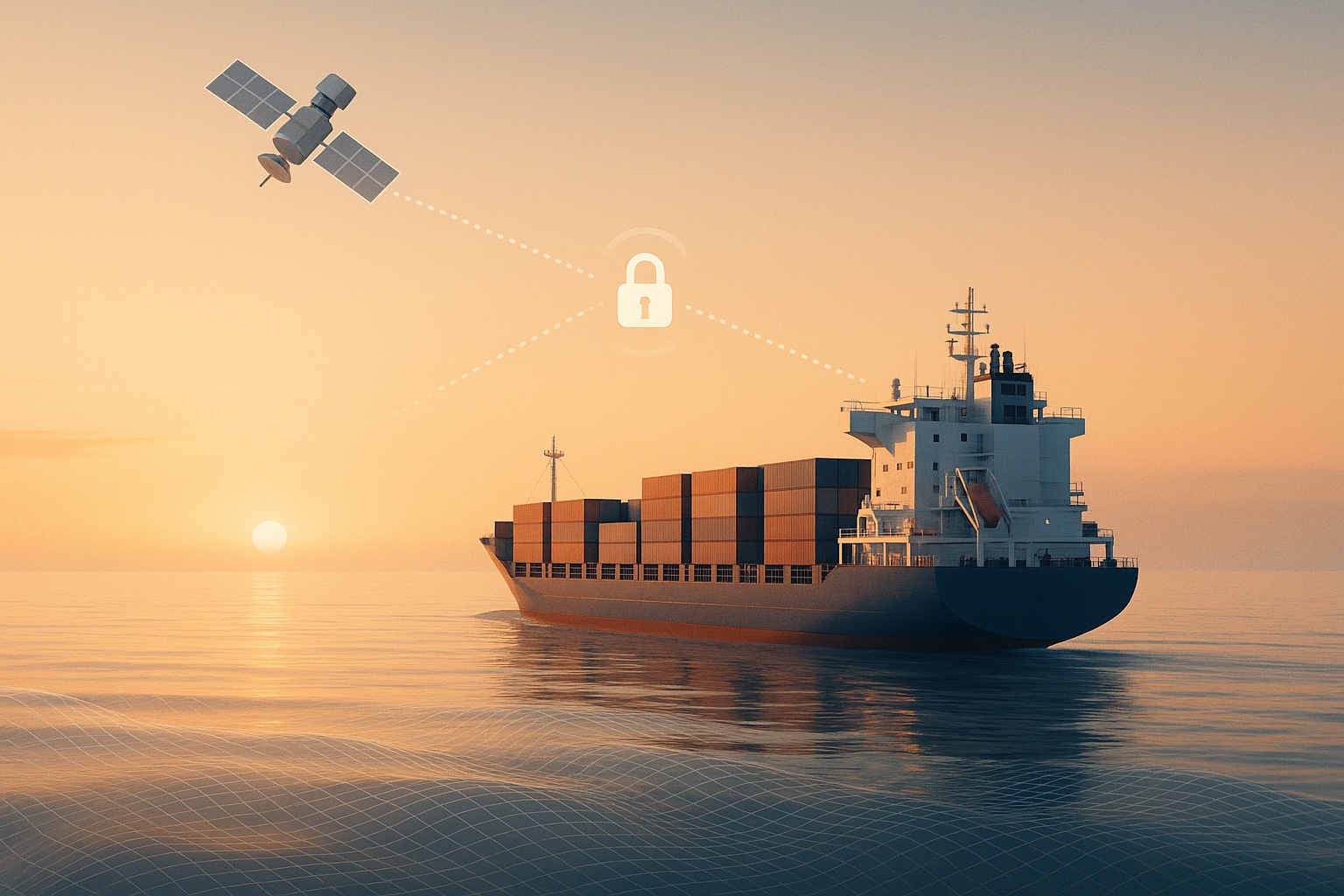
Beyond connectivity, NT Maritime offers unified communication tools for passengers and crew. These include onboard calling, messaging, video calls, and voicemail – all running on the same secure network infrastructure used for fleet management. This streamlined approach reduces complexity while ensuring that operational data, crew coordination, and passenger services benefit from a reliable and high-bandwidth communication backbone.

Conclusion

Real-time data has become a game-changer for cruise fleet management, offering operators key advantages that directly impact their bottom line. By using integrated platforms, fleets can achieve better operational efficiency through smarter routing, enhanced safety and compliance via continuous monitoring and automated reporting, and higher revenue thanks to centralized point-of-sale systems that enable dynamic pricing and personalized promotions. These improvements often result in a quick return on investment, driven by noticeable savings in fuel costs, fewer incidents, and increased per-passenger spending.

For mid-size fleets, the financial impact is substantial. Real-time tracking and analytics can save millions annually by enabling proactive maintenance, which minimizes unplanned downtime, and by optimizing labor allocation. Onboard, real-time hospitality data allows headquarters to instantly adjust offers and inventory, reducing waste while boosting sales. Take, for example, a mid-size cruise line that implemented real-time fleet monitoring and POS synchronization across a dozen ships. The result? A double-digit increase in onboard retail revenue during key sailings, plus real-time alerts that helped shore-based experts prevent a machinery failure, avoiding costly downtime.

None of this would be possible without reliable connectivity. Advances in low-earth-orbit satellite technology and hybrid connectivity models now make continuous, real-time synchronization feasible across entire fleets. This shift transforms outdated end-of-day batch uploads into seamless, cloud-connected operations. Companies like NT Maritime provide the secure communication networks, high-speed internet, and integrated voice, messaging, and video tools necessary to support these data flows and ensure uninterrupted coordination between crew and passengers.
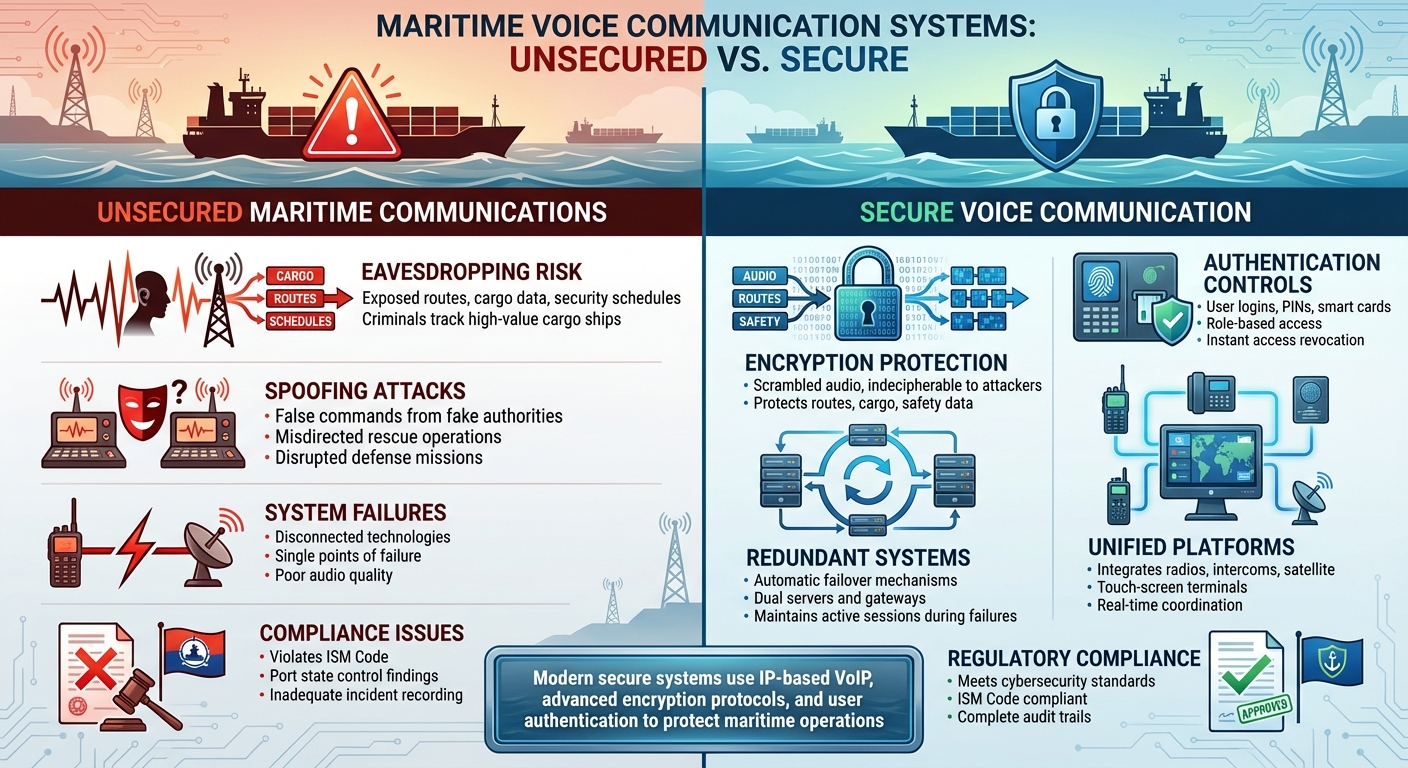
For operators looking to take the next step, the path forward is clear. Start by auditing current shipboard systems and connectivity to identify gaps between batch and real-time operations. Focus on high-impact areas – like fleet-wide performance dashboards, maintenance monitoring, or centralized POS systems – for quick, measurable wins. Test real-time platforms on a small group of ships to validate data accuracy and crew workflows before expanding fleet-wide. Finally, ensure alignment across IT, marine operations, and commercial teams with shared performance metrics. Adopting these real-time systems is no longer optional – it’s essential to staying competitive in the ever-evolving cruise industry.
FAQs

How do cruise ships protect data during real-time communication?

Cruise ships take significant measures to protect data during real-time communication by utilizing secure communication systems and cutting-edge IT solutions. These measures include encryption protocols to shield sensitive information, strict access controls to limit who can view or modify data, and secure transmission channels to ensure privacy during exchanges.

For instance, many maritime communication providers develop systems that focus on both data protection and consistent connectivity. This dual focus helps block unauthorized access while ensuring smooth operations for passengers, crew, and fleet management alike.

How do satellite systems support cruise ship operations?

Satellite systems are essential for keeping cruise ships connected to shore-based operations, no matter how remote their location. They enable real-time data sharing crucial for navigation, fleet coordination, and safety monitoring, ensuring everything runs smoothly.

These systems also improve communication for both passengers and crew by providing dependable onboard calling, messaging, and internet access. By supporting these critical functions, satellite systems play a key role in maintaining the efficiency and safety of cruise ship operations.

How does real-time data help keep passengers safe on cruise ships?

Real-time data is a game-changer when it comes to keeping passengers safe on cruise ships. It enables quick communication and smooth coordination among crew members, which means emergencies can be addressed faster. This swift response helps reduce risks and ensures the safety and well-being of everyone onboard.

Beyond emergencies, real-time data also plays a key role in health management. It supports efforts like contact tracing and managing access to certain areas, which can help stop illnesses from spreading. By using these technologies, cruise operators can provide a safer, more secure experience for both passengers and crew.

How Satellite Latency Affects Maritime Operations

Satellite latency is the delay in data transmission between vessels and remote systems due to the distances signals travel to and from satellites. For maritime operations, this delay impacts navigation, safety, fleet management, and onboard services. Key points:

  • GEO vs. LEO Satellites: Geostationary (GEO) satellites have higher latency (250–600+ ms) due to their 22,000-mile orbit, while Low Earth Orbit (LEO) satellites offer lower latency (70–100 ms in ocean areas) because they orbit closer to Earth.
  • Challenges at Sea: Harsh weather, ship movement, and satellite handoffs increase latency, causing issues like delayed GPS updates, slow telemetry data, and unreliable communication services.
  • Solutions: Multi-orbit systems (GEO + LEO), onboard traffic management, and optimized protocols help reduce latency. NT Maritime specializes in such systems, prioritizing critical operations while improving crew and passenger connectivity.

Quick Takeaway:

Lowering satellite latency with LEO satellites, traffic prioritization, and smart network design ensures smoother maritime operations, safer navigation, and better onboard experiences.

GEO vs LEO Satellite Latency Comparison for Maritime Operations

GEO vs LEO Satellite Latency Comparison for Maritime Operations

What Causes Satellite Latency in Maritime Networks

Satellite Orbits and Signal Distance

The main reason for satellite latency is the distance signals need to travel. Geostationary (GEO) satellites, positioned much farther from Earth, naturally introduce more latency compared to Low Earth Orbit (LEO) satellites. LEO satellites, orbiting just a few hundred to about 1,200 miles above the planet, can reduce latency to around 25–60 milliseconds on land and about 70–100 milliseconds in remote ocean regions. To address this, NT Maritime uses multi-orbit systems, which combine GEO’s wide coverage with LEO’s low latency. For instance, they route critical tasks like navigation updates and remote diagnostics through LEO, while bulk data transfers are handled by GEO. Essentially, the satellite’s altitude and the distance signals must travel play a crucial role in the overall performance of maritime networks.

Environmental Factors at Sea

Environmental challenges at sea add another layer of complexity to managing latency. Ships navigating rough waters rely on stabilized antennas to maintain satellite connections. However, misalignments caused by obstructions or the mechanical limits of these systems can lead to brief outages, forcing retransmissions that increase latency. Additionally, severe weather, such as heavy rain or storms, can weaken signals on higher-frequency Ku- and Ka-band links. This often forces systems to switch to lower modulation schemes, which come with higher error rates. During such conditions, latency spikes and reduced throughput are common, as local rain fade disrupts the initial connection between the ship and the satellite.

Network Design and Application Requirements

The design of maritime satellite networks also impacts latency. Many services use shared bandwidth models, meaning multiple vessels compete for resources on the same beam or carrier. During peak usage times, this competition can lead to network congestion, causing latency and jitter to rise. For applications like VoIP and video conferencing, this can result in awkward delays and choppy communication when round-trip times exceed 300–400 milliseconds. Meanwhile, critical systems such as navigation and remote vessel controls demand latencies under 50 milliseconds to function safely and efficiently. While IoT telemetry for tasks like engine monitoring and fuel optimization can handle higher latency, performance may degrade when protocols requiring quick acknowledgments face congested, high-delay links. Without proper onboard traffic prioritization and Quality of Service (QoS) measures, non-essential activities like streaming or guest Wi-Fi can overwhelm the network, leaving vital systems struggling for bandwidth.

How Latency Affects Maritime Operations

Satellite latency has a direct impact on maritime operations, particularly in navigation and safety systems. GEO satellites, for example, can introduce delays ranging from 250 ms to 800 ms. This lag can slow the delivery of crucial GPS updates, collision avoidance alerts, and emergency communications. When shore-based teams or remote pilots rely on live video feeds and real-time data to guide vessels through congested areas or narrow channels, even minor delays can jeopardize safe navigation.

Outdated weather updates and chart corrections add to the risks. Ships operating with old information face a higher chance of collisions or groundings, especially in busy shipping lanes or during rapidly changing conditions. Emergency coordination also becomes more challenging, as delays in distress signals or inter-vessel communication can slow down critical response efforts.

Fleet Management and IoT Systems

Latency also disrupts fleet management by delaying the transmission of telemetry data essential for real-time decisions. Key tasks like monitoring engine performance, optimizing fuel usage, and performing predictive maintenance rely on timely sensor updates. Delays in this data can prevent maintenance teams from addressing issues quickly, leading to higher operational costs and unplanned downtime.

Additionally, high latency hampers real-time tracking of vessels and cargo, complicating route planning and performance analysis. These delays not only affect fleet efficiency but also degrade the overall quality of communication across the network, making it harder to maintain seamless operations.

Crew and Passenger Services

For crew and passengers, high latency takes a toll on communication and internet services. Video calls, VoIP, and onboard internet become unreliable, negatively impacting crew morale and passenger satisfaction. These connectivity issues highlight the importance of prioritizing onboard traffic to ensure that critical systems remain unaffected.

Without effective traffic management and Quality of Service (QoS) policies, passenger Wi-Fi usage can overwhelm the network, disrupting essential bridge systems and operational communications. To address these challenges, NT Maritime offers integrated communication solutions tailored for maritime environments. Their systems prioritize traffic and use low-latency connectivity to ensure reliable performance for both mission-critical operations and crew welfare, including onboard calling, messaging, and video services.

How to Reduce Satellite Latency in Maritime Operations

Network Architecture Improvements

Switching from GEO (geostationary) satellites to LEO (low Earth orbit) satellites can significantly lower latency. For reduced-crew vessels, having communications networks with round-trip latency under 50 milliseconds is critical to ensure safe operations. This is why multi-orbit systems, which combine both types of satellites, are becoming increasingly important.

Multi-orbit connectivity takes advantage of the strengths of both GEO and LEO satellites. By using a combination of GEO satellites with software-defined capabilities and low-latency LEO satellites, shipping companies can optimize their communication networks. LEO satellites handle time-sensitive tasks like real-time navigation and collision avoidance, while GEO satellites cover broader areas and act as a backup. With dynamic network orchestration, the system automatically routes critical data through the fastest available connection, ensuring the lowest possible latency in real time. This software-driven approach makes connectivity more responsive, adapting to changing operational needs.

To build on these improvements, effective onboard traffic management is key to minimizing latency’s impact.

Onboard Traffic Management and QoS Policies

Managing onboard traffic effectively ensures that latency-sensitive tasks, such as navigation and safety systems, are not disrupted. This requires traffic segmentation and QoS (Quality of Service) prioritization. Ships can achieve this by setting up separate VLANs for bridge and safety systems, business operations, and crew or passenger services. Operators should also establish strict QoS limits for non-critical services and guest devices to prevent them from using bandwidth needed for essential systems like engine monitoring and emergency operations.

Another strategy is local caching, which stores frequently used data – such as charts, weather updates, and software patches – onboard. This reduces the need for repeated satellite communication, improving overall performance for users at sea. NT Maritime integrates these principles into their communication systems, prioritizing mission-critical operations while also supporting crew welfare with reliable services for calling, messaging, and video.

Application and Protocol Optimization

Beyond network and traffic strategies, optimizing applications and protocols can further enhance performance. Using protocols like QUIC and HTTP/3 can reduce handshake delays and increase throughput on high-latency links. For VoIP and video applications, adaptive codecs with jitter buffers and error correction help maintain quality even when latency varies.

WAN acceleration tools designed for satellite environments offer additional benefits. These tools provide TCP acceleration, compression, and application-specific tweaks to enhance responsiveness for remote desktops, VPNs, and cloud-based dashboards. Operators should test network performance under real-world conditions, as satellite links often exceed 100 milliseconds of latency. Real-time monitoring systems can track link quality and congestion, automatically adjusting bandwidth allocation when performance drops. This proactive management ensures that latency-sensitive services remain reliable, aligning with NT Maritime’s goal of maintaining resilient and efficient communications for maritime operations.

Starlink Maritime

Conclusion: Planning for Low-Latency Maritime Connectivity

Planning for low-latency maritime connectivity has become a priority as satellite latency directly impacts navigation, decision-making, and operational efficiency. Traditional GEO links introduce delays of over 250 ms, while LEO and multi-orbit systems significantly lower latency to 70–100 ms.

To adapt, maritime operators need a robust connectivity roadmap. This roadmap should sync vessel upgrades, contract renewals, and digital initiatives with specific latency and uptime goals. Start by identifying latency-sensitive applications and assessing the potential benefits of LEO or hybrid GEO–LEO systems.

Evaluate the performance of existing networks by measuring latency, jitter, and uptime across current routes. Use this data to perform a gap analysis and consider piloting LEO or hybrid solutions on select vessels to test their effectiveness before committing to a full-scale rollout.

Reliable connectivity also requires balancing low latency with redundancy. To ensure uninterrupted communication during outages, diversify satellite paths, establish clear fallback protocols, and strengthen cybersecurity. This includes secure network architectures, segmentation, and regular managed updates. These steps help create resilient networks capable of supporting critical operations.

NT Maritime offers multi-orbit network solutions designed to meet these demands. Their secure, IoT-ready systems enable real-time monitoring, remote maintenance, and improved onboard communication across commercial, cruise, and government or military fleets. Collaborating with NT Maritime early allows operators to co-develop a tailored roadmap that incorporates multi-orbit connectivity, onboard network upgrades, QoS policies, and application optimization – all aligned with the unique needs and budgets of their fleets.

FAQs

How do multi-orbit satellite systems benefit maritime communication?

Multi-orbit satellite systems bring a new level of reliability to maritime communication by leveraging the advantages of various satellite orbits. This approach ensures wider coverage, faster response times, and more consistent connectivity. Ships can stay connected with stable, high-speed internet, even in the most remote or demanding locations.

These systems are designed to enable smooth transitions between different satellite networks, minimizing delays and ensuring real-time data transfer. This is crucial for essential maritime tasks such as navigation, communication, and safety operations. Their ability to maintain uninterrupted service makes them an essential tool for modern maritime connectivity.

What challenges does satellite latency pose for maritime operations?

Satellite latency, particularly with Geostationary Earth Orbit (GEO) satellites, poses notable challenges for maritime operations. The sheer distance that signals must cover leads to delays, which can interfere with real-time communication and slow down critical decision-making.

These delays affect various aspects of maritime activities, including navigation updates, crew communication, and passenger services. This can ultimately hinder operational efficiency. To tackle these issues, advanced communication technologies are often needed to reduce latency and ensure more seamless operations while at sea.

How can maritime operators manage traffic to minimize the effects of satellite latency?

Maritime operators can tackle satellite latency issues by using Quality of Service (QoS) protocols. These protocols prioritize essential communication tasks – like navigation updates or emergency signals – so they get more bandwidth and experience fewer delays.

Another effective strategy is traffic shaping, which helps allocate bandwidth based on operational needs. By doing this, critical systems stay functional even when network demand is high. Optimizing traffic flow ensures that communication remains steady and dependable, no matter the conditions at sea.

Why Ships Need Secure Voice Communication

Ships face serious risks without secure voice communication. Outdated systems leave vessels vulnerable to eavesdropping, spoofing, and failures, which can result in safety hazards, disrupted operations, and even national security threats. Modern secure voice solutions solve these problems by encrypting conversations, ensuring only authorized personnel can access critical communications, and maintaining reliability even in emergencies.

Here’s why secure voice communication is essential for maritime operations:

  • Prevents Eavesdropping: Encryption protects sensitive information like routes, cargo data, and safety instructions from being intercepted by malicious actors.
  • Thwarts Spoofing: Authentication ensures only verified parties can send or receive instructions, reducing risks of false commands or misdirection.
  • Improves Reliability: Redundant systems and failover mechanisms keep communication lines open during hardware or network failures.
  • Streamlines Operations: Unified platforms integrate radios, intercoms, and satellite links, simplifying coordination between crew, ports, and shore teams.
  • Ensures Compliance: Modern systems meet cybersecurity and safety standards, helping operators avoid regulatory penalties.

For U.S. waters and defense missions, these systems are especially critical to safeguard patrol routes, logistics, and mission plans. Companies like NT Maritime provide encrypted, reliable solutions tailored to various vessel types, ensuring safe and efficient communication at sea. Investing in secure voice communication is a smart move to protect your crew, cargo, and operations.

Risks of Unsecured vs Benefits of Secure Maritime Voice Communication

Risks of Unsecured vs Benefits of Secure Maritime Voice Communication

What Is Secure Voice Communication in Maritime Operations?

Defining Secure Voice Communication

Secure voice communication in maritime operations involves protecting voice calls through encryption, authentication, and a resilient network setup. This ensures conversations remain private and protected from interception, tampering, or disruptions while at sea. Unlike older shipboard systems that rely on analog radios or outdated PBX setups without strong encryption, modern secure systems use IP-based VoIP technology, advanced encryption protocols, and user authentication to restrict access to authorized personnel only.

These systems are built on a fast and reliable network framework that integrates both voice and data channels, eliminating single points of failure. For example, redundant VoIP gateways automatically take over in the event of a failure, allowing active sessions to continue without interruption. This design is particularly crucial for vessels operating in remote areas, where equipment breakdowns could compromise safety. Such a setup supports a wide range of communication needs, both within the ship and with external entities.

Common Uses of Secure Voice Communication

Secure voice systems serve a variety of critical functions, both onboard and in external communications. Internally, they facilitate intercom communication between key areas like the bridge, engine room, cargo hold, security posts, and medical centers. These systems allow crews to coordinate navigation, engineering tasks, and safety operations during maneuvers, cargo handling, or emergency drills, with access limited to authorized participants. Integration with emergency and public address systems ensures that urgent messages are delivered instantly and securely to all relevant zones, originating only from verified sources.

Externally, secure voice communication connects ships with ports and harbor authorities for tasks like pilotage, tug coordination, and berthing instructions, often using VHF radio and integrated telephony. It also enables communication between vessels for collision avoidance or search-and-rescue efforts, with aircraft during inspections or transfers, and with shore-based operations centers via SATCOM and long-range radio. These channels often carry sensitive commercial data – such as routes, cargo details, and schedules – as well as critical safety information like distress signals and hazard alerts. Encryption and authentication ensure that only legitimate parties can access these communications and that instructions remain intact, preventing interference from potential adversaries.

NT Maritime‘s Secure Voice Solutions

NT Maritime

NT Maritime offers advanced secure communication solutions for commercial, cruise, and government or military vessels. Their systems provide encrypted onboard calling, messaging, video calls, and voicemail over ship WiFi. Specifically designed for federal and military use, these systems are built to withstand cyber threats while meeting strict compliance standards required for mission-critical operations.

The platform supports a variety of call types, including App-to-App calls, App-to-Ship PBX calls, Ship PBX-to-App calls, and App-to-Off-Ship calls. This flexibility allows crew members and passengers to coordinate internally and communicate seamlessly with shore-based teams. For cruise ships, NT Maritime also integrates features like Hotel-to-Guest and Guest-to-Guest calling, ensuring that operational and safety channels remain secure and isolated from guest communication systems. By uniting voice, data, and messaging on a single, secure network, NT Maritime helps vessels maintain clear and protected communication across all operations, both onboard and external. These capabilities address the vulnerabilities and risks mentioned earlier, highlighting the importance of modern, secure communication systems in ensuring maritime safety.

Leonardo DRS SHINCOM Shipboard Integrated Communications

Leonardo DRS

Risks of Unsecured Maritime Communications

Understanding how secure systems work is just one side of the coin. It’s equally important to grasp the dangers posed by unsecured maritime communications.

Cybersecurity Threats: Interception and Spoofing

When maritime communications aren’t encrypted, they become an open book for anyone to intercept. This can expose critical details like vessel positions, route changes, security schedules, cargo information (measured in U.S. dollars), and even technical vulnerabilities that might be casually discussed over open channels.

Attackers can take advantage of this by spoofing trusted sources – think port authorities or the coast guard. This tactic can mislead crews into making course adjustments, misdirect rescue operations, or even disrupt defense missions. For instance, during U.S. government or military operations, spoofed instructions could delay responses, scatter formations, or push a vessel into a strategically weaker position.

There are documented cases where criminals have exploited open marine radio traffic to track high-value cargo ships or tankers, time their attacks, or target less-defended vessels. Security drills have also shown how false radio transmissions on coastal channels can create chaos – triggering false alarms, misdirecting patrols, and throwing off critical operations in U.S. ports.

Inefficiencies from Outdated Systems

Many maritime communication systems rely on outdated, disconnected technologies for radio, intercom, telephone, and PA systems. This lack of integration slows down the flow of information and increases the chances of miscommunication – especially during emergencies. Without a unified communication platform, it’s difficult to coordinate between the bridge, engine room, cargo hold, and shore, or to monitor multiple channels from a single interface.

Older analog systems and a mishmash of legacy equipment often come with poor audio quality, inconsistent user interfaces, and limited functionality. Crew members are left to memorize complex procedures and channel plans for different devices. In high-pressure situations, like emergencies or heavy traffic, this can lead to dialing the wrong party, missing critical calls, or misinterpreting instructions due to static or poor sound clarity.

Safety and Regulatory Compliance Issues

Emergencies – whether it’s a fire, flooding, collision, or medical crisis – demand reliable communication. But non-redundant systems can fail when they’re needed most, cutting off essential coordination and putting lives at risk. Without backup IP networks, a single hardware failure or broken link can sever both radio and internal voice communications.

Regulators and industry standards are increasingly emphasizing the importance of secure and dependable communication systems as part of broader safety and cybersecurity protocols. Using unencrypted links to handle sensitive operational information can violate evolving maritime cybersecurity guidelines and the International Safety Management (ISM) Code. This could lead to negative findings during audits or inspections by port state control. Furthermore, inadequate recording capabilities, lack of system redundancy, and frequent outages can complicate incident reporting and evidence collection after accidents or security breaches.

These vulnerabilities underscore the pressing need for secure, modern communication systems to ensure safer, more efficient maritime operations.

How Secure Voice Communication Solves Maritime Problems

Now that we’ve explored the risks, let’s shift focus to how secure voice communication tackles these challenges head-on with encryption, unified platforms, and emergency-ready systems.

Enhanced Security with Encryption and Authentication

Encryption ensures voice traffic remains private, scrambling audio so only devices with the right keys can decode it. Modern encryption methods render intercepted data useless, whether it’s RF, satellite, or IP traffic. For attackers, this means capturing nothing but indecipherable noise, which greatly reduces the chances of espionage or data breaches.

Authentication tools like user logins, PINs, smart cards, and role-based access controls add another layer of security. Centralized management consoles oversee access, allowing administrators to track login attempts, configure user roles, and instantly revoke access if a device is lost or a crew member rotates out. This proactive approach plugs potential security gaps in daily operations.

Smoother Operations with Unified Communication Platforms

Security isn’t the only benefit – unifying communication channels boosts operational efficiency. Modern maritime communication platforms bring together analog and IP radios, telephones, intercoms, and satellite links into one manageable system. Crews can access all these channels through intuitive touch-screen terminals, simplifying tasks like switching between VHF/UHF radios, internal intercoms, or external phone calls.

Server-based VoIP gateways bridge the gap between analog radios, older telephony systems, and modern IP voice services. This seamless integration allows crew members, pilots, harbor authorities, and shore operations to connect without the hassle of manual patching. For complex operations like docking, cargo handling, or launching smaller vessels, this unified approach ensures the engine room, deck, and bridge stay in sync with real-time, clear communication.

By unifying systems, these platforms also create a solid foundation for emergency communications.

Reliable Support During Emergencies

In critical situations, integrated systems prioritize distress calls and automatically switch to backup servers to ensure communication remains uninterrupted, even in extreme conditions. With a single console, the bridge can coordinate with all key teams, minimizing confusion. Emergency protocols – like prioritizing mayday or distress calls – ensure vital messages cut through and avoid congestion, even when bandwidth is stretched thin.

Redundant networks add another layer of reliability, keeping communication lines open during system failures. Ruggedized terminals and loudspeakers are built to withstand intense conditions like high noise, vibration, salt spray, and humidity. These systems deliver clear audio, whether on deck, in the engine room, or in exposed areas. For demanding tasks like boarding operations or coordinating between the main ship and smaller vessels (RHIBs) in noisy, high-salinity environments, tactical headsets and loudspeakers ensure real-time command and control remains intact.

Steps to Implement Secure Voice Communication on Ships

Evaluating Current Communication Infrastructure

Start by taking stock of all the voice communication devices on board, such as bridge phones, intercoms, radios, PA/GA systems, satellite phones, and softphones. Document each device’s specifications and software versions. Then, map out all communication pathways – whether they’re ship-to-ship, ship-to-shore, ship-to-air, or internal channels. Determine which systems use IP protocols, which are analog, which operate on radio frequencies, and whether any form of encryption is already in place.

Look for system redundancies to identify potential single points of failure, such as servers, gateways, or power supplies. Check if there are redundant pathways or automatic failover mechanisms. Additionally, review access controls for consoles, network segmentation, and compliance with regulatory voice recording requirements.

If your systems already support IP-based protocols like SIP, can connect to VoIP gateways, and are compatible with external encryption devices, they are ready for secure integration. However, if you’re dealing with outdated analog hardware that lacks vendor support, has no encryption, or experiences frequent outages affecting safety operations, a complete replacement may be necessary.

This thorough evaluation lays the groundwork for designing a secure and reliable communication system.

Designing and Deploying Secure Solutions

When designing secure communication systems, focus on four key principles: encryption, redundancy, interoperability, and survivability. These address both cybersecurity concerns and operational challenges. Start by encrypting all voice traffic across the ship’s LAN, satellite connections, and shore links. Build redundancy into the system with dual communication servers, backup VoIP gateways, and mirrored databases to ensure active sessions are preserved during hardware or connection failures.

Use open-standard protocols like SIP-based VoIP, which integrate smoothly with existing radio and satellite systems while maintaining secure communication channels. For hardware, select ruggedized terminals that meet Defense Standards (DEF-STAN) or MIL-STD specifications, ensuring durability against harsh conditions like vibration, salt spray, and electromagnetic interference – especially in exposed or high-risk areas like the engine room.

Roll out the system in phases, starting with pilot tests and staggered deployments during maintenance windows. Keep legacy systems operational as temporary backups during the transition. Centralized configuration tools can simplify the process, allowing call flows, user roles, and encryption policies to be quickly duplicated across multiple ships.

Crew training is essential. Provide role-specific training for bridge teams, engineers, security personnel, and medical staff. Conduct drills that simulate real-world scenarios, such as server outages, switching to backup channels, initiating group calls, or using secure communication during emergencies like fires or collisions. Simplified touch-screen interfaces and unified consoles can reduce training time from weeks to just a few days, which is particularly important for rotating crews. Secure voice procedures should also be integrated into the ship’s Safety Management System to ensure they are regularly audited and updated.

How NT Maritime Supports Implementation

Once a secure system design is finalized, the next step is smooth implementation, and this is where NT Maritime excels. Their approach ensures both system integrity and operational continuity.

NT Maritime begins by assessing existing onboard networks and communication hardware. They identify opportunities to integrate secure voice services alongside Telehealth and crew or passenger communication tools, all while maintaining logical separation on a high-speed backbone. Their designs combine onboard calling, messaging, video calls, and voicemail with secure voice capabilities tailored to the needs of cruise lines, commercial fleets, and government or military vessels.

During deployment, NT Maritime provides preconfigured equipment and manages the project to align with vessel schedules. They also offer structured crew training and detailed documentation to ensure a smooth transition. Post-deployment, NT Maritime delivers round-the-clock support, monitoring, and regular security reviews to keep encryption standards, firmware, and configurations up to date. Operators can confidently expand services, such as adding new Telehealth features or crew tools, without compromising the security or reliability of the core voice communication system.

Conclusion

Secure voice communication plays a critical role in ensuring safety, efficiency, and compliance in maritime operations. Outdated systems leave vessels vulnerable to interception, spoofing, and system failures. In contrast, modern IP-based, encrypted voice platforms address these risks while seamlessly connecting bridge, engine room, and shore communications. These platforms are designed to remain operational even during hardware or connection failures, offering a reliable solution for today’s maritime challenges.

For U.S. operators managing vessels worth millions, the cost of implementing secure voice infrastructure is a fraction of the potential losses from collisions, cargo damage, or cyberattacks. Encrypted communication systems not only enhance security but also streamline workflows, reducing delays and errors while improving fleet oversight. During emergencies like distress calls, man-overboard situations, or fires, secure voice systems provide dependable, clear coordination – often the deciding factor between successful outcomes and operational setbacks. This level of reliability builds trust in secure communication systems when they are needed most.

"Secure communications for federal and military deployments ensure encrypted, reliable, and real-time information exchange. Built to withstand cyber threats, we support mission-critical operations with robust protection and compliance." – NT Maritime

To safeguard your operations, start by assessing communication risks and defining your needs based on vessel type and regulatory requirements. Collaborate with maritime communication experts like NT Maritime to develop a secure, unified system. Your plan should include encryption, redundancy, long-term voice recording, and compatibility with existing radios and IT networks. By investing in secure voice communication, you prepare your fleet for current challenges and future advancements, such as enhanced monitoring and telehealth services, ensuring the safety of your crew, cargo, and reputation.

Vessels equipped with secure, unified communication systems can navigate today’s complex maritime environment with confidence, meeting regulatory requirements while laying the groundwork for the next generation of digital operations.

FAQs

How does secure voice communication protect shipboard conversations from being intercepted?

Secure voice communication ensures that conversations on ships remain private by encrypting voice data, making it unintelligible to anyone without proper authorization. Additionally, it incorporates strong authentication protocols to confirm that only approved personnel can access the communication channels. This dual-layer of protection helps keep sensitive information confidential and strengthens overall operational security onboard.

What makes NT Maritime’s secure voice solutions essential for maritime operations?

NT Maritime offers secure voice solutions tailored to the demanding environment of maritime operations. With encrypted communication, these services enable passengers and crew to stay connected through onboard calling, messaging, and video calls, ensuring smooth and secure interactions even while at sea.

By protecting sensitive information from potential breaches and enhancing operational workflows, these solutions play an essential role in both commercial and government or military maritime missions.

Why is it important to modernize maritime communication systems?

Modernizing communication systems in the maritime industry is crucial for protecting sensitive information, boosting efficiency, and maintaining reliable connectivity for essential services like emergency response and Telehealth. Relying on outdated systems increases the risk of data breaches and communication breakdowns, which can jeopardize both safety and productivity on board.

By upgrading to modern solutions, vessels gain access to secure and dependable voice communication, along with advanced tools designed specifically for maritime operations. These improvements not only streamline day-to-day activities but also enhance safety measures for both the crew and passengers.