

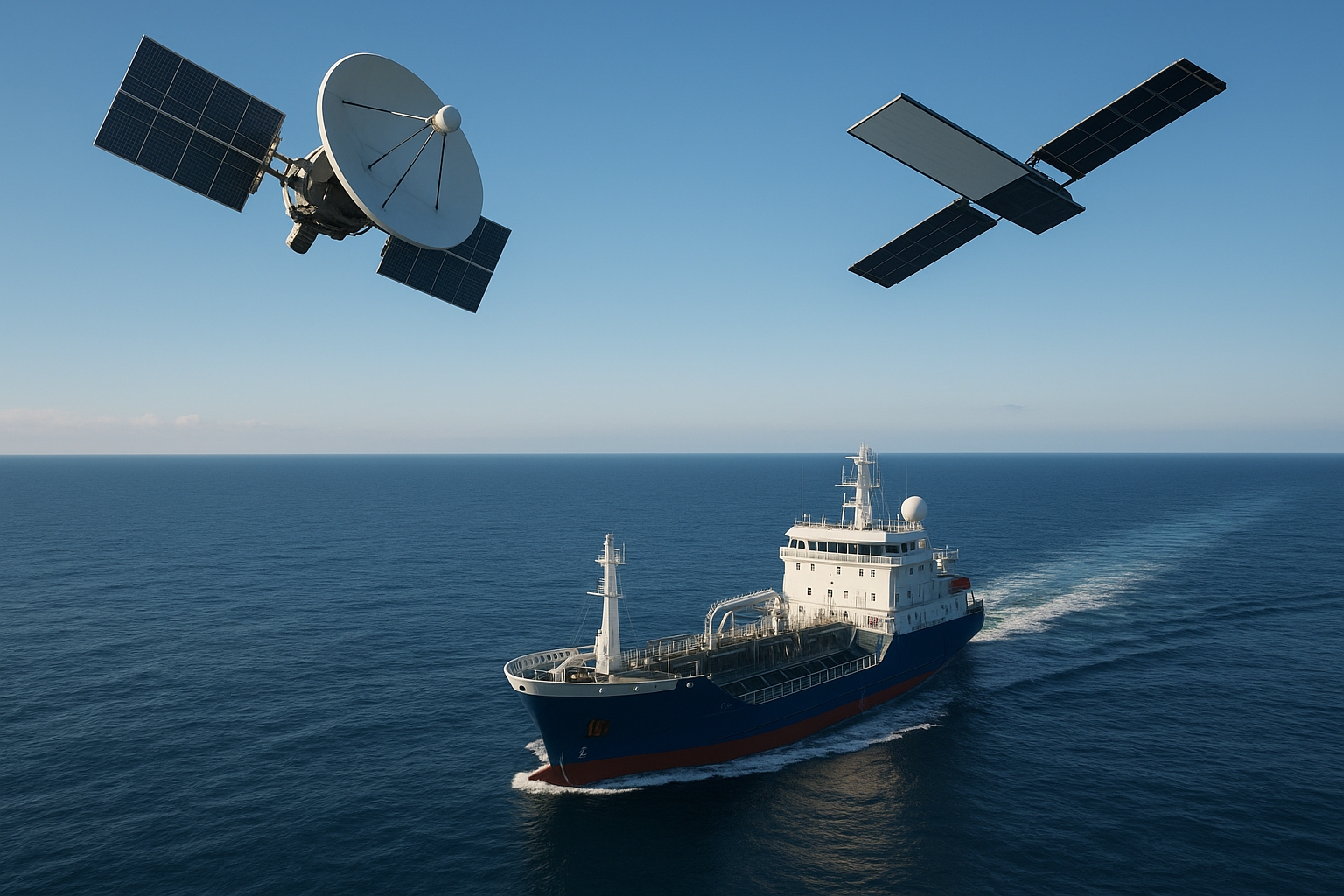
Choosing between VSAT and Starlink for maritime internet depends on your vessel’s needs. VSAT offers broad global coverage and proven reliability, while Starlink provides faster speeds and lower latency, especially near coastal regions. Here’s a quick breakdown:
- VSAT: Reliable for global routes, with slower speeds (1–50 Mbps) and high latency (600+ ms). Costs include $10,000–$60,000 for equipment and $500–$2,000 monthly fees.
- Starlink: Faster (100–350 Mbps), lower latency (20–40 ms), and more affordable upfront ($2,500–$10,000). Coverage is growing but limited in polar and remote waters.
Quick Comparison
| Feature | VSAT | Starlink |
|---|---|---|
| Latency | 600+ ms | 20–40 ms |
| Speed | 1–50 Mbps | 100–350 Mbps |
| Coverage | Near-global | Expanding, limited in some areas |
| Cost (Equipment) | $10,000–$60,000 | $2,500–$10,000 |
| Monthly Fees | $500–$2,000+ | $250–$500 |
For cruise ships, Starlink’s speed is ideal, but VSAT remains a dependable backup. Cargo vessels often rely on VSAT for its reliability on major routes. Yachts may prefer Starlink for affordability near coasts, with VSAT for global travel.
A hybrid approach – using both systems – is often the best solution for uninterrupted connectivity.
Welcome to Starlink Maritime: Bye Bye Vsat
VSAT for Maritime Communication
VSAT has been a key player in maritime satellite communication since it debuted in 1986. Over the years, this technology has transformed from a specialized solution into a critical service that enhances crew connectivity and boosts operational efficiency for global shipping. Below, we’ll explore how VSAT works, its features, and the costs involved in maritime applications.
How VSAT Works
VSAT relies on geostationary (GEO) satellites stationed roughly 22,369 miles (36,000 km) above the Earth’s equator. These satellites stay aligned with Earth’s rotation, forming a stable communication link between vessels and ground-based networks. Data is transmitted from the ship to the satellite and then to a ground station, where it connects to the internet or private networks.
A stabilized antenna on the vessel continuously tracks the satellite, ensuring a steady connection even at speeds of up to 30 knots. This precise tracking is why VSAT is known for its high reliability. The system includes two main components: the Above Deck Unit, which houses the dish, tracking mechanism, and protective radome, and the Below Deck Unit, which contains the modem, router, and control systems.
VSAT Features and Capabilities
Maritime VSAT provides coverage anywhere with a clear view of the sky, making it suitable for international shipping routes, cruises, and offshore operations. Depending on the equipment and service plan, it can deliver data speeds ranging from 4 kbit/s to 16 Mbit/s.
One of VSAT’s standout strengths is its reliability, with uptime rates often exceeding 99.9%. Service Level Agreements (SLAs) ensure minimum speeds and predictable costs, helping operators manage their budgets effectively.
VSAT operates across three primary frequency bands, each with its own characteristics:
- C-band (4–8 GHz): Known for its resilience in heavy rain, though it offers lower data speeds.
- Ku-band (12–18 GHz): A popular choice that balances affordability and coverage, though rain can affect its performance.
- Ka-band (26.5–40 GHz): Offers faster speeds, making it ideal for data-heavy applications, but its coverage can be less consistent under certain conditions.
However, VSAT does have its challenges. The distance to GEO satellites introduces a latency of about 250 milliseconds, with additional delays of 300 to 500 milliseconds due to protocol processing. These limitations are worth considering alongside its many advantages.
VSAT Costs and Installation
VSAT technology comes with a notable price tag. Basic systems start at around $10,000, while advanced setups can cost over $60,000. Installation typically adds another $5,000 to $10,000 to the total expense.
The size of the antenna plays a major role in both performance and cost. Most maritime VSAT antennas measure between 30 and 47 inches in diameter, while larger C-band systems can reach up to 94 inches. Bigger antennas generally offer better signal strength and faster data rates but require more deck space and structural support.
Monthly service fees usually range from $500 to $2,000 or more, depending on the data plan and SLA. Additionally, annual maintenance costs – covering routine inspections, software updates, and minor repairs – typically fall between $500 and $1,500.
Starlink for Maritime Communication
Introduced in 2022, Starlink Marine leverages a network of low Earth orbit (LEO) satellites to reshape maritime communication. Unlike traditional VSAT systems that depend on far-off geostationary satellites, Starlink’s LEO setup brings a new level of efficiency to the table.
How Starlink Works
Starlink satellites orbit much closer to Earth – around 340 miles – compared to the roughly 22,000-mile distance of geostationary satellites used by VSAT. This proximity enables faster connections. Vessels connect to the nearest satellite, which then relays data through a network of ground stations, or gateways. As satellites move across the sky, the system ensures uninterrupted service by automatically switching connections through a process called handover.
The terminals use phased array antennas, which electronically adjust their beams to track satellites. Their flat-panel design minimizes wind resistance, making them well-suited for maritime conditions. These features are key to Starlink’s performance, which stands out in several areas.
Starlink Features and Capabilities
Starlink delivers lower latency, making it ideal for real-time tasks like video conferencing and VoIP calls on ships. Download and upload speeds can vary depending on location and network conditions, but they often surpass those of traditional systems.
The network is continually growing, now covering many major shipping routes. However, coverage in polar regions remains limited for now. Local regulations in certain territorial waters may require terminals to deactivate temporarily, leading to occasional service interruptions. Additionally, heavy rain can sometimes weaken signal strength.
Starlink Costs and Installation
Starlink offers a compact terminal that’s quick to install and more affordable in terms of both hardware and labor compared to conventional maritime satellite systems. The terminal’s design allows for easy mounting, which reduces setup time and expenses.
Equipped with integrated GPS and gyroscopic stabilization, the system automatically adjusts to maintain optimal positioning, ensuring reliable performance even in rough seas. For added flexibility, vessel operators can pause connectivity when it’s not needed, which can help manage costs effectively.
VSAT vs Starlink: Performance Comparison
When deciding between VSAT and Starlink for maritime communication, the difference in performance becomes clear when you look at key metrics. The core distinction lies in the satellite technology – VSAT relies on geostationary satellites (GEO), while Starlink operates with low Earth orbit (LEO) satellites. This fundamental difference has a big impact on performance.
Performance Comparison
The positioning of the satellites is a major factor in the performance gap. VSAT’s GEO satellites are positioned much farther from Earth compared to Starlink’s LEO satellites, which significantly reduces the signal travel time for Starlink.
Latency is where the difference really stands out. Starlink offers latencies between 20–40 milliseconds in most maritime regions and can reach up to about 100 milliseconds in more remote areas. On the other hand, VSAT systems typically experience latencies of 600 milliseconds or more. When it comes to download speeds, Starlink consistently delivers between 100–350 Mbps, often exceeding 200 Mbps. In contrast, VSAT usually provides speeds ranging from 1–10 Mbps, with premium plans offering up to 50 Mbps.
Here’s a quick comparison of these performance metrics:
| Performance Metric | Starlink Marine | Traditional VSAT |
|---|---|---|
| Latency | 20–40 ms (up to 100 ms in remote areas) | 600+ ms |
| Download Speed | 100–350 Mbps | 1–50 Mbps |
sbb-itb-bda822c
Coverage and Geographic Limitations
Understanding where each technology performs best is essential for effective route planning. These coverage characteristics, combined with earlier performance differences, highlight patterns that influence connectivity reliability across various ocean regions.
VSAT’s Broad Coverage
VSAT systems offer near-global coverage through geostationary satellites, making them a reliable choice along heavily trafficked maritime routes. With consistent service across vast areas, VSAT can provide connectivity virtually anywhere on Earth, as long as the satellite remains in view.
Starlink’s Growing Presence
Starlink leverages a low Earth orbit (LEO) satellite network to reach remote locations. While the network is expanding with additional satellite launches, some gaps remain. Areas such as polar regions and certain international waters still experience limited coverage. Additionally, regulatory hurdles can impact Starlink’s availability in specific ports or territorial waters.
Regional and Physical Challenges
Both technologies require a clear sky view, which can be disrupted in crowded ports or confined anchorages. For instance, connectivity may falter when vessels are docked near larger ships or in tight spaces.
VSAT shines on traditional maritime routes, particularly those with high commercial traffic, offering dependable service between major ports. This makes it an ideal option for cargo ships following predictable paths. Starlink, on the other hand, is better suited for remote areas where conventional satellite systems often struggle, though its availability in less-frequented ocean regions is still inconsistent due to its ongoing deployment.
For operations in polar regions, both technologies face hurdles. VSAT’s geostationary satellites are limited by their positioning, making coverage in these areas more challenging. Starlink’s LEO satellites hold promise for improved polar connectivity as the network continues to grow, though its current service in these regions remains limited.
VSAT and Starlink Pros and Cons
For maritime operators, choosing the right communication system is crucial to ensuring smooth operations at sea. Each technology comes with its own strengths and weaknesses, so understanding these is key to making the best decision for your vessel’s needs.
VSAT has long been a reliable option, offering consistent connectivity along major shipping routes thanks to its well-established infrastructure. On the downside, it comes with higher latency, which can be a challenge for real-time applications like video calls or live monitoring. Additionally, the upfront costs for installation and equipment are significant, and its slower data speeds may struggle with bandwidth-heavy activities.
Starlink, on the other hand, shines with its low latency, enabling activities like video streaming, online gaming, and real-time communication that feel similar to land-based internet. It also has a lower initial cost, making advanced connectivity more accessible. However, Starlink isn’t without its challenges. It has coverage gaps in international waters and polar regions, which could lead to service interruptions. Regulatory hurdles in territorial waters can also complicate compliance, and its limited track record in maritime settings means there’s less experience with long-term troubleshooting.
| Technology | Key Advantages | Primary Disadvantages |
|---|---|---|
| VSAT | Reliable connectivity, global coverage, established support systems | High latency, expensive setup, slower data speeds |
| Starlink | Low latency, fast speeds, affordable upfront costs | Limited coverage in remote waters, regulatory issues, less maritime experience |
Weather conditions also play a role in performance. VSAT’s geostationary satellites generally provide stable signals during storms, while Starlink’s multiple satellite connections help reduce weather-related disruptions.
When it comes to maintenance, VSAT systems often require professional technicians for repairs, which might mean a trip to port for major fixes. Starlink’s simpler hardware is easier to troubleshoot, though finding replacement parts in remote areas can be tricky. VSAT providers typically offer customizable packages with features like priority traffic routing, while Starlink sticks to straightforward pricing plans, which can appeal to smaller operators.
Another consideration is longevity. VSAT systems are known for their durability, with many operating effectively for years. Starlink, though rapidly expanding its satellite network, may require more frequent updates to keep up with its evolving technology. These differences can significantly impact long-term investment decisions.
Best Technology by Vessel Type
Each type of vessel comes with its own set of connectivity needs, shaped by factors like operational demands, passenger expectations, and budget constraints. Here’s a closer look at which maritime communication technology works best for various vessel types.
Cruise Ships and Passenger Vessels
Cruise ships have some of the highest connectivity requirements due to the sheer number of passengers expecting fast, reliable internet. These vessels need systems that can handle large bandwidth loads seamlessly.
In areas where Starlink is available, its low latency and high-speed internet can deliver a service comparable to what passengers experience on land. Cruise ships often use Starlink as their primary option for high-speed connectivity, with VSAT serving as a backup in regions where Starlink coverage is limited.
Cargo Vessels and Commercial Ships
For commercial shipping, reliability and cost-efficiency are key. These vessels rely on connectivity for essential tasks like navigation, weather updates, crew communication, and operational reporting.
VSAT remains a trusted choice for these ships, offering dependable service on major shipping routes and backed by global support networks at many ports. Its predictable costs and proven reliability make it ideal for mission-critical operations. However, for coastal cargo vessels operating closer to shore, Starlink may be a practical alternative. Its simpler setup and lower upfront costs are appealing, though its coverage is not yet suited for transoceanic routes.
Private Yachts and Leisure Vessels
Private yachts often seek a balance between performance and affordability when it comes to connectivity. Many yacht owners, especially those cruising in coastal waters or popular destinations, choose Starlink for its low latency and easy installation. Unlike VSAT, Starlink doesn’t require professional installation, making it a convenient option for many yacht owners.
For luxury superyachts that demand global coverage, VSAT is often the go-to choice. While it comes with higher costs and a more complex setup, it ensures reliable connectivity no matter where the vessel travels.
| Vessel Type | Recommended Technology | Primary Considerations |
|---|---|---|
| Cruise Ships | Starlink (with VSAT backup) | High bandwidth demands |
| Cargo/Commercial | VSAT | Reliability and global coverage |
| Private Yachts | Starlink (coastal) / VSAT (global) | Cost-performance balance |
Weather conditions can also influence connectivity choices. For instance, commercial vessels on tight schedules benefit from VSAT’s consistent performance during bad weather. On the other hand, recreational yacht owners might accept occasional weather-related interruptions in exchange for better day-to-day internet performance.
Conclusion
When deciding between VSAT and Starlink, it all comes down to the specific needs of your vessel and its operations. Each technology has its strengths, designed to address different aspects of maritime connectivity.
VSAT stands out for its global coverage and dependable performance, making it a go-to option for commercial and remote operations. While the upfront installation costs may be higher, its robust infrastructure and reliable support networks ensure consistent service, which can make it a worthwhile investment for global routes.
Starlink, on the other hand, offers low latency, impressive speeds, and simpler installation, making it ideal for vessels operating in coastal or regional areas. With its rapid network expansion and competitive pricing, Starlink is making high-speed maritime internet more accessible than ever.
For many operators, a hybrid approach works best: leveraging Starlink for high-speed connectivity where available and relying on VSAT as a backup for extended coverage. This strategy is particularly popular among cruise operators, as it combines the strengths of both systems to maintain uninterrupted service while optimizing performance.
Ultimately, the choice between these two technologies depends on your vessel’s operational scope and budget. Coastal operations may benefit more from Starlink’s cost and speed advantages, while global routes often require VSAT’s reliability and reach. It’s also worth considering the total cost of ownership rather than just the initial setup costs, as VSAT’s predictable pricing and established support can offer better long-term value for commercial fleets.
As maritime communications continue to evolve, it’s important to reassess your setup periodically. Both VSAT and Starlink are advancing rapidly, and staying flexible will help you adapt to future improvements. The best choice is one that meets your current needs while leaving room for upgrades as these technologies grow.
FAQs
What should you consider when choosing between VSAT and Starlink for maritime communication?
When weighing VSAT against Starlink for maritime communication, there are a few critical aspects to keep in mind:
- Speed and latency: Starlink often delivers faster speeds and lower latency, making it a strong option for activities like video calls or live-streaming. VSAT, while slower, remains dependable for tasks that don’t require real-time responsiveness.
- Coverage: VSAT boasts global reach, even in remote waters, whereas Starlink’s coverage is still growing and might have gaps in certain regions.
- Equipment and installation: Starlink’s hardware is generally smaller and easier to install, contrasting with the larger, more complex antennas needed for VSAT systems.
- Cost considerations: Look at both upfront expenses (hardware and installation) and ongoing service charges. Starlink tends to be more affordable overall, though VSAT might be a better match for specific operational demands.
Ultimately, the decision should match your vessel’s communication needs, budget, and travel routes to ensure seamless and effective connectivity while at sea.
How can combining VSAT and Starlink improve internet connectivity for ships?
Using VSAT and Starlink together creates a powerful hybrid communication system that enhances connectivity for vessels. VSAT offers dependable, worldwide coverage via satellite networks, while Starlink delivers high-speed, low-latency internet in its coverage zones. By combining these two technologies, ships gain the advantage of VSAT’s extensive reach and Starlink’s faster speeds, ensuring reliable communication even in remote areas.
This setup is especially valuable for maritime operations that depend on uninterrupted internet access – whether for navigation, crew welfare, or passenger services. It also provides the flexibility to switch between networks based on factors like availability, performance, or cost, making it a versatile and efficient solution for today’s maritime communication challenges.
What regulatory challenges might arise when using Starlink for maritime communication in international waters?
Using Starlink while navigating international waters comes with its own set of regulatory hurdles due to differing laws and agreements across countries. Although Starlink is built to provide global coverage, maritime operators must adhere to international regulations, such as those established by the International Telecommunication Union (ITU). On top of that, vessels operating close to a nation’s territorial waters may need to meet specific local licensing requirements.
To ensure compliance, it’s a good idea to consult legal or regulatory experts who can help verify that your Starlink usage aligns with the relevant rules – particularly when traveling through multiple jurisdictions. Keeping up-to-date with changes in maritime communication regulations can also help you sidestep potential complications.