
In maritime communication, achieving low latency is critical for real-time operations like telemedicine, remote diagnostics, and autonomous vessel control. While Low Earth Orbit (LEO) satellites offer latency as low as 20–40 milliseconds compared to the 600–800 milliseconds of Geostationary (GEO) systems, several challenges still hinder seamless connectivity at sea. These include:
- Satellite Distance and Latency: GEO satellites’ high altitude causes significant delays, while LEO systems reduce this but require multi-orbit setups for efficiency.
- Coverage Gaps: Harsh ocean conditions and high-latitude regions often disrupt signals, requiring advanced multi-bearer systems and phased-array antennas.
- Bandwidth Limits: High data demand on ships leads to congestion; solutions like traffic prioritization and data compression are necessary.
- Cybersecurity Delays: Security protocols can increase latency; onboard security appliances and optimized encryption help mitigate this.
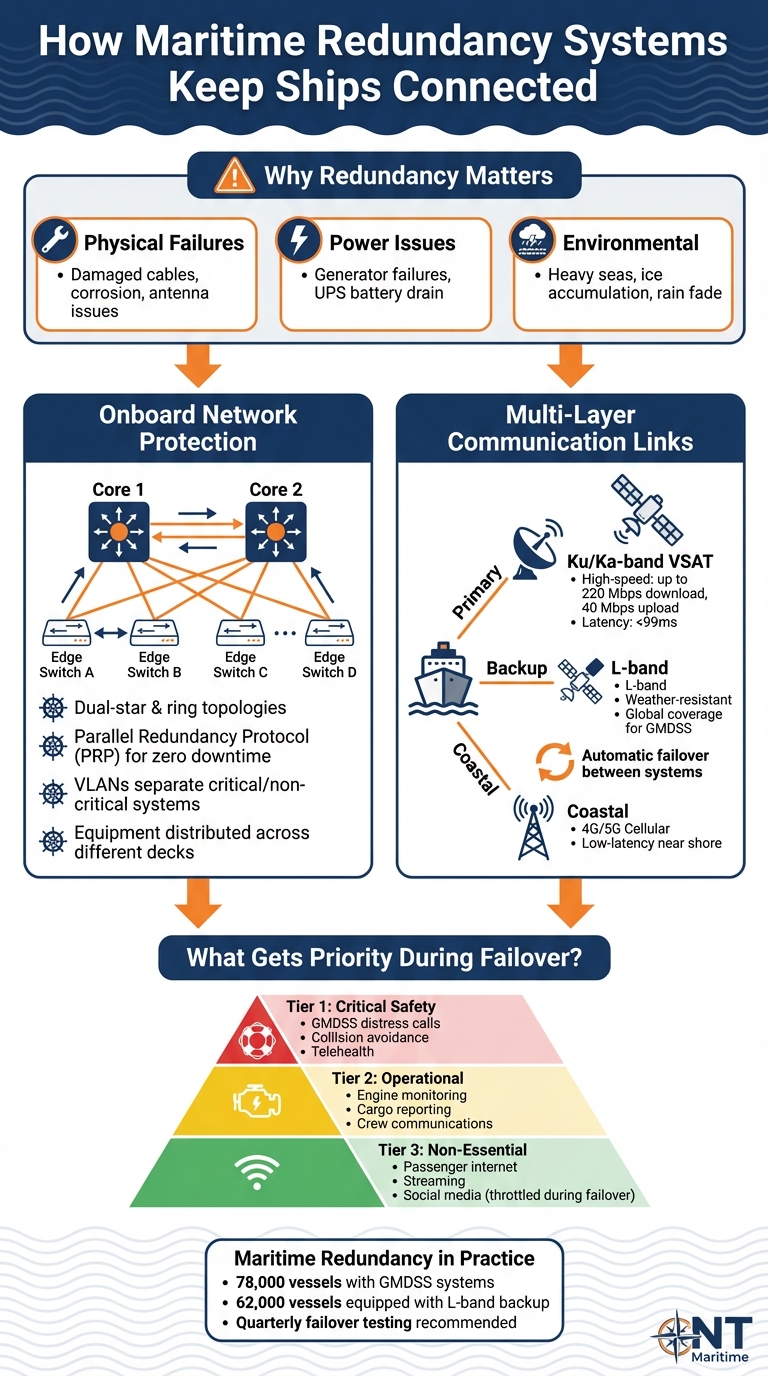
- Outdated Shipboard Infrastructure: Legacy networks and equipment create bottlenecks, requiring upgrades like VLANs, modern switches, and SD-WAN for better performance.
Starlink Maritime: Enabling High Speed, Low Latency Internet for the Maritime Industry

Challenge 1: Satellite Distance and Latency
GEO vs LEO Satellite Latency Comparison for Maritime Communication
How Geostationary Satellites Create Latency
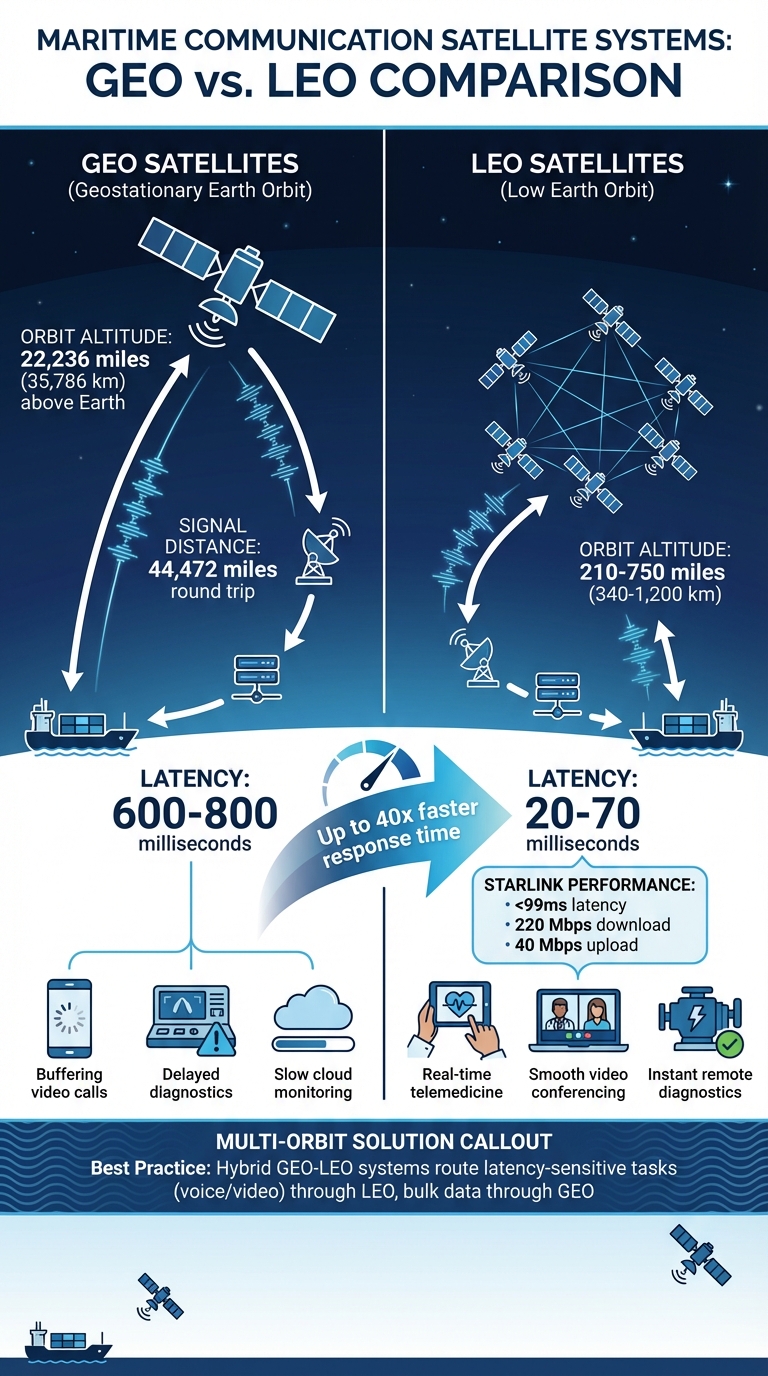
The delay in traditional maritime satellite communication boils down to one thing: physics. Geostationary (GEO) satellites orbit about 22,236 miles (35,786 km) above Earth’s equator. For a signal to travel from a ship to the satellite, down to a ground station, and back, it covers a whopping 44,472 miles. Even though radio signals travel at nearly the speed of light, this journey takes time – typically 600–800 milliseconds for a full round trip.
This delay impacts a range of maritime operations. Video calls experience noticeable pauses. Remote diagnostics lose accuracy. For critical tasks like dynamic positioning, collision avoidance, and remote pilotage, even a small delay can slow down responses from shore-based experts or automated systems, potentially affecting safety and efficiency.
For cruise ships, GEO VSAT systems often lead to buffering and interruptions during video calls or streaming. In commercial shipping and offshore energy, operators struggle with delays in cloud-based monitoring and remote support, making real-time decisions more challenging.
Solution: Low Earth Orbit (LEO) Satellites
Enter Low Earth Orbit (LEO) satellites, operating at altitudes between 210–750 miles (340–1,200 km). These satellites slash latency to 20–70 milliseconds, delivering speeds comparable to home broadband. For instance, NT Maritime offers Starlink services with latency under 99 milliseconds, download speeds up to 220 Mbps, and upload speeds reaching 40 Mbps – bringing high-speed internet to vessels at sea.
The difference is dramatic. Ships transitioning from GEO-only systems to LEO or hybrid GEO–LEO setups often see latency drop from several hundred milliseconds to under 100 ms. This improvement enables real-time applications like telemedicine, video conferencing, remote diagnostics, and fleet management. Many operators now rely on multi-orbit terminals that automatically direct latency-sensitive tasks, such as voice and video, through LEO satellites, while reserving GEO for less urgent bulk data transfers.
Challenge 2: Coverage Gaps and Harsh Ocean Conditions
Coverage Problems at Sea
Even with advancements like LEO satellites reducing latency, maintaining consistent connectivity at sea remains a significant hurdle. Vast stretches of ocean still suffer from poor or inconsistent coverage, especially in high-latitude regions. Since GEO satellites are positioned over the equator, ships operating closer to the poles often encounter signals that barely clear the horizon – or are obstructed entirely by the ship itself.
In remote oceanic zones far from shore-based infrastructure, signals can weaken or disappear altogether. Switching between satellite beams can cause brief but noticeable disruptions, particularly for fast-moving vessels. These micro-outages, occurring during antenna adjustments, can interrupt critical activities like video conferencing, remote diagnostics, or real-time monitoring.
Weather adds another layer of difficulty. Heavy rain, storms, and dense cloud cover interfere with high-frequency satellite bands, leading to a phenomenon known as rain fade. Meanwhile, rough seas – causing ships to pitch, roll, and yaw – force mechanically steered antennas to constantly adjust, which can result in intermittent connectivity and lower uptime. For operations like telemedicine or dynamic positioning, even a momentary signal loss can jeopardize safety and efficiency.
Addressing these challenges requires smarter, more adaptive network solutions.
Solution: Multi-Orbit and Multi-Bearer Systems
The key to overcoming these obstacles lies in redundancy and intelligent network routing. Multi-orbit systems dynamically switch between LEO and GEO satellites based on real-time conditions. LEO constellations offer low-latency, high-speed connections that fill in coverage gaps, particularly in polar regions and congested shipping lanes where GEO signals struggle. During severe weather, when one link falters, the system automatically switches to another, ensuring uninterrupted services like telemedicine or remote operations.
Multi-bearer setups further enhance connectivity by incorporating near-shore 4G/5G networks. As vessels approach ports, traffic can be offloaded to these terrestrial networks, freeing up satellite capacity for open-ocean operations. Intelligent routing ensures that time-sensitive tasks are prioritized on low-latency links, while bulk data is sent over higher-latency paths, improving overall system efficiency and reducing delays.
To complement these systems, advanced antenna technology plays a crucial role in stabilizing connections even in challenging conditions.
Advanced Antenna Technology
Modern phased-array antennas offer a game-changing approach to maintaining stable connections. Unlike traditional mechanically steered VSATs, these antennas adjust their beams electronically, eliminating the mechanical lag and reducing pointing errors. This capability minimizes disruptions during course changes and ensures more reliable connectivity.
Phased-array antennas can also connect to multiple networks simultaneously, such as LEO and GEO satellites, enhancing both redundancy and resilience. Their fast steering and multi-beam capabilities make them particularly effective in harsh maritime environments. For example, cruise ships equipped with these advanced antennas and LEO satellite links have delivered high-speed, low-latency internet to thousands of passengers, with fewer dropouts during adverse weather or sharp maneuvers compared to older GEO-only systems.
Challenge 3: Bandwidth Limits and Traffic Prioritization
Bandwidth Competition in Maritime Networks
Satellite connections at sea come with a major limitation: restricted bandwidth. Maritime operations generate massive amounts of data – think weather updates, location tracking, cargo information, and arrival schedules. When you add passenger entertainment and crew communication into the mix, the network can easily become overloaded. This is especially true for cruise ships and commercial vessels, where passengers expect uninterrupted streaming and video calls, while critical systems like navigation and telemedicine demand reliable, real-time data. GEO systems, which handle all these needs on a single link, often struggle with congestion and latency issues[2]. Managing this traffic effectively is no small task.
Solution: QoS and Traffic Shaping
Quality of Service (QoS) steps in to prioritize essential data over less critical traffic. Instead of treating all data equally, QoS ensures that vital applications – like telemedicine, navigation, and emergency systems – get the bandwidth and low-latency performance they need, even during heavy network usage. Traffic shaping works alongside QoS by capping the bandwidth available for non-essential activities, such as passenger video streaming. This approach keeps critical systems running smoothly while minimizing latency caused by packet loss and retransmissions[1]. Providers like NT Maritime integrate these strategies into their communication solutions, ensuring that crucial services always take precedence over recreational or non-essential traffic.
Network Performance Optimization
Beyond traffic management, other techniques can further boost network performance. Tools like WAN optimization, caching, and compression help reduce the amount of data sent over expensive satellite links[1]. For example, compression shrinks file sizes, while caching stores frequently accessed data – like weather reports, navigation charts, or operational manuals – locally on the vessel. This eliminates the need to repeatedly transfer the same information. These methods are especially valuable when bandwidth is limited and costs are high, allowing maritime operators to support more services without compromising performance. By reducing data loads and maintaining low latency, these optimizations play a critical role in modern maritime operations.
sbb-itb-bda822c
Challenge 4: Cybersecurity Effects on Latency
Security-Related Latency Problems
Maintaining low latency is vital for both operational efficiency and ensuring cybersecurity in maritime environments. However, safeguarding shipboard networks from cyber threats often comes with an unavoidable trade-off: increased delay. Encryption protocols like TLS and IPsec demand significant processing power from onboard routers and firewalls. These protocols handle tasks such as key exchanges, cipher operations, and packet wrapping, which inevitably add extra packet data. This additional data can boost bandwidth usage by 10–20%, a serious concern when relying on limited satellite connections.
Deep Packet Inspection (DPI) engines and intrusion detection systems also contribute to delays. These systems meticulously analyze payloads and headers against predefined security policies. Even for seemingly straightforward ship-to-cloud communications, traffic must travel from the vessel to a satellite, then to a shore-based data center, pass through security layers, and finally reach its destination. This routing effectively doubles or even triples the network segments involved, pushing round-trip times closer to those seen in GEO satellite systems, far from the 70 ms achievable with optimized LEO links.
These latency issues have real-world consequences, particularly for critical maritime operations. The signs are hard to miss: crew and passengers experience disrupted voice and video calls, fleet management applications load sluggishly, onboard telemetry and alarms face delays, and VPN connections frequently drop during periods of heavy traffic or adverse weather. The difference between raw test traffic and production traffic often highlights the problem – security processes like inspection, tunneling, and backhauling are the usual culprits.
Solution: Low-Latency Security Architectures
Addressing these delays requires rethinking how security is applied, moving toward a distributed security model. Instead of funneling all traffic through a central chokepoint, security enforcement can happen closer to the source. Deploying onboard security appliances – such as firewalls, intrusion detection/prevention systems (IDS/IPS), and secure web gateways – enables most filtering and inspection to occur locally. Only critical logs, alerts, and specific data flows need to be sent to shore-based centers. Typically, a unified next-generation firewall is installed in the ship’s main communications rack. This setup serves as the default gateway for various subnets, including crew, passenger, and operational technology networks. The onboard firewall handles local DPI, URL filtering, and threat prevention while keeping separate zones for systems like bridge controls, propulsion, hotel IT, and passenger Wi-Fi.
Optimizing encryption protocols also minimizes latency. For instance, using TLS 1.3 reduces the number of round trips needed during session setup compared to older versions. Fine-tuning settings like Maximum Transmission Unit (MTU) and Maximum Segment Size (MSS) prevents fragmentation over satellite links, cutting down on retransmissions and maintaining low latency without compromising encryption strength.
Network segmentation is another key strategy. By separating latency-sensitive systems from bulk traffic, critical operations like navigation and engine control can be placed on dedicated VLANs. These VLANs are configured with low-latency paths to shore support, limited inspection overhead, and high-priority Quality of Service (QoS) markings. Meanwhile, crew operational applications are given medium priority, and passenger internet and entertainment are assigned to best-effort segments that can handle higher latency and more extensive inspection. This proportional approach ensures that security measures don’t unnecessarily impact performance in areas where low latency is crucial.
Companies like NT Maritime have integrated these strategies into their secure communication solutions. By doing so, they ensure that essential services – such as Telehealth and onboard calling – operate smoothly with low latency, even under robust security protocols. This balance is critical for supporting the seamless operations modern vessels demand.
Challenge 5: Outdated Shipboard Infrastructure
Problems with Aging Onboard Systems
Even with low Earth orbit (LEO) satellite services offering latency as low as 20–40 ms, that advantage can vanish if a ship’s internal network is outdated. Many vessels still rely on legacy, flat shipboard networks built with unmanaged switches, outdated routers, and serial-based operational technology systems that were originally designed for low-bandwidth, high-latency traffic [7]. These aging networks introduce extra hops, congestion, and protocol conversion delays, making it impossible to fully leverage modern satellite services [3].
The main culprits? Outdated switches that max out at 100 Mbps or early 1 Gbps speeds without Quality of Service (QoS) capabilities, leading to congestion and long queuing delays when under heavy load [1]. Add to that old copper cabling (Cat5 or earlier) and poorly terminated connections, which cause errors and retransmissions. Legacy Wi‑Fi systems using outdated standards like 802.11a/b/g also struggle in environments with dense usage, causing high jitter. Servers and firewalls with underpowered CPUs further slow things down by struggling to handle modern encryption and routing tasks.
To make matters worse, many older ships have undergone unplanned network expansions, creating tangled "spaghetti networks" that are difficult to manage. Without proper segmentation between operational technology (OT), IT/business, and crew/guest networks, all traffic ends up competing within the same broadcast domain. This lack of segmentation means that heavy passenger streaming or gaming can interfere with critical services like safety systems, navigation data, Telehealth, or remote diagnostics, causing congestion and unpredictable latency spikes [6].
These outdated systems act as bottlenecks, limiting the potential of modern connectivity solutions.
Solution: Upgrading Shipboard Networks
Modernizing these outdated networks can significantly reduce congestion and restore the low-latency advantages of today’s satellite services. Ships should adopt managed, industrial-grade switches and routers capable of creating VLANs and firewalled zones to separate OT, corporate IT, and guest/crew Wi‑Fi traffic. This ensures that priority services are protected from interference [7]. Conducting a thorough network audit is a crucial first step. It helps identify unmanaged devices, single points of failure, and flat networks prone to broadcast storms and latency issues [7].
Replacing outdated equipment with managed solutions that support VLANs, access control lists, QoS, traffic shaping, redundancy protocols, and advanced monitoring tools is key. Upgrading cabling to Cat6 or Cat6a – or even fiber for backbone connections – reduces errors and supports higher data speeds with lower latency. Modern Wi‑Fi 6/6E access points, paired with redundant core network layers using ring or dual-homed topologies, ensure reliable performance even during peak usage.
Additionally, implementing SD‑WAN and multi-bearer routing enables ships to combine multiple connectivity options – such as GEO and LEO satellites, cellular networks, and port Wi‑Fi. These systems can dynamically route latency-sensitive applications like Telehealth, remote control, or VoIP to the fastest connection available based on real-time metrics like latency, jitter, and packet loss. Meanwhile, less critical tasks, such as backups or software updates, can be shifted to higher-latency channels [1][3][4][5].
System Integration for Better Communication
Once the hardware and networks are upgraded, integrating these systems into a unified architecture can further streamline operations. Centralized control mechanisms ensure consistent QoS, security, and routing policies across OT, IT, and guest domains. This approach helps optimize the use of limited satellite bandwidth [3]. Centralized platforms like SD‑WAN controllers and security systems can prioritize and schedule traffic, ensuring that operational and safety-critical data always have sufficient bandwidth, even during peak guest usage [1][5]. Shared monitoring and analytics tools also play a critical role by detecting issues like congestion or security threats early, allowing operators to make proactive adjustments instead of scrambling to fix problems after they arise.
Effective network segmentation is another must. Each domain – OT, corporate IT, and guest networks – should have its own VLAN and IP subnet. Inter-VLAN traffic should be managed by firewalls or Layer 3 switches with strict policies in place. OT networks should be given the highest priority and isolated from guest access entirely. Crew networks can have medium priority with controlled internet access, while guest networks are treated as best-effort connections, often placed behind carrier-grade NAT and captive portals. This structure minimizes unnecessary traffic, reduces vulnerabilities, and ensures that passenger streaming doesn’t interfere with critical low-latency services.
Companies like NT Maritime specialize in creating secure communication networks tailored for cruise ships and government or military vessels. Their end-to-end solutions include everything from satellite connectivity to onboard Wi‑Fi and applications, ensuring that latency-sensitive services like video calls, messaging, and remote monitoring work seamlessly once the onboard infrastructure is modernized.
Conclusion
Addressing the challenges of low-latency maritime communication requires a well-coordinated, end-to-end strategy that tackles every part of the network. By leveraging LEO and multi-orbit satellite systems, latency can drop dramatically – from the typical 600–800 ms down to just 20–40 ms. Advanced multi-bearer systems, paired with cutting-edge antennas, help maintain connectivity even in the harshest ocean environments. Additionally, QoS policies and traffic shaping ensure critical services remain prioritized over less essential data traffic, such as passenger streaming. Security systems designed for low latency safeguard data without slowing down network performance. To fully benefit from these advancements, modern shipboard hardware must replace outdated systems, enabling seamless integration with today’s satellite technologies.
Investing in low-latency connectivity is more than just a technical upgrade – it’s a strategic move. Real-time data exchange enhances operational efficiency, reduces fuel consumption, boosts crew welfare, and improves passenger experiences. These factors directly influence competitiveness and profitability. On the flip side, failing to address these challenges can lead to higher risks, slower responses to incidents, and less effective remote support, leaving fleets vulnerable as the industry evolves.
For example, NT Maritime provides secure communication networks and Telehealth solutions by combining LEO connectivity with updated onboard systems. Their approach supports cruise lines, government fleets, and military vessels, demonstrating how scalable, software-defined architectures can prepare fleets for the future. With these systems in place, operators can handle increasing data demands, adopt AI-driven analytics, and explore advanced technologies like autonomous navigation – all without constant hardware overhauls.
Achieving low latency at sea isn’t about a single breakthrough. It’s about creating a unified system – integrating modern satellite links, upgraded onboard networks, efficient traffic management, and robust security protocols – to meet the growing demands of maritime digital transformation.
FAQs
How do low Earth orbit (LEO) satellites improve latency in maritime communication compared to geostationary (GEO) satellites?
LEO satellites are changing the game for maritime communication by orbiting much closer to Earth – typically between 200 and 1,200 miles – compared to GEO satellites, which operate at a staggering 22,000 miles above. This shorter distance means signals travel faster, cutting down latency in a big way.
For the maritime sector, this translates to smoother real-time interactions, whether it’s video calls, live monitoring, or rapid data transfers, even in the middle of the ocean. LEO satellite networks are reshaping how ships stay connected, offering faster, more dependable communication where it was once a challenge.
How can coverage gaps in maritime communication be resolved?
To address coverage gaps in maritime communication, combining satellite systems with hybrid networks is key. These networks bring together various technologies to ensure smooth and uninterrupted connectivity, even in the most remote or demanding sea environments.
On top of that, tools like location-based services and Telehealth technologies play a crucial role in enhancing safety and providing essential services for both passengers and crew. By focusing on dependable, high-priority networks, maritime operations can maintain steady and secure communication across the expansive oceans.
How does outdated onboard infrastructure impact low-latency communication at sea?
Outdated onboard systems can throw a wrench into low-latency communication, leading to delays and even data packet loss. This kind of disruption weakens network reliability, making real-time activities – like voice calls, video conferencing, and data transfers – much less efficient.
Today’s maritime communication needs to keep up with high-speed data demands. Older equipment often falls short, unable to provide the smooth connectivity required by modern communication technologies, especially in the tough conditions of maritime environments.