
GMDSS: Secure Communication for Maritime Emergencies

The Global Maritime Distress and Safety System (GMDSS) is a critical communication network designed to ensure safety and coordination during maritime emergencies. It connects vessels with shore-based Rescue Coordination Centers (RCCs) using satellite and radio technologies to send automated distress alerts and safety information. Mandated by the International Maritime Organization (IMO), GMDSS applies to passenger ships and cargo vessels over 300 gross tons on international voyages.

Key Features of GMDSS:

  • Automated Distress Alerts: Sends a ship’s location and identification instantly.
  • Redundancy: Requires at least two independent methods of distress communication.
  • Safety Information: Provides weather updates, navigational warnings, and search-and-rescue coordination.
  • Equipment Requirements: Includes Digital Selective Calling (DSC), EPIRBs, NAVTEX, SARTs, and backup power systems.
  • Sea Area Coverage: Divides the oceans into four zones (A1–A4) with tailored equipment needs.

Recent updates (effective January 1, 2024) introduced modern satellite services like Iridium, ensuring global coverage, including polar regions. Companies like NT Maritime support GMDSS with advanced IT solutions, offering encrypted communication, high-speed internet, and real-time system monitoring for safer maritime operations.

GMDSS remains a cornerstone of maritime safety, enabling fast, reliable, and secure communication during emergencies.

What is GMDSS (Global Maritime Distress and Safety System)

GMDSS Functions and Components

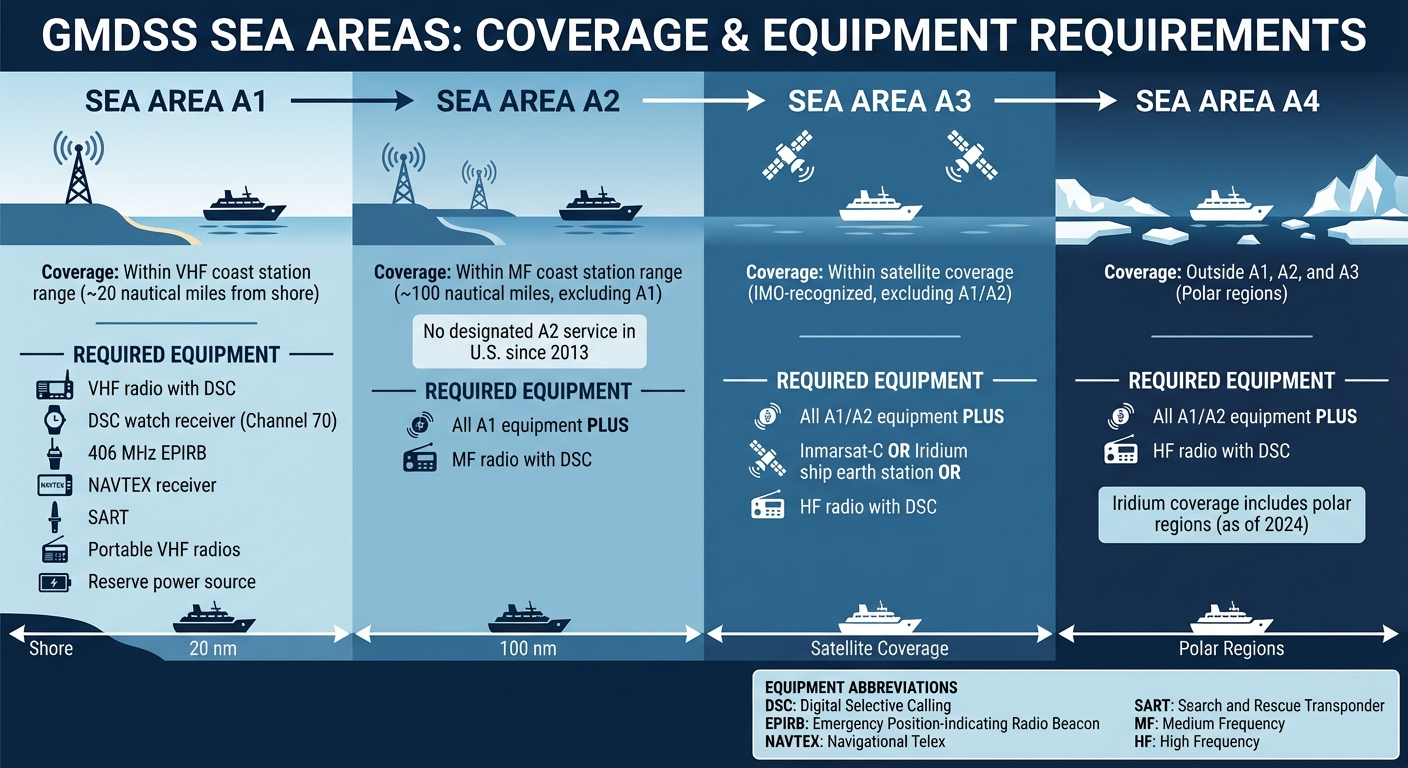
GMDSS Sea Areas and Required Equipment by Maritime Zone

GMDSS Sea Areas and Required Equipment by Maritime Zone

Primary Goals of GMDSS

The Global Maritime Distress and Safety System (GMDSS) was designed to handle nine key communication tasks that all equipped vessels must perform. These include sending and receiving distress alerts (both ship-to-shore and ship-to-ship), coordinating search and rescue (SAR) efforts, facilitating on-scene communications, transmitting locating signals, sharing maritime safety information (MSI), and enabling general and bridge-to-bridge communications.

One of the major shifts introduced by GMDSS was moving distress alerting from a ship-to-ship system to a direct connection with shore-based Rescue Coordination Centers (RCCs). These centers are responsible for managing and coordinating rescue operations.

"The GMDSS became inextricably linked with the parallel implementation of the International Search and Rescue Convention (SAR Convention) and the development of shore facilities within the structure of the World‐Wide SAR Plan."

  • International Mobile Satellite Organization (IMSO)

In addition to distress alerts, GMDSS provides automated broadcasts of navigational warnings, weather updates, and safety notices. These are delivered through terrestrial NAVTEX systems or satellite-enhanced group call services.

The following sections delve into the equipment and operational protocols that make these functions possible.

Required GMDSS Equipment and Systems

At the heart of GMDSS is Digital Selective Calling (DSC), a technology designed for automated distress alerting. Think of DSC as a "dial and bell" system that allows mariners to send distress alerts – including location and identification details – instantly to authorities and nearby ships without needing to monitor a radio loudspeaker constantly. Channel 70 (156.525 MHz) on VHF is exclusively reserved for DSC distress, safety, and calling purposes.

"Digital selective calling also allows mariners to initiate or receive distress, urgency, safety and routine radiotelephone calls… without requiring either party to be near a radio loudspeaker."

To include precise location data, DSC systems must be linked to GPS receivers using the NMEA 0183 protocol.

GMDSS regulations require all vessels under its scope to carry specific equipment, regardless of their operating area. This includes:

  • A 406 MHz Emergency Position Indicating Radio Beacon (EPIRB) for satellite-based distress alerts.
  • A NAVTEX receiver for automated maritime safety information.
  • A Search and Rescue Transponder (SART) to help locate survival craft.
  • Two-way portable VHF radios for on-scene communication.
  • A reserve power source to ensure radio functionality even if main and emergency power systems fail.

For satellite communications, IMO-recognized services currently include Inmarsat C, Fleet Safety, and Iridium Safety Services. The BeiDou Message Service System (BDMSS) is awaiting full implementation. The introduction of Iridium as a GMDSS provider ended Inmarsat’s monopoly and extended global coverage to include polar regions.

GMDSS regulations apply to cargo ships of 300 gross tons or more, as well as passenger ships carrying over 12 passengers on international voyages. These vessels must also have at least two licensed GMDSS radio operators, with one specifically assigned to handle communications during emergencies.

These systems and technologies are critical for ensuring reliable emergency communication, which remains a cornerstone of maritime safety.

Sea Areas and Equipment Requirements

GMDSS divides the world’s oceans into four sea areas (A1 through A4), with equipment requirements tailored to the vessel’s operating area rather than its size.

  • Sea Area A1: Covers areas within VHF coast station range, typically up to 20 nautical miles from shore, where continuous DSC alerting is available. Since January 20, 2015, the U.S. Coast Guard has officially designated certain coastal regions as Sea Area A1. Vessels in this area must carry a VHF radiotelephone with DSC and a DSC watch receiver tuned to Channel 70.
  • Sea Area A2: Includes regions within medium frequency (MF) coast station range, usually up to 100 nautical miles from shore (excluding A1). However, with the U.S. Coast Guard discontinuing its 2 MHz infrastructure in 2013, there is no designated Sea Area A2 service in the United States. For U.S. vessels, leaving A1 effectively means entering Sea Area A3.
  • Sea Area A3: Encompasses areas covered by IMO-recognized mobile satellite services, such as Inmarsat or Iridium, excluding A1 and A2 zones. Vessels operating here need either an Inmarsat-C or Iridium ship earth station, or an HF radiotelephone with DSC, in addition to the equipment required for A1 and A2.
  • Sea Area A4: Covers polar regions and other areas beyond A1, A2, and A3. Ships in this zone must have an HF radiotelephone with DSC, along with the equipment required for A1 and A2. The inclusion of Iridium as a satellite provider has significantly improved coverage in these previously underserved areas.
Sea Area Definition Primary Equipment Required
A1 Within VHF coast station range (~20 nautical miles) VHF radio with DSC, DSC watch receiver (Channel 70)
A2 Within MF coast station range (~100 nautical miles, excluding A1) MF radio with DSC, plus A1 equipment
A3 Within satellite coverage (IMO-recognized, excluding A1/A2) Inmarsat‑C or Iridium ship earth station, or HF radio with DSC, plus A1/A2 equipment
A4 Outside A1, A2, and A3 (Polar regions) HF radio with DSC, plus A1/A2 equipment

Operators have three options for maintaining their equipment: shore-based maintenance, at-sea maintenance (requiring a licensed maintainer), or duplicating equipment. To avoid overloading the system, live testing of DSC distress and safety frequencies with coast stations should be limited to once per week.

Security and Reliability in GMDSS Operations

Regulations and Standards for GMDSS

The Global Maritime Distress and Safety System (GMDSS) operates under a framework of international and national regulations, including SOLAS Chapter IV, ITU Radio Regulations, and U.S. FCC 47 CFR Part 80. These guidelines ensure consistent and reliable performance. SOLAS Chapter IV is the cornerstone for ships on international voyages, while ITU Radio Regulations define the technical standards for maritime communication systems .

"The GMDSS is mandated for ships internationally by the International Maritime Organization (IMO) Safety of Life at Sea Convention (SOLAS), 1974, as amended, and carries the force of an international treaty."

To ensure compliance, FCC-licensed technicians and the U.S. Coast Guard conduct inspections, checking documentation, operator proficiency, and log records. Ships must carry essential documents such as the Cargo Ship Safety Radio Certificate (CSSRC), a Record of Equipment (Form R), and maintain radio logs for at least two years – or three years if related to distress incidents.

As of January 1, 2024, updated GMDSS regulations have taken effect, phasing out outdated requirements and paving the way for modern communication technologies.

Backup Systems and Reliability Features

GMDSS reliability hinges on a robust system of redundancies. Ships must be equipped to send distress alerts through at least two independent methods. Additionally, reserve power systems are mandatory, providing one hour of backup for vessels built after February 1, 1995, or six hours for older ships without specific emergency power setups.

In Sea Areas A3 and A4, vessels must implement two of three maintenance options: duplicate equipment, shore-based maintenance contracts, or at-sea maintenance capabilities. For Sea Areas A1 and A2, only one option is required. Digital Selective Calling (DSC) plays a critical role by automating distress alerts with preformatted digital messages, minimizing the risk of human error. Position accuracy is further ensured with automatic updates from GPS/GNSS receivers, or manual updates every four hours when necessary.

These layers of redundancy not only strengthen reliability but also enable seamless integration with advanced IT solutions.

How Advanced IT Solutions Support GMDSS

Modern IT solutions complement GMDSS by integrating it with onboard systems, enhancing both performance and reliability. Companies like NT Maritime offer secure communication platforms that link GMDSS equipment with other vessel systems. This integration allows for real-time monitoring of system health, automated position updates, and ensures backup systems are always operational.

For ships navigating global routes, particularly in remote Sea Areas A3 and A4, high-speed satellite connectivity from providers such as Inmarsat and Iridium is a game-changer. These satellite networks work in harmony with onboard systems, ensuring that critical components like VHF/HF radios, satellite earth stations, and backup systems operate as a unified whole. This level of integration is especially valuable during inspections, where crews must demonstrate compliance with SOLAS Chapter IV, including the functionality of reserve power and redundant equipment systems. By leveraging these advanced IT solutions, vessels can ensure seamless communication and operational readiness under all circumstances.

Installing and Managing GMDSS on Vessels

Selecting and Integrating GMDSS Equipment

Choosing the right GMDSS (Global Maritime Distress and Safety System) equipment depends on where your vessel operates. For vessels in Sea Area A1 – within VHF range of coastal stations – you’ll need a VHF with DSC (Digital Selective Calling), a 406 MHz EPIRB (Emergency Position Indicating Radio Beacon), NAVTEX, SART (Search and Rescue Transponder), and portable VHF radios. In Sea Area A2, add an MF (Medium Frequency) installation with DSC to this setup. For Sea Area A3, you’ll need either an MF/HF (High Frequency) installation or a mobile satellite service through providers like Inmarsat or Iridium. Vessels in Sea Area A4, which covers polar regions, must carry MF/HF equipment in addition to the A1 gear.

All GMDSS equipment must be FCC-certified, except for 406 MHz EPIRBs. Any DSC-capable devices must be programmed with your vessel’s unique nine-digit Maritime Mobile Service Identity (MMSI) number. To ensure accurate distress alerts, integrate communication equipment with a GPS receiver so that your vessel’s position is automatically included. If automatic integration isn’t an option, set up a strict manual protocol to update the position and time every four hours while underway.

Power systems are equally important. Vessels built after February 1, 1995, must have at least one hour of backup power, while older vessels require six hours. Maintenance strategies should align with approved plans tailored to your operating area.

Once the equipment is installed, training your crew on emergency operations is the next critical step.

Crew Training and Emergency Procedures

It’s mandatory for masters and mates to hold a GMDSS Radio Operator’s License, which involves completing a two-week training course and demonstrating proficiency with the equipment.

Crew training should include standardized distress protocols, such as DSC operations, satellite communication procedures, and the use of SAR (Search and Rescue) equipment like 406 MHz EPIRBs and SARTs. Additionally, they must know how to monitor Maritime Safety Information (MSI) using NAVTEX or SafetyNet systems.

To maintain operational readiness, equipment testing is vital. Crew members should conduct daily, weekly, and monthly checks, including battery voltage tests and DSC test calls. According to the U.S. Coast Guard, each vessel must have at least two licensed radio operators, with one designated as the primary operator:

"One of the operators shall be designated as the primary operator. But, they all must be capable of performing distress, urgency and safety communications."

Using NT Maritime Solutions for Emergency Communication

NT Maritime

Beyond hardware, NT Maritime offers advanced IT solutions to strengthen emergency communication. Their secure platforms integrate seamlessly with GMDSS equipment, providing real-time system health monitoring and ensuring that backup systems remain functional. During emergencies, Telehealth technologies enable vessels to connect with shore-based medical professionals through video calls and secure messaging, offering critical medical guidance when needed.

NT Maritime’s high-speed internet services also support data-heavy emergency coordination, ensuring smooth internal communication among crew members during crises. For government and military vessels, the company provides encrypted communication networks that meet federal standards, adding an extra layer of security for sensitive operations. These integrated systems work hand-in-hand with GMDSS equipment to keep crews informed and prepared in challenging situations.

Conclusion

The Global Maritime Distress and Safety System (GMDSS) has revolutionized maritime safety by creating a direct link between vessels and Rescue Coordination Centers. This system ensures that distress alerts are immediately relayed to authorities, enabling swift mobilization of rescue efforts and significantly reducing response times during emergencies. Thanks to Digital Selective Calling (DSC) technology, vessels can automatically transmit precise location and identification details – even in situations where crew members are unable to respond promptly.

The U.S. Coast Guard highlights the importance of GMDSS in maritime safety:

"GMDSS is a worldwide coordinated maritime distress system designed to provide the rapid transfer of distress messages from vessels in distress to units best suited for providing or coordinating assistance".

Recent advancements have further strengthened GMDSS capabilities. As of January 1, 2024, the system now integrates advanced satellite services alongside traditional Inmarsat technology, ensuring full global coverage – including the once-elusive polar regions. Whether navigating coastal waters within 20–30 miles of shore or venturing into remote polar seas, vessels can rely on dependable emergency communication.

In addition to these upgrades, NT Maritime has introduced innovative IT solutions to enhance maritime emergency communication. Their offerings include secure networks, real-time monitoring, and Telehealth services, which bolster GMDSS equipment. High-speed internet enables seamless coordination during emergencies, while encrypted networks provide an added layer of security for government and military vessels. Together, these advancements work hand in hand with GMDSS, creating a robust and reliable safety framework when lives are on the line.

To maintain this high level of safety, vessel operators must prioritize GMDSS compliance. This includes regular equipment testing, comprehensive crew training, and the integration of modern communication technologies to ensure the system functions flawlessly when it matters most.

FAQs

What equipment is required for vessels to comply with GMDSS regulations?

To comply with GMDSS requirements, vessels must have specific communication tools onboard to prioritize safety at sea. These tools include:

  • A VHF marine radio with Digital Selective Calling (DSC) for reliable short-range communication.
  • An MF/HF radiotelephone or satellite telephone for long-distance communication needs.
  • An Emergency Position Indicating Radio Beacon (EPIRB) to send distress signals and provide location data in emergencies.
  • A secondary VHF radio or cellular radio as a backup communication option.

This equipment is essential for sending and receiving distress alerts, coordinating search and rescue (SAR) operations, sharing maritime safety information, and ensuring seamless bridge-to-bridge communication. Proper installation and regular maintenance of these systems are crucial to meet regulatory standards and ensure safety at sea.

How does Iridium enhance GMDSS coverage?

Iridium’s network of low-Earth-orbit satellites offers worldwide coverage, even reaching remote and polar areas that were once hard to access. This expanded reach enables the GMDSS to deliver dependable distress communication from virtually anywhere on the planet, boosting maritime safety and improving emergency response efforts.

What certifications and training are required for crew members to operate GMDSS equipment?

To use GMDSS equipment, crew members need a U.S.-flag GMDSS Radio Operator endorsement along with the appropriate STCW endorsement. These certifications are granted after successfully completing a U.S. Coast Guard-approved training course and passing the necessary exam. This training ensures that operators are skilled in handling communication tools such as VHF and MF/HF radios, satellite EPIRBs, and NAVTEX systems.

The certification details are documented on the mariner’s STCW endorsement and must be kept current through periodic refresher courses to stay in line with Coast Guard regulations. NT Maritime offers customized training solutions to help vessels meet these regulatory requirements effectively.


Top 7 Maritime Communication Systems in 2025

The maritime industry in 2025 relies on advanced communication systems to ensure safety, efficiency, and connectivity for ships across the globe. These systems integrate modern technologies like satellite internet, 5G, and IoT to support navigation, weather updates, emergency alerts, and onboard communication for both crew and passengers. Here’s a quick summary of the top systems shaping maritime communication today:

  1. NT Maritime Integrated Communication Platform: Offers high-speed internet (220 Mbps download, 40 Mbps upload), onboard calling, video, and telehealth services with strong security measures.
  2. Satellite-Based Maritime Internet Systems: Provides global coverage using geostationary and LEO satellites, with speeds up to 100 Mbps and low latency for real-time operations.
  3. Cruise Line Communication Platforms: Combines satellite, cellular, and onboard WiFi for uninterrupted passenger and crew connectivity, with integrated safety features.
  4. Government and Military Communication Solutions: Focuses on secure, mission-critical communication with strict compliance to federal standards.
  5. 5G and Cellular Maritime Networks: Enhances vessel-to-shore communication with faster speeds, lower latency, and seamless integration with shipboard systems.
  6. Global Maritime Distress and Safety Systems (GMDSS): Ensures emergency communication across sea areas using modernized satellite and digital technologies.
  7. Software-Defined Radios and IoT Communication: Flexible systems supporting multiple protocols, IoT integration, and real-time monitoring for predictive maintenance.

These systems address the growing demands of the maritime industry by providing reliable, secure, and efficient communication solutions, paving the way for safer and more connected operations.

Quick Comparison:

System Key Features Speed/Latency Coverage Integration Focus Security Standards
NT Maritime Platform High-speed internet, telehealth 220 Mbps/99 ms Onboard WiFi Passenger management, safety Encrypted, multi-layer auth
Satellite Internet Global coverage, LEO & GEO satellites 100 Mbps/20-40ms (LEO) Global (incl. polar) IT infrastructure End-to-end encryption
Cruise Line Platforms Hybrid satellite/cellular/WiFi Dynamic Coastal & open sea Safety, passenger services Network segmentation
Gov/Military Solutions Mission-critical, secure comms Varies Classified routes Classified data handling Federal compliance
5G Maritime Networks Low latency, high bandwidth 5G speeds Coastal & near-shore Remote diagnostics, cargo Zero-trust, geofencing
GMDSS Emergency communication, updated tech Varies Sea Areas A1-A4 Safety systems, AIS IMO/SOLAS compliance
SDR & IoT Systems Multi-protocol, IoT-enabled Varies Coastal & open sea Predictive maintenance, ECDIS AES-256 encryption

These technologies are reshaping maritime communication, ensuring better safety, efficiency, and connectivity for diverse maritime operations.

The Future of Marine Communications: Harnessing Advanced Technologies

1. NT Maritime Integrated Communication Platform

NT Maritime

NT Maritime’s platform brings together all communication needs for cruise ships, government vessels, and military ships. It’s designed to provide dependable, flexible, and secure connectivity at sea, improving both operations and the experience for passengers.

The system supports onboard calling, messaging (including group chats and ship-to-app communication), video calls, and voicemail. These features adapt effortlessly to the size of the vessel, ensuring smooth operations and enhanced communication for everyone onboard.

Coverage and Connectivity

Using the ship’s WiFi, the platform ensures consistent coverage throughout the vessel. It also provides high-speed internet with download speeds up to 220 Mbps, upload speeds up to 40 Mbps, and latency under 99 ms. This level of connectivity supports real-time operations and keeps passengers connected.

Integration with Shipboard Systems

A standout feature of the platform is how it integrates with onboard systems. It works seamlessly with passenger management systems to automate notifications, handle emergency communications, and send personalized messages. Additionally, telehealth capabilities allow for efficient medical consultations and monitoring while at sea.

Security and Compliance Standards

Security is a top priority. The platform employs encrypted channels, multi-layer authentication, and secure transmission protocols to safeguard sensitive information. It meets strict federal and military standards, ensuring communications remain protected at all times.

2. Satellite-Based Maritime Internet Systems

Satellite-based maritime internet has become the backbone of modern vessel connectivity, offering dependable communication links across the vast expanse of the world’s oceans. By using low Earth orbit (LEO) and geostationary satellites, these systems deliver broadband-level speeds that support everything from crew communication and passenger entertainment to the seamless transmission of critical operational data.

This technology fills the connectivity gap where traditional networks fall short.

Coverage and Connectivity

Satellite systems offer global coverage, ensuring vessels stay connected no matter where they are on the ocean. Unlike terrestrial networks that lose signal beyond coastal areas, satellite connectivity ensures consistent service whether a ship is 10 miles or 1,000 miles from shore.

This coverage spans from polar regions to equatorial waters, making it indispensable for vessels navigating international routes. Ships in remote areas, such as the mid-Pacific or Southern Ocean, rely entirely on satellite links for communication.

  • Geostationary satellites: Positioned 22,236 miles above Earth, these satellites cover wide areas but experience higher latency.
  • LEO satellite constellations: Orbiting much closer – between 340 and 1,200 miles – LEO satellites provide lower latency but require a larger number of satellites to maintain uninterrupted service as they move across the sky.

Bandwidth and Latency

Satellite internet speeds vary based on the technology and service tier:

  • Download speeds: Range from 1 Mbps to over 100 Mbps.
  • Upload speeds: Range from 512 Kbps to 20 Mbps.

Latency differs significantly between satellite types:

  • Geostationary satellites: Latency typically falls between 500-700 milliseconds, which can affect real-time applications.
  • LEO satellites: Latency is much lower, around 20-40 milliseconds, making activities like video calls and voice communication far more practical.

Integration with Shipboard Systems

Modern satellite internet systems integrate seamlessly with onboard IT infrastructure. They connect through standard networking equipment, allowing vessels to extend their internal networks to include satellite connectivity without requiring major upgrades.

  • Automatic failover systems: These ensure uninterrupted service by switching between satellite providers or beams if one connection fails, maintaining critical communication during outages or equipment issues.
  • Quality of Service (QoS) management: Critical communications, such as safety messages and operational data, are prioritized over less essential traffic like passenger entertainment, ensuring vital functions remain unaffected during peak usage.
  • Network management tools: These allow crews to monitor data usage and allocate bandwidth efficiently, optimizing performance.

This level of integration enhances both safety and operational efficiency, setting the stage for more advanced capabilities.

Security and Compliance Standards

Maritime satellite systems are designed with robust security features to protect sensitive data:

  • End-to-end encryption: Ensures secure data transmission between vessels and onshore facilities, meeting international security standards.
  • Authentication protocols: Prevent unauthorized access to the satellite connection, with multi-factor authentication adding extra protection for administrative controls.
  • Regulatory compliance: These systems meet International Maritime Organization (IMO) regulations, flag state requirements, and SOLAS (Safety of Life at Sea) standards for emergency communications.

Additionally, audit trails and logging keep detailed records of network activity. These logs help operators demonstrate compliance with data protection rules and assist in security investigations when needed.

3. Cruise Line Communication Platforms

Cruise line communication platforms are designed to tackle the dual challenges of connectivity and safety for ships carrying thousands of passengers and crew. Modern cruise ships rely on integrated systems to ensure smooth operations, guest satisfaction, and effective emergency communication.

These platforms aim to deliver critical messaging while also maintaining high-quality service for recreational use.

Coverage and Connectivity

Cruise lines utilize hybrid connectivity systems that combine satellite, near-shore cellular networks, and onboard WiFi. This setup ensures uninterrupted service, no matter where the ship is located.

Near coastal areas like the Caribbean or Mediterranean, terrestrial networks can supplement satellite connections, boosting service quality. However, during long ocean crossings, ships rely heavily on satellite systems to maintain communication over extended periods.

Another key feature is shore-to-ship connectivity, which goes beyond basic internet access. Passengers can use their personal devices to make calls, thanks to international routing that mimics land-based dialing. This level of connectivity not only enhances convenience but also lays the foundation for more advanced system integration.

Integration with Shipboard Systems

Reliable network coverage allows for deep integration with onboard systems. Communication platforms connect directly with passenger management and hotel systems, streamlining operations and enabling real-time updates.

These platforms also play a critical role in safety and security. During emergencies or safety drills, they can broadcast instructions in multiple languages and coordinate crew actions in real time. This integration improves operational efficiency while enhancing the guest experience, aligning with modern maritime communication expectations.

Bandwidth and Latency

Dynamic bandwidth management ensures that mission-critical data is prioritized, while latency is minimized for real-time communication needs.

Bandwidth is carefully allocated to meet the demands of passenger internet use, crew communication, operational data transfers, and onboard entertainment. During peak usage times, traffic shaping techniques help distribute access fairly among users.

Many platforms employ edge computing to cache frequently accessed content onboard. This reduces reliance on satellite links and improves response times. Quality of Service protocols further guarantee that emergency communications are prioritized, even during high-demand periods.

This optimized data flow also supports the rigorous security measures outlined below.

Security and Compliance Standards

Cruise line communication platforms adhere to strict security standards to protect passenger data and ensure maritime safety. They comply with international data protection regulations, including those governing European and U.S. markets.

Network segmentation is a common practice, isolating passenger communications from crew operations and critical ship systems. This reduces the risk of unauthorized access. Advanced firewalls and continuous monitoring further safeguard the network by detecting and blocking suspicious activity.

To protect sensitive information, strong encryption protocols are used during data transmission. Ongoing compliance monitoring ensures that all communications meet maritime regulations, facilitating smooth audits during port inspections. These measures help maintain secure and efficient connections, which are vital for passenger and crew safety.

4. Government and Military Communication Solutions

As digital advancements reshape industries, government and military communication systems are no exception. These solutions are designed to handle mission-critical communications while maintaining the highest levels of security to safeguard classified information. To meet strict federal requirements, they must achieve certifications like the Cybersecurity Maturity Model Certification (CMMC) and secure a spot on the Department of Defense Information Network Approved Products List (DODIN APL). These certifications ensure not only data protection but also compliance with stringent federal standards, making these systems dependable for essential operations.

5. 5G and Cellular Maritime Networks

The maritime industry is embracing 5G and cellular networks to enhance vessel-to-shore communication and improve onboard operations. These networks are transforming how ships interact with shore facilities and manage onboard systems, creating a more connected and efficient maritime environment.

Bandwidth and Latency

5G networks in maritime settings bring faster speeds and significantly lower latency. This means crews can communicate in real time, receive instant navigation updates, and access critical weather data for timely decision-making. The combination of higher bandwidth and reduced delays ensures smoother operations, even in demanding conditions.

Coverage and Connectivity

Maritime cellular networks are designed to extend coverage far beyond the coastline. Advanced base station setups and network configurations, such as virtual network segmentation, ensure that essential communications are prioritized. These systems also integrate seamlessly with existing cellular networks, allowing vessels to maintain reliable connectivity as they transition from coastal waters to the open sea.

Integration with Shipboard Systems

5G technology integrates seamlessly with onboard systems, enabling features like remote diagnostics, automated cargo tracking, and edge computing. This integration allows for real-time monitoring and management of key vessel functions, optimizing performance and unifying data from onboard sensors and systems. These capabilities enhance both operational efficiency and decision-making processes.

Security and Compliance Standards

To protect communications, 5G maritime networks use advanced encryption and authentication protocols tailored specifically for maritime needs. These measures align with international guidelines and often employ a zero-trust model, requiring constant verification of users and devices. Additionally, geofencing technology restricts data access based on a vessel’s location, adding an extra layer of security in sensitive areas.

6. Global Maritime Distress and Safety Systems (GMDSS)

The Global Maritime Distress and Safety System (GMDSS) is the internationally required emergency communication framework for ships navigating international waters. Its primary purpose is to ensure vessels can send out distress alerts, receive critical maritime safety updates, and stay in contact with rescue coordination centers across the globe.

This system combines various communication technologies, including satellites, terrestrial radio frequencies, and digital selective calling (DSC). In recent years, the International Maritime Organization (IMO) has been working to modernize GMDSS by incorporating digital technologies to improve efficiency and reduce response times.

Coverage and Connectivity

The GMDSS divides the oceans into four specific sea areas, each defined by its communication coverage capabilities:

  • Sea Area A1: Covers coastal waters within the range of VHF radio, typically up to 20-30 nautical miles from the shore.
  • Sea Area A2: Extends coverage to medium frequency (MF) radio, reaching approximately 100-150 nautical miles offshore.
  • Sea Area A3: Includes regions covered by geostationary satellite systems, providing communication far beyond the range of terrestrial systems.
  • Sea Area A4: Encompasses polar regions where geostationary satellites are less effective, requiring alternative communication methods.

Each area demands specific equipment configurations. For instance, ships operating in Sea Area A3 must be equipped with Inmarsat terminals and MF/HF radios to ensure reliable emergency communication. To enhance coverage, particularly in polar regions, GMDSS now incorporates Low Earth Orbit (LEO) satellite constellations, which also help minimize communication delays – critical in emergencies.

Integration with Shipboard Systems

Modern GMDSS equipment is designed to work seamlessly with a ship’s bridge systems and navigation tools. For example:

  • Digital Selective Calling (DSC) controllers link directly with GPS systems, enabling automated distress signals with precise location data.
  • Emergency Position Indicating Radio Beacons (EPIRBs) automatically activate during emergencies, transmitting rescue signals on the 406 MHz frequency with location accuracy up to 100 meters.

Additionally, GMDSS integrates with automatic identification systems (AIS) and voyage data recorders, forming a comprehensive safety network. In distress situations, these systems can simultaneously relay critical information – such as vessel details, crew data, and situational updates – to rescue coordination centers.

Search and Rescue Transponders (SARTs) have also been upgraded to include AIS functionality. This enhancement allows rescue vessels and aircraft to detect distress signals more easily, improving response coordination and reducing the time required for rescues.

Security and Compliance Standards

GMDSS operations are governed by strict standards set by the International Telecommunication Union (ITU) and the IMO’s SOLAS Convention. These regulations specify requirements for equipment certifications, operator licensing, and routine system testing to ensure reliability during emergencies.

To secure distress communications, GMDSS employs protocols like authentication codes and encryption to verify legitimate distress calls and prevent false alarms that could waste valuable rescue resources. Ships are also required to:

  • Conduct monthly equipment tests and maintain battery systems.
  • Undergo annual inspections by certified technicians.
  • Keep detailed logs of equipment performance, repairs, and any failures.

As GMDSS evolves, cybersecurity has become a key focus. Modern updates address vulnerabilities in satellite communication links, ensuring emergency systems remain protected from interference or malicious attacks.

Crew training is another critical component. Under the STCW Convention, radio operators must meet specific competency standards and complete periodic refresher courses to maintain their certifications. This ensures that in emergencies, crew members can operate GMDSS systems effectively and confidently.

7. Software-Defined Radios and IoT Communication

Building on advanced satellite and cellular networks, Software-Defined Radio (SDR) technology is transforming maritime connectivity by combining flexible communication protocols with IoT capabilities. SDRs replace traditional fixed hardware with programmable software, making maritime communication systems more adaptable. This flexibility allows real-time integration with IoT sensors to monitor engine performance, cargo conditions, and other critical metrics, enabling quicker decision-making and predictive maintenance.

SDRs have introduced a level of versatility that wasn’t possible with older systems. These modern radios can handle multiple communication protocols – VHF, UHF, HF, and satellite frequencies – eliminating the need for separate radio systems. This not only reduces equipment costs but also simplifies operations on the ship’s bridge. Since the system is software-based, updates and modifications can be implemented without replacing hardware, ensuring the technology stays current.

Coverage and Connectivity

SDR systems provide seamless connectivity, adapting from coastal cellular networks to open-ocean satellite systems, and even creating mesh networks among vessels. In coastal waters, SDRs prioritize high-speed data transmission through cellular and terrestrial networks. As vessels move into open ocean areas, the system automatically switches to satellite communication, requiring no manual input from the crew.

Mesh networking is another game-changer. Ships equipped with compatible SDR systems can form temporary, self-healing communication networks when within range of each other. This extends coverage and creates backup communication pathways, which is especially valuable for fleet operations where constant coordination is essential for safety and efficiency.

IoT connectivity through SDR platforms is equally impressive. These systems can operate across multiple frequency bands simultaneously. For instance, Low-Power Wide-Area Network (LPWAN) protocols like LoRaWAN efficiently handle sensor data from hundreds of IoT devices on large vessels. At the same time, higher-bandwidth connections manage tasks like video surveillance, navigation data, and crew communications. The system intelligently prioritizes and routes data through the most suitable channels based on bandwidth and urgency.

Integration with Shipboard Systems

SDR and IoT systems integrate seamlessly with existing maritime technology, enhancing the functionality of shipboard systems. For example, Electronic Chart Display and Information Systems (ECDIS) can receive real-time weather and navigation updates via SDR networks. Meanwhile, IoT sensors continuously monitor vital ship systems such as ballast tanks, fuel levels, and refrigeration units.

Bridge management systems gain significant advantages from SDR integration. Communication protocols can be updated remotely to meet new international regulations or to add features tailored to specific routes. This ensures that vessels operate efficiently and comply with regional requirements.

One practical application of this technology is in cargo monitoring systems. For temperature-sensitive cargo, wireless sensors connected to the ship’s SDR network provide continuous monitoring. If temperature deviations occur, alerts are sent to both the ship’s crew and shore-based managers, enabling immediate corrective actions. This capability is particularly crucial for shipments like pharmaceuticals and perishable foods, where temperature control is critical.

In the engine room, IoT sensors linked to SDR networks enable predictive maintenance. Devices like vibration sensors, temperature monitors, and oil analysis systems send data in real time, identifying potential equipment failures weeks in advance. This data is automatically shared with maintenance teams onshore, allowing them to prepare parts and resources before the vessel’s next port call.

As these systems expand in functionality, robust security measures ensure the technology remains resilient against cyber threats.

Security and Compliance Standards

Maritime SDR and IoT systems must adhere to International Telecommunication Union (ITU) regulations, which govern radio frequency usage and interference prevention. The software-defined nature of SDRs simplifies compliance, as updates can be implemented through software changes rather than hardware replacements. This adaptability is critical as maritime communication regulations evolve to address cybersecurity challenges.

To protect sensitive data, modern SDR systems incorporate advanced encryption protocols. The Advanced Encryption Standard (AES-256) is widely used to secure cargo manifests, navigation plans, and crew communications. Meanwhile, IoT sensor data is encrypted using lightweight protocols that balance security with the power constraints of battery-operated devices.

Network segmentation is another key security feature. Critical safety communications, such as GMDSS emergency protocols, operate on dedicated frequencies that are isolated from other shipboard data traffic. This separation is enforced through both software and physical network configurations, ensuring compliance with international safety standards.

Regular firmware updates and security patches are essential for safeguarding SDR and IoT systems. These updates can be automatically downloaded and installed when the vessel has reliable connectivity, such as in port or via satellite. However, updates affecting safety-critical systems require manual verification and testing before deployment to ensure reliability.

The Maritime Cybersecurity Framework, established by the International Maritime Organization, mandates regular security assessments for SDR and IoT systems. These assessments evaluate encryption strength, access controls, and network segmentation to prevent cyber attacks. Compliance documentation must also be maintained and made available during port state inspections, reinforcing the industry’s commitment to operational safety and reliability.

Feature Comparison and Benefits

When evaluating systems, it’s essential to look at factors like bandwidth, latency, coverage, integration, and overall operational advantages. Breaking these elements down helps highlight the importance of choosing a solution tailored to specific needs.

For instance, NT Maritime’s integrated platform offers impressive performance: 220 Mbps download speeds, 40 Mbps upload speeds, and latency under 99 ms. Beyond speed, it provides a secure network, seamless passenger management tools, and telehealth services, all while meeting regulatory requirements. This makes it a comprehensive option for maritime operations.

Other platforms cater to distinct priorities. Some focus on boosting coastal speeds using cellular or 5G technology. Others prioritize satellite-based connectivity to ensure reliable service in remote areas. There are also solutions designed specifically for secure communication, ideal for critical operations.

One key consideration is integration capability. Platforms that combine multiple functions into a single system can significantly simplify operations and reduce costs, making them a smart choice for businesses aiming to streamline their technology stack.

Conclusion

The analysis above underscores the transformative impact of advanced communication systems on maritime operations. From NT Maritime’s platform delivering speeds of 220 Mbps to the cutting-edge GMDSS networks, these technologies have become the backbone of global maritime infrastructure.

For cruise lines, high-speed internet and integrated systems not only streamline operations but also elevate guest experiences and improve crew connectivity. Meanwhile, shipping companies, government agencies, and military operations rely on secure, reliable networks for effective coordination and the protection of critical information.

The fusion of satellite technology, 5G networks, and software-defined radios is opening up new possibilities for the maritime sector. Organizations that prioritize building robust communication infrastructures are positioning themselves to leverage emerging technologies, paving the way for advancements like improved analytics and autonomous vessels.

As we approach 2025, the pace of digital transformation continues to pick up. These systems are laying the groundwork for safer, more efficient, and highly connected maritime operations, enhancing security and performance across all areas of the industry.

FAQs

How do maritime communication systems work with onboard technology to enhance ship operations?

Maritime communication systems are built to integrate smoothly with onboard technology, boosting efficiency, safety, and connectivity. By 2025, advancements in AI and IoT are expected to transform operations, enabling systems to collaborate more effectively. For example, satellite communication modules can sync with navigation and safety systems, providing real-time data sharing and more informed decision-making.

Emerging technologies like dynamic adaptive routing (DAR) will also play a key role. This technology allows ships to automatically switch between networks – such as 5G or low-Earth orbit (LEO) satellites – ensuring optimal performance while keeping costs under control. These advancements will help vessels stay connected and functional, even in remote waters, paving the way for smoother and more reliable maritime operations.

What security measures protect sensitive data in maritime communication systems?

By 2025, maritime communication systems are set to incorporate stronger security measures to protect sensitive information. Key advancements will include end-to-end encryption to block unauthorized access, intrusion detection systems to spot and counter cyber threats, and adherence to international standards such as IMO regulations to uphold data privacy and operational reliability.

On top of that, these systems will employ multi-factor authentication and real-time monitoring to tackle the increasingly complex cyber risks facing the maritime sector. These upgrades aim to safeguard data while ensuring maritime operations continue smoothly and efficiently.

How does the Global Maritime Distress and Safety System (GMDSS) provide reliable emergency communication in remote ocean regions?

The Global Maritime Distress and Safety System (GMDSS) plays a critical role in ensuring reliable emergency communication for ships navigating remote ocean regions. It achieves this by integrating advanced technologies like satellite communication and Digital Selective Calling (DSC). These tools operate seamlessly across MF/HF and VHF radio frequencies, allowing vessels to send distress alerts quickly and efficiently, even in the most isolated areas.

By utilizing a combination of communication methods, the GMDSS ensures that ships, rescue coordination centers, and nearby vessels can stay connected during emergencies. This robust setup is specifically designed to enhance maritime safety and deliver immediate assistance, regardless of a vessel’s distance from shore.