
High-Speed Internet for Military Ships: Key Providers

High-speed internet is critical for modern naval operations, ensuring communication, intelligence sharing, and crew welfare. Military ships require secure, reliable connectivity in remote and challenging environments. This article compares five key providers of maritime internet solutions for military use:

  • NT Maritime: Offers hybrid satellite systems (GEO, MEO, LEO) with global coverage, high speeds, and advanced security features tailored for defense needs.
  • Inmarsat Fleet Broadband: Reliable L-band GEO satellites with 99%+ uptime but limited to 80% global coverage and slower speeds (up to 432 kbps).
  • Iridium Certus: Provides 100% global coverage, including polar regions, with LEO satellites and moderate speeds (up to 704 kbps).
  • Viasat Government & Defense: High-throughput GEO satellites delivering multi-Mbps speeds, ideal for bandwidth-heavy tasks, but with higher latency and no polar coverage.
  • Starlink Business Maritime: LEO satellites offering 100–250 Mbps speeds and low latency (30–50 ms), with near-global coverage focused on major ocean regions.

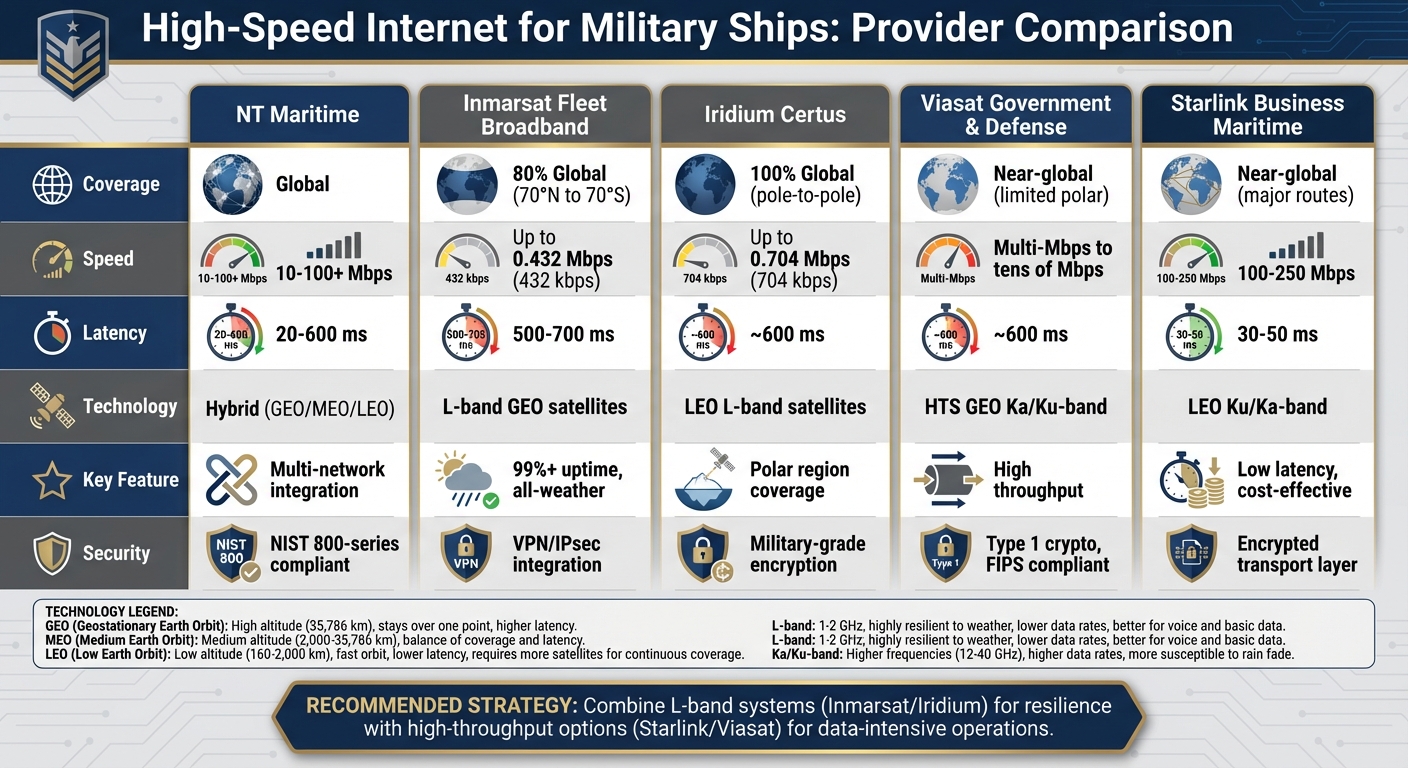
Quick Comparison

Provider Coverage Speeds (Mbps) Latency Key Features
NT Maritime Global 10–100+ Mbps 20–600 ms Hybrid networks, tailored for defense, secure
Inmarsat Fleet 80% Global Up to 0.432 500–700 ms Reliable, all-weather, L-band GEO satellites
Iridium Certus 100% Global Up to 0.704 ~600 ms Pole-to-pole, durable solid-state antennas
Viasat Government Near-global Multi-Mbps ~600 ms High throughput, encrypted, defense-grade
Starlink Maritime Near-global 100–250 30–50 ms Low latency, cost-effective, data-heavy tasks

Military planners often combine L-band systems (e.g., Inmarsat, Iridium) for resilience with high-throughput options (e.g., Starlink, Viasat) for data-intensive activities. NT Maritime excels at integrating these networks into a single, secure platform to meet diverse naval mission needs.
Military Maritime Internet Providers Comparison: Speed, Coverage, and Latency

Military Maritime Internet Providers Comparison: Speed, Coverage, and Latency

1. NT Maritime High-Speed Internet Solutions

NT Maritime

Network Technology

NT Maritime delivers reliable connectivity through hybrid satellite architectures designed for uninterrupted operations. This system combines VSAT services over Ku/Ka-band frequencies with L-band backup links, leveraging networks like Inmarsat FleetBroadband and Iridium Certus. Its multi-path design automatically transitions between GEO, MEO, and LEO satellite constellations based on changing conditions. Onboard antennas work seamlessly with modems, routers, and firewalls, ensuring smooth segmentation of mission-critical and crew communications. The system supports VoIP, secure messaging, and video conferencing via a QoS-aware IP backbone, prioritizing low-latency traffic for essential command and control tasks. This advanced setup ensures dependable connectivity across maritime operations.

Coverage

Thanks to its hybrid design, NT Maritime provides consistent coverage across a variety of maritime environments. Its dual-network approach guarantees global connectivity, spanning equatorial to polar regions. This capability is vital for Arctic and Antarctic missions, where GEO satellites often have limited visibility. U.S. Navy vessels benefit from this system, maintaining connectivity in contested waters or during polar expeditions. Additionally, terrestrial links can be integrated when ships are near coastlines or in port, reducing dependency on satellite networks and expanding overall availability.

Security Features

NT Maritime’s networks are built to meet NIST 800-series cybersecurity standards and FIPS-validated cryptography requirements, ensuring secure operations for U.S. government and defense missions. All data is encrypted using IPsec and TLS-based VPNs, safeguarding critical command and control communications. The system includes next-generation firewalls with deep packet inspection, application-layer filtering, and geo-fencing for added protection. Logical segmentation through VLANs and role-based access controls separates mission networks, administrative systems, and crew welfare Wi-Fi. For Telehealth services, encryption is paired with data integrity checks and certificate-based authentication, protecting medical consultations and records while enabling secure remote specialist access during deployments.

Performance and Latency

NT Maritime’s satellite platforms deliver aggregate throughputs ranging from tens to hundreds of Mbps per vessel – an impressive leap from older systems that typically managed just 5–10 Mbps. Latency depends on the satellite orbit: GEO links generally experience round-trip delays of about 600 ms, suitable for tasks like email and file transfers, while LEO connections bring latency down to just tens of milliseconds, enhancing real-time operations. Traffic engineering further optimizes performance, prioritizing ISR feeds and command traffic with minimal jitter, while delaying bulk data transfers during critical operations. With reliability targets exceeding 99% link availability, automatic failover mechanisms ensure uninterrupted command and safety communications, even during harsh weather or satellite disruptions. These performance improvements are crucial for supporting mission-critical activities at sea.

2. Inmarsat Fleet Broadband Solutions
Inmarsat Fleet Broadband

Network Technology

Inmarsat FleetBroadband relies on L-band connectivity via GEO satellites to provide continuous IP data and voice services. Terminals like the SAILOR 250 and 500 allow users to handle data, email, and voice communications all at once. One key advantage of the L-band frequency is its resistance to rain fade, unlike higher-frequency bands like Ku or Ka. This makes it a dependable choice for mission-critical military operations, even in poor weather conditions. FleetBroadband is commonly integrated into military and government vessels, working alongside stabilized marine antennas and onboard routers to ensure seamless communication. This setup delivers reliable global coverage.

Coverage

FleetBroadband ensures consistent satellite internet access across roughly 80% of the globe, covering regions between 70°N and 70°S. This extensive reach is essential for military missions in varied maritime environments. However, polar regions remain outside its coverage, requiring alternative solutions for connectivity in those areas. The network boasts an impressive uptime reliability of over 99%, making it a trusted option for government and military operations where uninterrupted connectivity is critical.

Security Features

FleetBroadband is designed as a commercial platform that seamlessly integrates with secure government networks, rather than being a classified system on its own. To safeguard sensitive data, defense and homeland-security users implement end-to-end VPNs and IPsec tunnels that link ships to command centers. Encryption tools, such as FIPS-validated devices, are employed to protect critical traffic. Onboard, network segmentation separates operational, administrative, and crew networks, ensuring that only mission-specific systems can access secure shore connections. Additionally, FleetBroadband’s use of the L-band provides a reliable backup for essential communications, such as command and safety systems, when higher-capacity VSAT links are unavailable.

Performance and Latency

FleetBroadband terminals, like the SAILOR 500, support broadband speeds of up to 432 kbps and can handle up to nine simultaneous voice calls. This level of performance is ideal for tasks like email, web browsing, telemetry, and mission planning. However, it’s not equipped for high-bandwidth activities like HD video streaming. As a GEO-satellite service, FleetBroadband experiences latency ranging from 500 to 700 ms round-trip, which is higher than low-Earth-orbit systems. Despite this, the latency is manageable for voice communication, messaging, and many command-and-control applications. Military users often pair FleetBroadband with higher-throughput systems like VSAT or LEO for demanding tasks, using FleetBroadband as a dependable fallback when other networks falter.

3. Iridium Certus Maritime Platform

Iridium Certus

Network Technology

The Iridium Certus Maritime platform relies on a Low Earth Orbit (LEO) satellite network, with satellites positioned just 485 miles above the Earth. This setup ensures lower latency and stable signal quality. It operates using L-band frequencies, which are highly resistant to disruptions caused by rain or atmospheric conditions. The platform’s terminals deliver download speeds of over 700 kbps and upload speeds of 352 kbps, all through a single, integrated unit that supports voice, data, and safety services. Its solid-state antennas are maintenance-free and designed without moving parts, making them highly durable in tough maritime environments. This design significantly reduces the maintenance workload for military crews, even in the harshest conditions.

Coverage

Iridium Certus Maritime offers seamless global connectivity, providing 100% pole-to-pole coverage. This capability is especially valuable for naval operations in polar regions and remote oceanic areas where traditional satellite systems fall short. Whether it’s Arctic patrols, Antarctic research missions, or operations in international waters, military vessels can rely on uninterrupted communication. This ensures mission-critical tasks, real-time coordination with command centers onshore, and vital crew support services remain operational, no matter the location.

Security Features

The platform is built with military applications in mind, incorporating secure technology through equipment like the Thales VesseLINK Maritime terminal. While designed for commercial use, it employs military-grade encryption and advanced security protocols tailored for government and defense needs. The solid-state antennas and dedicated safety features provide reliable and secure communication without frequent maintenance, ensuring consistent performance even in high-stakes environments.

Performance and Latency

Iridium Certus Maritime terminals excel in supporting multiple high-quality voice lines, high-speed IP data, and safety services simultaneously. Thanks to its LEO satellite architecture, it achieves latency as low as 600 ms or less, enabling clear voice communication for command operations, fast data transfers for intelligence sharing, and dependable emergency protocols. The single-terminal design simplifies installation and operation on military vessels, reducing complexity while ensuring all communication needs are met. Additionally, built-in upgrade capabilities allow the platform to keep pace with evolving military communication demands, making it a future-ready solution.

4. Viasat Government & Defense Positioning

Network Technology

When it comes to high-speed maritime internet for defense, Viasat sets itself apart with its advanced HTS (High-Throughput Satellite) solutions. Using GEO satellites operating in the Ku- and Ka-bands with spot-beam architecture, Viasat delivers connectivity ranging from several Mbps to tens of Mbps. These services are designed to meet the needs of the U.S. Department of Defense, NATO, and allied naval operations. Viasat’s offerings go beyond just connectivity – they include the entire ecosystem: space segment, ground infrastructure, network management, terminals, and cybersecurity. This comprehensive approach ensures reliable and secure coverage for critical missions.

Coverage

Viasat provides near-global coverage, prioritizing key maritime operational zones. While its network reaches across most ocean areas, coverage in polar regions like the Arctic and Antarctic is limited. For these areas, additional SATCOM solutions are required to maintain connectivity.

Security Features

Security is a cornerstone of Viasat’s services. The company employs multiple layers of protection, including end-to-end encryption, IPsec protocols, and support for Type 1 cryptographic systems. Network monitoring and intrusion detection systems work alongside traffic segmentation to separate mission-critical data from administrative or crew-related traffic. Additionally, private government gateways ensure sensitive data stays off public networks. These measures align with FIPS and NSA Suite B standards, providing a high level of confidence for secure communications.

Performance and Latency

Using GEO satellites, Viasat operates with a round-trip latency of about 600 milliseconds. While this latency is inherent to GEO systems, it remains sufficient for command-and-control operations and real-time video feeds. Viasat’s infrastructure includes QoS (Quality of Service) protocols to ensure mission-critical data gets top priority. The "SATCOM as a Service" model also offers flexibility, allowing users to scale bandwidth as needed without requiring upfront capital investment.

Starlink Business Maritime

Network Technology

Starlink Maritime uses low Earth orbit (LEO) satellite technology to meet the intense demands of military operations at sea. Unlike traditional GEO satellites that orbit about 22,000 miles above Earth, Starlink’s LEO satellites operate much closer, which dramatically reduces latency. This low-latency setup is crucial for tasks like live ISR feeds, real-time mission planning, cloud-based command-and-control systems, and secure video conferencing – activities that often struggle with the delays of GEO networks. The system uses electronically steered flat-panel antennas, which are less bulky than traditional VSAT domes. This design not only simplifies deck installation but also minimizes radar cross-section concerns, all while delivering hundreds of Mbps per vessel.

Coverage

Starlink Maritime provides high-speed internet with near-global coverage, focusing on major shipping routes and ocean regions. For the U.S. Navy and Coast Guard, this means dependable connectivity across the Atlantic, Pacific, and Indian Oceans, as well as key chokepoints and coastal patrol areas. While LEO networks excel in most regions, they face challenges in extreme polar areas. To address this, military planners often combine LEO with GEO or L-band systems to ensure uninterrupted service for Arctic and high-latitude missions, where traditional providers still dominate. This hybrid approach ensures tactical operations benefit from both Starlink’s low-latency performance and broader coverage options.

Security Features

Starlink prioritizes security by incorporating encrypted user traffic and secure satellite-to-ground communications. For U.S. military and government use, Starlink is typically treated as a transport layer, with mission-critical encryption handled by tools like Type 1 or FIPS 140-validated VPNs, NSA-approved tactical radios, or secure tunneling gateways. To further enhance security, military users integrate Starlink terminals into shipboard systems that include firewalls, intrusion prevention measures, zero-trust identities, and cross-domain solutions. Many also use Starlink as part of a software-defined WAN (SD-WAN) setup, which dynamically routes sensitive traffic to more secure networks when necessary. This layered approach allows users to benefit from Starlink’s speed and low latency while adhering to strict DoD and intelligence community security standards.

Performance and Latency

Starlink Maritime delivers download speeds of 100–250 Mbps, upload speeds of 20 Mbps, and latency averaging 30–50 ms. This performance makes it possible to handle data-heavy tasks like HD video conferencing with shore-based teams, large software updates, intelligence transfers, and even concurrent crew internet use. The low latency is particularly useful for VoIP, real-time collaboration tools, and interactive training platforms, which have historically struggled on GEO networks. Pricing for Starlink Business Maritime is set at $250 per month, with hardware available for $1,999.

Provider Comparison: Advantages and Disadvantages

When it comes to selecting a high-speed internet provider for military ships, the decision hinges on several factors: network design, coverage, performance, and security. Each provider offers unique strengths and trade-offs, and understanding these is crucial to aligning capabilities with mission requirements.

NT Maritime (NT Connect) takes a unique approach as a systems integrator, blending multiple networks like Starlink, Inmarsat, and Iridium into a unified, managed solution. This setup ensures high throughput and built-in redundancy while offering tailored compliance for government and military fleets. However, its performance ultimately depends on the coverage and reliability of the underlying satellite networks.

Inmarsat Fleet Broadband is known for its reliability and all-weather performance, leveraging GEO L-band satellites to provide speeds up to 432 kbps with an impressive 99.9%+ uptime. While it delivers consistent voice and data capabilities essential for command operations, its coverage is limited to about 80% of the globe, falling short in extreme polar regions.

Iridium Certus stands out for its 100% global coverage, including pole-to-pole connectivity, thanks to its LEO L-band satellites. With speeds up to 704 kbps and robust solid-state antennas, it’s a solid choice for Arctic operations, backup links, and critical command communications where uninterrupted connectivity is vital.

Viasat Government & Defense offers high-capacity GEO Ka/Ku-band VSAT solutions, delivering multi-Mbps to tens of Mbps throughput. This makes it ideal for bandwidth-heavy tasks like real-time ISR feeds and HD video conferencing. Its strengths include integration with defense networks and secure, encrypted links. However, inherent GEO latency and limited coverage in extreme polar areas are considerations.

Starlink Business Maritime provides speeds between 100–250 Mbps with low latency (under 99 ms) using LEO Ku/Ka-band satellites. It offers a cost-effective option for high throughput compared to traditional GEO plans. While its coverage includes major shipping routes, it still requires verification for operations in extreme polar regions and long-term classified missions.

For military planners, the most effective approach often combines L-band systems (like Inmarsat or Iridium) for resilient command and safety communications with high-throughput options (like Starlink or Viasat) for mission-critical data and crew welfare. This layered network strategy, which integrates resilience, capacity, and security, is precisely what NT Maritime excels in delivering.

These comparisons highlight the importance of a multi-layered architecture to address the evolving demands of maritime missions effectively.

Conclusion

The best approach combines the unique strengths of different networks to meet specific mission requirements. Each provider brings distinct advantages that need to align with operational demands.

As outlined in the earlier provider reviews, the ideal solution hinges on matching network capabilities to mission needs. Some systems are built for global coverage, while others shine in uptime reliability or delivering high-capacity performance. High-throughput networks, for example, are excellent for handling bandwidth-heavy tasks in a cost-effective way.

A multi-layered strategy ensures seamless integration and security. NT Maritime offers a standout example by unifying multiple networks into a single, defense-grade platform designed to handle evolving military challenges.

For modern naval operations, a layered architecture is key. This means using L-band systems like Iridium or Inmarsat for mission-critical resilience, while relying on high-throughput networks like Viasat or Starlink for tasks requiring significant bandwidth. Integrated management becomes crucial for prioritizing traffic, maintaining security segmentation, and adapting to emerging threats. Smaller vessels with tighter budgets can focus on dependable L-band systems with basic data packages, while larger ships benefit from hybrid solutions that balance reliable access, crew welfare, and operational flexibility.

Military planners should adopt a tailored, modular approach. This involves combining resilient L-band links for essential tasks with high-capacity networks for data-intensive operations, ensuring the system can evolve alongside future mission requirements.

FAQs

What are the advantages of NT Maritime’s hybrid satellite system for military vessels?

NT Maritime’s hybrid satellite system delivers secure, high-speed internet access tailored for the unique demands of military operations at sea. This system ensures reliable communication networks that keep crews connected, even when operating in remote or challenging environments.

With this system, crews benefit from advanced onboard communication tools, including calling, messaging, and video conferencing. Additionally, its integrated systems are designed to enhance both operational efficiency and safety. These features are specifically crafted to meet military needs, enabling seamless communication and better coordination during critical missions.

How does NT Maritime provide secure communication for military ships?

NT Maritime specializes in providing secure communication systems specifically designed for military ships. By leveraging mission-critical networks and advanced location services, they ensure reliable and protected communication channels, even in the most demanding maritime conditions.

On top of that, NT Maritime integrates Telehealth technologies to address onboard medical needs, adding an extra layer of safety and operational efficiency for naval missions. Their solutions focus on delivering the security and reliability essential for government and military operations.

Why is a multi-layered network strategy essential for military maritime operations?

A robust, multi-layered network strategy plays a crucial role in military maritime operations. It ensures secure and reliable communication, even in the most remote or high-risk environments. By integrating various communication technologies – like onboard systems, satellite connections, and terrestrial networks – this approach creates redundancy, helping maintain uninterrupted connectivity.

Additionally, it bolsters cybersecurity by minimizing vulnerabilities and safeguarding mission-critical systems. This ensures that both strategic and tactical goals can be achieved effectively, no matter the conditions at sea.


Satellite vs Cellular: Best Maritime Internet?

Satellite vs Cellular: Best Maritime Internet?

When it comes to maritime internet, your choice boils down to satellite or cellular connectivity. Both have distinct advantages, and your decision depends on where your vessel operates and what kind of connectivity you need. Here’s the breakdown:

  • Satellite Internet: Best for global coverage, especially in open seas. Low Earth Orbit (LEO) satellites now provide faster speeds and lower latency, making them suitable for real-time applications. However, satellite systems are more expensive and can be affected by severe weather.
  • Cellular Internet: Ideal for vessels near coastlines. With 4G LTE and increasing 5G availability, cellular networks deliver faster speeds and lower latency than traditional satellite systems. That said, coverage is limited to 15–40 nautical miles offshore.
  • Hybrid Systems: Combine satellite and cellular networks for seamless switching based on location and signal strength, balancing cost and performance.

Quick Comparison

Feature Satellite Cellular
Coverage Global, including open seas Coastal (15–40 miles)
Speed 5–250 Mbps (LEO) 50 Mbps–2 Gbps (4G/5G)
Latency 25–600 ms 10–64 ms
Reliability Weather-dependent Coastal congestion may occur
Best For Open-ocean vessels Coastal operations

For cruise ships, cargo vessels, and superyachts, hybrid systems are often the best solution. They leverage cellular networks near shore and switch to satellite in remote areas, ensuring reliable connectivity. Choose based on your vessel’s routes, budget, and connectivity needs.

Podcast Episode: The Ultimate Guide to Data SIM Cards, Wireless Internet for Boats

How Satellite Internet Works at Sea

Satellite internet keeps vessels connected globally by using radio signals relayed through orbiting satellites. Here’s how it works: when a ship sends data, it travels from the vessel’s antenna to a satellite in space, which then relays it down to a ground station tied to the internet backbone. For incoming data, the process is reversed.

This system relies on three main components: the satellite constellation itself, ground stations (also known as teleports) that link to terrestrial networks, and the onboard equipment on the vessel. These elements are strategically positioned worldwide to provide consistent coverage and backup systems.

Maritime satellite internet operates on specific frequency bands such as C-band and Ku-band, with newer systems increasingly adopting Ka-band for higher data speeds. Each band has its own strengths, including differences in signal strength, resistance to weather, and bandwidth. These factors play a crucial role in how satellite orbit types influence overall performance.

LEO vs. Geostationary Satellites

Geostationary satellites are positioned roughly 22,236 miles above the Earth’s equator. They remain fixed relative to the planet, allowing vessels to use simpler, stationary antennas. However, the distance introduces a delay: signals take about 500–600 milliseconds for a round trip, which can impact real-time communications.

In terms of performance, traditional geostationary systems provide download speeds ranging from 1 to 50 Mbps, depending on the user’s service plan and network traffic. Upload speeds are typically slower, between 256 Kbps and 5 Mbps. Despite the latency, these systems are known for their widespread coverage and decades of reliability across vast ocean areas.

Low Earth Orbit (LEO) satellites, on the other hand, operate much closer to Earth, at altitudes between 300 and 1,200 miles. This proximity reduces latency to just 20–40 milliseconds, making them ideal for real-time applications. LEO constellations require hundreds or even thousands of satellites to ensure continuous coverage, as each satellite moves quickly across the sky.

LEO systems can achieve download speeds exceeding 100 Mbps, with upload speeds often matching or nearing the same levels. However, they come with added complexity: shipboard antennas must track the rapidly moving satellites and seamlessly switch connections as satellites pass. This requires advanced – and more costly – tracking equipment.

Weather impacts the two systems differently. Geostationary satellites, particularly those using Ku-band frequencies, can experience rain fade during heavy storms, which temporarily reduces signal quality. LEO systems may show better resilience to weather, but this depends on the specific constellation and frequency band being used.

Required Hardware and Installation

For maritime satellite internet to perform well in ever-changing conditions at sea, the right hardware is essential. The most noticeable component is the satellite antenna, which plays a critical role in maintaining connectivity. Geostationary systems typically use parabolic dishes ranging from 24 inches to 8 feet in diameter. Larger dishes generally provide stronger signals and higher data rates. These antennas are housed within protective radomes to shield them from harsh weather and reduce wind drag.

Modern geostationary antennas are equipped with gyro-stabilized systems that keep the antenna locked onto the satellite, even in rough seas. High-end systems can maintain a signal in waves as high as 15 feet, though extreme conditions may still affect performance.

LEO satellite systems, meanwhile, rely on phased array or mechanically steered antennas to track the fast-moving satellites. These antennas are typically smaller and flatter than traditional dishes, making them a good fit for smaller vessels or situations where space is limited.

Below deck, the setup includes a satellite modem, which handles the conversion of digital data into radio signals and vice versa. These modems are built to endure the tough marine environment, withstanding temperature swings, high humidity, and constant vibration. Most setups also include redundancy features and automatic failover systems to maintain connectivity in case of equipment issues.

Proper installation is key to ensuring reliable performance. The antenna must be placed in a location with an unobstructed line-of-sight to the sky, away from interference caused by the ship’s structure, masts, or other equipment. Typically, this means mounting it at the vessel’s highest practical point. Professional installers use specialized tools to model signal coverage and pinpoint the best placement.

Power needs can vary widely. Smaller geostationary systems consume 50–150 watts, while high-throughput systems may require 300–500 watts. LEO terminals tend to use less power because of the stronger signals from closer satellites, though their advanced tracking mechanisms may offset this advantage.

Finally, the system’s cabling and internal networking tie everything together. Coaxial or fiber optic cables rated for marine environments connect the satellite equipment to the vessel’s internal network. Additional components, such as network switches and wireless access points, distribute the connection throughout the ship. Proper cable routing and weatherproofing are essential to prevent signal loss and protect equipment from damage caused by saltwater exposure.

How Cellular Internet Works at Sea

Cellular internet at sea functions by connecting to land-based cell towers through technology similar to what smartphones use. As ships move away from the shore, onboard systems communicate with coastal towers using radio waves, which are routed through terrestrial networks.

Unlike satellite-based systems, cellular maritime internet relies entirely on staying within range of land-based towers. A clear line of sight to these towers is essential for maintaining a connection. However, as vessels venture farther out, signal strength diminishes due to the Earth’s curvature and the limited range of coastal towers. Additional challenges, such as adverse weather and atmospheric interference, can further weaken the signal and affect reliability.

Modern maritime cellular systems often operate on 4G LTE networks, with 5G becoming more prevalent. These technologies provide faster speeds, lower latency, and better efficiency, making them ideal for operations close to the coastline. However, the reliance on land-based infrastructure means coverage is directly tied to how far a vessel is from shore.

Coastal Coverage Range

Ships generally experience reliable cellular coverage within 3–8 miles of the coast. LTE networks can extend up to 50 nautical miles under optimal conditions, while specialized equipment can boost the range to about 18–20 miles.

Several factors play a role in determining the actual coverage range. For example, the height of a ship’s antenna and the coastal terrain can significantly influence how far the signal travels.

Required Hardware for Cellular

Hardware is just as critical as signal reach when it comes to cellular internet at sea. Maritime cellular systems utilize durable equipment designed to handle harsh conditions like constant vibrations, temperature changes, and exposure to saltwater. Essential components include core routers, omnidirectional antennas, and signal boosters.

Marine antennas, typically omnidirectional, are mounted high on the ship to maintain a clear line of sight to coastal towers. Signal boosters are also employed to strengthen weaker signals, extending coverage where possible. The right combination of rugged hardware is key to ensuring stable and consistent internet access while navigating coastal waters.

Satellite vs Cellular: Direct Comparison

When deciding between satellite and cellular internet for maritime use, it’s essential to weigh their technical and operational differences. Coverage, speed, and cost are the key factors that will help you choose the right option for your vessel.

Coverage and Reliability

Coverage and reliability are where satellite and cellular internet diverge the most. Satellite internet provides global ocean coverage, making it accessible even in the most remote areas, as long as there’s an unobstructed view of the sky.

On the other hand, cellular internet excels in coastal waters. It offers reliable connectivity within 15–40 nautical miles of shore, but its performance drops off quickly as you move further out to sea.

Factor Satellite Cellular
Coverage Area Global ocean coverage Reliable within 15–40 nautical miles of shore
Weather Impact Can degrade during heavy rain or snow Minimal, though congestion may occur
Reliability Consistent with a clear sky view Strong within the coastal coverage range

Speed and Performance

Advancements in technology have significantly improved the performance of both satellite and cellular networks, but each has its strengths. Cellular networks, especially 4G and 5G, deliver exceptional speeds when close to shore.

Steve Gorman, Field Service Engineer at Super Yacht Americas Sales, KVH, highlights this advantage:

"With cellular, I think the biggest benefit right now is that with 5G, it can actually be faster than low earth orbit (LEO) services like Starlink and OneWeb." – Steve Gorman

Satellite internet performance varies based on the type of service. Traditional geostationary satellites often struggle with slower speeds and high latency, typically around 550 milliseconds. In contrast, LEO services like Starlink Maritime have transformed satellite internet, offering speeds between 5–250 Mbps and latency as low as 25–99 milliseconds.

Performance Metric Satellite (LEO) Cellular (4G/5G)
Download Speed 5–250 Mbps (varies by plan) 50 Mbps – 2 Gbps
Upload Speed 2–25 Mbps 8–80 Mbps
Latency 25–99 ms Under 64 ms (often single digits)
Performance Conditions Requires clear sky; weather-dependent Best within 15–40 nautical miles; may face congestion

The next step is to determine which option aligns best with your vessel’s needs based on these factors.

Best Solution by Vessel Type

The connectivity needs of vessels vary based on their operations, size, and travel routes. Choosing between satellite, cellular, or a hybrid system depends on these factors. Here’s a closer look at the best connectivity options for different types of vessels.

Cruise Ships

Cruise ships face a unique challenge: providing reliable, high-speed internet to thousands of passengers who expect seamless streaming, social media access, video calls, and more. To meet these demands, many cruise lines use hybrid connectivity systems. These systems tap into cellular networks when near the coast and switch to satellite networks farther out at sea. Modern satellite technology can deliver download speeds of up to 220 Mbps, ensuring smooth operations and keeping passengers connected.

Cargo and Commercial Vessels

For cargo and commercial vessels, the focus is on operational efficiency and cost-effectiveness rather than passenger entertainment. These vessels rely on dependable connectivity for tasks like tracking, communication, and receiving weather updates. Near shorelines, cellular networks offer an affordable solution. However, for long journeys into open seas, satellite connectivity becomes essential, enabling real-time monitoring and navigation to keep operations running smoothly.

Superyachts and Leisure Vessels

Owners of superyachts and leisure vessels expect internet connectivity that rivals the performance of high-end residential or business setups. These vessels often use premium hybrid solutions, which combine high-speed satellite and cellular services. The technology supports activities like video conferencing and streaming, all while maintaining low latency. Additionally, low-profile antennas are often installed to preserve the vessel’s sleek design without sacrificing performance.

Below is a quick comparison of the ideal connectivity solutions for each vessel type:

Vessel Type Primary Need Recommended Connectivity
Cruise Ships High-capacity, high-speed internet for many users Hybrid system: coastal cellular + offshore satellite
Cargo/Commercial Reliable communication for operational tasks Coastal cellular with satellite for deep-sea connectivity
Superyachts/Leisure Premium, multi-device support with low latency Premium hybrid: high-speed satellite + low-profile antennas

What’s Coming Next

The maritime internet is undergoing rapid changes, with new technologies set to reshape how ships stay connected while at sea. These advancements aim to tackle current challenges and unlock new opportunities for maritime operations.

Expanding LEO Satellite Networks

Low Earth Orbit (LEO) satellite networks are making waves in maritime connectivity. Unlike traditional geostationary satellites that orbit much farther away, LEO satellites operate at altitudes between roughly 340 and 1,200 miles. This closer range dramatically reduces signal travel time, cutting latency to under 50 milliseconds – compared to the 600 milliseconds or more typical of geostationary systems.

LEO networks rely on vast constellations of satellites, often numbering in the hundreds or thousands, to provide seamless global coverage. This means fewer dead zones and more reliable connections, even in remote ocean regions.

Speed is another area where LEO networks shine. Current systems already deliver download speeds exceeding 200 Mbps, with potential to approach 1 Gbps in the near future. Meanwhile, hardware is evolving rapidly – next-generation antennas are becoming smaller, lighter, and easier to install. Features like automatic tracking and self-alignment are simplifying maintenance, making these systems more accessible for vessels of all sizes.

As LEO technology advances, cellular networks are also stepping up to enhance maritime connectivity.

5G and Emerging Cellular Networks

5G technology is extending reliable connectivity for vessels operating near coastlines. Early deployments are already providing coverage up to 15–25 miles offshore, a significant boost for vessels navigating busy shipping lanes, harbors, and fishing zones.

Under optimal conditions, 5G-enabled ships can reach download speeds of up to 1 Gbps and upload speeds around 100 Mbps. Features like network slicing allow operators to prioritize critical tasks – such as emergency communications or navigation – ensuring that essential data gets through, even during high-traffic periods.

A key development is the integration of 5G with satellite systems, creating hybrid connectivity solutions. These setups enable vessels to switch seamlessly between 5G and satellite networks based on their location and signal strength. Additionally, edge computing within 5G networks is enabling local data processing for time-sensitive tasks like autonomous navigation or real-time weather monitoring.

Looking further ahead, research into 6G technology is already underway. While specifics are still emerging, early signs suggest that future networks could offer even better offshore coverage, faster speeds, and lower latency through enhanced integration and optimization techniques. The horizon for maritime connectivity looks more promising than ever.

Final Recommendations

Choose between satellite and cellular internet based on where your vessel operates, what kind of connectivity you need, and how much you’re willing to spend.

Key Points

Satellite internet offers worldwide coverage, making it perfect for vessels traveling in remote areas or open oceans. Modern low-earth orbit (LEO) satellites provide faster speeds and lower latency, supporting advanced communication systems onboard. That said, satellite services tend to be pricier and may experience interruptions during severe weather.

Cellular internet is a fast and efficient option for vessels operating near the coast. With the rollout of 5G, cellular networks are becoming even more capable, but their range is still limited to areas close to shore.

Hybrid solutions combine the strengths of both satellite and cellular networks, automatically switching between them based on location and signal strength. This setup balances performance and cost but requires more advanced hardware to function seamlessly.

Connectivity options continue to improve. LEO satellite networks are expanding their coverage and boosting speeds, while cellular networks are extending their reach offshore. These evolving technologies provide a foundation for making connectivity decisions tailored to your vessel’s needs and budget.

Choosing by Vessel Type and Budget

Your vessel’s size, operational zone, and budget will guide the right connectivity mix.

  • Large vessels like cruise ships and commercial fleets often benefit from hybrid systems. These systems combine the speed of coastal cellular networks with the global reach of satellite coverage.
  • Coastal cargo operations can rely primarily on cellular networks, with satellite as a backup for areas with poor coverage.
  • Superyachts and leisure vessels can choose based on their typical routes. Coastal vessels are better suited for cellular services, while those traveling internationally will need the broader coverage offered by LEO satellites.

Make sure your connectivity solution matches your operational needs. For example, global satellite coverage is unnecessary for vessels that operate mainly near the coast, but reliable communication is essential for mission-critical operations.

FAQs

What should I consider about costs when choosing between satellite and cellular internet for maritime use?

When it comes to maritime internet costs, satellite services tend to be on the pricier side. Monthly fees can fall anywhere between $40 and over $500, depending on the provider and the speed you’re after. On top of that, the initial setup can be steep due to the specialized equipment and infrastructure required. On the other hand, cellular internet is often a more budget-friendly choice, offering flexible data plans and lower upfront costs – especially when you’re using SIM card-based options.

Satellite internet works best if you need global coverage or have high data demands, but it might not make sense financially for short-term use or less intensive needs. Cellular solutions are a more affordable alternative if you’re operating near shorelines or in areas with dependable network coverage. To choose the right option, think about what you need most – whether it’s coverage, data capacity, or staying within a specific budget.

How does 5G technology improve the speed and reliability of maritime cellular internet?

The arrival of 5G technology has transformed maritime cellular internet, offering blazing-fast speeds, reduced lag, and dependable connections. With data rates climbing to an impressive 20 Gbps and latency dropping to as low as 5 milliseconds, 5G delivers the kind of connectivity needed for high-demand tasks like real-time communication and rapid data sharing.

What’s more, 5G extends its reach even to remote maritime zones by leveraging advanced tools such as vessel-based relay stations and multi-hop connections. This ensures reliable service across critical shipping routes, enhancing safety, boosting efficiency, and meeting the growing connectivity demands of modern maritime operations.

What should I consider when choosing between a hybrid system and a dedicated satellite or cellular system for my vessel?

When choosing between a hybrid system and a dedicated satellite or cellular system for maritime connectivity, it’s essential to weigh factors like coverage needs, technical complexity, and cost-efficiency.

Hybrid systems work well for vessels that operate in both coastal and remote areas. By combining satellite and cellular networks, they deliver more consistent connectivity. That said, managing multiple communication channels in hybrid systems can require advanced coordination and expertise.

Cost is another key consideration. While hybrid systems often come with higher upfront costs, they can save money in the long run by enhancing reliability and minimizing downtime – especially in remote or weather-challenged regions. On the flip side, dedicated systems are simpler and might be more budget-friendly for vessels with predictable routes or minimal connectivity demands. Ultimately, your decision should reflect your vessel’s specific operational needs and financial priorities.

Maritime Internet Costs: What to Expect?

Maritime Internet Costs: What to Expect?

Maritime internet is expensive – expect to pay $1,000 to over $10,000 per month compared to the $50–$100 typical for land-based internet. Why? It relies on satellite systems to provide connectivity over oceans, making it costly to maintain stable connections for moving vessels. Costs depend on factors like vessel type, user demand, and geographic coverage.

For example:

  • Cargo ships with basic needs pay less.
  • Cruise ships with high-speed demands for passengers pay significantly more.
  • Operating in remote areas increases charges.

Pricing models include daily, weekly, and monthly plans, with options for tiered data or unlimited use. Packages range from basic communication to high-speed internet for large vessels. Controlling costs involves choosing the right plan, monitoring usage, and using hybrid systems like Starlink or LTE near shorelines.

Understanding your vessel’s needs and available technologies can help you manage expenses effectively.

Internet At Sea! Viasat Maritime 3 Year Full Review 📡 Sailing Vessel Delos

Viasat Maritime

How Maritime Internet Pricing Works

Maritime internet pricing reflects the unique challenges of staying connected on open waters. Knowing how these pricing models work can help you make smarter, cost-conscious decisions. Let’s break down the key models and factors that shape your final bill.

Pricing Models Explained

Internet providers typically offer a range of plans: daily, weekly, monthly, and tiered data options. Here’s how they work:

  • Daily plans are perfect for short trips or occasional use.
  • Weekly packages can be more economical for medium-length journeys.
  • Monthly unlimited plans cater to heavy users who need constant connectivity, though they often come with fair usage policies that may reduce speeds after hitting a data cap.
  • Tiered plans start with a set data allowance, with extra charges applied once you exceed it.

For vessels requiring consistent internet access, monthly unlimited plans might seem appealing, but it’s crucial to monitor data usage closely – especially with tiered plans – to avoid unexpected charges.

Package Types and What’s Included

Maritime internet packages are typically grouped into three levels:

  • Basic packages: Designed for essential tasks like checking emails, accessing weather updates, and light browsing. Speeds are modest but sufficient for minimal needs.
  • Standard packages: Offer faster speeds for activities like social media, video calls, and moderate file transfers.
  • Premium packages: Deliver high-speed connectivity for heavy data tasks. These often include extras like technical support, equipment maintenance, backup options, and advanced security features.

Some providers also offer specialized services, such as priority bandwidth during emergencies or enhanced security protocols for sensitive data.

What Affects Your Price

Several factors influence the cost of maritime internet:

  • Vessel type: Passenger ships generally pay more than cargo vessels due to higher connectivity demands.
  • Geographic coverage: Operating in remote areas often comes with additional surcharges.
  • Booking terms: Early reservations and long-term contracts can secure discounts, while last-minute bookings tend to be more expensive.

Choosing the right pricing model and package, while accounting for these factors, can help you manage your maritime internet expenses efficiently.

Main Factors That Drive Maritime Internet Costs

Knowing what influences maritime internet costs can help you plan your budget and choose the right service level for your vessel. Building on the pricing models discussed earlier, here are the key factors that shape your overall costs.

Satellite Bandwidth and Coverage Requirements

Maintaining global satellite coverage is no small feat, and the high infrastructure costs involved are passed on to customers. Satellites need to be strategically positioned to ensure reliable coverage, particularly in remote ocean regions where standard internet infrastructure is nonexistent.

If your vessel requires higher bandwidth, you’ll need more satellite resources, which directly increases your monthly fees. Operating in remote areas often comes with additional charges due to limited satellite availability and higher operational expenses.

Vessel Size and Number of Users

The size of your vessel and the number of people onboard significantly impact costs. Larger vessels with more users demand higher bandwidth and more advanced equipment, which drives up both initial setup and recurring expenses.

User density plays a major role here. For example, a typical cargo ship might require 2-5 Mbps of shared bandwidth, while passenger ships often need 50-200+ Mbps to accommodate hundreds of simultaneous users.

Bigger ships also need more powerful antennas, extra access points, and backup systems. These hardware requirements, along with installation and maintenance, can add thousands of dollars to your setup and monthly bills.

Special Security and Medical Requirements

Government and military vessels face higher costs due to the need for secure, encrypted communication channels. These ships must meet strict federal security standards, and the additional infrastructure and certifications involved can double or even triple the cost of standard internet services.

For vessels requiring telehealth capabilities, costs can rise further. Ships operating in isolated areas or carrying large numbers of passengers often need reliable video conferencing for emergency medical consultations. This requires dedicated bandwidth and specialized equipment, which adds to the overall price.

Compliance standards also play a role in driving up costs. Ships subject to government or industry-specific regulations must invest in additional security measures, data logging, and certified equipment that meets operational requirements. These compliance-related expenses are typically included in monthly service fees rather than billed separately, but they can make a noticeable impact on your budget.

Maritime Internet Package Comparison

When choosing a maritime internet package, it’s crucial to strike the right balance between performance and cost. These packages are tailored to meet the diverse needs of different vessels, falling into four main categories.

Available Package Categories

Each category of maritime internet packages caters to specific vessel types and usage requirements:

  • Basic Communication: These packages cover essential needs like crew calling, messaging, and voicemail. They’re a practical choice for cargo ships and smaller commercial vessels where internet use is limited to operational purposes.
  • Advanced Communication: Designed for vessels requiring more robust communication tools, these packages include features like video calling, group messaging, and app-to-ship calling. They’re often integrated with onboard passenger management systems, making them ideal for mid-size vessels with limited passenger services.
  • Secure Government/Military: These packages prioritize security with encrypted communication networks and federal compliance. They include restricted access controls and specialized protocols, making them suitable for critical government or military operations.
  • High-Speed Internet: Offering speeds of up to 220 Mbps for downloads and 40 Mbps for uploads, with latency under 99 milliseconds, these packages are built for cruise ships and large passenger vessels. They deliver the reliable, high-performance internet that guests expect.

A quick comparison of these categories is provided below.

Feature Comparison

Package Type Key Features Best For
Basic Communication Calling, messaging, voicemail Cargo ships, small commercial vessels
Advanced Communication Video calls, group messaging, app-to-ship calling Mid-size vessels with limited passenger services
Secure Government/Military Encrypted networks, federal compliance Government and military operations
High-Speed Internet Up to 220 Mbps download, 40 Mbps upload, <99ms latency Cruise ships, large passenger vessels

How to Control Maritime Internet Costs

Managing maritime internet costs effectively requires a clear understanding of your connectivity needs and smart use of technology. By carefully selecting the right package, using advanced tools, and exploring flexible plans, you can keep expenses in check without compromising essential connectivity.

Choosing the Right Package for Your Needs

Start by assessing your vessel’s current and future connectivity requirements. Do you need advanced features for operations and remote support, or are basic communication tools sufficient? Thinking ahead – 5 to 10 years – can help you avoid short-term fixes that might lead to costly upgrades later.

Your vessel’s location is another critical factor. For regional operations, options like VSAT and LTE can be more economical. However, if your routes include polar regions or require global coverage, L-band technology, while pricier, might be unavoidable.

Location-based solutions can also help cut costs. For example, when operating within 5–10 miles of the shore, LTE cellular networks are a much cheaper alternative to satellite connections.

Another way to optimize costs is by adopting hybrid systems. These combine technologies like VSAT, LEO satellites (e.g., Starlink), and 4G/5G networks to balance coverage, speed, and cost. With automatic switching, hybrid systems choose the most efficient connection based on your location, ensuring reliable service without unnecessary expenses.

Technology Tools for Cost Management

Technology can be a powerful ally in controlling costs. Bandwidth management systems, for instance, allow you to monitor internet usage and avoid overage charges. Additionally, integrated communication platforms and managed applications can help streamline data usage, ensuring critical services take priority over less essential activities.

Finding Discounts and Flexible Solutions

Flexible service plans can lead to significant savings compared to fixed-rate packages. Look for providers offering scalable options that let you upgrade to next-generation technology without hefty penalties or the need for full system replacements.

Understanding pricing models is also essential. Depending on your usage patterns, you can choose between prepaid, usage-based, or unlimited plans to find the most cost-effective solution for your needs. By tailoring your plan to your actual usage, you can avoid paying for features you don’t need.

Key Points About Maritime Internet Costs

Understanding what drives maritime internet costs can help you choose the right plan and avoid unnecessary expenses.

One major factor is bandwidth capacity. For example, NT Maritime offers download speeds of up to 220 Mbps, but higher data capacity often comes with a higher price tag.

Other factors also play a role, including the size of the vessel, the number of users, and the operating region. Larger ships or those operating in remote areas typically require more robust and specialized connectivity solutions, which can increase costs.

To manage expenses, consider using scalable and modern connectivity options that balance performance with budget. Additionally, monitoring tools can help you keep track of data usage and avoid unexpected overage charges. These strategies allow you to adjust your plan as your needs evolve.

FAQs

What are the best ways to manage and reduce maritime internet costs for my vessel?

Managing maritime internet costs doesn’t have to be overwhelming. A good starting point is to set data usage quotas for both your crew and onboard systems. This approach ensures everyone gets a fair share of the available data while keeping essential operations running smoothly without unnecessary overuse.

Another smart move is to regularly monitor and analyze how data is being consumed. By understanding usage patterns, you can pinpoint areas where adjustments might save money. For added flexibility, consider giving your crew the option to purchase extra data through self-service tools. This not only empowers them but also keeps costs under control. Lastly, look into service plans designed specifically for your vessel’s requirements. This way, you’re not paying for features or data you don’t actually need.

What are the differences between basic, standard, and premium maritime internet plans, and how do I choose the right one?

Maritime internet plans are typically grouped into three categories: basic, standard, and premium, each catering to different levels of usage.

  • Basic plans are best for light activities like checking emails or occasional browsing. These usually cost around $70 per month and often come with limited data, with extra charges applied if you exceed the allowance.
  • Standard plans strike a middle ground, offering a mix of reasonable speeds, data, and affordability. They’re a good option for moderate usage across several devices.
  • Premium plans are designed for heavy usage, providing the fastest speeds and the largest data allowances. Ideal for tasks like streaming or video conferencing, these plans can exceed $40 per day, depending on the provider and features.

When selecting a plan, think about your data needs, how many devices you’ll connect, and whether speed and reliability are essential for your activities.

How does my vessel’s location affect the cost and availability of maritime internet?

Your vessel’s location significantly impacts the cost and availability of maritime internet services. If you’re in areas with access to multiple submarine cables, you’ll likely enjoy faster speeds and lower prices because of increased competition. On the other hand, when you’re in remote regions or out in the open ocean, connectivity often depends on satellite-based systems, which tend to be pricier.

Some providers may also have limited coverage in certain zones, particularly those categorized as "at sea." Other factors like geopolitical issues, local infrastructure, and environmental conditions can further affect both pricing and service availability. Knowing your vessel’s usual routes can help you pick a plan that strikes the right balance between cost and coverage.