

How Scalable Networks Improve Ship Connectivity

Modern ships demand reliable connectivity for safety, efficiency, and crew welfare. However, maritime environments present unique challenges:

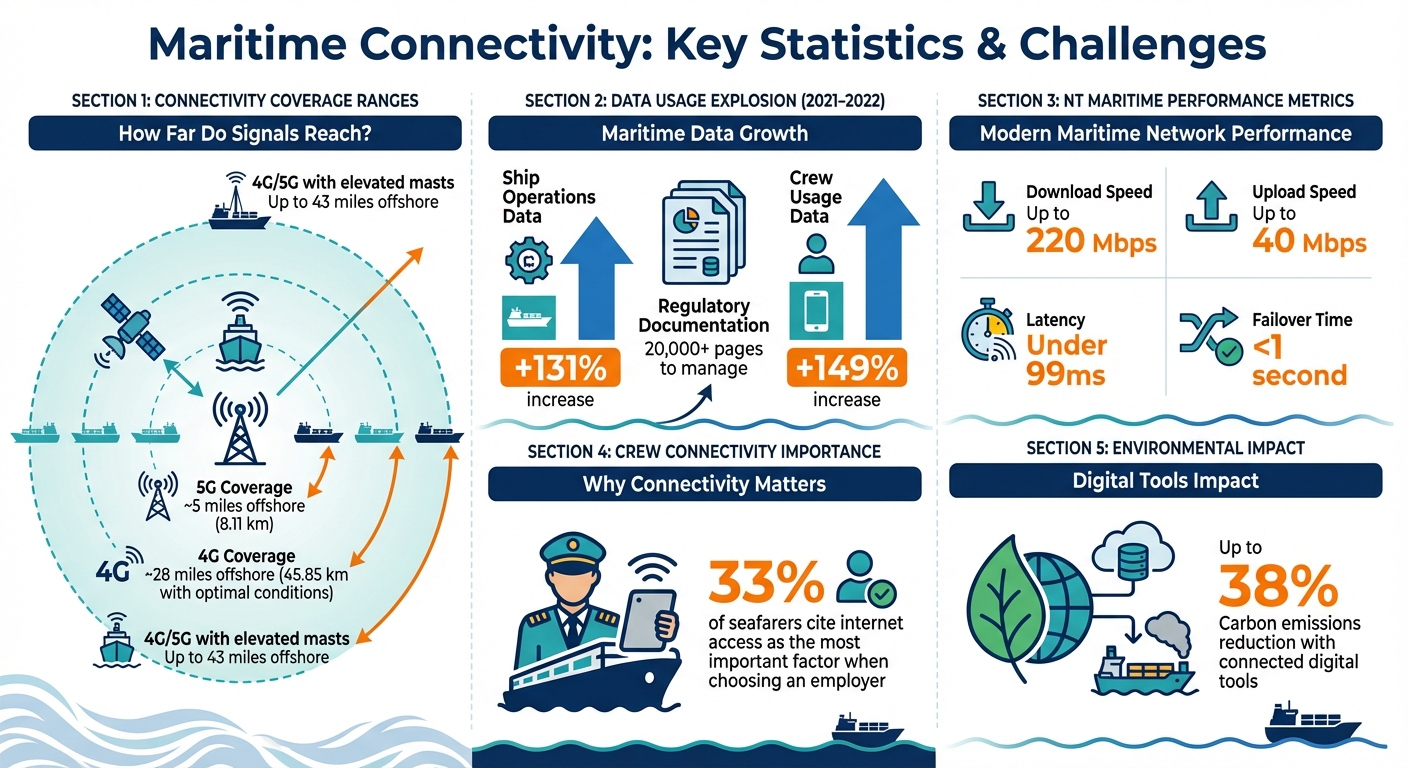
  • Limited terrestrial coverage: 5G signals fade ~5 miles offshore; 4G reaches ~28 miles.
  • Satellite issues: High latency and limited bandwidth.
  • Growing data needs: Ship operations and crew usage increased by 131% and 149% (2021-2022).
  • Regulatory pressures: Ships must manage increasing operational data to meet over 20,000 pages of regulations.

Scalable networks address these problems by combining technologies:

  • Hybrid connectivity: Integrates 5G, satellite (LEO, MEO, GEO), and vessel-to-vessel relays.
  • Network slicing: Prioritizes critical operations over less urgent traffic.
  • Edge computing: Processes data onboard, reducing satellite dependency.
  • Modular designs: Allow cost-effective upgrades without overhauling systems.

NT Maritime leads with solutions offering:

  • Speeds up to 220 Mbps (download) and 40 Mbps (upload).
  • Latency under 99ms.
  • Crew welfare tools like video calling and Telehealth.

Key takeaway: Scalable networks transform ships into connected hubs, ensuring efficient operations, better crew experiences, and compliance with modern demands.
Maritime Connectivity Statistics: Network Coverage, Data Growth, and Performance Metrics

Maritime Connectivity Statistics: Network Coverage, Data Growth, and Performance Metrics

Marlink

Assessing Current Ship Connectivity Needs

Before upgrading any ship’s connectivity, start by documenting all existing onboard assets. This means taking stock of every piece of connectivity hardware, from satellite terminals to Wi-Fi access points. Your inventory should include VSAT (GEO) systems, newer LEO constellations like Starlink or OneWeb, and L-Band safety backups such as FleetBroadband or Iridium Certus. Don’t overlook terrestrial components like 4G/5G cellular setups, which, when paired with marine-grade antennas and signal boosters, are vital for coastal operations. These systems typically provide coverage up to 19 miles offshore, but with higher masts, this range can extend to 43 miles. A thorough inventory of all hardware types will lay the groundwork for a scalable connectivity strategy.

Inventory Network Components

Go beyond basic hardware and include specialized maritime systems that handle critical data. This means cataloging systems such as AIS (Automatic Identification System), GNSS (Global Navigation Satellite System), GMDSS (Global Maritime Distress and Safety System) equipment, Dynamic Positioning computers, industrial Ethernet switches, routers, and ship gateways that connect various systems. High-bandwidth devices like radars, cameras, and LiDAR sensors generate large files, which can put significant strain on your network’s transmission capacity. Additionally, emerging technologies such as unmanned surface vehicles (USVs), autonomous underwater vehicles (AUVs), and tethered UAVs may act as mobile relays or data collectors.

During your audit, pay close attention to antenna heights. Raising mast height is one of the simplest and most effective ways to extend the range of non-satellite connections. Also, identify any single points of failure – like a lone router or gateway – that could disrupt connectivity for the entire vessel.

Classify Applications and Traffic

Once your inventory is complete, assess how each asset supports different network demands. Divide traffic into four main categories: Operational (navigation and safety), Business (machinery analytics and logistics), Situational Awareness (sensor data), and Crew/Passenger welfare. Safety-critical data, such as GMDSS communications, should take top priority, followed by low-latency control and business applications. Crew and passenger traffic generally operates on a "best effort" basis unless specific retention goals require otherwise. Welfare services, such as NT Maritime’s Telehealth and onboard calling, are increasingly important, with 33% of seafarers now citing internet access as the most important factor when choosing an employer.

Set Scalability Goals

Establish clear objectives for bandwidth, latency, and resilience to meet both current and future demands. For example, autonomous ship operations require latency under 0.5 milliseconds to support real-time collision avoidance. High-throughput ship-to-shore uplink connections – ranging from 1 to 10 Mbps – are critical for transmitting sensor data, high-definition video for remote surveys, and situational awareness feeds. Your network should also be capable of switching between active and standby links (e.g., LTE to satellite) in under one second to avoid service interruptions. Additionally, ensure compliance with updated Maritime Labour Convention (MLC) requirements, which mandate internet access for seafarers.

As Neil Giles, Chief Technology Officer at Petredec Pte. Limited, explains: "The ultimate goal is to provide [crews] with the same level of connectivity that they get at home".

Designing a Scalable Onboard Network Architecture

Creating a network that can grow and adapt to the ever-changing demands of maritime environments requires a thoughtful and flexible design. By combining modular frameworks, hybrid connectivity, and onboard technology, ships can achieve reliable and efficient communication systems.

Use a Modular Network Design

A modular network structure divides the ship’s system into three layers: access, distribution, and core. This setup allows for seamless upgrades or expansions in specific areas without disrupting the entire network. Introducing an abstraction layer between OSI Layers 2 and 3 makes it possible to reroute, duplicate, or prioritize traffic across cellular, satellite, and Wi-Fi networks without interrupting active sessions. This ensures uninterrupted application performance, even when the network switches from LTE to VSAT mid-session.

Software-Defined Networking (SDN) takes this modularity further by replacing traditional hardware with programmable software. This flexibility allows adjustments to radio frequencies and modulation in real time, adapting to changing maritime conditions. For example, a Multi-RAT Gateway (MRGW) can handle multiple Radio Access Technologies, enabling dynamic traffic management between LTE, 5G, and VSAT based on current availability. Additionally, modern 5G systems use "splits" between the Radio Access Network (RAN) and the core, allowing lightweight user planes to operate onboard while centralizing control functions.

Integrate Hybrid Connectivity Solutions

Combining satellite, cellular, and Wi-Fi mesh technologies creates a robust network with redundancy and automated failover capabilities. A centralized gateway can monitor real-time wireless metrics – like RSRP and RSRQ – and automatically select the best connection based on location and signal quality. For example, in coastal areas, 4G at 700 MHz can cover distances up to 45.85 km from shore, while 5G at 3.5 GHz offers higher bandwidth but typically covers only about 8.11 km. Bonding multiple WAN sources, such as Starlink and LTE, boosts speed and ensures high availability. If the primary connection fails, a backup can take over in less than a second.

For vessels navigating open waters, a multi-hop architecture can extend 5G coverage by using other ships as relays. This approach reduces reliance on costly satellite bandwidth while maintaining connectivity, especially for fleets following the same routes. Chris Sepp, Vice President of IT at Atlas Corp. (Seaspan), highlights that breaking the perception of maritime connectivity as bandwidth-limited opens the door to scalable digital solutions for fleets with over 200 vessels. NT Maritime also uses hybrid connectivity to sustain crew welfare services.

Plan for Onboard Wireless and Edge Computing

Wi-Fi mesh networks onboard distribute satellite or mobile connections throughout the ship, supporting crew welfare, passenger needs, and IoT devices like sensors and beacons. Edge computing, which processes data locally on the ship, reduces reliance on satellite or cloud connections. This setup is critical for real-time applications like AI-driven navigation and IoT-enabled engines, minimizing latency for safety systems and engine monitoring.

Modern edge infrastructure uses modular nodes, making it easy to upgrade RAM, CPU, or storage without disrupting operations. Zero-Touch Provisioning (ZTP) simplifies deployment, allowing non-technical crew members to plug in hardware that configures itself via the cloud, cutting installation time by up to 90%. Running communication gateways as virtual machines enhances compatibility and ensures consistent performance from shore-based labs to onboard edge clusters. This approach also prepares the network for future advancements, such as 6G or additional Low Earth Orbit (LEO) satellite constellations.

Feature Function Onboard Wireless Role
Edge Computing Local data processing & storage Connects devices & distributes data
Connectivity Operates autonomously (offline) Links users/IoT to backhaul
Scalability Modular hardware upgrades Expands mesh & increases access points
Benefit Zero latency for critical systems Improves crew welfare & IoT mobility

Implementing Security, QoS, and Reliability in Scalable Networks

In scalable networks, it’s essential to secure critical systems and maintain performance, even during failures. For maritime environments, downtime isn’t just inconvenient – it can jeopardize safety and disrupt operations. By integrating security measures, Quality of Service (QoS), and redundancy from the outset, networks can grow without sacrificing reliability. Let’s explore how to implement these elements to create a resilient maritime network.

Prioritize Traffic with QoS Policies

Certain types of traffic, like telehealth video calls, need to take priority over routine updates. That’s where QoS comes in – it determines which data packets get transmitted first, reducing packet loss, jitter, and latency during peak usage. By categorizing traffic (e.g., VoIP, video, telemetry), the network ensures critical services maintain high performance, even when bandwidth is stretched.

Use 802.1Q CoS tagging for Layer 2 and DSCP markings for Layer 3 to classify and prioritize traffic based on importance. Scheduling algorithms can further optimize performance: reserve Strict Priority for emergency traffic while using Weighted Round Robin (WRR) for general traffic to balance resources. Abstraction layers can also reroute or prioritize traffic seamlessly across satellite, cellular, and Wi-Fi interfaces without interrupting active sessions.

PCP Value Priority Traffic Type Recommended Use Case
7 7 (Highest) Network Control Routing protocols and network management
6 6 Internetwork Control Critical network signaling
5 5 Voice (VO) VoIP; Telehealth voice calls (<10ms latency)
4 4 Video (VI) Real-time surveillance; Telehealth video (<100ms latency)
3 3 Critical Applications Shared Situational Awareness (SSA) data
0 1 (Lowest) Best Effort General internet and non-critical updates

Source: IEEE recommendations for Priority Code Point (PCP)

For the most critical functions, like routing protocols, assign the highest priority (PCP 7). Telehealth voice calls should use PCP 5, while video traffic like surveillance or telehealth video calls can be prioritized at PCP 4. Routine internet browsing or background updates should remain at the lowest priority (PCP 0).

Build Redundancy into the Network

Redundancy is key to avoiding single points of failure. A hierarchical network design – divided into Core, Distribution, and Access layers – ensures predictable traffic patterns and simplifies troubleshooting. Redundant Layer 3 interconnections can recover from failures in as little as 60–200 milliseconds.

Technologies like EtherChannel or 802.3ad combine multiple physical links into a single logical path, boosting resilience. To further enhance reliability, terminate links on separate hardware. For endpoint connectivity, use redundancy protocols like HSRP or GLBP, which can converge in under a second.

Additional safeguards include redundant power supplies, CPUs, and supervisor engines. Stateful Switchover (SSO) and Non-Stop Forwarding (NSF) technologies maintain Layer 3 forwarding during supervisor failures, typically recovering in 1–3 seconds. For backhaul connectivity, combine multiple technologies like satellite (LEO/MEO/GEO), 5G/LTE, and vessel-to-vessel relays. Bandwidth bonding can aggregate these connections, ensuring both failover and increased throughput. Backup links can take over in less than a second if the primary connection fails.

Avoid daisy-chaining fixed-configuration switches, which can create routing issues. Instead, use stacking technologies like VCStack or StackWise, or deploy modular chassis to reduce complexity. For the fastest failover performance, rely on hardware-based link failure detection rather than software timers.

Enforce Security and Compliance Standards

While redundancy ensures connectivity, robust security safeguards your network from threats. Maritime networks face unique cybersecurity challenges due to their operation in international waters, connections to multiple networks, and the mix of operational technology (OT), crew systems, and passenger services they host. Traditional perimeter-based defenses are no longer enough. Instead, adopt a Zero Trust Architecture to protect resources regardless of their location.

"Zero trust assumes there is no implicit trust granted to assets or user accounts based solely on their physical or network location (i.e., local area networks versus the internet) or based on asset ownership."

NT Maritime’s systems align with federal and military cybersecurity guidelines to reinforce these principles. Network segmentation plays a critical role by isolating essential maritime operations from other traffic. For example, separate LANs can be used for business systems (e.g., email, PMS), crew services (prepaid internet), and M2M/custom services (e.g., ECDIS, VDR). This ensures that a compromised device cannot access critical navigation or engine control systems. Role-Based Access Control (RBAC) further limits access to sensitive areas, granting permissions only to authorized personnel.

To secure data in transit, use Virtual Private Networks (VPNs) between vessels and shore, protecting communications across various WAN links (VSAT, cellular, satellite). For remote access to OT systems, deploy secure firewalls and robust remote access solutions to safeguard both port and ship infrastructure.

Comply with NIST SP 800-207 standards to protect individual resources rather than entire network segments. As remote users and cloud-based assets grow in number, this approach becomes increasingly critical. Automate failover processes using network management devices capable of switching between hardware and multiple WAN links (VSAT, 4G/5G, L-band) without manual intervention, eliminating single points of failure. Lastly, ensure compliance with NIS2 standards to maintain comprehensive visibility and security across all industrial network components.

Scaling and Monitoring the Network Over Time

Once your network is up and running, the focus shifts to maintaining its performance, scaling operations effectively, and integrating emerging technologies. The demand for maritime data continues to grow, and without vigilant monitoring and adaptable infrastructure, networks can quickly become overwhelmed.

Centralized Monitoring and Management

Centralized platforms streamline fleet connectivity by offering a single dashboard to manage everything. These systems provide real-time insights into data usage, hardware performance, and SIM connectivity. They also enable automated traffic management. For instance, Multi-RAT Gateways (MRGW) can dynamically switch between LTE and VSAT networks based on current channel conditions, ensuring each application gets the best possible connection.

A notable example comes from January 2023, when researchers from Gachon University and SyncTechno Inc. tested an MRGW on the Korean Autonomous Surface Ship (KASS) testbed near Ulsan, South Korea. The system seamlessly switched between LTE and VSAT networks within one second of detecting a disconnection, maintaining uninterrupted real-time video streaming. This was achieved using REST APIs and SNMP for wireless monitoring, verified through the DX Ocean remote monitoring platform.

Centralized systems also bring significant cost savings. Techniques like Delta Synchronization reduce data usage by transmitting only the changes in files. High-quality connectivity enables shoreside technicians to troubleshoot remotely, cutting down on expensive physical interventions.

Chris Sepp, Vice President of IT at Atlas Corp. (Seaspan), explains: "All of our ships are deployed to generate revenue. We don’t have the luxury of having regular physical access to them in drydock, so the majority of shoreside interventions need to be performed remotely".

This kind of centralized management provides the foundation for scaling your network in a data-driven way.

Use Metrics and Automation for Scaling

Making informed decisions starts with tracking the right metrics. Key indicators like latency (measured in milliseconds), jitter, packet loss, throughput (Mbps), and total data consumption help you stay ahead of potential issues. For example, Starlink’s maritime plans, which range from 50 GB to 2 TB, require careful monitoring to avoid overage fees or throttled speeds. Metrics also ensure that critical tools, such as ERP systems or video conferencing, continue to perform well even during times of high usage.

Metric Category Key Parameters Purpose
Performance Latency (ms), Jitter (ms), Packet Loss (%) Maintain stability for real-time apps like VoIP and video
Utilization Throughput (Mbps), Load per Carrier Optimize hybrid network routing
Consumption Total Data (GB/TB), Usage per User/App Control costs and prevent throttling
Reliability Uptime (%), Signal Strength (dB) Ensure SLA compliance and link stability

Automation is another game-changer. In November 2025, Northern Marine Group, a division of Stena, cut its fleet software compliance time by 92%, reducing it from six months to just two weeks. Led by DevSecOps Manager Scott Mungall, the team replaced manual CD-mailing with the Resilio Platform‘s automated data distribution over VSAT. This enabled multi-gigabyte updates to reach vessels even in low-bandwidth regions like the Indian Ocean.

Automation also supports proactive scaling by setting thresholds for CPU, memory, and storage usage. These thresholds can trigger alerts or even auto-scaling before performance suffers. SD-WAN orchestration further enhances efficiency by routing traffic based on application priority and link quality, ensuring critical services always get the best connection.

By leveraging these tools and metrics, you can ensure your network remains scalable and resilient.

Future-Proof with Modular Upgrades

To keep up with changing demands, modular upgrades make it easy to expand your network without overhauling the entire system. Node-based clusters combine compute, storage, and networking into units that can be added incrementally as capacity needs grow. Software-Defined Infrastructure (SDI) adds another layer of flexibility by abstracting hardware, allowing resources to be dynamically allocated across the fleet without relying on cloud services. This approach eliminates the need for costly system replacements – new nodes simply integrate into the existing setup.

Tools like Terraform and Ansible automate provisioning, ensuring consistent configurations across multiple vessels and reducing the risk of manual errors. Zero-touch provisioning takes this a step further, allowing for hardware replacements or network expansions without requiring on-site IT staff. Standardizing hardware and software across the fleet simplifies troubleshooting, reduces training time, and speeds up deployment through pre-configured templates.

Tore Morten Olsen, President of Maritime at Marlink, highlights: "The maritime industry is on the brink of a technological step change, driven by low Earth orbit (LEO) satellite connectivity, cloud-based platforms, and artificial intelligence".

With modular designs, your network can easily adapt to new technologies, whether that’s next-generation satellite systems, 5G-Advanced, or AI-powered applications, without starting from scratch.

Conclusion

The importance of scalable networks in maritime operations cannot be overstated – they drive efficiency, enhance crew well-being, and provide a competitive edge. Recent trends highlight this shift: between June 2021 and June 2022, crew-related data usage skyrocketed by 149%, while business application usage grew by 131%. These numbers reveal how ships are transforming into hubs of connectivity, reshaping life and work at sea.

Scalable network architectures play a key role in optimizing voyages, cutting down port waiting times, and reducing fuel consumption. Connected sensors further enhance operations by enabling predictive maintenance, which prevents costly equipment failures before they occur. Additionally, digital tools integrated into these networks can significantly lower carbon emissions – by as much as 38% – helping the maritime sector meet IMO 2030 goals. For seafarers, connectivity is no longer a luxury but a necessity. In fact, 33% of seafarers now prioritize internet access over pay and leave when choosing an employer, underscoring its role in crew retention.

NT Maritime’s communication solutions are at the forefront of this transformation. Offering secure, high-speed internet (up to 220 Mbps download and 40 Mbps upload with latency under 99ms) and integrated communication systems, their technology supports both commercial and government/military needs. These solutions enable everything from crew video calls with loved ones to real-time HD surveillance and telemedicine services. With NT Maritime, vessels are equipped to tackle today’s challenges while preparing for tomorrow’s opportunities.

FAQs

How do scalable networks improve connectivity and crew well-being on ships?

Scalable networks transform ship connectivity by seamlessly integrating satellite, LTE, and land-based links, delivering fast, dependable, and cost-efficient internet access. This means crew members can enjoy smooth video calls, streaming services, and social media, making life onboard more connected and comfortable.

Beyond personal use, these networks play a critical role in supporting essential services like telehealth consultations, real-time weather updates, and cloud-based tools, all of which enhance safety and operational efficiency. NT Maritime takes this a step further by providing secure, unified communication systems that adapt to fleet size, ensuring both crew well-being and operational priorities are met.

How does edge computing enhance ship connectivity?

Edge computing transforms ship connectivity by handling data processing directly on the vessel. This approach reduces the need to depend on high-latency satellite links. Tasks such as AI-powered navigation, predictive maintenance, and passenger services can be managed locally, which helps cut delays, saves bandwidth for essential communications, and keeps sensitive data securely onboard.

By pairing edge computing with flexible network setups, ships can maintain critical services like crew communication, onboard calls, and telehealth applications – even when shore-based cloud connections are disrupted. It also enables real-time decisions for improving fuel efficiency, optimizing routes, and enhancing safety systems. NT Maritime incorporates edge-enabled infrastructure into its offerings, ensuring ships have dependable, high-speed internet and communication tools, no matter the conditions.

What are the benefits of hybrid connectivity for ship communication networks?

Hybrid connectivity blends satellite networks – such as LEO, GEO, and L-Band – with terrestrial 4G/5G cellular connections. This setup allows vessels to automatically select the most efficient and cost-effective network available at any given moment. By dynamically switching or dividing traffic between networks, it ensures a stable connection without interrupting user activity.

Near shore, this system reduces latency by prioritizing faster cellular signals. Once the vessel moves into open waters, it seamlessly transitions to satellite networks. This not only keeps costs down by favoring cheaper options when possible but also guarantees consistent internet access. For ship operators, this means smoother video calls, reliable crew-to-shore communication, and continuous telemetry for navigation and safety systems.

NT Maritime leverages hybrid connectivity to deliver secure, high-speed internet, onboard calling, and integrated communication services – keeping passengers and crew connected regardless of their location.
Voicemail Features for Cruise Passengers

Cruise ship voicemail systems are designed to keep you connected and informed throughout your trip. From receiving important updates to managing messages conveniently, these systems integrate with onboard services and modern technology to enhance your experience. Here’s what you need to know:

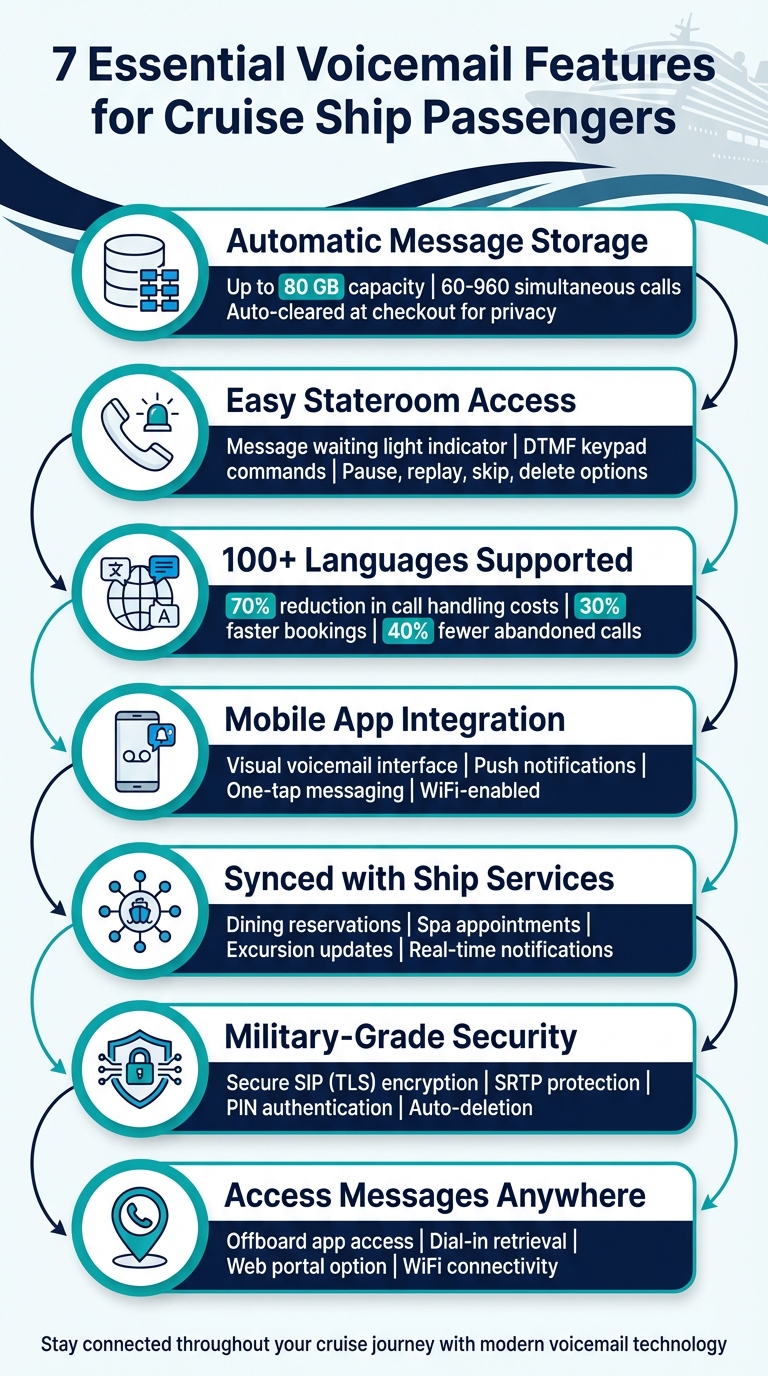
  • Message Storage: Voicemails are stored only during your trip and cleared upon disembarkation for privacy.
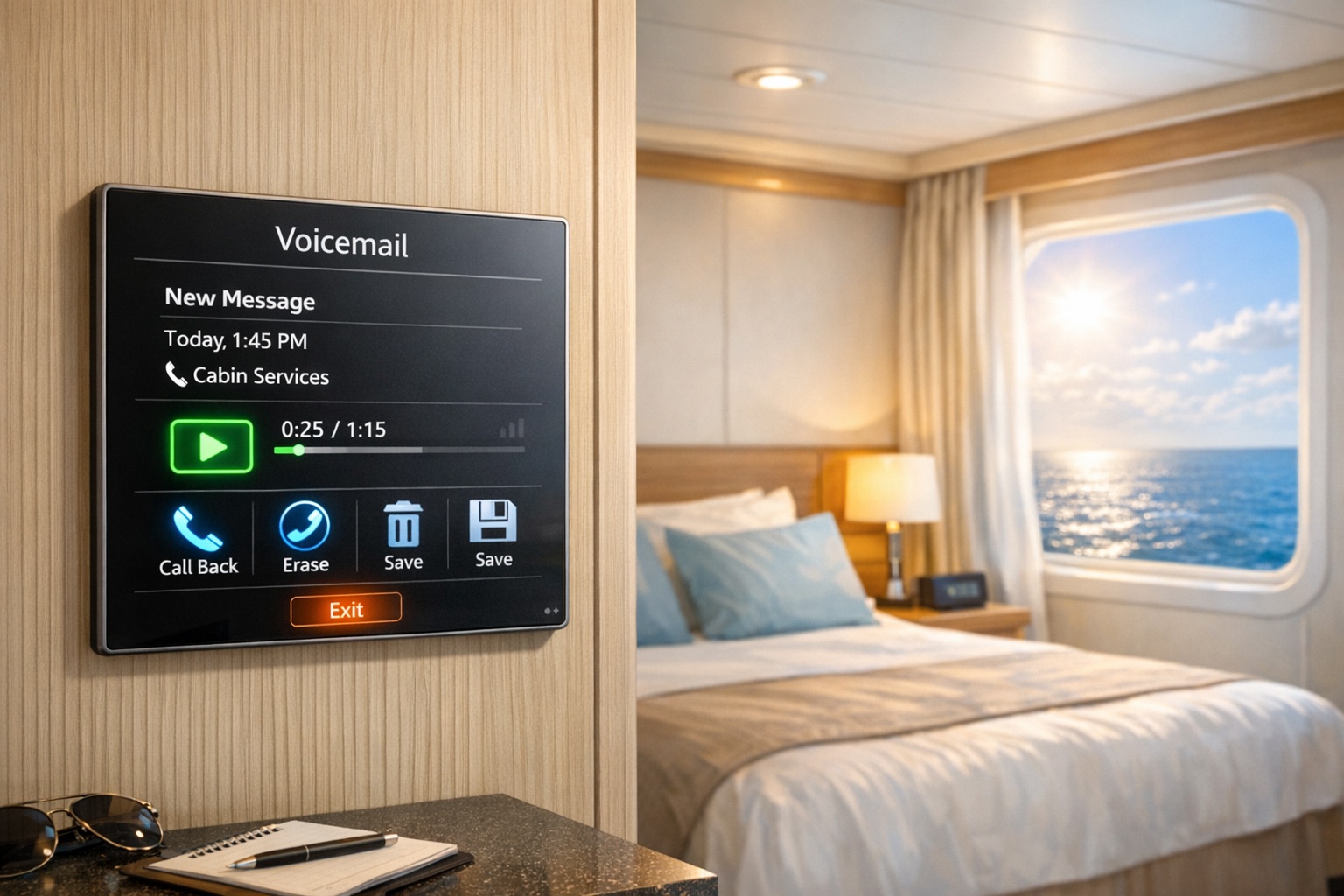
  • In-Stateroom Playback: Phones feature message indicators and keypad commands for easy voicemail management.
  • Multilingual Options: Supports over 100 languages, allowing personalized greetings and full menu access in your preferred language.
  • App-Based Access: Check voicemails directly from your smartphone using the cruise app, with push notifications for new messages.
  • Service Integration: Syncs with dining, spa, and other reservations for timely updates.
  • Security: PIN protection and encryption ensure message privacy.
  • Remote Access: Retrieve messages offboard via app or dial-in methods.

These features ensure you stay connected whether onboard or ashore, making communication simple and efficient during your cruise.

7 Essential Voicemail Features for Cruise Ship Passengers

7 Essential Voicemail Features for Cruise Ship Passengers

1. Message Storage and Retention

Cruise ship voicemail systems are designed to handle high volumes efficiently, offering unlimited mailboxes and up to 80 GB of storage. Depending on the system’s size, they can manage between 60 and 960 simultaneous calls.

Voicemails are stored only for the duration of your cruise. Once your trip ends, the system – integrated with the ship’s Property Management System (SPMS) – automatically clears your mailbox upon check-out. This ensures that your privacy is maintained for the next guest.

"Cruise VoiceMail is seamlessly integrated with each cruise line’s check-in/out procedures to ensure these shipboard operations are efficient." – CTModule

You can manage your voicemails conveniently from your stateroom phone by saving or deleting individual messages. Alternatively, you can use a web interface at the reception desk or the cruise line’s app. These tools display caller information and message length, helping you prioritize which voicemails to address. These features work hand-in-hand with other onboard communication systems, adding to the ease and enjoyment of your cruise.

2. Playback Options in Staterooms

Your stateroom phone works much like a hotel phone, featuring a message waiting light that either flashes or stays on when you have a new voicemail. The system relies on DTMF keypad commands, allowing you to pause, replay, skip, or delete messages as needed. Since keypad commands can differ between cruise lines, it’s a good idea to check the Ship’s Directory in your stateroom for specific instructions. You can also tweak playback settings for a better listening experience.

To adjust the volume while listening to a voicemail, use the physical volume buttons on your phone’s handset or base unit. On ships equipped with Cisco XML-enabled phones, you might have access to on-screen menus that make navigating your voicemail even easier. Some cruise lines also provide a web-based interface at the reception desk, allowing for visual message management.

While listening to internal voicemail is free, making ship-to-shore calls can be expensive. For example, Carnival charges $1.99 per minute, while Holland America rates go up to $7.95 per minute .

3. Multilingual Support

Cruise voicemail systems now cater to over 100 languages, making them accessible to a global audience. Setting up voicemail is straightforward, using ISO codes like "en" for English, "es" for Spanish, or "fr" for French, with English as the default option. This broad language coverage complements the user-friendly design mentioned earlier.

What makes these systems even smarter is their ability to adapt to cultural differences – like understanding idioms, context, and regional variations. Some advanced setups even greet callers in their preferred language by using data from caller profiles or cabin information. For instance, Costa Cruises uses GlobalLink technology to tailor its digital content into 12 languages across 20 markets. Similarly, Royal Caribbean employs GlobalLink Applanga for real-time localization of their mobile app.

The benefits of multilingual support go beyond convenience. It can slash call handling costs by up to 70%, speed up bookings by 30%, and reduce abandoned calls by 40%. Passengers also enjoy the option to record personalized greetings and access a full voicemail menu in their chosen language, enhancing their overall experience.

4. App-Based Voicemail Access

Cruise communication has taken a leap forward, allowing passengers to check their voicemail right from their smartphones or tablets. No need to return to your stateroom – just connect your device to the ship’s WiFi network and use the cruise line’s official app. These apps feature a visual voicemail interface, neatly organizing messages in a list for easy access and management.

By integrating with the ship’s PBX system, these apps work seamlessly alongside traditional stateroom phones. Passengers can view their messages on-screen, then tap to play, delete, or organize them in any order. Some apps even include a patented "one-tap" feature, making it simple to record and send voice messages with just a single press.

"NT Maritime’s robust technology allows guests to enjoy a cruise vacation with the ability to enjoy communication and connectivity among friends and family on their cruise just as they would if they were on a land-based vacation." – NT Maritime

Push notifications make this system even more convenient, ensuring you’re alerted to new messages no matter where you are on the ship. Plus, the app syncs with the ship’s management system, so your voicemail inbox is ready to go from the moment you check in until your trip ends. To avoid any delays, it’s a good idea to download your cruise line’s app before boarding.

Thanks to advanced maritime technology, these apps deliver reliable performance throughout your journey. You can manage your messages from anywhere on the ship, eliminating the need to rely solely on stateroom phones. This modern approach keeps passengers connected and informed, offering a level of convenience that complements the freedom of cruising.

5. Integration with Ship Services

Modern voicemail systems now work seamlessly with SPMS (Shipboard Property Management Systems) to deliver instant notifications for dining, spa appointments, excursions, and other guest services. By syncing with platforms like Oracle Hospitality Cruise SPMS, these voicemail systems automatically update guests about reservations and appointments across all onboard services. This centralized connection simplifies communication, ensuring guests stay informed throughout their journey.

The system operates through the ship’s SIP network, connecting directly to stateroom phones, mobile apps, and crew devices. For instance, if you book a specialty dining experience or schedule a spa treatment, you’ll receive an automatic voicemail reminder or a push notification. And if a restaurant is fully booked, the system can alert you the moment a table becomes available.

Each service operates on its own dedicated channel, allowing for efficient management. Concierge teams can track guest comfort requests, while catering staff handle meal planning and dietary preferences – all through the same integrated platform. This setup ensures that messages, such as housekeeping requests, are sent directly to the right department, cutting down on unnecessary follow-ups.

Cruise lines can also use Open Applications Management to customize notifications, like real-time weather updates, without interfering with existing communication channels. These added features ensure guests receive timely and relevant updates throughout their trip.

With NT Maritime’s integrated communication solutions, every voicemail notification ties directly to onboard services, making it easier for passengers to enjoy a hassle-free cruise experience.

6. Security and PIN Protection

Beyond the ease of onboard integration, voicemail systems on cruise ships prioritize passenger privacy with strong security measures. These systems rely on secure PIN codes and automatic message deletion to protect your information. When you check in, a secure mailbox is created and linked to your reservation. Once your trip ends, all messages are erased to ensure no one else can access them after your departure.

To safeguard voice data, modern systems employ Secure SIP (TLS) and SRTP encryption – the same protocols used in military-grade systems to defend against cyber threats. These encryption methods add an extra layer of protection, ensuring that only authorized users can access the system.

The ship’s communication platform also incorporates advanced rights management and single sign-on (SSO) to control feature access. For example, accessing voicemail through a cruise line’s app requires secure login credentials. Some apps, like Carnival HUB ($5 one-time fee) or Royal Caribbean ($1.99 per day), charge for this service. This added layer of authentication ensures your messages remain private.

"Pursuant to the United States’ Stored Communications Act (the SCA), We may be considered a provider of electronic communication services for certain services We offer through the Digital Platforms… In such instances, We will not turn over records or other information pertaining to you unless compelled to do so by a Court of competent jurisdiction." – Royal Caribbean Group

For added security, change any default PIN assigned at check-in to a unique code immediately. If you lose your room key or wearable device (like a Medallion), notify the reception desk right away. These items are connected to your communication services, and deactivating them promptly helps maintain your privacy and security.

7. Remote Voicemail Access

Staying connected while on a cruise doesn’t have to stop when you step off the ship. Thanks to remote voicemail access, you can check your stateroom messages even when ashore, using either the cruise app or a dial-in method.

With NT Maritime’s "Ship PBX to App" integration, you can access your voicemail offboard with ease. Simply download the app while onboard and sync it to your profile. Once you’re in port, connect to a local Wi-Fi network – like the one at a nearby café or restaurant – to listen to your messages without racking up cellular roaming charges.

Prefer the old-school approach? You can also retrieve messages by calling your stateroom number from an external phone. When the voicemail greeting begins, press either the * or # key to enter your PIN. Just make sure you set up your PIN before leaving the ship, as most systems won’t allow remote access without it. Keep in mind, though, that these calls might come with hefty charges.

To avoid roaming fees altogether, switch your phone to airplane mode and enable Wi-Fi only. Some cruise lines also provide a web-based option, allowing you to log into the ship’s guest portal from any browser to manage and listen to your voice messages. For specific details, check with guest services to confirm which remote access options are available on your ship and whether the system uses the star or pound key for dial-in access.

These remote voicemail features make sure you’re always connected, whether you’re relaxing in your stateroom or exploring the port. It’s all part of creating a seamless communication experience for cruise passengers.

Conclusion

Voicemail features play a key role in enhancing the cruise experience, ensuring passengers stay informed without missing important updates. With capabilities like message storage, multilingual options, app-based access, and remote retrieval, modern voicemail systems align perfectly with today’s communication needs.

What’s even more impressive is how these systems integrate with onboard services. Whether it’s a message from housekeeping, a dining update, or a service notification, voicemail keeps guests connected to everything they need for a smooth and enjoyable vacation. Crew members can leave personalized updates, ensuring everything from dinner reservations to special requests is handled efficiently.

NT Maritime powers these advanced communication systems, offering cruise lines the tools to deliver everything from quick voice messages to staying in touch with loved ones via video messages. With high-speed connectivity and a BYOD (Bring Your Own Device) approach, these systems make communication onboard flexible, seamless, and cost-effective – even in the middle of the ocean.

FAQs

How do I check my voicemails after leaving the cruise ship?

You can check your voicemails using the NT Maritime passenger app. Just log in on your smartphone or tablet, and with an internet connection after leaving the ship, you can stream or download any saved messages.

This handy tool helps you stay in touch and ensures you won’t miss any important updates, whether you’re sailing or enjoying time on shore.

What languages are available for the cruise voicemail system?

The cruise voicemail system is built to cater to passengers from various backgrounds by providing support in multiple languages. Commonly available options include English, Spanish, French, and German, though the exact languages offered can differ by cruise line. To find out which languages are available on your specific cruise, reach out to the onboard communication team or contact your cruise provider directly.

How does the cruise voicemail system protect my messages and ensure privacy?

The cruise voicemail system prioritizes privacy and security to protect passengers’ messages. Voicemail recordings are encrypted both during storage and while being transmitted, ensuring that only those with proper authorization can access them. Each passenger sets up a unique PIN or password when activating their voicemail, adding an extra layer of protection against unauthorized access.

This system operates within a secure onboard communication network, utilizing advanced defenses such as firewalls and network segmentation to safeguard data. Regular security audits and constant monitoring are in place to identify and prevent any potential threats. These measures ensure compliance with stringent data protection standards, giving passengers peace of mind that their messages remain secure throughout their trip.

Why Ships Need Secure Voice Communication

Ships face serious risks without secure voice communication. Outdated systems leave vessels vulnerable to eavesdropping, spoofing, and failures, which can result in safety hazards, disrupted operations, and even national security threats. Modern secure voice solutions solve these problems by encrypting conversations, ensuring only authorized personnel can access critical communications, and maintaining reliability even in emergencies.

Here’s why secure voice communication is essential for maritime operations:

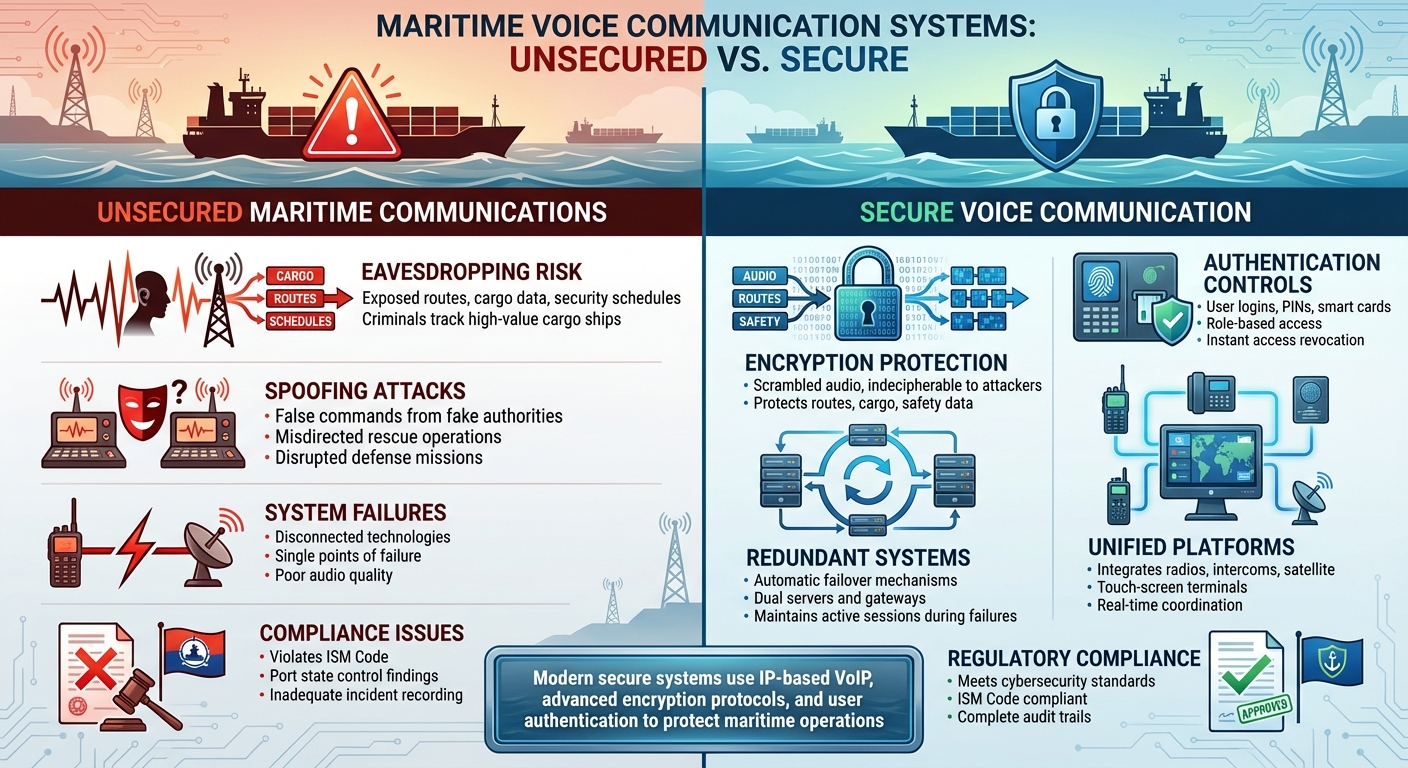
  • Prevents Eavesdropping: Encryption protects sensitive information like routes, cargo data, and safety instructions from being intercepted by malicious actors.
  • Thwarts Spoofing: Authentication ensures only verified parties can send or receive instructions, reducing risks of false commands or misdirection.
  • Improves Reliability: Redundant systems and failover mechanisms keep communication lines open during hardware or network failures.
  • Streamlines Operations: Unified platforms integrate radios, intercoms, and satellite links, simplifying coordination between crew, ports, and shore teams.
  • Ensures Compliance: Modern systems meet cybersecurity and safety standards, helping operators avoid regulatory penalties.

For U.S. waters and defense missions, these systems are especially critical to safeguard patrol routes, logistics, and mission plans. Companies like NT Maritime provide encrypted, reliable solutions tailored to various vessel types, ensuring safe and efficient communication at sea. Investing in secure voice communication is a smart move to protect your crew, cargo, and operations.

Risks of Unsecured vs Benefits of Secure Maritime Voice Communication

Risks of Unsecured vs Benefits of Secure Maritime Voice Communication

What Is Secure Voice Communication in Maritime Operations?

Defining Secure Voice Communication

Secure voice communication in maritime operations involves protecting voice calls through encryption, authentication, and a resilient network setup. This ensures conversations remain private and protected from interception, tampering, or disruptions while at sea. Unlike older shipboard systems that rely on analog radios or outdated PBX setups without strong encryption, modern secure systems use IP-based VoIP technology, advanced encryption protocols, and user authentication to restrict access to authorized personnel only.

These systems are built on a fast and reliable network framework that integrates both voice and data channels, eliminating single points of failure. For example, redundant VoIP gateways automatically take over in the event of a failure, allowing active sessions to continue without interruption. This design is particularly crucial for vessels operating in remote areas, where equipment breakdowns could compromise safety. Such a setup supports a wide range of communication needs, both within the ship and with external entities.

Common Uses of Secure Voice Communication

Secure voice systems serve a variety of critical functions, both onboard and in external communications. Internally, they facilitate intercom communication between key areas like the bridge, engine room, cargo hold, security posts, and medical centers. These systems allow crews to coordinate navigation, engineering tasks, and safety operations during maneuvers, cargo handling, or emergency drills, with access limited to authorized participants. Integration with emergency and public address systems ensures that urgent messages are delivered instantly and securely to all relevant zones, originating only from verified sources.

Externally, secure voice communication connects ships with ports and harbor authorities for tasks like pilotage, tug coordination, and berthing instructions, often using VHF radio and integrated telephony. It also enables communication between vessels for collision avoidance or search-and-rescue efforts, with aircraft during inspections or transfers, and with shore-based operations centers via SATCOM and long-range radio. These channels often carry sensitive commercial data – such as routes, cargo details, and schedules – as well as critical safety information like distress signals and hazard alerts. Encryption and authentication ensure that only legitimate parties can access these communications and that instructions remain intact, preventing interference from potential adversaries.

NT Maritime‘s Secure Voice Solutions

NT Maritime

NT Maritime offers advanced secure communication solutions for commercial, cruise, and government or military vessels. Their systems provide encrypted onboard calling, messaging, video calls, and voicemail over ship WiFi. Specifically designed for federal and military use, these systems are built to withstand cyber threats while meeting strict compliance standards required for mission-critical operations.

The platform supports a variety of call types, including App-to-App calls, App-to-Ship PBX calls, Ship PBX-to-App calls, and App-to-Off-Ship calls. This flexibility allows crew members and passengers to coordinate internally and communicate seamlessly with shore-based teams. For cruise ships, NT Maritime also integrates features like Hotel-to-Guest and Guest-to-Guest calling, ensuring that operational and safety channels remain secure and isolated from guest communication systems. By uniting voice, data, and messaging on a single, secure network, NT Maritime helps vessels maintain clear and protected communication across all operations, both onboard and external. These capabilities address the vulnerabilities and risks mentioned earlier, highlighting the importance of modern, secure communication systems in ensuring maritime safety.

Leonardo DRS SHINCOM Shipboard Integrated Communications

Leonardo DRS

Risks of Unsecured Maritime Communications

Understanding how secure systems work is just one side of the coin. It’s equally important to grasp the dangers posed by unsecured maritime communications.

Cybersecurity Threats: Interception and Spoofing

When maritime communications aren’t encrypted, they become an open book for anyone to intercept. This can expose critical details like vessel positions, route changes, security schedules, cargo information (measured in U.S. dollars), and even technical vulnerabilities that might be casually discussed over open channels.

Attackers can take advantage of this by spoofing trusted sources – think port authorities or the coast guard. This tactic can mislead crews into making course adjustments, misdirect rescue operations, or even disrupt defense missions. For instance, during U.S. government or military operations, spoofed instructions could delay responses, scatter formations, or push a vessel into a strategically weaker position.

There are documented cases where criminals have exploited open marine radio traffic to track high-value cargo ships or tankers, time their attacks, or target less-defended vessels. Security drills have also shown how false radio transmissions on coastal channels can create chaos – triggering false alarms, misdirecting patrols, and throwing off critical operations in U.S. ports.

Inefficiencies from Outdated Systems

Many maritime communication systems rely on outdated, disconnected technologies for radio, intercom, telephone, and PA systems. This lack of integration slows down the flow of information and increases the chances of miscommunication – especially during emergencies. Without a unified communication platform, it’s difficult to coordinate between the bridge, engine room, cargo hold, and shore, or to monitor multiple channels from a single interface.

Older analog systems and a mishmash of legacy equipment often come with poor audio quality, inconsistent user interfaces, and limited functionality. Crew members are left to memorize complex procedures and channel plans for different devices. In high-pressure situations, like emergencies or heavy traffic, this can lead to dialing the wrong party, missing critical calls, or misinterpreting instructions due to static or poor sound clarity.

Safety and Regulatory Compliance Issues

Emergencies – whether it’s a fire, flooding, collision, or medical crisis – demand reliable communication. But non-redundant systems can fail when they’re needed most, cutting off essential coordination and putting lives at risk. Without backup IP networks, a single hardware failure or broken link can sever both radio and internal voice communications.

Regulators and industry standards are increasingly emphasizing the importance of secure and dependable communication systems as part of broader safety and cybersecurity protocols. Using unencrypted links to handle sensitive operational information can violate evolving maritime cybersecurity guidelines and the International Safety Management (ISM) Code. This could lead to negative findings during audits or inspections by port state control. Furthermore, inadequate recording capabilities, lack of system redundancy, and frequent outages can complicate incident reporting and evidence collection after accidents or security breaches.

These vulnerabilities underscore the pressing need for secure, modern communication systems to ensure safer, more efficient maritime operations.

How Secure Voice Communication Solves Maritime Problems

Now that we’ve explored the risks, let’s shift focus to how secure voice communication tackles these challenges head-on with encryption, unified platforms, and emergency-ready systems.

Enhanced Security with Encryption and Authentication

Encryption ensures voice traffic remains private, scrambling audio so only devices with the right keys can decode it. Modern encryption methods render intercepted data useless, whether it’s RF, satellite, or IP traffic. For attackers, this means capturing nothing but indecipherable noise, which greatly reduces the chances of espionage or data breaches.

Authentication tools like user logins, PINs, smart cards, and role-based access controls add another layer of security. Centralized management consoles oversee access, allowing administrators to track login attempts, configure user roles, and instantly revoke access if a device is lost or a crew member rotates out. This proactive approach plugs potential security gaps in daily operations.

Smoother Operations with Unified Communication Platforms

Security isn’t the only benefit – unifying communication channels boosts operational efficiency. Modern maritime communication platforms bring together analog and IP radios, telephones, intercoms, and satellite links into one manageable system. Crews can access all these channels through intuitive touch-screen terminals, simplifying tasks like switching between VHF/UHF radios, internal intercoms, or external phone calls.

Server-based VoIP gateways bridge the gap between analog radios, older telephony systems, and modern IP voice services. This seamless integration allows crew members, pilots, harbor authorities, and shore operations to connect without the hassle of manual patching. For complex operations like docking, cargo handling, or launching smaller vessels, this unified approach ensures the engine room, deck, and bridge stay in sync with real-time, clear communication.

By unifying systems, these platforms also create a solid foundation for emergency communications.

Reliable Support During Emergencies

In critical situations, integrated systems prioritize distress calls and automatically switch to backup servers to ensure communication remains uninterrupted, even in extreme conditions. With a single console, the bridge can coordinate with all key teams, minimizing confusion. Emergency protocols – like prioritizing mayday or distress calls – ensure vital messages cut through and avoid congestion, even when bandwidth is stretched thin.

Redundant networks add another layer of reliability, keeping communication lines open during system failures. Ruggedized terminals and loudspeakers are built to withstand intense conditions like high noise, vibration, salt spray, and humidity. These systems deliver clear audio, whether on deck, in the engine room, or in exposed areas. For demanding tasks like boarding operations or coordinating between the main ship and smaller vessels (RHIBs) in noisy, high-salinity environments, tactical headsets and loudspeakers ensure real-time command and control remains intact.

Steps to Implement Secure Voice Communication on Ships

Evaluating Current Communication Infrastructure

Start by taking stock of all the voice communication devices on board, such as bridge phones, intercoms, radios, PA/GA systems, satellite phones, and softphones. Document each device’s specifications and software versions. Then, map out all communication pathways – whether they’re ship-to-ship, ship-to-shore, ship-to-air, or internal channels. Determine which systems use IP protocols, which are analog, which operate on radio frequencies, and whether any form of encryption is already in place.

Look for system redundancies to identify potential single points of failure, such as servers, gateways, or power supplies. Check if there are redundant pathways or automatic failover mechanisms. Additionally, review access controls for consoles, network segmentation, and compliance with regulatory voice recording requirements.

If your systems already support IP-based protocols like SIP, can connect to VoIP gateways, and are compatible with external encryption devices, they are ready for secure integration. However, if you’re dealing with outdated analog hardware that lacks vendor support, has no encryption, or experiences frequent outages affecting safety operations, a complete replacement may be necessary.

This thorough evaluation lays the groundwork for designing a secure and reliable communication system.

Designing and Deploying Secure Solutions

When designing secure communication systems, focus on four key principles: encryption, redundancy, interoperability, and survivability. These address both cybersecurity concerns and operational challenges. Start by encrypting all voice traffic across the ship’s LAN, satellite connections, and shore links. Build redundancy into the system with dual communication servers, backup VoIP gateways, and mirrored databases to ensure active sessions are preserved during hardware or connection failures.

Use open-standard protocols like SIP-based VoIP, which integrate smoothly with existing radio and satellite systems while maintaining secure communication channels. For hardware, select ruggedized terminals that meet Defense Standards (DEF-STAN) or MIL-STD specifications, ensuring durability against harsh conditions like vibration, salt spray, and electromagnetic interference – especially in exposed or high-risk areas like the engine room.

Roll out the system in phases, starting with pilot tests and staggered deployments during maintenance windows. Keep legacy systems operational as temporary backups during the transition. Centralized configuration tools can simplify the process, allowing call flows, user roles, and encryption policies to be quickly duplicated across multiple ships.

Crew training is essential. Provide role-specific training for bridge teams, engineers, security personnel, and medical staff. Conduct drills that simulate real-world scenarios, such as server outages, switching to backup channels, initiating group calls, or using secure communication during emergencies like fires or collisions. Simplified touch-screen interfaces and unified consoles can reduce training time from weeks to just a few days, which is particularly important for rotating crews. Secure voice procedures should also be integrated into the ship’s Safety Management System to ensure they are regularly audited and updated.

How NT Maritime Supports Implementation

Once a secure system design is finalized, the next step is smooth implementation, and this is where NT Maritime excels. Their approach ensures both system integrity and operational continuity.

NT Maritime begins by assessing existing onboard networks and communication hardware. They identify opportunities to integrate secure voice services alongside Telehealth and crew or passenger communication tools, all while maintaining logical separation on a high-speed backbone. Their designs combine onboard calling, messaging, video calls, and voicemail with secure voice capabilities tailored to the needs of cruise lines, commercial fleets, and government or military vessels.

During deployment, NT Maritime provides preconfigured equipment and manages the project to align with vessel schedules. They also offer structured crew training and detailed documentation to ensure a smooth transition. Post-deployment, NT Maritime delivers round-the-clock support, monitoring, and regular security reviews to keep encryption standards, firmware, and configurations up to date. Operators can confidently expand services, such as adding new Telehealth features or crew tools, without compromising the security or reliability of the core voice communication system.

Conclusion

Secure voice communication plays a critical role in ensuring safety, efficiency, and compliance in maritime operations. Outdated systems leave vessels vulnerable to interception, spoofing, and system failures. In contrast, modern IP-based, encrypted voice platforms address these risks while seamlessly connecting bridge, engine room, and shore communications. These platforms are designed to remain operational even during hardware or connection failures, offering a reliable solution for today’s maritime challenges.

For U.S. operators managing vessels worth millions, the cost of implementing secure voice infrastructure is a fraction of the potential losses from collisions, cargo damage, or cyberattacks. Encrypted communication systems not only enhance security but also streamline workflows, reducing delays and errors while improving fleet oversight. During emergencies like distress calls, man-overboard situations, or fires, secure voice systems provide dependable, clear coordination – often the deciding factor between successful outcomes and operational setbacks. This level of reliability builds trust in secure communication systems when they are needed most.

"Secure communications for federal and military deployments ensure encrypted, reliable, and real-time information exchange. Built to withstand cyber threats, we support mission-critical operations with robust protection and compliance." – NT Maritime

To safeguard your operations, start by assessing communication risks and defining your needs based on vessel type and regulatory requirements. Collaborate with maritime communication experts like NT Maritime to develop a secure, unified system. Your plan should include encryption, redundancy, long-term voice recording, and compatibility with existing radios and IT networks. By investing in secure voice communication, you prepare your fleet for current challenges and future advancements, such as enhanced monitoring and telehealth services, ensuring the safety of your crew, cargo, and reputation.

Vessels equipped with secure, unified communication systems can navigate today’s complex maritime environment with confidence, meeting regulatory requirements while laying the groundwork for the next generation of digital operations.

FAQs

How does secure voice communication protect shipboard conversations from being intercepted?

Secure voice communication ensures that conversations on ships remain private by encrypting voice data, making it unintelligible to anyone without proper authorization. Additionally, it incorporates strong authentication protocols to confirm that only approved personnel can access the communication channels. This dual-layer of protection helps keep sensitive information confidential and strengthens overall operational security onboard.

What makes NT Maritime’s secure voice solutions essential for maritime operations?

NT Maritime offers secure voice solutions tailored to the demanding environment of maritime operations. With encrypted communication, these services enable passengers and crew to stay connected through onboard calling, messaging, and video calls, ensuring smooth and secure interactions even while at sea.

By protecting sensitive information from potential breaches and enhancing operational workflows, these solutions play an essential role in both commercial and government or military maritime missions.

Why is it important to modernize maritime communication systems?

Modernizing communication systems in the maritime industry is crucial for protecting sensitive information, boosting efficiency, and maintaining reliable connectivity for essential services like emergency response and Telehealth. Relying on outdated systems increases the risk of data breaches and communication breakdowns, which can jeopardize both safety and productivity on board.

By upgrading to modern solutions, vessels gain access to secure and dependable voice communication, along with advanced tools designed specifically for maritime operations. These improvements not only streamline day-to-day activities but also enhance safety measures for both the crew and passengers.

How to Set Up Secure Maritime Communications

Securing maritime communications is critical for protecting ships from cyber threats like data breaches, GPS spoofing, and ransomware. Ships rely on satellite connections, which are vulnerable to attacks, making strong cybersecurity measures essential. Here’s how to secure maritime communication systems effectively:

  • Understand Threats: Risks include intercepted data, compromised navigation, and insider misuse.
  • Meet Regulations: Follow standards like SOLAS, GMDSS, and U.S. Coast Guard rules to ensure compliance.
  • Use Encryption: Implement SSL/TLS, VPNs, and end-to-end encryption to secure data.
  • Strengthen Access Controls: Use Multi-Factor Authentication (MFA) and role-based access.
  • Deploy Onboard Security: Firewalls, VPNs, and network segmentation protect internal systems.
  • Monitor and Maintain: Regular updates, real-time monitoring, and crew training reduce vulnerabilities.

Webinar: Onboard cybersecurity – Key insights and best practices

Security Requirements for Maritime Communications

Maritime vessels face a challenging cybersecurity landscape. Operating at sea comes with its own set of risks, compounded by the need to comply with strict regulations and cater to different operational demands depending on the type of vessel. These factors create a complex environment where specialized security solutions are essential to protect against cyber threats. Both international and U.S. standards play a critical role in addressing these risks.

Maritime Cybersecurity Threats

Maritime operations are vulnerable to a variety of cyber threats, each with potentially severe consequences:

  • Data breaches can expose sensitive shipping information, leading to financial losses, supply chain disruptions, and competitive disadvantages.
  • GPS spoofing attacks use fake signals to mislead vessels, potentially steering them into restricted or hazardous areas. Such incidents can escalate into international disputes or endanger crew and cargo.
  • Ransomware attacks are particularly dangerous at sea, where limited technical support can jeopardize navigation and operational safety.
  • Man-in-the-middle attacks target satellite communications, allowing attackers to intercept and manipulate sensitive data in real time.
  • Insider threats pose risks when crew members with extended access to systems misuse their privileges, intentionally or unintentionally compromising operations.

International and U.S. Regulations

To mitigate these threats, vessels must comply with a range of maritime security regulations:

  • The Safety of Life at Sea (SOLAS) Convention requires vessels to maintain reliable communication systems for distress and safety. Chapter IV specifically addresses cybersecurity measures for ship systems and networks, ensuring robust protections are in place.
  • The Global Maritime Distress and Safety System (GMDSS) mandates redundant communication channels for emergencies. These systems must remain secure and operational under challenging conditions.
  • U.S. Coast Guard regulations (33 CFR Part 104) demand vessel security plans that include protections for communication systems. Compliance involves regular security assessments, crew training, and tailored incident response protocols.
  • The Maritime Transportation Security Act (MTSA) focuses on safeguarding communication systems from unauthorized access and ensuring data integrity. Compliance requires detailed security procedures and routine audits.
  • The International Ship and Port Facility Security (ISPS) Code extends its requirements to communication security, emphasizing the protection of sensitive operational data and secure channels for security-related communications.

Communication Needs by Maritime Sector

Different maritime sectors have unique communication requirements, each demanding specific security measures:

  • Cruise lines handle vast amounts of passenger data and require high-bandwidth connections to support services like entertainment, financial transactions, and safety communications. These vessels need constant connectivity to ensure guest satisfaction and regulatory compliance. Any security breach can lead to hefty penalties and significant reputational damage.
  • Cargo ships prioritize the protection of commercial and operational data, such as cargo manifests and shipping schedules. While their bandwidth needs are lower, they require highly reliable and secure connections to coordinate with ports, customs, and logistics partners. Protecting this data is critical to avoid competitive or criminal exploitation.
  • Government vessels operate under the strictest security protocols, often managing classified information. These ships require encrypted communications that can withstand sophisticated cyberattacks, ensuring operational security even in hostile environments. Their systems must also support secure voice, data, and video communications while maintaining interoperability with allied forces.

Communication requirements vary widely depending on the vessel’s size, purpose, and operating conditions. Smaller ships may rely on basic satellite services, while larger commercial and government vessels need advanced, multi-layered communication systems with redundancy and state-of-the-art security measures.

Tools and Technologies for Secure Maritime Communications

Creating secure maritime communication systems involves a layered approach that blends advanced network security measures with integrated communication platforms. In maritime settings, safeguarding sensitive data and maintaining seamless operations are top priorities.

Onboard Network Security: Firewalls and VPNs

Securing a vessel’s internal network calls for specialized tools designed for maritime conditions. Firewalls tailored for these environments perform deep packet inspections even when bandwidth is limited or connections are spotty, blocking harmful traffic before it can reach essential systems. Network segmentation, achieved through VLANs, separates different types of traffic, minimizing the risk of attackers moving laterally across the network. Encrypted VPNs further fortify the system by creating secure channels for remote troubleshooting and software updates. Intrusion detection systems add an extra layer of protection by continuously monitoring traffic and responding to unusual activity in real time. Together, these measures lay the groundwork for comprehensive solutions like those offered by NT Maritime.

NT Maritime Communication Solutions

NT Maritime

NT Maritime provides integrated communication platforms designed to meet the unique challenges of maritime operations. Their onboard systems offer encrypted voice, text, and group communication networks, ensuring secure internal connectivity. Video calling features enable private, secure face-to-face conversations, meeting strict standards for sensitive data transmissions. For medical emergencies, NT Maritime’s telehealth technologies allow onboard personnel to consult securely with shore-based specialists, ensuring the confidentiality and reliability of critical health information. High-speed internet services deliver impressive speeds of up to 220 Mbps for downloads and 40 Mbps for uploads, with latency kept under 99 milliseconds – maintaining performance even when bandwidth is limited. Additionally, NT Maritime’s secure packages for government and military use provide encrypted, isolated communication channels for handling classified information.

How to Set Up Secure Communication Systems

To strengthen maritime security, implementing advanced encryption and strict access controls is a must. Many older maritime systems lack basic encryption and authentication, leaving them vulnerable to attacks. By integrating modern encryption protocols and robust access controls, maritime communication networks can be significantly more secure. Below, we outline the key steps for setting up encryption and access controls to protect sensitive communications.

Setting Up Encryption and Access Controls

Start by deploying SSL/TLS or VPN encryption to secure ship-to-shore communications. Ensure all communication channels use end-to-end encryption, which protects data both while it’s being transmitted and when it’s stored. This step is crucial for safeguarding voice transmissions, messages, and other data exchanges between vessels and shore-based operations.

Adopt a Zero-Trust model by incorporating Multi-Factor Authentication (MFA), Single Sign-On (SSO), and identity-based, role-specific access controls. These measures ensure that only authorized personnel can access sensitive systems.

"MFA, which requires users to provide two or more verification factors to gain access, is essential for keeping key systems safe from people who shouldn’t have access to them." – Sperton

Real-world results highlight the effectiveness of these strategies. For example, in 2021, the Port of Houston successfully defended against a suspected nation-state cyberattack. By leveraging a strong zero-trust framework, the port avoided what could have been $1.14 million in breach-related damages.

Maintaining and Monitoring Secure Maritime Communication Systems

Ensuring maritime communication systems remain secure and functional over time is no small feat. The maritime environment presents unique challenges that demand constant vigilance and a proactive approach to maintenance. Let’s explore how regular upkeep, real-time monitoring, and crew training contribute to lasting security.

Regular Maintenance and Updates

Keeping software and hardware up to date is the cornerstone of maritime cybersecurity. Ships often spend long stretches at sea, far from technical support, so having a clear update plan before departure is critical. Scheduling security patches during planned maintenance and ensuring backup systems are fully operational during updates are essential steps to minimize risks.

Hardware inspections are equally important. The harsh conditions at sea – saltwater, humidity, and vibrations – can wear down equipment faster than on land. Regularly check components like antenna connections, cooling systems, and network cables to prevent failures.

One real-world incident underscores the importance of updates. A ship with integrated navigation systems suffered a complete system failure during bad weather and heavy traffic. The culprit? Outdated software caused the system to crash, forcing the crew to rely on manual backups and delaying repairs. The situation not only posed safety risks but also resulted in significant costs and downtime.

To avoid such scenarios, plan updates during port calls when technical support is readily available. Keep detailed logs of software versions, patches, and hardware replacements to track system health and ensure compliance.

Real-Time Monitoring and Incident Response

Real-time monitoring is crucial, especially when immediate technical support isn’t an option. Automated tools can track network traffic, system performance, and security events, enabling quick detection of potential threats.

On average, it takes 140 days to identify a cyberattack, though this timeline has been improving due to heightened awareness and stronger security protocols. For ships operating in isolation, delayed detection can lead to severe consequences.

Equip crews with incident response protocols they can execute independently. These protocols should cover isolating compromised systems, activating backup communication channels, and documenting security events for later analysis. Detailed playbooks for common scenarios – such as malware infections or unauthorized access – ensure the crew can act swiftly and effectively.

NT Maritime’s communication systems provide built-in monitoring tools that alert crews to potential issues in real time. These alerts, combined with diagnostic data, help crews address problems before they escalate. However, technology alone isn’t enough; rigorous crew training is essential to strengthen overall security.

Crew Training and Awareness

The crew is the first line of defense against cyber threats, making training a top priority. Human error and a lack of cybersecurity awareness are leading causes of security breaches.

"Human errors and the lack of cyber security awareness are two main factors leading to major cyber security incidents. Awareness and training can significantly reduce the likelihood and the impact of security breaches." – Cyber Risk GmbH

Simulated exercises, such as phishing tests and social engineering scenarios, help crew members recognize and respond to threats in a controlled environment. Training programs should be updated regularly to address emerging threats, new technologies, and evolving best practices. Practical skills like spotting suspicious emails, creating strong passwords, and securely handling data should take center stage.

Collaboration between IT teams and operational crews is key to building a resilient system. When both groups understand each other’s challenges, security protocols can be seamlessly integrated into daily operations. Quarterly cybersecurity drills that test incident reporting, system isolation, and emergency communication protocols help identify gaps and reinforce best practices.

For specialized training, programs like the Maritime Cybersecurity Trained Professional (MarCybTPro) offer courses tailored to maritime environments. The first program costs $297, with additional courses priced at $197 each.

Conclusion

Protecting maritime communications is critical to ensuring the safety of vessel operations, crew, and passengers in the face of ever-evolving cyber threats. The maritime sector presents its own set of challenges, from harsh weather conditions to long stretches without direct technical support, making specialized solutions a necessity.

To address these challenges, a combination of integrated technologies and strict maintenance protocols is key. Tools like encrypted satellite communications, firewalls, VPNs, regular system updates, and comprehensive crew training all work together to create a strong security framework.

For vessels operating independently at sea, real-time monitoring and effective incident response protocols are equally important. These measures allow crews to identify and neutralize potential threats before they escalate into serious issues.

NT Maritime’s secure networks meet federal and military standards, offering high-speed connectivity and integrated communication systems tailored for a broad range of maritime operations. These solutions deliver the reliability and security needed while remaining adaptable to the changing demands of the industry.

By investing in secure communication systems, maritime operations can achieve better operational continuity, meet regulatory requirements, and ensure the safety of their crew. As the industry becomes more digitized, vessels equipped with advanced communication security will not only reduce risks but also maintain a competitive edge.

Adopting these strategies and leveraging NT Maritime’s trusted platform can help safeguard your vessel against emerging cyber threats, ensuring smooth and secure operations well into the future.

FAQs

What encryption technologies are best for securing maritime communications, and how do they ensure data protection?

For ensuring secure maritime communications, AES-256 encryption (Advanced Encryption Standard with 256-bit keys) stands out as a trusted option. Known for its use in military-grade applications, it protects sensitive data by transforming plaintext into ciphertext through advanced algorithms, making it extremely difficult for unauthorized parties to gain access. This encryption works effectively for both data in transit and data stored on devices.

Another crucial technology is TLS (Transport Layer Security), which is widely used to secure ship-to-shore communications. TLS ensures that data remains confidential and unaltered during transmission. For added protection, specialized encryptors tailored for maritime environments are employed. These devices help prevent data interception or tampering, ensuring secure and reliable communication even in challenging conditions at sea. Together, these tools play a key role in safeguarding critical information and maintaining seamless connectivity.

What are the key differences between U.S. and international cybersecurity regulations for maritime vessels?

In the United States, the Coast Guard enforces maritime cybersecurity regulations with a clear focus on detailed compliance. These rules require incident reporting, the development of cybersecurity plans, the designation of a Cybersecurity Officer, and annual personnel training. Compliance deadlines are strict, with some requirements already set for 2027. These regulations primarily target U.S.-flagged vessels and facilities, aiming to create enforceable and uniform cybersecurity standards.

On the other hand, international standards, such as the IMO’s Resolution MSC.428(98), take a broader approach. They require ships to incorporate cyber risk management into their safety systems and encourage the use of global frameworks like IEC 62443 to enhance system security. Unlike the highly prescriptive U.S. regulations, international guidelines prioritize flexibility and adopt a risk-based approach to managing cybersecurity challenges.

How can crew members be trained to effectively handle cybersecurity risks at sea?

To help crew members tackle cybersecurity risks at sea, start with thorough training on secure communication systems and protocols. Teach them how to safely operate equipment, spot potential threats, and adhere to cybersecurity practices designed to protect both the vessel and its data.

Make sure they’re familiar with the latest maritime cybersecurity regulations, like the IMO’s 2021 Maritime Cyber Risk Management guidelines. Stress how these rules play a crucial role in safeguarding sensitive information and ensuring smooth operations. Regular drills and updates on new threats can go a long way in keeping the crew sharp and ready to respond effectively.