
5 Challenges in Low-Latency Maritime Communication

In maritime communication, achieving low latency is critical for real-time operations like telemedicine, remote diagnostics, and autonomous vessel control. While Low Earth Orbit (LEO) satellites offer latency as low as 20–40 milliseconds compared to the 600–800 milliseconds of Geostationary (GEO) systems, several challenges still hinder seamless connectivity at sea. These include:

  • Satellite Distance and Latency: GEO satellites’ high altitude causes significant delays, while LEO systems reduce this but require multi-orbit setups for efficiency.
  • Coverage Gaps: Harsh ocean conditions and high-latitude regions often disrupt signals, requiring advanced multi-bearer systems and phased-array antennas.
  • Bandwidth Limits: High data demand on ships leads to congestion; solutions like traffic prioritization and data compression are necessary.
  • Cybersecurity Delays: Security protocols can increase latency; onboard security appliances and optimized encryption help mitigate this.
  • Outdated Shipboard Infrastructure: Legacy networks and equipment create bottlenecks, requiring upgrades like VLANs, modern switches, and SD-WAN for better performance.

Starlink

Challenge 1: Satellite Distance and Latency
GEO vs LEO Satellite Latency Comparison for Maritime Communication

GEO vs LEO Satellite Latency Comparison for Maritime Communication

How Geostationary Satellites Create Latency

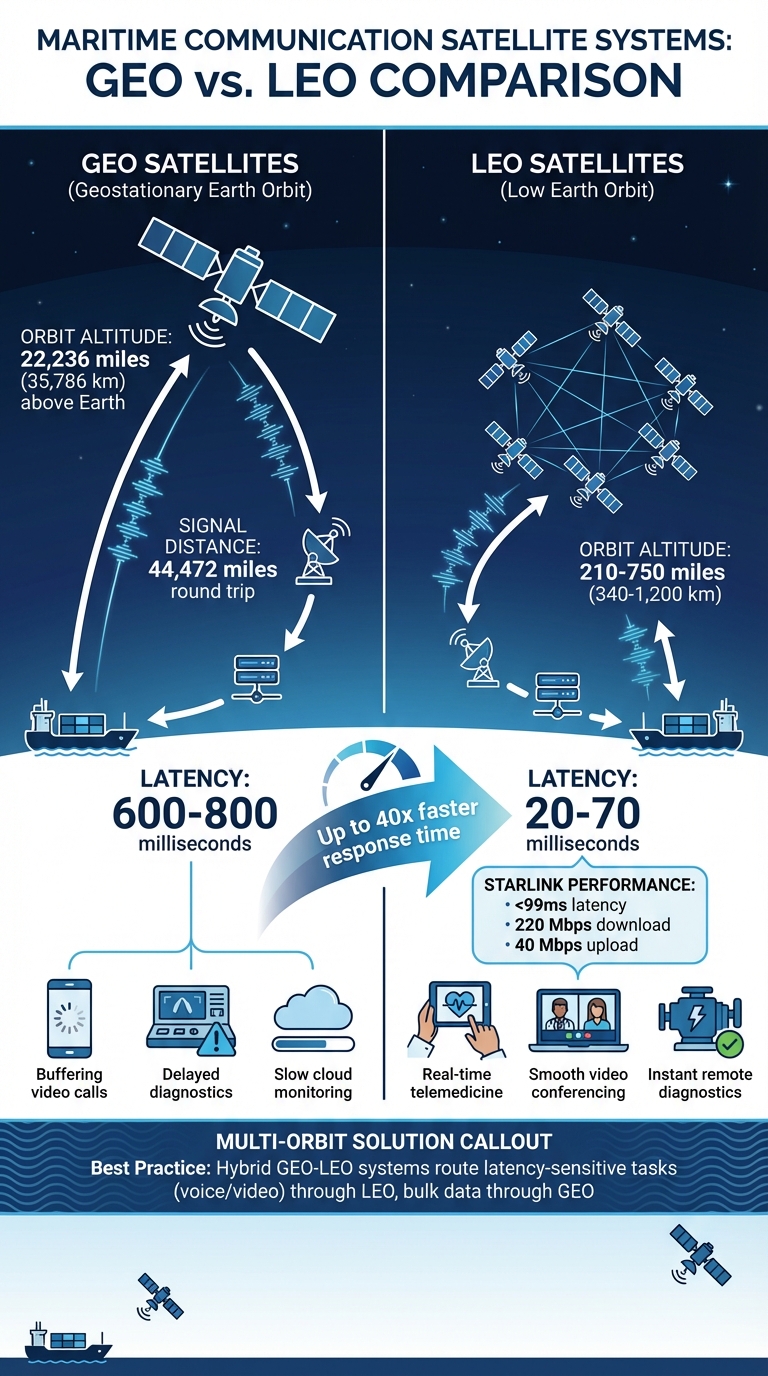
The delay in traditional maritime satellite communication boils down to one thing: physics. Geostationary (GEO) satellites orbit about 22,236 miles (35,786 km) above Earth’s equator. For a signal to travel from a ship to the satellite, down to a ground station, and back, it covers a whopping 44,472 miles. Even though radio signals travel at nearly the speed of light, this journey takes time – typically 600–800 milliseconds for a full round trip.

This delay impacts a range of maritime operations. Video calls experience noticeable pauses. Remote diagnostics lose accuracy. For critical tasks like dynamic positioning, collision avoidance, and remote pilotage, even a small delay can slow down responses from shore-based experts or automated systems, potentially affecting safety and efficiency.

For cruise ships, GEO VSAT systems often lead to buffering and interruptions during video calls or streaming. In commercial shipping and offshore energy, operators struggle with delays in cloud-based monitoring and remote support, making real-time decisions more challenging.

Solution: Low Earth Orbit (LEO) Satellites

Enter Low Earth Orbit (LEO) satellites, operating at altitudes between 210–750 miles (340–1,200 km). These satellites slash latency to 20–70 milliseconds, delivering speeds comparable to home broadband. For instance, NT Maritime offers Starlink services with latency under 99 milliseconds, download speeds up to 220 Mbps, and upload speeds reaching 40 Mbps – bringing high-speed internet to vessels at sea.

The difference is dramatic. Ships transitioning from GEO-only systems to LEO or hybrid GEO–LEO setups often see latency drop from several hundred milliseconds to under 100 ms. This improvement enables real-time applications like telemedicine, video conferencing, remote diagnostics, and fleet management. Many operators now rely on multi-orbit terminals that automatically direct latency-sensitive tasks, such as voice and video, through LEO satellites, while reserving GEO for less urgent bulk data transfers.

Challenge 2: Coverage Gaps and Harsh Ocean Conditions

Coverage Problems at Sea

Even with advancements like LEO satellites reducing latency, maintaining consistent connectivity at sea remains a significant hurdle. Vast stretches of ocean still suffer from poor or inconsistent coverage, especially in high-latitude regions. Since GEO satellites are positioned over the equator, ships operating closer to the poles often encounter signals that barely clear the horizon – or are obstructed entirely by the ship itself.

In remote oceanic zones far from shore-based infrastructure, signals can weaken or disappear altogether. Switching between satellite beams can cause brief but noticeable disruptions, particularly for fast-moving vessels. These micro-outages, occurring during antenna adjustments, can interrupt critical activities like video conferencing, remote diagnostics, or real-time monitoring.

Weather adds another layer of difficulty. Heavy rain, storms, and dense cloud cover interfere with high-frequency satellite bands, leading to a phenomenon known as rain fade. Meanwhile, rough seas – causing ships to pitch, roll, and yaw – force mechanically steered antennas to constantly adjust, which can result in intermittent connectivity and lower uptime. For operations like telemedicine or dynamic positioning, even a momentary signal loss can jeopardize safety and efficiency.

Addressing these challenges requires smarter, more adaptive network solutions.

Solution: Multi-Orbit and Multi-Bearer Systems

The key to overcoming these obstacles lies in redundancy and intelligent network routing. Multi-orbit systems dynamically switch between LEO and GEO satellites based on real-time conditions. LEO constellations offer low-latency, high-speed connections that fill in coverage gaps, particularly in polar regions and congested shipping lanes where GEO signals struggle. During severe weather, when one link falters, the system automatically switches to another, ensuring uninterrupted services like telemedicine or remote operations.

Multi-bearer setups further enhance connectivity by incorporating near-shore 4G/5G networks. As vessels approach ports, traffic can be offloaded to these terrestrial networks, freeing up satellite capacity for open-ocean operations. Intelligent routing ensures that time-sensitive tasks are prioritized on low-latency links, while bulk data is sent over higher-latency paths, improving overall system efficiency and reducing delays.

To complement these systems, advanced antenna technology plays a crucial role in stabilizing connections even in challenging conditions.

Advanced Antenna Technology

Modern phased-array antennas offer a game-changing approach to maintaining stable connections. Unlike traditional mechanically steered VSATs, these antennas adjust their beams electronically, eliminating the mechanical lag and reducing pointing errors. This capability minimizes disruptions during course changes and ensures more reliable connectivity.

Phased-array antennas can also connect to multiple networks simultaneously, such as LEO and GEO satellites, enhancing both redundancy and resilience. Their fast steering and multi-beam capabilities make them particularly effective in harsh maritime environments. For example, cruise ships equipped with these advanced antennas and LEO satellite links have delivered high-speed, low-latency internet to thousands of passengers, with fewer dropouts during adverse weather or sharp maneuvers compared to older GEO-only systems.

Challenge 3: Bandwidth Limits and Traffic Prioritization

Bandwidth Competition in Maritime Networks

Satellite connections at sea come with a major limitation: restricted bandwidth. Maritime operations generate massive amounts of data – think weather updates, location tracking, cargo information, and arrival schedules. When you add passenger entertainment and crew communication into the mix, the network can easily become overloaded. This is especially true for cruise ships and commercial vessels, where passengers expect uninterrupted streaming and video calls, while critical systems like navigation and telemedicine demand reliable, real-time data. GEO systems, which handle all these needs on a single link, often struggle with congestion and latency issues[2]. Managing this traffic effectively is no small task.

Solution: QoS and Traffic Shaping

Quality of Service (QoS) steps in to prioritize essential data over less critical traffic. Instead of treating all data equally, QoS ensures that vital applications – like telemedicine, navigation, and emergency systems – get the bandwidth and low-latency performance they need, even during heavy network usage. Traffic shaping works alongside QoS by capping the bandwidth available for non-essential activities, such as passenger video streaming. This approach keeps critical systems running smoothly while minimizing latency caused by packet loss and retransmissions[1]. Providers like NT Maritime integrate these strategies into their communication solutions, ensuring that crucial services always take precedence over recreational or non-essential traffic.

Network Performance Optimization

Beyond traffic management, other techniques can further boost network performance. Tools like WAN optimization, caching, and compression help reduce the amount of data sent over expensive satellite links[1]. For example, compression shrinks file sizes, while caching stores frequently accessed data – like weather reports, navigation charts, or operational manuals – locally on the vessel. This eliminates the need to repeatedly transfer the same information. These methods are especially valuable when bandwidth is limited and costs are high, allowing maritime operators to support more services without compromising performance. By reducing data loads and maintaining low latency, these optimizations play a critical role in modern maritime operations.

sbb-itb-bda822c

Challenge 4: Cybersecurity Effects on Latency

Maintaining low latency is vital for both operational efficiency and ensuring cybersecurity in maritime environments. However, safeguarding shipboard networks from cyber threats often comes with an unavoidable trade-off: increased delay. Encryption protocols like TLS and IPsec demand significant processing power from onboard routers and firewalls. These protocols handle tasks such as key exchanges, cipher operations, and packet wrapping, which inevitably add extra packet data. This additional data can boost bandwidth usage by 10–20%, a serious concern when relying on limited satellite connections.

Deep Packet Inspection (DPI) engines and intrusion detection systems also contribute to delays. These systems meticulously analyze payloads and headers against predefined security policies. Even for seemingly straightforward ship-to-cloud communications, traffic must travel from the vessel to a satellite, then to a shore-based data center, pass through security layers, and finally reach its destination. This routing effectively doubles or even triples the network segments involved, pushing round-trip times closer to those seen in GEO satellite systems, far from the 70 ms achievable with optimized LEO links.

These latency issues have real-world consequences, particularly for critical maritime operations. The signs are hard to miss: crew and passengers experience disrupted voice and video calls, fleet management applications load sluggishly, onboard telemetry and alarms face delays, and VPN connections frequently drop during periods of heavy traffic or adverse weather. The difference between raw test traffic and production traffic often highlights the problem – security processes like inspection, tunneling, and backhauling are the usual culprits.

Solution: Low-Latency Security Architectures

Addressing these delays requires rethinking how security is applied, moving toward a distributed security model. Instead of funneling all traffic through a central chokepoint, security enforcement can happen closer to the source. Deploying onboard security appliances – such as firewalls, intrusion detection/prevention systems (IDS/IPS), and secure web gateways – enables most filtering and inspection to occur locally. Only critical logs, alerts, and specific data flows need to be sent to shore-based centers. Typically, a unified next-generation firewall is installed in the ship’s main communications rack. This setup serves as the default gateway for various subnets, including crew, passenger, and operational technology networks. The onboard firewall handles local DPI, URL filtering, and threat prevention while keeping separate zones for systems like bridge controls, propulsion, hotel IT, and passenger Wi-Fi.

Optimizing encryption protocols also minimizes latency. For instance, using TLS 1.3 reduces the number of round trips needed during session setup compared to older versions. Fine-tuning settings like Maximum Transmission Unit (MTU) and Maximum Segment Size (MSS) prevents fragmentation over satellite links, cutting down on retransmissions and maintaining low latency without compromising encryption strength.

Network segmentation is another key strategy. By separating latency-sensitive systems from bulk traffic, critical operations like navigation and engine control can be placed on dedicated VLANs. These VLANs are configured with low-latency paths to shore support, limited inspection overhead, and high-priority Quality of Service (QoS) markings. Meanwhile, crew operational applications are given medium priority, and passenger internet and entertainment are assigned to best-effort segments that can handle higher latency and more extensive inspection. This proportional approach ensures that security measures don’t unnecessarily impact performance in areas where low latency is crucial.

Companies like NT Maritime have integrated these strategies into their secure communication solutions. By doing so, they ensure that essential services – such as Telehealth and onboard calling – operate smoothly with low latency, even under robust security protocols. This balance is critical for supporting the seamless operations modern vessels demand.

Challenge 5: Outdated Shipboard Infrastructure

Problems with Aging Onboard Systems

Even with low Earth orbit (LEO) satellite services offering latency as low as 20–40 ms, that advantage can vanish if a ship’s internal network is outdated. Many vessels still rely on legacy, flat shipboard networks built with unmanaged switches, outdated routers, and serial-based operational technology systems that were originally designed for low-bandwidth, high-latency traffic [7]. These aging networks introduce extra hops, congestion, and protocol conversion delays, making it impossible to fully leverage modern satellite services [3].

The main culprits? Outdated switches that max out at 100 Mbps or early 1 Gbps speeds without Quality of Service (QoS) capabilities, leading to congestion and long queuing delays when under heavy load [1]. Add to that old copper cabling (Cat5 or earlier) and poorly terminated connections, which cause errors and retransmissions. Legacy Wi‑Fi systems using outdated standards like 802.11a/b/g also struggle in environments with dense usage, causing high jitter. Servers and firewalls with underpowered CPUs further slow things down by struggling to handle modern encryption and routing tasks.

To make matters worse, many older ships have undergone unplanned network expansions, creating tangled "spaghetti networks" that are difficult to manage. Without proper segmentation between operational technology (OT), IT/business, and crew/guest networks, all traffic ends up competing within the same broadcast domain. This lack of segmentation means that heavy passenger streaming or gaming can interfere with critical services like safety systems, navigation data, Telehealth, or remote diagnostics, causing congestion and unpredictable latency spikes [6].

These outdated systems act as bottlenecks, limiting the potential of modern connectivity solutions.

Solution: Upgrading Shipboard Networks

Modernizing these outdated networks can significantly reduce congestion and restore the low-latency advantages of today’s satellite services. Ships should adopt managed, industrial-grade switches and routers capable of creating VLANs and firewalled zones to separate OT, corporate IT, and guest/crew Wi‑Fi traffic. This ensures that priority services are protected from interference [7]. Conducting a thorough network audit is a crucial first step. It helps identify unmanaged devices, single points of failure, and flat networks prone to broadcast storms and latency issues [7].

Replacing outdated equipment with managed solutions that support VLANs, access control lists, QoS, traffic shaping, redundancy protocols, and advanced monitoring tools is key. Upgrading cabling to Cat6 or Cat6a – or even fiber for backbone connections – reduces errors and supports higher data speeds with lower latency. Modern Wi‑Fi 6/6E access points, paired with redundant core network layers using ring or dual-homed topologies, ensure reliable performance even during peak usage.

Additionally, implementing SD‑WAN and multi-bearer routing enables ships to combine multiple connectivity options – such as GEO and LEO satellites, cellular networks, and port Wi‑Fi. These systems can dynamically route latency-sensitive applications like Telehealth, remote control, or VoIP to the fastest connection available based on real-time metrics like latency, jitter, and packet loss. Meanwhile, less critical tasks, such as backups or software updates, can be shifted to higher-latency channels [1][3][4][5].

System Integration for Better Communication

Once the hardware and networks are upgraded, integrating these systems into a unified architecture can further streamline operations. Centralized control mechanisms ensure consistent QoS, security, and routing policies across OT, IT, and guest domains. This approach helps optimize the use of limited satellite bandwidth [3]. Centralized platforms like SD‑WAN controllers and security systems can prioritize and schedule traffic, ensuring that operational and safety-critical data always have sufficient bandwidth, even during peak guest usage [1][5]. Shared monitoring and analytics tools also play a critical role by detecting issues like congestion or security threats early, allowing operators to make proactive adjustments instead of scrambling to fix problems after they arise.

Effective network segmentation is another must. Each domain – OT, corporate IT, and guest networks – should have its own VLAN and IP subnet. Inter-VLAN traffic should be managed by firewalls or Layer 3 switches with strict policies in place. OT networks should be given the highest priority and isolated from guest access entirely. Crew networks can have medium priority with controlled internet access, while guest networks are treated as best-effort connections, often placed behind carrier-grade NAT and captive portals. This structure minimizes unnecessary traffic, reduces vulnerabilities, and ensures that passenger streaming doesn’t interfere with critical low-latency services.

Companies like NT Maritime specialize in creating secure communication networks tailored for cruise ships and government or military vessels. Their end-to-end solutions include everything from satellite connectivity to onboard Wi‑Fi and applications, ensuring that latency-sensitive services like video calls, messaging, and remote monitoring work seamlessly once the onboard infrastructure is modernized.

Conclusion

Addressing the challenges of low-latency maritime communication requires a well-coordinated, end-to-end strategy that tackles every part of the network. By leveraging LEO and multi-orbit satellite systems, latency can drop dramatically – from the typical 600–800 ms down to just 20–40 ms. Advanced multi-bearer systems, paired with cutting-edge antennas, help maintain connectivity even in the harshest ocean environments. Additionally, QoS policies and traffic shaping ensure critical services remain prioritized over less essential data traffic, such as passenger streaming. Security systems designed for low latency safeguard data without slowing down network performance. To fully benefit from these advancements, modern shipboard hardware must replace outdated systems, enabling seamless integration with today’s satellite technologies.

Investing in low-latency connectivity is more than just a technical upgrade – it’s a strategic move. Real-time data exchange enhances operational efficiency, reduces fuel consumption, boosts crew welfare, and improves passenger experiences. These factors directly influence competitiveness and profitability. On the flip side, failing to address these challenges can lead to higher risks, slower responses to incidents, and less effective remote support, leaving fleets vulnerable as the industry evolves.

For example, NT Maritime provides secure communication networks and Telehealth solutions by combining LEO connectivity with updated onboard systems. Their approach supports cruise lines, government fleets, and military vessels, demonstrating how scalable, software-defined architectures can prepare fleets for the future. With these systems in place, operators can handle increasing data demands, adopt AI-driven analytics, and explore advanced technologies like autonomous navigation – all without constant hardware overhauls.

Achieving low latency at sea isn’t about a single breakthrough. It’s about creating a unified system – integrating modern satellite links, upgraded onboard networks, efficient traffic management, and robust security protocols – to meet the growing demands of maritime digital transformation.

FAQs

How do low Earth orbit (LEO) satellites improve latency in maritime communication compared to geostationary (GEO) satellites?

LEO satellites are changing the game for maritime communication by orbiting much closer to Earth – typically between 200 and 1,200 miles – compared to GEO satellites, which operate at a staggering 22,000 miles above. This shorter distance means signals travel faster, cutting down latency in a big way.

For the maritime sector, this translates to smoother real-time interactions, whether it’s video calls, live monitoring, or rapid data transfers, even in the middle of the ocean. LEO satellite networks are reshaping how ships stay connected, offering faster, more dependable communication where it was once a challenge.

How can coverage gaps in maritime communication be resolved?

To address coverage gaps in maritime communication, combining satellite systems with hybrid networks is key. These networks bring together various technologies to ensure smooth and uninterrupted connectivity, even in the most remote or demanding sea environments.

On top of that, tools like location-based services and Telehealth technologies play a crucial role in enhancing safety and providing essential services for both passengers and crew. By focusing on dependable, high-priority networks, maritime operations can maintain steady and secure communication across the expansive oceans.

How does outdated onboard infrastructure impact low-latency communication at sea?

Outdated onboard systems can throw a wrench into low-latency communication, leading to delays and even data packet loss. This kind of disruption weakens network reliability, making real-time activities – like voice calls, video conferencing, and data transfers – much less efficient.

Today’s maritime communication needs to keep up with high-speed data demands. Older equipment often falls short, unable to provide the smooth connectivity required by modern communication technologies, especially in the tough conditions of maritime environments.
High-Speed Internet for Military Ships: Key Providers

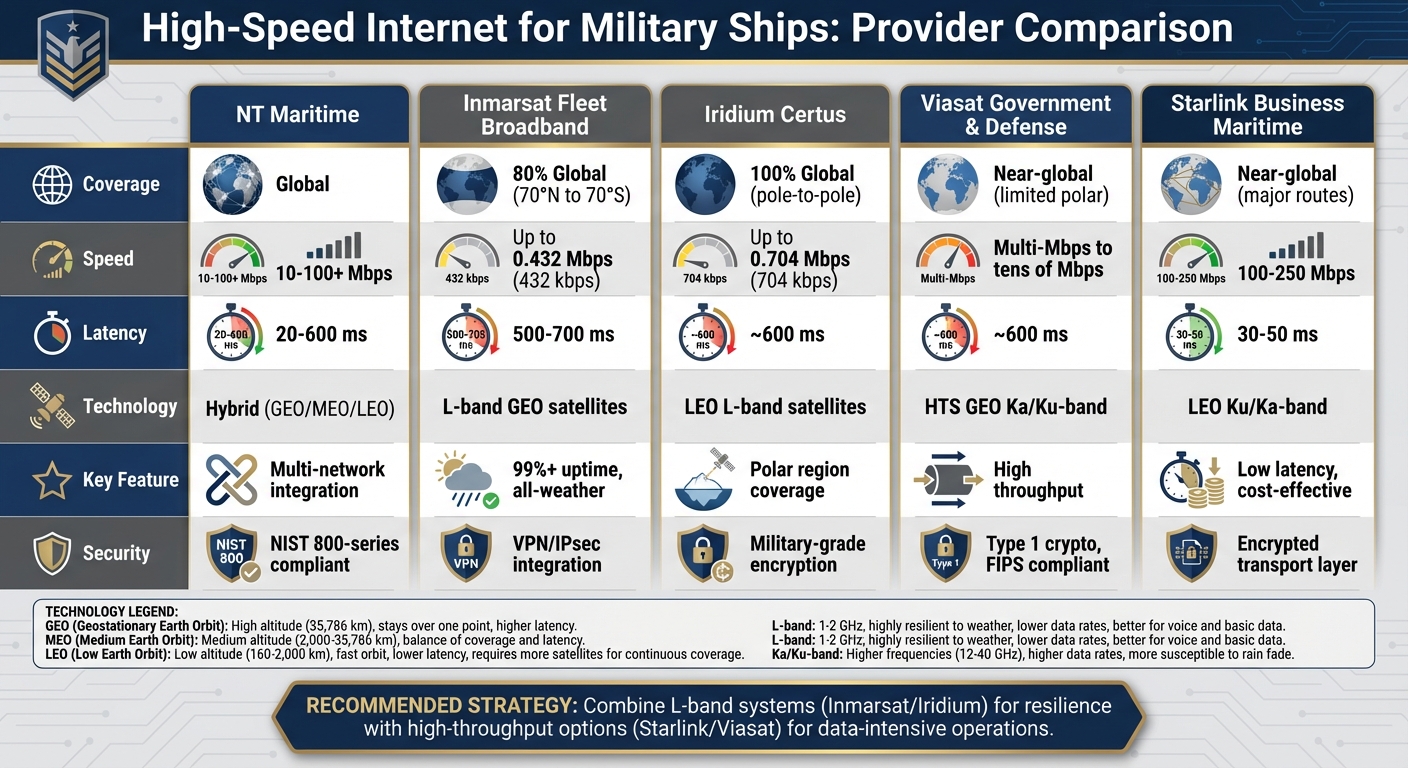
High-speed internet is critical for modern naval operations, ensuring communication, intelligence sharing, and crew welfare. Military ships require secure, reliable connectivity in remote and challenging environments. This article compares five key providers of maritime internet solutions for military use:

  • NT Maritime: Offers hybrid satellite systems (GEO, MEO, LEO) with global coverage, high speeds, and advanced security features tailored for defense needs.
  • Inmarsat Fleet Broadband: Reliable L-band GEO satellites with 99%+ uptime but limited to 80% global coverage and slower speeds (up to 432 kbps).
  • Iridium Certus: Provides 100% global coverage, including polar regions, with LEO satellites and moderate speeds (up to 704 kbps).
  • Viasat Government & Defense: High-throughput GEO satellites delivering multi-Mbps speeds, ideal for bandwidth-heavy tasks, but with higher latency and no polar coverage.
  • Starlink Business Maritime: LEO satellites offering 100–250 Mbps speeds and low latency (30–50 ms), with near-global coverage focused on major ocean regions.

Quick Comparison

Provider Coverage Speeds (Mbps) Latency Key Features
NT Maritime Global 10–100+ Mbps 20–600 ms Hybrid networks, tailored for defense, secure
Inmarsat Fleet 80% Global Up to 0.432 500–700 ms Reliable, all-weather, L-band GEO satellites
Iridium Certus 100% Global Up to 0.704 ~600 ms Pole-to-pole, durable solid-state antennas
Viasat Government Near-global Multi-Mbps ~600 ms High throughput, encrypted, defense-grade
Starlink Maritime Near-global 100–250 30–50 ms Low latency, cost-effective, data-heavy tasks

Military planners often combine L-band systems (e.g., Inmarsat, Iridium) for resilience with high-throughput options (e.g., Starlink, Viasat) for data-intensive activities. NT Maritime excels at integrating these networks into a single, secure platform to meet diverse naval mission needs.

Military Maritime Internet Providers Comparison: Speed, Coverage, and Latency

Military Maritime Internet Providers Comparison: Speed, Coverage, and Latency

1. NT Maritime High-Speed Internet Solutions

NT Maritime

Network Technology

NT Maritime delivers reliable connectivity through hybrid satellite architectures designed for uninterrupted operations. This system combines VSAT services over Ku/Ka-band frequencies with L-band backup links, leveraging networks like Inmarsat FleetBroadband and Iridium Certus. Its multi-path design automatically transitions between GEO, MEO, and LEO satellite constellations based on changing conditions. Onboard antennas work seamlessly with modems, routers, and firewalls, ensuring smooth segmentation of mission-critical and crew communications. The system supports VoIP, secure messaging, and video conferencing via a QoS-aware IP backbone, prioritizing low-latency traffic for essential command and control tasks. This advanced setup ensures dependable connectivity across maritime operations.

Coverage

Thanks to its hybrid design, NT Maritime provides consistent coverage across a variety of maritime environments. Its dual-network approach guarantees global connectivity, spanning equatorial to polar regions. This capability is vital for Arctic and Antarctic missions, where GEO satellites often have limited visibility. U.S. Navy vessels benefit from this system, maintaining connectivity in contested waters or during polar expeditions. Additionally, terrestrial links can be integrated when ships are near coastlines or in port, reducing dependency on satellite networks and expanding overall availability.

Security Features

NT Maritime’s networks are built to meet NIST 800-series cybersecurity standards and FIPS-validated cryptography requirements, ensuring secure operations for U.S. government and defense missions. All data is encrypted using IPsec and TLS-based VPNs, safeguarding critical command and control communications. The system includes next-generation firewalls with deep packet inspection, application-layer filtering, and geo-fencing for added protection. Logical segmentation through VLANs and role-based access controls separates mission networks, administrative systems, and crew welfare Wi-Fi. For Telehealth services, encryption is paired with data integrity checks and certificate-based authentication, protecting medical consultations and records while enabling secure remote specialist access during deployments.

Performance and Latency

NT Maritime’s satellite platforms deliver aggregate throughputs ranging from tens to hundreds of Mbps per vessel – an impressive leap from older systems that typically managed just 5–10 Mbps. Latency depends on the satellite orbit: GEO links generally experience round-trip delays of about 600 ms, suitable for tasks like email and file transfers, while LEO connections bring latency down to just tens of milliseconds, enhancing real-time operations. Traffic engineering further optimizes performance, prioritizing ISR feeds and command traffic with minimal jitter, while delaying bulk data transfers during critical operations. With reliability targets exceeding 99% link availability, automatic failover mechanisms ensure uninterrupted command and safety communications, even during harsh weather or satellite disruptions. These performance improvements are crucial for supporting mission-critical activities at sea.

2. Inmarsat Fleet Broadband Solutions

Inmarsat Fleet Broadband

Network Technology

Inmarsat FleetBroadband relies on L-band connectivity via GEO satellites to provide continuous IP data and voice services. Terminals like the SAILOR 250 and 500 allow users to handle data, email, and voice communications all at once. One key advantage of the L-band frequency is its resistance to rain fade, unlike higher-frequency bands like Ku or Ka. This makes it a dependable choice for mission-critical military operations, even in poor weather conditions. FleetBroadband is commonly integrated into military and government vessels, working alongside stabilized marine antennas and onboard routers to ensure seamless communication. This setup delivers reliable global coverage.

Coverage

FleetBroadband ensures consistent satellite internet access across roughly 80% of the globe, covering regions between 70°N and 70°S. This extensive reach is essential for military missions in varied maritime environments. However, polar regions remain outside its coverage, requiring alternative solutions for connectivity in those areas. The network boasts an impressive uptime reliability of over 99%, making it a trusted option for government and military operations where uninterrupted connectivity is critical.

Security Features

FleetBroadband is designed as a commercial platform that seamlessly integrates with secure government networks, rather than being a classified system on its own. To safeguard sensitive data, defense and homeland-security users implement end-to-end VPNs and IPsec tunnels that link ships to command centers. Encryption tools, such as FIPS-validated devices, are employed to protect critical traffic. Onboard, network segmentation separates operational, administrative, and crew networks, ensuring that only mission-specific systems can access secure shore connections. Additionally, FleetBroadband’s use of the L-band provides a reliable backup for essential communications, such as command and safety systems, when higher-capacity VSAT links are unavailable.

Performance and Latency

FleetBroadband terminals, like the SAILOR 500, support broadband speeds of up to 432 kbps and can handle up to nine simultaneous voice calls. This level of performance is ideal for tasks like email, web browsing, telemetry, and mission planning. However, it’s not equipped for high-bandwidth activities like HD video streaming. As a GEO-satellite service, FleetBroadband experiences latency ranging from 500 to 700 ms round-trip, which is higher than low-Earth-orbit systems. Despite this, the latency is manageable for voice communication, messaging, and many command-and-control applications. Military users often pair FleetBroadband with higher-throughput systems like VSAT or LEO for demanding tasks, using FleetBroadband as a dependable fallback when other networks falter.

3. Iridium Certus Maritime Platform

Iridium Certus

Network Technology

The Iridium Certus Maritime platform relies on a Low Earth Orbit (LEO) satellite network, with satellites positioned just 485 miles above the Earth. This setup ensures lower latency and stable signal quality. It operates using L-band frequencies, which are highly resistant to disruptions caused by rain or atmospheric conditions. The platform’s terminals deliver download speeds of over 700 kbps and upload speeds of 352 kbps, all through a single, integrated unit that supports voice, data, and safety services. Its solid-state antennas are maintenance-free and designed without moving parts, making them highly durable in tough maritime environments. This design significantly reduces the maintenance workload for military crews, even in the harshest conditions.

Coverage

Iridium Certus Maritime offers seamless global connectivity, providing 100% pole-to-pole coverage. This capability is especially valuable for naval operations in polar regions and remote oceanic areas where traditional satellite systems fall short. Whether it’s Arctic patrols, Antarctic research missions, or operations in international waters, military vessels can rely on uninterrupted communication. This ensures mission-critical tasks, real-time coordination with command centers onshore, and vital crew support services remain operational, no matter the location.

Security Features

The platform is built with military applications in mind, incorporating secure technology through equipment like the Thales VesseLINK Maritime terminal. While designed for commercial use, it employs military-grade encryption and advanced security protocols tailored for government and defense needs. The solid-state antennas and dedicated safety features provide reliable and secure communication without frequent maintenance, ensuring consistent performance even in high-stakes environments.

Performance and Latency

Iridium Certus Maritime terminals excel in supporting multiple high-quality voice lines, high-speed IP data, and safety services simultaneously. Thanks to its LEO satellite architecture, it achieves latency as low as 600 ms or less, enabling clear voice communication for command operations, fast data transfers for intelligence sharing, and dependable emergency protocols. The single-terminal design simplifies installation and operation on military vessels, reducing complexity while ensuring all communication needs are met. Additionally, built-in upgrade capabilities allow the platform to keep pace with evolving military communication demands, making it a future-ready solution.

4. Viasat Government & Defense Positioning

Network Technology

When it comes to high-speed maritime internet for defense, Viasat sets itself apart with its advanced HTS (High-Throughput Satellite) solutions. Using GEO satellites operating in the Ku- and Ka-bands with spot-beam architecture, Viasat delivers connectivity ranging from several Mbps to tens of Mbps. These services are designed to meet the needs of the U.S. Department of Defense, NATO, and allied naval operations. Viasat’s offerings go beyond just connectivity – they include the entire ecosystem: space segment, ground infrastructure, network management, terminals, and cybersecurity. This comprehensive approach ensures reliable and secure coverage for critical missions.

Coverage

Viasat provides near-global coverage, prioritizing key maritime operational zones. While its network reaches across most ocean areas, coverage in polar regions like the Arctic and Antarctic is limited. For these areas, additional SATCOM solutions are required to maintain connectivity.

Security Features

Security is a cornerstone of Viasat’s services. The company employs multiple layers of protection, including end-to-end encryption, IPsec protocols, and support for Type 1 cryptographic systems. Network monitoring and intrusion detection systems work alongside traffic segmentation to separate mission-critical data from administrative or crew-related traffic. Additionally, private government gateways ensure sensitive data stays off public networks. These measures align with FIPS and NSA Suite B standards, providing a high level of confidence for secure communications.

Performance and Latency

Using GEO satellites, Viasat operates with a round-trip latency of about 600 milliseconds. While this latency is inherent to GEO systems, it remains sufficient for command-and-control operations and real-time video feeds. Viasat’s infrastructure includes QoS (Quality of Service) protocols to ensure mission-critical data gets top priority. The "SATCOM as a Service" model also offers flexibility, allowing users to scale bandwidth as needed without requiring upfront capital investment.

Starlink Business Maritime

Network Technology

Starlink Maritime uses low Earth orbit (LEO) satellite technology to meet the intense demands of military operations at sea. Unlike traditional GEO satellites that orbit about 22,000 miles above Earth, Starlink’s LEO satellites operate much closer, which dramatically reduces latency. This low-latency setup is crucial for tasks like live ISR feeds, real-time mission planning, cloud-based command-and-control systems, and secure video conferencing – activities that often struggle with the delays of GEO networks. The system uses electronically steered flat-panel antennas, which are less bulky than traditional VSAT domes. This design not only simplifies deck installation but also minimizes radar cross-section concerns, all while delivering hundreds of Mbps per vessel.

Coverage

Starlink Maritime provides high-speed internet with near-global coverage, focusing on major shipping routes and ocean regions. For the U.S. Navy and Coast Guard, this means dependable connectivity across the Atlantic, Pacific, and Indian Oceans, as well as key chokepoints and coastal patrol areas. While LEO networks excel in most regions, they face challenges in extreme polar areas. To address this, military planners often combine LEO with GEO or L-band systems to ensure uninterrupted service for Arctic and high-latitude missions, where traditional providers still dominate. This hybrid approach ensures tactical operations benefit from both Starlink’s low-latency performance and broader coverage options.

Security Features

Starlink prioritizes security by incorporating encrypted user traffic and secure satellite-to-ground communications. For U.S. military and government use, Starlink is typically treated as a transport layer, with mission-critical encryption handled by tools like Type 1 or FIPS 140-validated VPNs, NSA-approved tactical radios, or secure tunneling gateways. To further enhance security, military users integrate Starlink terminals into shipboard systems that include firewalls, intrusion prevention measures, zero-trust identities, and cross-domain solutions. Many also use Starlink as part of a software-defined WAN (SD-WAN) setup, which dynamically routes sensitive traffic to more secure networks when necessary. This layered approach allows users to benefit from Starlink’s speed and low latency while adhering to strict DoD and intelligence community security standards.

Performance and Latency

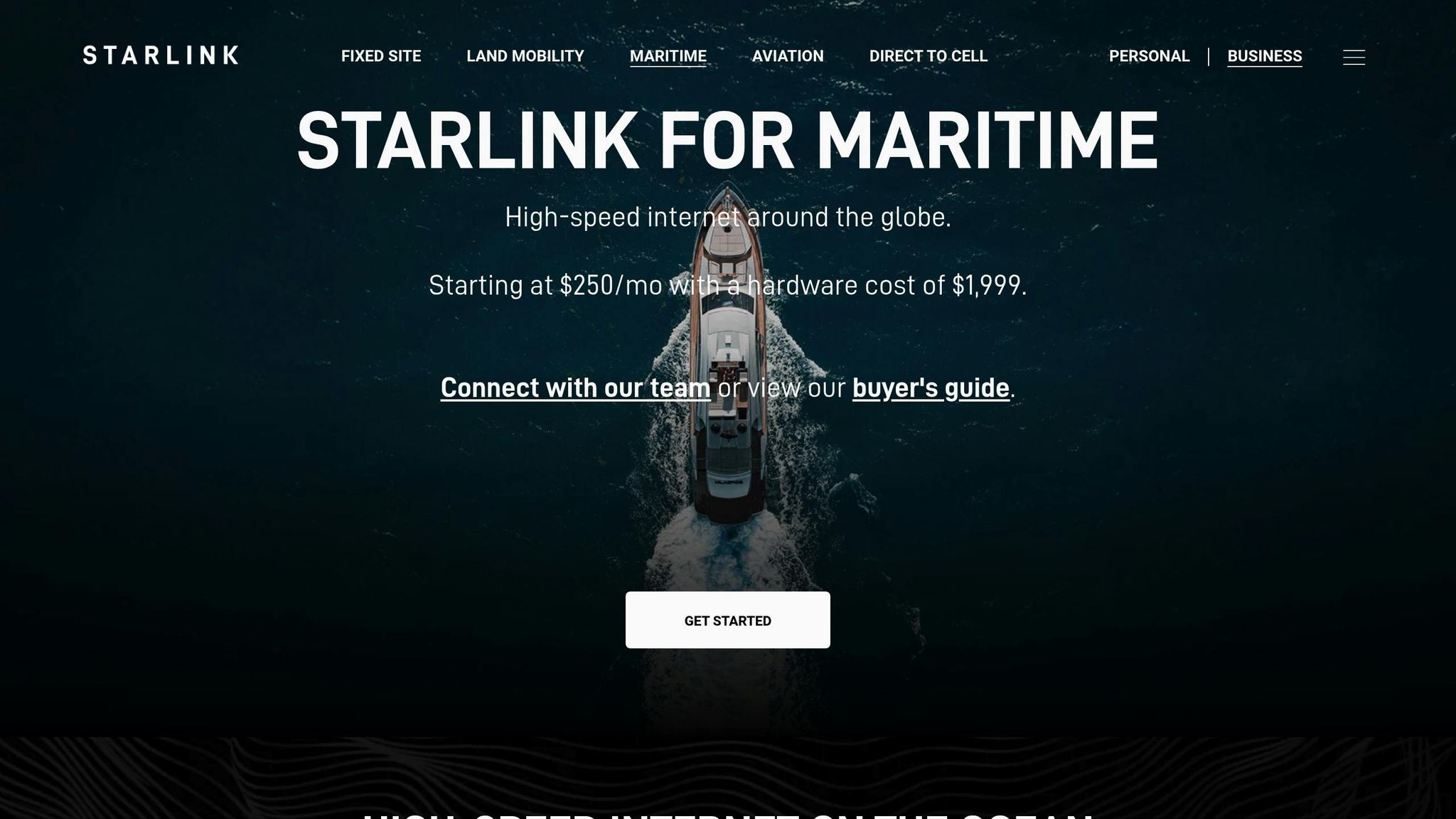
Starlink Maritime delivers download speeds of 100–250 Mbps, upload speeds of 20 Mbps, and latency averaging 30–50 ms. This performance makes it possible to handle data-heavy tasks like HD video conferencing with shore-based teams, large software updates, intelligence transfers, and even concurrent crew internet use. The low latency is particularly useful for VoIP, real-time collaboration tools, and interactive training platforms, which have historically struggled on GEO networks. Pricing for Starlink Business Maritime is set at $250 per month, with hardware available for $1,999.

Provider Comparison: Advantages and Disadvantages

When it comes to selecting a high-speed internet provider for military ships, the decision hinges on several factors: network design, coverage, performance, and security. Each provider offers unique strengths and trade-offs, and understanding these is crucial to aligning capabilities with mission requirements.

NT Maritime (NT Connect) takes a unique approach as a systems integrator, blending multiple networks like Starlink, Inmarsat, and Iridium into a unified, managed solution. This setup ensures high throughput and built-in redundancy while offering tailored compliance for government and military fleets. However, its performance ultimately depends on the coverage and reliability of the underlying satellite networks.

Inmarsat Fleet Broadband is known for its reliability and all-weather performance, leveraging GEO L-band satellites to provide speeds up to 432 kbps with an impressive 99.9%+ uptime. While it delivers consistent voice and data capabilities essential for command operations, its coverage is limited to about 80% of the globe, falling short in extreme polar regions.

Iridium Certus stands out for its 100% global coverage, including pole-to-pole connectivity, thanks to its LEO L-band satellites. With speeds up to 704 kbps and robust solid-state antennas, it’s a solid choice for Arctic operations, backup links, and critical command communications where uninterrupted connectivity is vital.

Viasat Government & Defense offers high-capacity GEO Ka/Ku-band VSAT solutions, delivering multi-Mbps to tens of Mbps throughput. This makes it ideal for bandwidth-heavy tasks like real-time ISR feeds and HD video conferencing. Its strengths include integration with defense networks and secure, encrypted links. However, inherent GEO latency and limited coverage in extreme polar areas are considerations.

Starlink Business Maritime provides speeds between 100–250 Mbps with low latency (under 99 ms) using LEO Ku/Ka-band satellites. It offers a cost-effective option for high throughput compared to traditional GEO plans. While its coverage includes major shipping routes, it still requires verification for operations in extreme polar regions and long-term classified missions.

For military planners, the most effective approach often combines L-band systems (like Inmarsat or Iridium) for resilient command and safety communications with high-throughput options (like Starlink or Viasat) for mission-critical data and crew welfare. This layered network strategy, which integrates resilience, capacity, and security, is precisely what NT Maritime excels in delivering.

These comparisons highlight the importance of a multi-layered architecture to address the evolving demands of maritime missions effectively.

Conclusion

The best approach combines the unique strengths of different networks to meet specific mission requirements. Each provider brings distinct advantages that need to align with operational demands.

As outlined in the earlier provider reviews, the ideal solution hinges on matching network capabilities to mission needs. Some systems are built for global coverage, while others shine in uptime reliability or delivering high-capacity performance. High-throughput networks, for example, are excellent for handling bandwidth-heavy tasks in a cost-effective way.

A multi-layered strategy ensures seamless integration and security. NT Maritime offers a standout example by unifying multiple networks into a single, defense-grade platform designed to handle evolving military challenges.

For modern naval operations, a layered architecture is key. This means using L-band systems like Iridium or Inmarsat for mission-critical resilience, while relying on high-throughput networks like Viasat or Starlink for tasks requiring significant bandwidth. Integrated management becomes crucial for prioritizing traffic, maintaining security segmentation, and adapting to emerging threats. Smaller vessels with tighter budgets can focus on dependable L-band systems with basic data packages, while larger ships benefit from hybrid solutions that balance reliable access, crew welfare, and operational flexibility.

Military planners should adopt a tailored, modular approach. This involves combining resilient L-band links for essential tasks with high-capacity networks for data-intensive operations, ensuring the system can evolve alongside future mission requirements.

FAQs

What are the advantages of NT Maritime’s hybrid satellite system for military vessels?

NT Maritime’s hybrid satellite system delivers secure, high-speed internet access tailored for the unique demands of military operations at sea. This system ensures reliable communication networks that keep crews connected, even when operating in remote or challenging environments.

With this system, crews benefit from advanced onboard communication tools, including calling, messaging, and video conferencing. Additionally, its integrated systems are designed to enhance both operational efficiency and safety. These features are specifically crafted to meet military needs, enabling seamless communication and better coordination during critical missions.

How does NT Maritime provide secure communication for military ships?

NT Maritime specializes in providing secure communication systems specifically designed for military ships. By leveraging mission-critical networks and advanced location services, they ensure reliable and protected communication channels, even in the most demanding maritime conditions.

On top of that, NT Maritime integrates Telehealth technologies to address onboard medical needs, adding an extra layer of safety and operational efficiency for naval missions. Their solutions focus on delivering the security and reliability essential for government and military operations.

Why is a multi-layered network strategy essential for military maritime operations?

A robust, multi-layered network strategy plays a crucial role in military maritime operations. It ensures secure and reliable communication, even in the most remote or high-risk environments. By integrating various communication technologies – like onboard systems, satellite connections, and terrestrial networks – this approach creates redundancy, helping maintain uninterrupted connectivity.

Additionally, it bolsters cybersecurity by minimizing vulnerabilities and safeguarding mission-critical systems. This ensures that both strategic and tactical goals can be achieved effectively, no matter the conditions at sea.

Ultimate Guide to Satellite Bandwidth for Maritime IT

Satellite bandwidth is the backbone of modern maritime communication, enabling vessels to stay connected far from shore. With over 38,000 ships now equipped with broadband systems, the demand for reliable, high-speed connectivity at sea has grown significantly. Here’s what you need to know:

  • What It Is: Satellite bandwidth refers to the data capacity leased for communication between ships and satellites. It supports internet, voice calls, navigation, and more.
  • Why It Matters: It ensures safety (distress signals, weather updates), improves efficiency (fleet tracking, fuel monitoring), and enhances crew and passenger experience (Wi-Fi, entertainment).
  • Key Technologies: VSAT systems (Ku-, Ka-, C-bands), LEO satellites (low latency, faster speeds), and phased-array antennas are commonly used.
  • Bandwidth Allocation: Ships can choose shared or dedicated bandwidth, balancing cost and performance based on their needs.
  • Future Trends: LEO satellites are revolutionizing connectivity, with bandwidth capacity expected to grow sevenfold by 2034.

This guide dives into how satellite bandwidth works, its importance, and how to choose the right solution for your vessel.

How Do Maritime Vessels Communicate? – VSAT Systems Explained

Satellite Technologies and Bandwidth Allocation Methods

Maritime vessels rely on three main satellite technologies to maintain connectivity, each tailored to different operational needs and vessel types. Understanding these technologies, along with the methods used to allocate bandwidth, is crucial for making smart connectivity choices. Let’s break down the essentials.

Satellite Technologies Used in Maritime IT

VSAT systems are the backbone of maritime communications, operating across Ku-, Ka-, and C-bands. Each band serves specific needs:

  • Ku-band is popular among commercial vessels for its balance of cost and broad global coverage.
  • Ka-band delivers faster speeds, ideal for high-bandwidth activities like passenger Wi-Fi and video streaming.
  • C-band stands out for its reliability in harsh weather, making it a go-to for vessels in challenging environments.

LEO (Low Earth Orbit) constellations have revolutionized maritime connectivity. With latency as low as 20–40 milliseconds, they enable near real-time applications. By Q2 2025, over 26,000 ships were using LEO broadband services, with some providers offering download speeds up to 220 Mbps and upload speeds around 40 Mbps [4].

Phased-array antennas represent cutting-edge technology, dynamically tracking multiple satellites to ensure uninterrupted connectivity as vessels move through different coverage zones [4].

The choice of satellite technology often hinges on the vessel’s purpose:

  • Cruise ships lean toward LEO networks for high-speed passenger internet.
  • Cargo vessels typically use VSAT systems for cost-effective operations.
  • Military and government vessels often rely on C-band for secure and dependable connectivity.

Many vessels now adopt multi-orbit strategies, combining geostationary (GEO) and LEO systems to ensure backup connectivity and optimize performance in real time [4]. This approach ensures that connectivity aligns with operational demands, a principle also reflected in how bandwidth is allocated.

How Bandwidth Gets Allocated

Beyond choosing the right satellite technology, efficiently allocating bandwidth is key to optimizing performance. Maritime networks primarily use two approaches for bandwidth distribution, each with its own trade-offs.

Point-to-point technologies create dedicated links between a vessel and a satellite. This setup ensures consistent performance, making it ideal for mission-critical applications.

Point-to-multipoint technologies share bandwidth among multiple vessels within a satellite beam. While more cost-effective, performance can vary based on network congestion and demand.

The choice between shared and dedicated bandwidth significantly impacts both costs and service quality:

  • Shared bandwidth pools resources among users, offering an affordable option but with potential slowdowns during peak usage.
  • Dedicated bandwidth reserves capacity for a single vessel, guaranteeing stable performance for tasks like telemedicine or real-time monitoring, though it comes at a higher price.

Here’s a quick comparison of allocation methods:

Allocation Method Performance Cost Best For
Point-to-Point Dedicated Consistent High Mission-critical operations, large vessels
Point-to-Multipoint Shared Variable Low–Medium General communications, smaller vessels
Hybrid Approach Balanced Medium–High Mixed operational needs

The bandwidth game is rapidly changing. NGSO capacity, particularly from LEO satellites, is expected to grow from 286 Gbps in 2024 to 2 Tbps by 2034 – a sevenfold increase. This surge in capacity is driving down costs while improving performance across all allocation methods. Operators must weigh factors like user needs, application demands, route reliability, and data requirements to find the most effective and economical solution. The goal? To match current operational priorities while preparing for what’s next.

How to Maximize Bandwidth Usage at Sea

Getting the most out of satellite bandwidth while at sea requires a mix of technical fine-tuning, smart traffic management, and properly configured hardware. Maritime professionals can adopt a variety of methods to enhance connectivity, ensuring smooth operations and reliable communication – whether for critical tasks or day-to-day needs.

Methods to Improve Bandwidth Performance

One effective approach is adaptive coding and modulation (ACM), a technology that adjusts signal parameters in real time based on current link conditions. This is particularly useful in overcoming challenges like weather disruptions, as it helps maintain optimal throughput even when signal quality fluctuates.

Another tool is TCP acceleration, which tackles the inherent latency of satellite communications. By optimizing the transport protocol, it speeds up data transfers, making it especially effective for latency-sensitive applications such as video calls and real-time monitoring.

Then there’s HTTP prefetching, which anticipates user needs by loading web content ahead of time. This reduces perceived delays and works well for applications that consume a lot of bandwidth, such as streaming or large data transfers.

For example, a cruise line using HTS-enabled Ka-band VSAT saw a 50% increase in available bandwidth and a 30% reduction in latency after implementing these strategies. This allowed them to support reliable video streaming and telemedicine services for both passengers and crew.

Additionally, High Throughput Satellites (HTS) with spot beam technology offer a significant performance boost. These systems provide higher capacity and lower latency, making them ideal for handling the data-heavy demands of modern maritime operations.

These technical improvements set the stage for efficient traffic management, which is crucial for maintaining consistent connectivity.

Network Traffic Management and Segmentation

Once performance enhancements are in place, managing network traffic becomes the next priority. Smart traffic management ensures that critical applications always have the bandwidth they need. By segmenting the network and prioritizing traffic, operators can allocate resources to essential functions and prevent congestion.

For instance, traffic prioritization can ensure that navigation systems and safety communications take precedence over recreational internet use. This guarantees that vital operations remain unaffected, even during periods of heavy network demand.

A commercial shipping fleet demonstrated the effectiveness of this approach by implementing network segmentation and traffic prioritization. Even during peak passenger internet usage, the fleet maintained uninterrupted operational communications, highlighting how proper traffic management can balance competing demands.

Another component of traffic management is backup connectivity options. These systems provide redundancy through automatic failover mechanisms, switching to alternative satellite links or cellular networks when needed. Dynamic bandwidth allocation further enhances flexibility by adjusting resources in real time based on changing requirements.

Hardware Setup and Environmental Factors

The right hardware setup is essential for maximizing performance. Proper antenna installation and alignment are critical, as they ensure a clear line of sight to satellites. This becomes even more important on moving vessels, where surrounding structures and constant motion can disrupt signals.

Stabilized antennas play a key role here. These systems automatically adjust to maintain alignment with satellites, even as ships roll, pitch, or change course. For example, commercial vessels often rely on 1 to 1.5-meter stabilized Ku-band VSAT antennas, while smaller vessels use Ultra Small Aperture Terminals (USATs) for more cost-effective connectivity.

Additionally, marine-rated equipment is designed to withstand the harsh conditions at sea, including saltwater corrosion, high humidity, and extreme temperatures ranging from -20°F to 140°F. Such equipment typically features corrosion-resistant materials and sealed enclosures to protect against environmental damage, ensuring reliable performance in any weather.

To minimize downtime, remote diagnostics and updates allow technicians to troubleshoot and maintain systems without being physically present. Routine maintenance, including firmware updates and checks on antenna alignment and connection security, helps prevent issues before they arise.

Finally, it’s important to monitor environmental factors like weather and sea conditions, as these can heavily impact satellite signals. Operators should plan communication activities during favorable conditions and rely on backup systems to maintain connectivity during severe weather, ensuring uninterrupted service even in challenging circumstances.

How to Choose the Right Satellite Bandwidth Solution

Finding the right satellite bandwidth solution means balancing performance, cost, and your vessel’s specific operational needs. With NGSO (primarily LEO) capacity expected to dominate the market – growing from 85% in 2024 to 98% by 2034 – maritime operators are rethinking how they approach connectivity. Here’s a breakdown of the key factors to consider when aligning your connectivity needs with your operational priorities.

What to Look for in Satellite Bandwidth Options

When evaluating satellite bandwidth options, focus on the features that align with your vessel’s unique requirements.

Start with performance metrics like download/upload speeds, latency, and coverage. For example, a cruise ship catering to thousands of passengers will need a solution vastly different from what a small cargo vessel requires.

  • Latency: This is critical for real-time functions like video calls or telemedicine. LEO systems, with latency as low as 20–40 ms, are a game-changer compared to the 600+ ms typical of GEO satellites. These systems are ideal for time-sensitive applications [4].
  • Coverage: Your route dictates your coverage needs. While global coverage is essential for vessels on worldwide routes, regional solutions may work for coastal or ferry operations. LEO and multi-orbit solutions now offer near-global coverage, even in polar and remote ocean regions [4].
  • Hardware: Equipment requirements can vary. LEO systems often need sophisticated electronically steered antennas, while GEO VSAT typically uses traditional stabilized parabolic antennas. Factors like deck space, power availability, and installation complexity should influence your decision [4].
  • Security: For federal and military operations, robust encryption and cybersecurity are non-negotiable. Your solution must ensure secure data exchange for critical missions.
  • Service Integration: Seamless integration with onboard systems – like passenger management platforms or ship PBX – can enhance functionality. Features such as app-to-app calling and integrated WiFi messaging are valuable for both crew and passengers.

It’s also important to assess peak performance and reserve capacity. For example, a global cruise line opted for a C-band VSAT system on flagship vessels to ensure uninterrupted connectivity, despite higher hardware costs. Meanwhile, for regional ferries, they chose Ku-band spot-beam services with smaller antennas to strike a balance between performance and cost.

Satellite Technology Comparison

Understanding the strengths and limitations of different satellite technologies can help you make an informed choice:

Technology Data Rates Latency Coverage Hardware Requirements Best Use Cases
GEO VSAT Moderate to High 600+ ms Global (except polar regions) Stabilized parabolic antennas Backup connectivity, legacy systems, non–time-critical operations
LEO (e.g., Starlink) High (100+ Mbps) 20–40 ms Near-global, including polar areas Electronically steered/flat panel antennas Real-time operations, crew/passenger internet, IoT applications
MEO Very High (Gbps) 100–150 ms Regional/global Advanced tracking systems High-throughput enterprise applications

LEO systems, like Starlink, are rapidly gaining traction, with over 26,000 ships now using LEO broadband services. These systems provide speeds of up to 220 Mbps for downloads and 40 Mbps for uploads, with low latency – perfect for data-heavy, real-time applications [4].

While GEO VSAT is still relevant for backup connectivity and areas not fully covered by LEO systems, its market share is shrinking as NGSO solutions expand. Many operators are adopting multi-orbit strategies, combining GEO, MEO, and LEO technologies to ensure both reliability and enhanced performance.

The cost landscape is also shifting. In 2025, service revenues reached $1.27 billion for GEO VSAT and $745 million for LEO broadband [4]. With advancing technology, the total cost of ownership is dropping, and flexible contracts tailored to specific needs are helping operators manage budgets more effectively.

To choose the right solution, match your vessel type, route, and operational demands with the appropriate satellite technology. Cruise lines, for instance, need high bandwidth and low latency to handle large numbers of users, while federal and military operations may prioritize security and reliability. Looking ahead, scalability is crucial – NGSO bandwidth is expected to grow sevenfold, from 286 Gbps in 2024 to 2 Tbps by 2034, ensuring your investment can meet future data demands.

NT Maritime‘s Bandwidth Management Solutions

NT Maritime

NT Maritime provides tailored bandwidth management and communication solutions specifically designed to meet the unique challenges of maritime environments. Serving a $3.2 billion market with over 38,300 vessels relying on VSAT and LEO broadband services [4], the company delivers tools that enhance connectivity and operational efficiency at sea.

NT Maritime’s Communication and Bandwidth Services

NT Maritime offers high-speed internet with download speeds of up to 220 Mbps, upload speeds of 40 Mbps, and latency under 99 ms. This level of connectivity supports everything from crew communications to demanding applications like real-time video conferencing and telemedicine.

At the core of NT Maritime’s offerings are secure communication networks. These networks support a wide range of tools for both passengers and crew, including onboard calling, messaging, video calls, and voicemail systems. What makes NT Maritime stand out is their seamless integration of these services – passengers can access connected communication systems that are fully integrated with onboard management tools.

Passengers benefit from unlimited onboard calls and messages via a dedicated app, which also enables group messaging and photo sharing, creating a connectivity experience comparable to land-based vacations. The bring-your-own-device (BYOD) feature allows passengers to use their own smartphones and tablets over the ship’s WiFi, eliminating the need for specialized equipment.

For healthcare needs, NT Maritime’s Telehealth solutions offer remote medical consultations, real-time health monitoring, and secure transmission of medical data. These services ensure timely care for both emergencies and routine medical needs.

For government and military operations, NT Maritime provides secure communication systems designed to withstand cyber threats. These systems meet FIPS (Federal Information Processing Standards) and other maritime cybersecurity requirements, ensuring encrypted, reliable communication for mission-critical operations. These secure networks enable real-time data sharing while maintaining the highest levels of security.

How NT Maritime Improves Maritime IT Operations

NT Maritime enhances IT operations by optimizing bandwidth through dynamic allocation and real-time traffic management, ensuring critical functions remain uninterrupted even in challenging conditions.

Their approach includes traffic prioritization, network segmentation, and dynamic bandwidth allocation. Essential applications like navigation systems, safety communications, and Telehealth services are prioritized, while recreational internet and entertainment services are allocated bandwidth based on availability. This Quality of Service (QoS) model ensures smooth operation across all systems without congestion.

With real-time monitoring and analytics, NT Maritime keeps a constant eye on network performance. Their systems can detect potential bottlenecks before they disrupt operations, automatically reallocating resources or notifying IT staff to address issues. This proactive strategy minimizes downtime and ensures reliable service, even during periods of high demand.

A key strength of NT Maritime’s solutions is their ability to integrate seamlessly with existing shipboard infrastructure. Their systems support standard interfaces, allowing easy integration without the need for extensive modifications. This reduces installation complexity and limits operational disruptions during deployment.

Cruise lines using NT Maritime’s services report higher passenger satisfaction, thanks to reliable high-speed internet and communication tools. Government vessels benefit from secure, compliant networks that support critical missions and real-time data sharing. For crew members, access to video calls and messaging alleviates isolation during long voyages, improving morale and retention.

NT Maritime also employs redundant network designs to ensure service continuity. By using multiple satellite connections and backup protocols, they maintain connectivity even during adverse weather or equipment failures. This level of reliability is particularly important for vessels operating in remote areas where alternative communication options are limited.

Beyond connectivity, NT Maritime’s solutions contribute to operational efficiencies. Features like real-time weather and traffic data for optimized routing, predictive maintenance alerts, and fuel consumption monitoring help reduce costs. These capabilities directly enhance return on investment for vessel operators, with many reporting noticeable reductions in operational expenses through improved connectivity and data-driven decision-making. By maximizing satellite bandwidth, NT Maritime supports smoother and more efficient maritime IT operations.

Key Points About Satellite Bandwidth for Maritime IT

Over the last two decades, the maritime industry has seen incredible progress in satellite connectivity. Data speeds have skyrocketed, now reaching up to 128 Mbps and beyond. Compare that to the early Fleet 77 systems, which offered only minimal connectivity – this transformation has made satellite bandwidth indispensable for modern maritime operations.

The maritime satellite communications market has grown to an impressive $3.2 billion, fueled by global adoption. In Q1 2025 alone, 5,000 new vessels were equipped with broadband systems, showcasing the rapid pace of technological integration [4].

Non-geostationary satellite systems (NGSO), especially low Earth orbit (LEO) satellites, are now leading the market. These systems have surged from 85% market share in 2024 to a projected 98% by 2034. Why the shift? LEO satellites offer distinct advantages: lower latency, greater bandwidth, and enhanced global coverage – capabilities that traditional geostationary satellites just can’t match.

That said, bandwidth planning is essential for maritime operations. Ships must carefully balance bandwidth usage to meet operational needs, provide for crew welfare, and offer passenger services – all while keeping costs under control. Tailoring bandwidth allocation to the specific needs of each vessel type is key.

Advanced network management tools play a critical role here. Features like quality of service (QoS), traffic prioritization, and network segmentation ensure that vital communication channels remain uninterrupted.

The growing integration of IoT devices and cloud platforms is another major driver of bandwidth demand. From weather routing to predictive maintenance, vessels increasingly depend on real-time data exchange, making reliable satellite connectivity essential for smooth operations.

Looking ahead, multi-orbit connectivity is emerging as the next big step for maritime IT. By combining GEO, MEO, and LEO satellite networks, vessels can achieve maximum uptime and performance [4]. To stay ahead, maritime professionals need to invest in advanced shipboard antennas, implement strong traffic management systems, and work with providers who understand the complexities of maritime environments.

The future of maritime satellite bandwidth is bright. With NGSO bandwidth capacity expected to grow from 286 Gbps in 2024 to 2 Tbps by 2034, the industry is poised for groundbreaking innovations. This rapid growth underscores the importance of being proactive in bandwidth planning to keep pace with the demands of modern maritime technology.

FAQs

How can I decide if my vessel needs shared or dedicated satellite bandwidth?

Choosing between shared and dedicated satellite bandwidth boils down to your vessel’s communication needs and how you use data.

Shared bandwidth is a budget-friendly option, perfect for vessels with lighter data demands. It’s suitable for activities like browsing the internet or making occasional video calls. However, since the bandwidth is shared among multiple users, speeds can dip during busy times.

On the flip side, dedicated bandwidth offers steady, reliable speeds, making it the go-to choice for vessels with heavy data requirements. This is especially critical for cruise ships, government vessels, or operations that depend on essential systems like Telehealth or live video conferencing. While it’s more expensive, dedicated bandwidth ensures uninterrupted connectivity, which is vital for mission-critical tasks.

To decide, assess your vessel’s specific needs – consider the number of users, types of applications, and your budget. Not sure where to start? A maritime IT provider like NT Maritime can guide you toward the best solution for your operations.

What are the advantages of using a multi-orbit approach for maritime satellite connectivity?

A multi-orbit strategy taps into the strengths of various satellite orbits – geostationary (GEO), medium Earth orbit (MEO), and low Earth orbit (LEO) – to deliver dependable and efficient maritime connectivity. By combining these orbits, it ensures uninterrupted coverage, even in the most remote areas, utilizing the unique advantages each orbit offers.

For instance, GEO satellites are known for their wide coverage and stable connections, making them perfect for consistent communication needs. On the other hand, LEO satellites excel in providing lower latency and faster speeds, which are crucial for tasks like video calls or real-time monitoring. By integrating these orbit types, maritime operations can enjoy improved performance, greater adaptability, and dependable connectivity, even in the challenging conditions of open waters.

How can I maintain reliable satellite communication during bad weather at sea?

Reliable satellite communication during tough weather conditions hinges on using the right equipment, smart system setup, and vigilant monitoring. Start by choosing top-tier antennas and modems built to withstand rough seas and harsh weather. These devices are designed to keep connections stable, even in challenging environments like storms.

You can also manage bandwidth effectively by focusing on critical communications and reducing non-essential data usage when the weather takes a turn. Regular maintenance and inspections of your satellite equipment are essential to catch and fix issues caused by wear and tear before they disrupt service. For a more resilient setup, explore advanced maritime IT systems that include redundancy and failover features, ensuring your connection stays intact no matter the conditions.

How LEO Satellites Enable Low-Latency Internet at Sea

Low Earth Orbit (LEO) satellites are transforming internet access at sea by providing fast, reliable, and low-latency connectivity. Unlike older systems, LEO satellites orbit closer to Earth – under 500 miles – making them ideal for real-time applications like video calls, telemedicine, and remote diagnostics. This proximity reduces latency to just 70 milliseconds, compared to over 600 milliseconds for traditional geostationary satellites.

Here’s why LEO satellites are changing maritime connectivity:

  • Low Latency: Perfect for time-sensitive tasks like video conferencing and emergency communications.
  • High Speeds: Supports activities like 4K streaming and real-time data transfer.
  • Global Coverage: Reliable internet even in remote areas, including polar regions.
  • Improved Crew and Passenger Experience: Enables seamless communication, entertainment, and access to online resources.
  • Operational Efficiency: Supports predictive maintenance, weather routing, and IoT integration.

LEO systems rely on advanced constellations of satellites and specialized hardware like electronically steered antennas to maintain stable connections on moving ships. Providers like OneWeb and Telesat are leading the charge, making high-performance maritime internet more accessible.

LEO satellite technology is reshaping maritime operations, improving communication, safety, and overall connectivity at sea.

Starlink Maritime

Benefits of LEO Satellites for Maritime Internet

LEO satellites are revolutionizing how ships stay connected by providing fast, low-latency internet that improves operations, enhances crew well-being, and elevates passenger experiences worldwide.

Low Latency for Real-Time Applications

With latency as low as 70 ms, LEO satellites enable real-time applications like telemedicine and remote equipment diagnostics. This near-instant response time allows for high-quality video consultations with medical professionals or onshore engineers, ensuring quick problem-solving before minor issues turn into major expenses.

For the crew, this low-latency connection means better communication with loved ones through video calls, helping to maintain morale during extended periods at sea.

High-Speed Data Transfer

LEO satellite networks deliver impressive speeds, making even the most data-demanding activities possible. For example, Intelsat‘s FlexMaritime service offers download speeds up to 100 Mbps and upload speeds up to 10 Mbps. This level of connectivity supports smooth 4K video streaming for entertainment and training, as well as real-time transmission of critical sensor data for predictive maintenance.

Fast and reliable data transfer also streamlines operations. Crews can access training materials and safety briefings instantly, while real-time data enables adjustments to weather routing, fuel efficiency, and other key operational metrics. These capabilities not only enhance safety but also help reduce costs.

Global Coverage and Reliability

One of the standout features of LEO satellite networks is their ability to provide seamless connectivity across the globe, even in areas where traditional systems fall short. Ships remain connected no matter where they are, from busy shipping lanes to the most remote parts of the ocean.

LEO satellites also excel in polar regions, where geostationary satellites often struggle. Networks like OneWeb’s constellation ensure reliable service even in Arctic waters, a crucial advantage for research vessels, government operations, and the growing Arctic tourism industry.

Additionally, the constellation-based design of LEO networks allows for automatic handoffs between satellites, ensuring uninterrupted service as vessels move across coverage areas. This reliability supports everything from streaming and gaming to social media and video calls, keeping crew and passengers connected wherever they go.

These capabilities make LEO satellites a game-changer for maritime connectivity, setting the stage for more advanced onboard systems to fully harness their potential at sea.

Technical Requirements for LEO Connectivity at Sea

Setting up LEO satellite connectivity on a ship isn’t just about installing equipment – it’s about preparing for the unique challenges of the maritime environment. Ships face constant motion from waves, weather, and navigation, so the hardware must be tough and capable of keeping up with fast-moving satellites.

Hardware and Equipment

At the core of any LEO satellite system at sea is the electronically steered array (ESA) or active electronically steered array (AESA) antenna. These antennas rely on electronic beam steering rather than mechanical movement, allowing them to track multiple LEO satellites quickly and stay aligned with their orbits as they race across the sky. In contrast, traditional parabolic antennas struggle to keep up with such rapid movements, especially on a moving vessel. ESA and AESA antennas solve this problem by electronically adjusting for the ship’s pitch, roll, and yaw, ensuring a stable connection even in rough waters.

Beyond the antenna, ships need rugged modems, satellite terminals, and network systems designed to withstand harsh maritime conditions. These components must resist saltwater corrosion, extreme temperatures, and constant vibrations, forming a reliable foundation for maintaining high-speed connectivity.

Integration With Onboard Infrastructure

Once the hardware is installed, the next step is integrating it with the ship’s existing network systems. The satellite terminal connects to the vessel’s LAN, supporting onboard Wi‑Fi, crew tools, and passenger networks. Network management systems play a crucial role here, prioritizing data traffic and implementing cybersecurity measures like end-to-end encryption, secure authentication, and network segmentation to safeguard sensitive information.

For passenger ships, integration goes further. It connects to passenger management systems, enabling features like app-based calling, video chats, and messaging. BYOD (Bring Your Own Device) functionality ensures passengers and crew can use their personal devices seamlessly over the ship’s Wi-Fi. Additionally, linking the satellite system with the ship’s Private Branch Exchange (PBX) system allows onboard communication apps to work with the vessel’s internal phone network and even make calls to shore. This creates a unified and efficient communication setup.

Operational Considerations

Ensuring continuous LEO satellite coverage requires careful operational planning. Antennas need an unobstructed line-of-sight to the sky, so they must be positioned away from structures that could block signals. Automatic handovers between satellites are also critical as ships move through different coverage zones. While LEO networks are designed to handle these transitions smoothly, onboard systems must be configured correctly to support this functionality. To enhance reliability, having backup connections, such as GEO satellites or 4G/LTE nearshore, is highly recommended.

Regular maintenance is key. Antennas need periodic checks, and system software requires updates to stay current. Crew members should be trained to handle basic troubleshooting, and 24/7 technical support from service providers ensures quick resolution of more complex issues. Ground station support is equally important, as it relays data between the ship and terrestrial networks. Monitoring satellite health and keeping an eye on coverage maps can help anticipate potential service gaps.

Power management is another critical factor. While modern LEO systems are built to be energy-efficient, ships must have enough power generation capacity and backup systems to maintain connectivity during emergencies or equipment failures.

Maritime Applications of LEO-Enabled Internet

LEO satellite technology is changing the game for maritime operations, offering applications that were simply out of reach with traditional satellite systems. Its high-speed, low-latency connectivity directly enhances crew welfare, passenger experiences, and maritime safety.

Improving Crew Welfare

Life on the open sea can feel isolating, especially during long stretches away from home. LEO satellite internet bridges that gap by enabling real-time communication with loved ones through video calls and instant messaging. Beyond staying connected, it also provides access to entertainment and training resources through smooth streaming and online platforms. Virtual wellness tools and mental health apps become easily accessible, offering critical support during extended voyages. These advances in connectivity not only improve life for the crew but also set the stage for better passenger experiences.

Better Passenger Experiences

Today’s travelers expect seamless internet access, even at sea. LEO satellites deliver high-speed connectivity that supports 4K video streaming, online gaming, and uninterrupted video calls.

NT Maritime takes this a step further with its passenger communication solutions. Their technology allows passengers to stay connected with unlimited calls and messages via dedicated apps. Group messaging features make it easy to share photos and plan meetups. As NT Maritime explains:

Their "robust technology allows guests to enjoy a cruise vacation with the ability to enjoy communication and connectivity among friends and family on their cruise just as they would if they were on a land‑based vacation".

LEO connectivity also makes telehealth consultations a reality, enabling passengers to receive real-time medical advice from shore-based doctors – an essential feature for longer voyages. This reliable connectivity also supports critical safety and operational needs.

Supporting Safety and Operations

Safety at sea depends on constant and secure communication, and LEO satellites provide the always-on connectivity modern systems demand. Ships equipped with LEO technology can act as "floating data centers", continuously sending performance data to shore-based teams. This enables predictive maintenance, identifying potential issues before they escalate.

Real-time monitoring also improves security and navigation. Advanced identification systems benefit from LEO’s low-latency connections, which are particularly valuable in remote or challenging environments.

In emergencies, LEO connectivity allows ships to quickly share detailed information with rescue coordination centers, ensuring faster and more effective responses. High-quality video communication further supports real-time guidance from shore-based experts.

Cybersecurity also gets a boost with LEO systems, which enable encrypted, reliable data exchanges that meet compliance standards and withstand cyber threats. The integration of IoT devices becomes more practical, with sensors transmitting data on engine performance, cargo conditions, and more. This level of connectivity significantly enhances safety and operational efficiency, showcasing how LEO technology is reshaping maritime operations across the board.

NT Maritime: Using LEO Satellite Technology for Maritime Connectivity

NT Maritime

NT Maritime leverages LEO satellites to provide dependable, high-performance connectivity at sea. By combining advanced satellite technology with practical maritime solutions, they create a robust digital environment for both commercial and government operations. Below, we explore their solutions, performance capabilities, and system integration.

NT Maritime Solutions Overview

NT Maritime offers a range of IT and communication tools tailored for maritime settings. Their services include secure communication networks, tools for crew and passenger connectivity, and telehealth support. These enable features like onboard calling, messaging, video calls, and voicemail, all optimized to function smoothly over ship Wi-Fi. For government and military clients, NT Maritime ensures secure, encrypted communications that meet stringent federal and military standards, safeguarding against cyber threats.

Their solutions cater to both commercial cruise operations and critical government missions, delivering reliable connectivity across diverse maritime applications.

High-Speed and Low-Latency Connectivity

NT Maritime’s integration of LEO satellite technology achieves download speeds up to 220 Mbps, upload speeds up to 40 Mbps, and latency under 99 milliseconds. These speeds represent a significant leap from traditional maritime internet options, offering fiber-like performance even in the middle of the ocean.

This high-speed connectivity unlocks possibilities that were previously out of reach. Real-time applications like video conferencing, telemedicine, and remote diagnostics become practical and efficient. The low latency is particularly valuable for time-sensitive activities, such as emergency communications or live monitoring of operations.

The technology behind these speeds includes electronically steered array (ESA) antennas. These compact, flat antennas are designed to track fast-moving LEO satellites and work seamlessly with onboard systems like routers, modems, and secure Wi-Fi networks. This setup ensures that high-speed internet is distributed efficiently throughout the vessel.

Integrated Communication Systems

NT Maritime’s communication systems extend beyond basic internet access, creating a fully connected digital ecosystem onboard. Their solutions support various communication types, such as App-to-App and App-to-Ship calls, integrating smoothly with existing vessel communication infrastructure.

For passengers, NT Maritime offers tools to stay connected via unlimited calls and messages using dedicated apps. Group messaging features make it easy to coordinate activities and share updates. These systems can also be customized to align with a cruise line’s branding, enhancing the overall guest experience.

For crew members, the high-speed connectivity provides more than just communication. It enables video calls with loved ones, access to entertainment platforms, and participation in online training programs, significantly boosting morale and addressing retention challenges in the maritime industry.

Security is a top priority, particularly for government and military clients. NT Maritime ensures encrypted voice and data transmission, secure onboard networks, and advanced cybersecurity measures to meet defense-level requirements. Their integration process prioritizes critical applications, ensuring uninterrupted connectivity essential for maritime operations.

NT Maritime’s systems are designed to integrate seamlessly with existing onboard IT infrastructure. They are compatible with LAN/Wi-Fi networks, VoIP systems, and ship management platforms, ensuring minimal disruption during installation while maximizing the benefits of LEO satellite connectivity across all aspects of vessel operations.

The Future of Maritime Connectivity With LEO Satellites

LEO satellites are revolutionizing maritime connectivity. What was once a world of limited, high-latency connections is quickly transforming into one where fiber-like internet speeds are becoming the norm – even in the middle of the ocean. This shift is reshaping how ships operate, improving crew morale, and enhancing passenger experiences. It’s also opening doors for advanced technologies like real-time data processing and autonomous operations.

But these satellites offer far more than just faster internet. LEO systems support real-time analytics, predictive maintenance, and even autonomous navigation. Thanks to their low-latency and high-speed capabilities, ships can now send operational data instantly to shore. This allows onshore teams to monitor performance in real time and address potential issues before they escalate.

Key Takeaways

LEO satellites bring three major advantages to the maritime world:

  • Ultra-low latency: With response times around 70 milliseconds, real-time applications are now possible.
  • High-speed data transfer: Download speeds can reach up to 100 Mbps, with uploads hitting 10 Mbps – ideal for bandwidth-heavy tasks.
  • Global coverage: These satellites even provide connectivity in polar regions, redefining what’s possible for maritime communication.

This enhanced connectivity also enables the integration of IoT systems and AI-powered analytics across entire fleets. As satellite constellations like Telesat’s 198-satellite Lightspeed network grow, these solutions are becoming more reliable and cost-efficient.

NT Maritime’s Role in Advancing Connectivity

NT Maritime is at the forefront of this technological leap, using LEO satellite capabilities to transform maritime operations. Their approach goes far beyond basic internet access, addressing both operational needs and the well-being of those onboard. With download speeds reaching up to 220 Mbps, upload speeds up to 40 Mbps, and latency under 99 milliseconds, NT Maritime delivers cutting-edge performance. These capabilities support advanced applications like high-definition video conferencing and real-time remote diagnostics.

Security is another critical focus. NT Maritime ensures robust protection against cyber threats through secure communication networks. By integrating onboard services – such as calling, messaging, video conferencing, and voicemail – with LEO connectivity, they provide communication experiences that rival those on land.

Looking ahead, NT Maritime’s dedication to innovation ensures they’re ready to embrace the next wave of LEO advancements. Their strong partnerships with major cruise lines and government clients position them to lead the industry in adopting next-generation maritime connectivity solutions.

FAQs

What makes LEO satellites ideal for providing low-latency internet at sea compared to traditional geostationary satellites?

LEO (Low Earth Orbit) satellites orbit much closer to Earth compared to traditional geostationary satellites. This shorter distance means data signals have less ground to cover, leading to lower latency. In simple terms, internet connections become faster and more responsive – something that’s especially important for real-time activities like video calls or online teamwork.

What sets LEO satellites apart is their network setup, often referred to as a constellation. This arrangement provides wider and more dependable coverage, even reaching remote areas over the ocean. For maritime use, this is a game-changer, delivering high-speed internet access to passengers and crew, no matter where their journey takes them.

What equipment is needed to set up LEO satellite internet on a ship?

To get LEO satellite internet up and running on a ship, you’ll need specific hardware designed to connect with low Earth orbit satellites. This setup generally includes a compact satellite antenna that can track LEO satellites in real-time, a modem to process satellite signals, and networking equipment like routers to share the connection across the ship.

Installing this system involves carefully aligning the antenna and integrating it with the ship’s existing communication systems. Working with a provider such as NT Maritime can simplify this process, ensuring the equipment is properly configured to deliver fast, low-latency internet access for both passengers and crew.

How do LEO satellites enhance maritime safety and operational efficiency?

LEO (Low Earth Orbit) satellites are transforming maritime operations by delivering high-speed internet with minimal delay. This technology enables real-time communication and data sharing, which plays a key role in safer navigation, accurate weather monitoring, and swift emergency responses.

From an operational standpoint, LEO satellite connectivity enhances IT systems, ensuring smooth communication between ships and onshore teams. This leads to better coordination, streamlined logistics, and access to essential tools like Telehealth services and secure networks, benefiting both passengers and crew members.

Satellite vs Cellular: Best Maritime Internet?

Satellite vs Cellular: Best Maritime Internet?

When it comes to maritime internet, your choice boils down to satellite or cellular connectivity. Both have distinct advantages, and your decision depends on where your vessel operates and what kind of connectivity you need. Here’s the breakdown:

  • Satellite Internet: Best for global coverage, especially in open seas. Low Earth Orbit (LEO) satellites now provide faster speeds and lower latency, making them suitable for real-time applications. However, satellite systems are more expensive and can be affected by severe weather.
  • Cellular Internet: Ideal for vessels near coastlines. With 4G LTE and increasing 5G availability, cellular networks deliver faster speeds and lower latency than traditional satellite systems. That said, coverage is limited to 15–40 nautical miles offshore.
  • Hybrid Systems: Combine satellite and cellular networks for seamless switching based on location and signal strength, balancing cost and performance.

Quick Comparison

Feature Satellite Cellular
Coverage Global, including open seas Coastal (15–40 miles)
Speed 5–250 Mbps (LEO) 50 Mbps–2 Gbps (4G/5G)
Latency 25–600 ms 10–64 ms
Reliability Weather-dependent Coastal congestion may occur
Best For Open-ocean vessels Coastal operations

For cruise ships, cargo vessels, and superyachts, hybrid systems are often the best solution. They leverage cellular networks near shore and switch to satellite in remote areas, ensuring reliable connectivity. Choose based on your vessel’s routes, budget, and connectivity needs.

Podcast Episode: The Ultimate Guide to Data SIM Cards, Wireless Internet for Boats

How Satellite Internet Works at Sea

Satellite internet keeps vessels connected globally by using radio signals relayed through orbiting satellites. Here’s how it works: when a ship sends data, it travels from the vessel’s antenna to a satellite in space, which then relays it down to a ground station tied to the internet backbone. For incoming data, the process is reversed.

This system relies on three main components: the satellite constellation itself, ground stations (also known as teleports) that link to terrestrial networks, and the onboard equipment on the vessel. These elements are strategically positioned worldwide to provide consistent coverage and backup systems.

Maritime satellite internet operates on specific frequency bands such as C-band and Ku-band, with newer systems increasingly adopting Ka-band for higher data speeds. Each band has its own strengths, including differences in signal strength, resistance to weather, and bandwidth. These factors play a crucial role in how satellite orbit types influence overall performance.

LEO vs. Geostationary Satellites

Geostationary satellites are positioned roughly 22,236 miles above the Earth’s equator. They remain fixed relative to the planet, allowing vessels to use simpler, stationary antennas. However, the distance introduces a delay: signals take about 500–600 milliseconds for a round trip, which can impact real-time communications.

In terms of performance, traditional geostationary systems provide download speeds ranging from 1 to 50 Mbps, depending on the user’s service plan and network traffic. Upload speeds are typically slower, between 256 Kbps and 5 Mbps. Despite the latency, these systems are known for their widespread coverage and decades of reliability across vast ocean areas.

Low Earth Orbit (LEO) satellites, on the other hand, operate much closer to Earth, at altitudes between 300 and 1,200 miles. This proximity reduces latency to just 20–40 milliseconds, making them ideal for real-time applications. LEO constellations require hundreds or even thousands of satellites to ensure continuous coverage, as each satellite moves quickly across the sky.

LEO systems can achieve download speeds exceeding 100 Mbps, with upload speeds often matching or nearing the same levels. However, they come with added complexity: shipboard antennas must track the rapidly moving satellites and seamlessly switch connections as satellites pass. This requires advanced – and more costly – tracking equipment.

Weather impacts the two systems differently. Geostationary satellites, particularly those using Ku-band frequencies, can experience rain fade during heavy storms, which temporarily reduces signal quality. LEO systems may show better resilience to weather, but this depends on the specific constellation and frequency band being used.

Required Hardware and Installation

For maritime satellite internet to perform well in ever-changing conditions at sea, the right hardware is essential. The most noticeable component is the satellite antenna, which plays a critical role in maintaining connectivity. Geostationary systems typically use parabolic dishes ranging from 24 inches to 8 feet in diameter. Larger dishes generally provide stronger signals and higher data rates. These antennas are housed within protective radomes to shield them from harsh weather and reduce wind drag.

Modern geostationary antennas are equipped with gyro-stabilized systems that keep the antenna locked onto the satellite, even in rough seas. High-end systems can maintain a signal in waves as high as 15 feet, though extreme conditions may still affect performance.

LEO satellite systems, meanwhile, rely on phased array or mechanically steered antennas to track the fast-moving satellites. These antennas are typically smaller and flatter than traditional dishes, making them a good fit for smaller vessels or situations where space is limited.

Below deck, the setup includes a satellite modem, which handles the conversion of digital data into radio signals and vice versa. These modems are built to endure the tough marine environment, withstanding temperature swings, high humidity, and constant vibration. Most setups also include redundancy features and automatic failover systems to maintain connectivity in case of equipment issues.

Proper installation is key to ensuring reliable performance. The antenna must be placed in a location with an unobstructed line-of-sight to the sky, away from interference caused by the ship’s structure, masts, or other equipment. Typically, this means mounting it at the vessel’s highest practical point. Professional installers use specialized tools to model signal coverage and pinpoint the best placement.

Power needs can vary widely. Smaller geostationary systems consume 50–150 watts, while high-throughput systems may require 300–500 watts. LEO terminals tend to use less power because of the stronger signals from closer satellites, though their advanced tracking mechanisms may offset this advantage.

Finally, the system’s cabling and internal networking tie everything together. Coaxial or fiber optic cables rated for marine environments connect the satellite equipment to the vessel’s internal network. Additional components, such as network switches and wireless access points, distribute the connection throughout the ship. Proper cable routing and weatherproofing are essential to prevent signal loss and protect equipment from damage caused by saltwater exposure.

How Cellular Internet Works at Sea

Cellular internet at sea functions by connecting to land-based cell towers through technology similar to what smartphones use. As ships move away from the shore, onboard systems communicate with coastal towers using radio waves, which are routed through terrestrial networks.

Unlike satellite-based systems, cellular maritime internet relies entirely on staying within range of land-based towers. A clear line of sight to these towers is essential for maintaining a connection. However, as vessels venture farther out, signal strength diminishes due to the Earth’s curvature and the limited range of coastal towers. Additional challenges, such as adverse weather and atmospheric interference, can further weaken the signal and affect reliability.

Modern maritime cellular systems often operate on 4G LTE networks, with 5G becoming more prevalent. These technologies provide faster speeds, lower latency, and better efficiency, making them ideal for operations close to the coastline. However, the reliance on land-based infrastructure means coverage is directly tied to how far a vessel is from shore.

Coastal Coverage Range

Ships generally experience reliable cellular coverage within 3–8 miles of the coast. LTE networks can extend up to 50 nautical miles under optimal conditions, while specialized equipment can boost the range to about 18–20 miles.

Several factors play a role in determining the actual coverage range. For example, the height of a ship’s antenna and the coastal terrain can significantly influence how far the signal travels.

Required Hardware for Cellular

Hardware is just as critical as signal reach when it comes to cellular internet at sea. Maritime cellular systems utilize durable equipment designed to handle harsh conditions like constant vibrations, temperature changes, and exposure to saltwater. Essential components include core routers, omnidirectional antennas, and signal boosters.

Marine antennas, typically omnidirectional, are mounted high on the ship to maintain a clear line of sight to coastal towers. Signal boosters are also employed to strengthen weaker signals, extending coverage where possible. The right combination of rugged hardware is key to ensuring stable and consistent internet access while navigating coastal waters.

Satellite vs Cellular: Direct Comparison

When deciding between satellite and cellular internet for maritime use, it’s essential to weigh their technical and operational differences. Coverage, speed, and cost are the key factors that will help you choose the right option for your vessel.

Coverage and Reliability

Coverage and reliability are where satellite and cellular internet diverge the most. Satellite internet provides global ocean coverage, making it accessible even in the most remote areas, as long as there’s an unobstructed view of the sky.

On the other hand, cellular internet excels in coastal waters. It offers reliable connectivity within 15–40 nautical miles of shore, but its performance drops off quickly as you move further out to sea.

Factor Satellite Cellular
Coverage Area Global ocean coverage Reliable within 15–40 nautical miles of shore
Weather Impact Can degrade during heavy rain or snow Minimal, though congestion may occur
Reliability Consistent with a clear sky view Strong within the coastal coverage range

Speed and Performance

Advancements in technology have significantly improved the performance of both satellite and cellular networks, but each has its strengths. Cellular networks, especially 4G and 5G, deliver exceptional speeds when close to shore.

Steve Gorman, Field Service Engineer at Super Yacht Americas Sales, KVH, highlights this advantage:

"With cellular, I think the biggest benefit right now is that with 5G, it can actually be faster than low earth orbit (LEO) services like Starlink and OneWeb." – Steve Gorman

Satellite internet performance varies based on the type of service. Traditional geostationary satellites often struggle with slower speeds and high latency, typically around 550 milliseconds. In contrast, LEO services like Starlink Maritime have transformed satellite internet, offering speeds between 5–250 Mbps and latency as low as 25–99 milliseconds.

Performance Metric Satellite (LEO) Cellular (4G/5G)
Download Speed 5–250 Mbps (varies by plan) 50 Mbps – 2 Gbps
Upload Speed 2–25 Mbps 8–80 Mbps
Latency 25–99 ms Under 64 ms (often single digits)
Performance Conditions Requires clear sky; weather-dependent Best within 15–40 nautical miles; may face congestion

The next step is to determine which option aligns best with your vessel’s needs based on these factors.

Best Solution by Vessel Type

The connectivity needs of vessels vary based on their operations, size, and travel routes. Choosing between satellite, cellular, or a hybrid system depends on these factors. Here’s a closer look at the best connectivity options for different types of vessels.

Cruise Ships

Cruise ships face a unique challenge: providing reliable, high-speed internet to thousands of passengers who expect seamless streaming, social media access, video calls, and more. To meet these demands, many cruise lines use hybrid connectivity systems. These systems tap into cellular networks when near the coast and switch to satellite networks farther out at sea. Modern satellite technology can deliver download speeds of up to 220 Mbps, ensuring smooth operations and keeping passengers connected.

Cargo and Commercial Vessels

For cargo and commercial vessels, the focus is on operational efficiency and cost-effectiveness rather than passenger entertainment. These vessels rely on dependable connectivity for tasks like tracking, communication, and receiving weather updates. Near shorelines, cellular networks offer an affordable solution. However, for long journeys into open seas, satellite connectivity becomes essential, enabling real-time monitoring and navigation to keep operations running smoothly.

Superyachts and Leisure Vessels

Owners of superyachts and leisure vessels expect internet connectivity that rivals the performance of high-end residential or business setups. These vessels often use premium hybrid solutions, which combine high-speed satellite and cellular services. The technology supports activities like video conferencing and streaming, all while maintaining low latency. Additionally, low-profile antennas are often installed to preserve the vessel’s sleek design without sacrificing performance.

Below is a quick comparison of the ideal connectivity solutions for each vessel type:

Vessel Type Primary Need Recommended Connectivity
Cruise Ships High-capacity, high-speed internet for many users Hybrid system: coastal cellular + offshore satellite
Cargo/Commercial Reliable communication for operational tasks Coastal cellular with satellite for deep-sea connectivity
Superyachts/Leisure Premium, multi-device support with low latency Premium hybrid: high-speed satellite + low-profile antennas

What’s Coming Next

The maritime internet is undergoing rapid changes, with new technologies set to reshape how ships stay connected while at sea. These advancements aim to tackle current challenges and unlock new opportunities for maritime operations.

Expanding LEO Satellite Networks

Low Earth Orbit (LEO) satellite networks are making waves in maritime connectivity. Unlike traditional geostationary satellites that orbit much farther away, LEO satellites operate at altitudes between roughly 340 and 1,200 miles. This closer range dramatically reduces signal travel time, cutting latency to under 50 milliseconds – compared to the 600 milliseconds or more typical of geostationary systems.

LEO networks rely on vast constellations of satellites, often numbering in the hundreds or thousands, to provide seamless global coverage. This means fewer dead zones and more reliable connections, even in remote ocean regions.

Speed is another area where LEO networks shine. Current systems already deliver download speeds exceeding 200 Mbps, with potential to approach 1 Gbps in the near future. Meanwhile, hardware is evolving rapidly – next-generation antennas are becoming smaller, lighter, and easier to install. Features like automatic tracking and self-alignment are simplifying maintenance, making these systems more accessible for vessels of all sizes.

As LEO technology advances, cellular networks are also stepping up to enhance maritime connectivity.

5G and Emerging Cellular Networks

5G technology is extending reliable connectivity for vessels operating near coastlines. Early deployments are already providing coverage up to 15–25 miles offshore, a significant boost for vessels navigating busy shipping lanes, harbors, and fishing zones.

Under optimal conditions, 5G-enabled ships can reach download speeds of up to 1 Gbps and upload speeds around 100 Mbps. Features like network slicing allow operators to prioritize critical tasks – such as emergency communications or navigation – ensuring that essential data gets through, even during high-traffic periods.

A key development is the integration of 5G with satellite systems, creating hybrid connectivity solutions. These setups enable vessels to switch seamlessly between 5G and satellite networks based on their location and signal strength. Additionally, edge computing within 5G networks is enabling local data processing for time-sensitive tasks like autonomous navigation or real-time weather monitoring.

Looking further ahead, research into 6G technology is already underway. While specifics are still emerging, early signs suggest that future networks could offer even better offshore coverage, faster speeds, and lower latency through enhanced integration and optimization techniques. The horizon for maritime connectivity looks more promising than ever.

Final Recommendations

Choose between satellite and cellular internet based on where your vessel operates, what kind of connectivity you need, and how much you’re willing to spend.

Key Points

Satellite internet offers worldwide coverage, making it perfect for vessels traveling in remote areas or open oceans. Modern low-earth orbit (LEO) satellites provide faster speeds and lower latency, supporting advanced communication systems onboard. That said, satellite services tend to be pricier and may experience interruptions during severe weather.

Cellular internet is a fast and efficient option for vessels operating near the coast. With the rollout of 5G, cellular networks are becoming even more capable, but their range is still limited to areas close to shore.

Hybrid solutions combine the strengths of both satellite and cellular networks, automatically switching between them based on location and signal strength. This setup balances performance and cost but requires more advanced hardware to function seamlessly.

Connectivity options continue to improve. LEO satellite networks are expanding their coverage and boosting speeds, while cellular networks are extending their reach offshore. These evolving technologies provide a foundation for making connectivity decisions tailored to your vessel’s needs and budget.

Choosing by Vessel Type and Budget

Your vessel’s size, operational zone, and budget will guide the right connectivity mix.

  • Large vessels like cruise ships and commercial fleets often benefit from hybrid systems. These systems combine the speed of coastal cellular networks with the global reach of satellite coverage.
  • Coastal cargo operations can rely primarily on cellular networks, with satellite as a backup for areas with poor coverage.
  • Superyachts and leisure vessels can choose based on their typical routes. Coastal vessels are better suited for cellular services, while those traveling internationally will need the broader coverage offered by LEO satellites.

Make sure your connectivity solution matches your operational needs. For example, global satellite coverage is unnecessary for vessels that operate mainly near the coast, but reliable communication is essential for mission-critical operations.

FAQs

What should I consider about costs when choosing between satellite and cellular internet for maritime use?

When it comes to maritime internet costs, satellite services tend to be on the pricier side. Monthly fees can fall anywhere between $40 and over $500, depending on the provider and the speed you’re after. On top of that, the initial setup can be steep due to the specialized equipment and infrastructure required. On the other hand, cellular internet is often a more budget-friendly choice, offering flexible data plans and lower upfront costs – especially when you’re using SIM card-based options.

Satellite internet works best if you need global coverage or have high data demands, but it might not make sense financially for short-term use or less intensive needs. Cellular solutions are a more affordable alternative if you’re operating near shorelines or in areas with dependable network coverage. To choose the right option, think about what you need most – whether it’s coverage, data capacity, or staying within a specific budget.

How does 5G technology improve the speed and reliability of maritime cellular internet?

The arrival of 5G technology has transformed maritime cellular internet, offering blazing-fast speeds, reduced lag, and dependable connections. With data rates climbing to an impressive 20 Gbps and latency dropping to as low as 5 milliseconds, 5G delivers the kind of connectivity needed for high-demand tasks like real-time communication and rapid data sharing.

What’s more, 5G extends its reach even to remote maritime zones by leveraging advanced tools such as vessel-based relay stations and multi-hop connections. This ensures reliable service across critical shipping routes, enhancing safety, boosting efficiency, and meeting the growing connectivity demands of modern maritime operations.

What should I consider when choosing between a hybrid system and a dedicated satellite or cellular system for my vessel?

When choosing between a hybrid system and a dedicated satellite or cellular system for maritime connectivity, it’s essential to weigh factors like coverage needs, technical complexity, and cost-efficiency.

Hybrid systems work well for vessels that operate in both coastal and remote areas. By combining satellite and cellular networks, they deliver more consistent connectivity. That said, managing multiple communication channels in hybrid systems can require advanced coordination and expertise.

Cost is another key consideration. While hybrid systems often come with higher upfront costs, they can save money in the long run by enhancing reliability and minimizing downtime – especially in remote or weather-challenged regions. On the flip side, dedicated systems are simpler and might be more budget-friendly for vessels with predictable routes or minimal connectivity demands. Ultimately, your decision should reflect your vessel’s specific operational needs and financial priorities.