

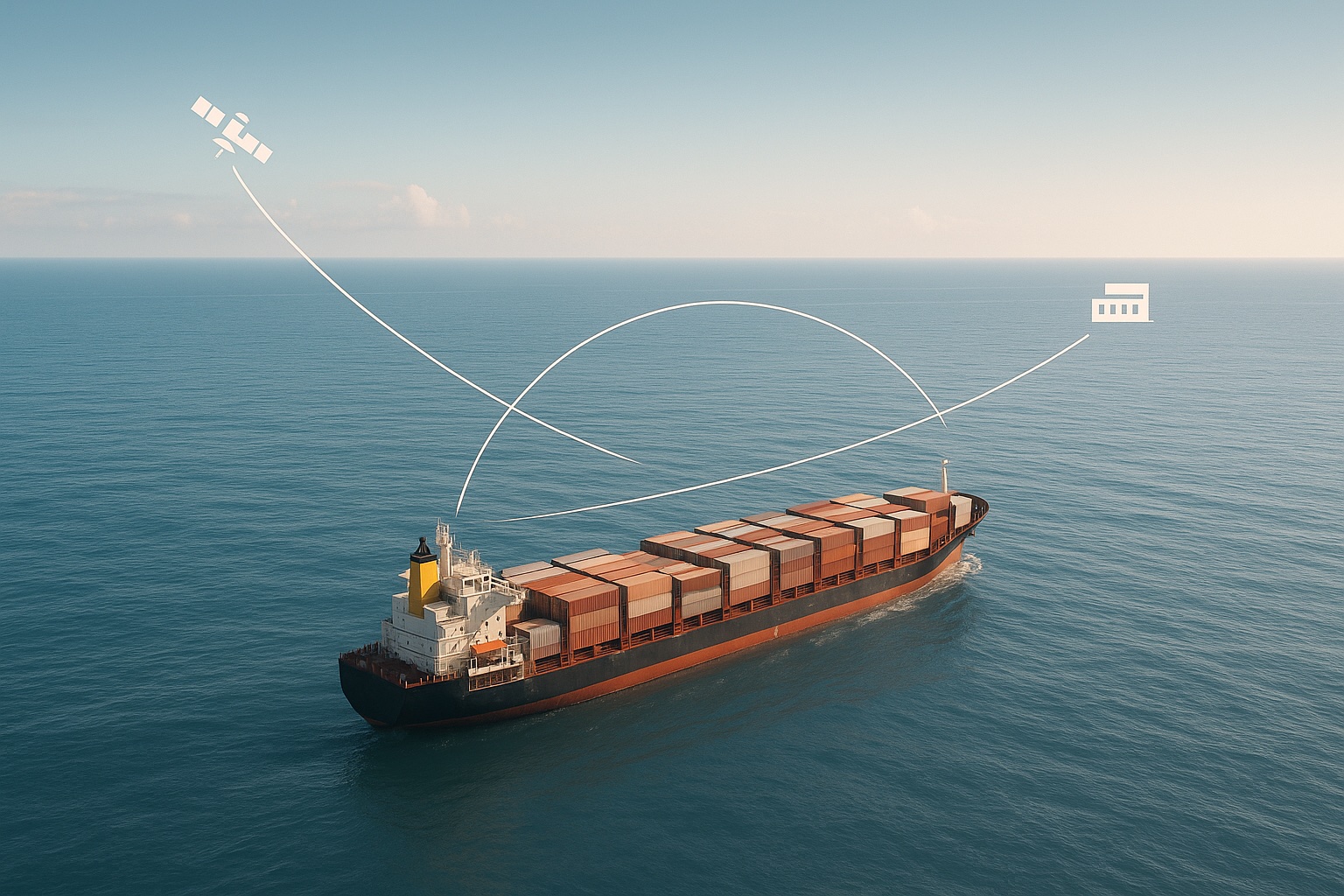
Ships rely on redundancy to maintain communication and safety at sea, even during failures. Redundancy ensures backup systems are ready to take over instantly, keeping vessels operational in remote environments. Here’s why it matters:
- Core Purpose: Redundancy duplicates communication and IT systems, enabling failover – an automatic switch to backups during issues like equipment failures or connection loss.
- Key Benefits: It supports navigation, safety alerts (e.g., GMDSS), weather updates, and emergency services. It also ensures smooth operations, crew connectivity, and passenger services.
- Challenges: Harsh marine conditions, power outages, and equipment failures can disrupt systems. Common issues include damaged cables, satellite interruptions, or overheating switches.
- Solutions: Modern networks use designs like dual-star or ring topologies, failover mechanisms, and multiple satellite/terrestrial links (e.g., Ku-band, L-band) for reliability. Traffic prioritization ensures critical tasks remain unaffected during failovers.
- Maintenance: Regular testing, monitoring, and crew training are vital to ensure redundancy systems work as intended.
Bottom Line: Redundancy is a safety net that keeps ships connected and compliant, minimizing risks and disruptions even in extreme conditions.
How Maritime Redundancy Systems Protect Ship Communications
Starlink Router & Marine Network Routers Explained
Risks and Challenges in Maritime Communication Systems
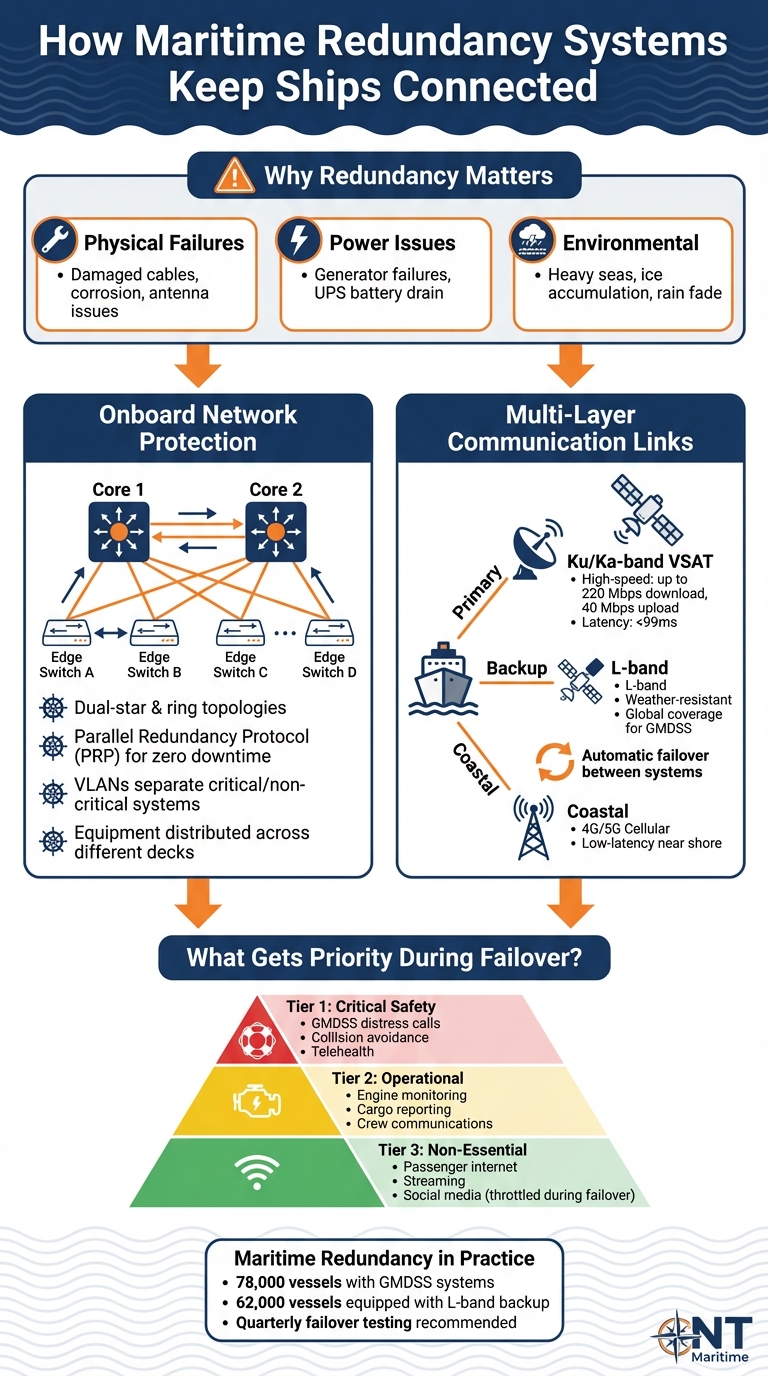
Maritime communication systems face unique challenges due to the harsh conditions of the marine environment. Physical infrastructure failures are particularly common. Cables can snap under stress, water intrusion can damage connections, and salt exposure accelerates corrosion. Antenna cabling on masts suffers from constant wind and vibration, while equipment racks are subjected to heat, humidity, and electromagnetic interference, all of which degrade network performance over time.
Power-related issues pose additional risks. Generator failures, tripped breakers, or drained UPS batteries can lead to complete outages of communication systems. When all critical systems depend on a single power distribution panel, a single fault can result in total connectivity loss. Environmental factors further complicate matters. Heavy seas can cause satellite antennas to lose their signal lock, ice accumulation in polar regions can block transmissions, and rain fade disrupts higher-frequency Ku and Ka-band links. However, L-band connections tend to perform better in adverse weather conditions. These challenges often manifest through specific, recurring failure scenarios.
Common Failure Scenarios
Failures frequently stem from overlooked vulnerabilities. For instance, a core switch overheating in a poorly ventilated rack can become a single point of failure. Similarly, unprotected cable routes through high-risk areas leave no fallback if damaged. Ships also encounter satellite signal interruptions when cranes or parts of the vessel’s superstructure obstruct antennas, or when severe weather hampers the tracking systems. While lower L-band frequencies are more resilient to atmospheric interference, higher bands are more susceptible to these disruptions.
Another common issue involves non-redundant power supplies. When critical communication equipment relies on a single UPS unit or power panel, an electrical fault can bring the entire system offline. Such failures not only disrupt essential equipment but also compromise the safety of the vessel and its operations.
How Failures Affect Safety and Operations
Communication failures can severely impact safety systems, particularly the Global Maritime Distress and Safety System (GMDSS), which relies on uninterrupted connectivity for distress alerts, safety broadcasts, and continuous monitoring. To meet SOLAS requirements, vessels must maintain multiple redundant communication systems, such as VHF, MF/HF, and satellite terminals, to ensure that no single failure compromises distress capabilities.
For passenger and cruise ships, communication outages can disrupt onboard services, leading to passenger complaints, compensation claims, and damage to the brand’s reputation. Offshore and specialized vessels face operational delays when remote support from shore-based engineers or real-time data exchange is interrupted, often resulting in higher day rates. Commercial cargo ships may encounter delays in port due to disruptions in electronic documentation, voyage reporting, or compliance systems.
Beyond these immediate impacts, shared networks for safety and non-safety functions create additional vulnerabilities. Congestion or cyber issues from passenger services can interfere with critical navigation and control systems, posing serious operational risks. Addressing these challenges is essential to maintaining the safety and efficiency expected in maritime operations.
Building Redundant Onboard Networks
To address potential risks and ensure uninterrupted operations, a well-thought-out network design is essential. This involves creating an architecture that avoids single points of failure and reduces recovery time, ensuring critical systems remain operational at all times. Achieving this requires duplicating key components – such as core switches, routers, and firewalls – and establishing at least two independent paths between critical endpoints and the network core. The result? Faster recovery and more reliable operations.
Network Designs for Redundancy
In shipboard environments, where space is limited, dual-star and ring topologies strike a balance between resilience and manageability. A dual-star design features two separate core switches connected redundantly to distribution and edge switches. If one core or uplink fails, traffic automatically reroutes through the other core, maintaining seamless connectivity. On the other hand, ring topologies create a continuous loop, allowing traffic to flow uninterrupted even if a single segment goes down. This self-healing design has been widely proven in industrial applications.
For mission-critical systems like propulsion, steering, and power management, Parallel Redundancy Protocol (PRP) offers an advanced solution. PRP ensures zero downtime by sending duplicate data frames over two separate LANs. The receiving system uses the first frame to arrive, guaranteeing uninterrupted connectivity even if one path fails. Meanwhile, for less critical systems – like crew Wi-Fi or passenger internet – link aggregation is a simpler yet effective method. By combining multiple physical links into one logical connection, it not only improves resilience but also boosts bandwidth between switches.
These strategies naturally lead to the segregation of critical and non-critical systems for added security and performance.
Separating Critical and Non-Critical Networks
Physical separation is ideal for critical systems, but when that’s not feasible, logical segmentation can provide robust alternatives. VLANs (Virtual Local Area Networks) and access control lists (ACLs) are key tools for isolating traffic on shared infrastructure. For instance, operational technology (OT) systems, bridge systems, crew IT, passenger Wi-Fi, and administrative functions can each operate on their own VLANs, ensuring that activity in one area doesn’t interfere with others. Firewalls and ACLs further enhance security by strictly controlling inter-VLAN communication, allowing only essential protocols to pass through. This prevents malware or excessive traffic from passenger networks from impacting critical systems like ECDIS, radar, or engine automation.
Equipment Placement Strategies
Designing a redundant topology isn’t just about network architecture – it’s also about where you place the equipment. Distributing redundant components across different physical locations is vital to protect against localized incidents like fires, flooding, or collisions. For example, the American Bureau of Shipping mandates alternate communication paths and network redundancy to ensure critical operations continue even if one network or server fails.
Best practices include routing independent network paths through separate cabling systems, power sources, and switch placements. This way, damage to one side of the vessel won’t disrupt all connectivity. Similarly, core switches, servers, and satellite modems should be placed on different decks and in separate rooms. Cabling should run through distinct trunks or trays to minimize the risk of a single event, like compartment flooding, taking out all connections. Dual power feeds from separate distribution boards, each backed by UPS systems, add another layer of reliability. This geographic and infrastructural diversity ensures that redundant systems remain operational even under challenging conditions.
sbb-itb-bda822c
Redundant Ship-to-Shore Connectivity
Having a reliable onboard network is just one piece of the puzzle. Ships also require multiple independent communication links to shore facilities to ensure connectivity remains intact if one link fails. This redundancy extends beyond onboard systems to critical ship-to-shore connections. The most effective setup combines various satellite bands – like Ku-band or Ka-band VSAT for primary connectivity, paired with L-band services such as Inmarsat FleetBroadband or Iridium Certus as a dependable backup – alongside terrestrial options like 4G/5G cellular when near coastlines. By layering these systems, ships can maintain uninterrupted external communication. If weather, equipment malfunctions, or satellite issues disrupt the primary connection, traffic automatically reroutes to a backup link, ensuring operations continue seamlessly.
Multiple Satellite and Terrestrial Connections
L-band satellites play a key role in maritime redundancy because their lower-frequency signals are less affected by rain fade and atmospheric interference compared to higher-frequency VSAT connections. While Ku-band and Ka-band offer high-speed connectivity – perfect for tasks like crew internet access, passenger streaming, and large data transfers – they can falter during severe weather. In contrast, L-band provides reliable global or near-global coverage, even in remote ocean areas, offering low-speed connectivity essential for distress signals, GMDSS messaging, navigational updates, and critical telemetry.
When ships are near the coast, terrestrial options such as 4G/5G cellular, microwave links, or port Wi-Fi provide cost-effective, low-latency alternatives. Advanced routers and SD-WAN appliances actively monitor all available connections for packet loss, latency, and jitter, dynamically routing traffic to the best-performing link. If the cellular signal weakens as the ship moves offshore, the system seamlessly switches back to satellite without interrupting communication.
Traffic Prioritization and Failover Policies
In any failover scenario, safety-critical traffic – like GMDSS distress calls, collision-avoidance updates, and Telehealth sessions – must always take priority. These services require guaranteed bandwidth and minimal latency, even when the system switches to a slower L-band link. Operational tasks, such as engine monitoring, cargo reporting, and crew-related communications, are given second-tier priority, with minimum bandwidth allocations and stricter rate limits during congestion. Meanwhile, non-essential activities like passenger internet browsing, streaming, and social media are deprioritized. When the network fails over to a low-bandwidth backup, these services may be throttled or temporarily suspended to ensure critical operations remain unaffected.
Failover mechanisms rely on health metrics to instantly reroute traffic, while hold-down timers prevent frequent switching between links. For instance, after traffic shifts from a failed VSAT connection to L-band, the system waits until the primary link remains stable for several minutes before switching back. Regular drills, such as simulating a complete satellite outage or deliberately overloading the network with passenger traffic, help verify that GMDSS messages and safety voice calls can still be completed within acceptable latency limits.
NT Maritime‘s Communication Solutions

NT Maritime applies these principles to create practical, reliable solutions. Their integrated platform simplifies the complexity of managing redundant ship-to-shore links for onboard users. By combining multi-link architectures that bond or dynamically switch between satellite bands and terrestrial connections, NT Maritime ensures that services like voice calls, messaging, video conferencing, and Telehealth sessions are automatically routed through the best available connection.
Centralized Quality of Service policies ensure that safety and operational traffic are always prioritized over passenger usage. When primary links are functioning, NT Maritime delivers high-speed internet – up to 220 Mbps for downloads, 40 Mbps for uploads, and latency under 99 milliseconds. For government and military operations, NT Maritime’s networks are designed to resist cyber threats while supporting mission-critical communications with encrypted, real-time data exchange. This ensures that even in challenging conditions or during link failures, essential communication remains uninterrupted.
Maintaining and Testing Redundant Systems
Creating redundant networks is just the starting point; the real challenge lies in ensuring they work when needed. Regular testing and maintenance are essential to confirm that backups function as intended, and this only happens when crews actively verify failover capabilities.
Testing Failover and Recovery
Running failover drills is crucial to assess redundancy. Ships should simulate realistic failures at scheduled intervals – quarterly tests are a good baseline – by disconnecting network cables, shutting down primary switches, or disabling the main satellite link. These tests aim to confirm that critical operations, such as navigation data, engine monitoring, VoIP, and safety systems, continue with minimal disruption.
A well-structured test plan should evaluate both the switch to the backup system and the return to the primary system. For instance, after forcing traffic from a failed VSAT connection to an L-band link, teams should restore the primary connection and verify that traffic transitions back smoothly. During these tests, logging is essential – record switchover times, alarms, and any service interruptions. If critical systems fail to meet performance benchmarks (e.g., safety communications experiencing more than a one- to two-second delay), adjustments like configuration changes, hardware updates, or design reviews are necessary.
Testing alone isn’t enough. Continuous monitoring and preventive care are equally important for long-term reliability.
Monitoring and Preventive Maintenance
Ongoing monitoring helps detect issues before they escalate into outages. Tools like network monitoring systems or SD-WAN controllers should track metrics such as latency, jitter, packet loss, interface status, and throughput across all redundant links. Alerts for threshold breaches or link instability provide early warnings. SD-WAN controllers, in particular, conduct frequent health checks, which can be invaluable for identifying problems. Monitoring power systems and UPS units is also critical, as power failures are a common weak link.
Preventive maintenance schedules play a key role in avoiding simultaneous failures of primary and backup systems. Crews should regularly inspect cables, connectors, antennas, and environmental factors like temperature, humidity, and vibration that could affect network and communication equipment. Firmware and software updates should follow a structured schedule – typically semiannual or as recommended by vendors – using staged rollout and rollback plans to minimize risks. Replacing aging or high-risk components ahead of failure ensures redundancy remains effective.
Documentation and Crew Training
Testing and monitoring are only part of the equation. Comprehensive documentation and well-trained crews are essential for rapid, effective responses during incidents. Maintain up-to-date network diagrams that clearly outline primary and backup paths, VLANs, IP schemes, and equipment locations. Failover and recovery playbooks should include detailed, step-by-step instructions, escalation paths, and decision trees for common failure scenarios. Configuration baselines and change logs are equally important, as they allow engineers to revert to stable states and pinpoint when issues began.
Training should be tailored to varying crew responsibilities. Bridge and engineering watchkeepers need a basic understanding of redundancy systems, alarm meanings, and escalation protocols. Meanwhile, ETOs and IT officers require hands-on technical training to conduct failover tests, analyze monitoring dashboards, review log files, and safely isolate faulty equipment. Scenario-based drills, like simulating a satellite failure during critical Telehealth operations, prepare crews for high-pressure situations. These proactive measures ensure redundancy strategies are effective. NT Maritime supports these efforts by providing customized training packages that align with their managed SD-WAN and satellite platforms, helping crews understand exactly how their systems fail over and recover to maintain seamless onboard connectivity.
Conclusion
Key Takeaways
In today’s maritime landscape, redundancy isn’t just a luxury – it’s a necessity. With digital systems at the heart of ship navigation, safety, and operations, any outage can lead to serious safety, financial, and reputational consequences that operators simply can’t afford. To mitigate these risks, ABS requires backup systems to keep mission-critical operations running. This principle applies across the board: independent port and starboard LANs ensure that a single cable failure doesn’t disrupt control systems, while multi-layer satellite connectivity guarantees communication even during severe weather or equipment malfunctions.
The advantages of redundancy go beyond just peace of mind. From a safety perspective, duplicate GMDSS terminals and networks ensure uninterrupted access to distress and safety broadcasts, a compliance requirement under SOLAS for vessels over 500 gross tons. Operationally, high-availability systems reduce disruptions to essential functions like navigation, engine controls, and cargo operations, helping to avoid costly delays or diversions caused by equipment failures. Financially, while redundancy requires upfront investment, it reduces downtime, protects revenue, and lowers overall costs in the long run. With nearly 78,000 vessels subscribed to GMDSS and around 62,000 vessels equipped with L-band broadband for backup connectivity, the maritime sector has clearly embraced resilient systems as crucial for staying competitive and compliant.
However, redundancy is only effective if it’s properly tested, monitored, and understood. Systems that seem reliable on paper can fail in real-world scenarios if crews aren’t trained in failover procedures, monitoring tools miss early signs of degradation, or documentation isn’t up to date. Proactive investments allow operators to design robust systems, train personnel, and secure strong service-level agreements – avoiding the scramble to fix vulnerabilities after a crisis. These steps underscore why redundancy is more than just a technical feature; it’s a practical safeguard for modern maritime operations.
NT Maritime’s Commitment to Reliable Solutions
NT Maritime is dedicated to supporting the maritime industry with multi-layer redundant communication systems built around proven best practices. Their approach integrates secure, segmented onboard networks with high-speed satellite internet and dependable L-band failover systems. This ensures that navigation, safety protocols, and operational communications remain intact even when primary connections fail. Additionally, their services – like integrated voice, messaging, and Telehealth – continue to function seamlessly over backup links, ensuring compliance while improving the user experience.
FAQs
How does maritime redundancy benefit ship operations?
Maritime redundancy is a cornerstone of maintaining uninterrupted communication and IT services aboard ships. By integrating backup systems and fail-safes, it reduces the risk of downtime, ensures smoother operations, and keeps connectivity intact, even in tough conditions.
This level of reliability is crucial for several reasons: it boosts safety, ensures seamless communication for crew and passengers, and supports the ship’s daily activities. With dependable redundancy systems in place, vessels can remain connected regardless of their location on the globe.
How do ships stay connected during extreme weather?
Ships are equipped with redundancy systems to ensure communication stays reliable, even in extreme weather conditions. These systems incorporate multiple communication methods – like satellite, radio, and terrestrial networks – that seamlessly switch to a backup if one fails.
This multi-layered setup keeps communication steady and IT operations running smoothly, allowing crews to stay connected and maintain critical systems, no matter how challenging the environment gets.
How do redundancy systems ensure reliable communication on ships?
Redundancy systems play a crucial role in ensuring reliable communication by incorporating multiple backup protocols. These systems include failover mechanisms that automatically switch to alternative systems if one encounters a failure. This design helps maintain seamless operations without interruptions.
To keep these systems running smoothly, several practices are essential: conducting regular tests, maintaining hardware backups, and diversifying network paths. These steps are particularly important for safeguarding critical communication and IT functions, especially in demanding maritime environments.