

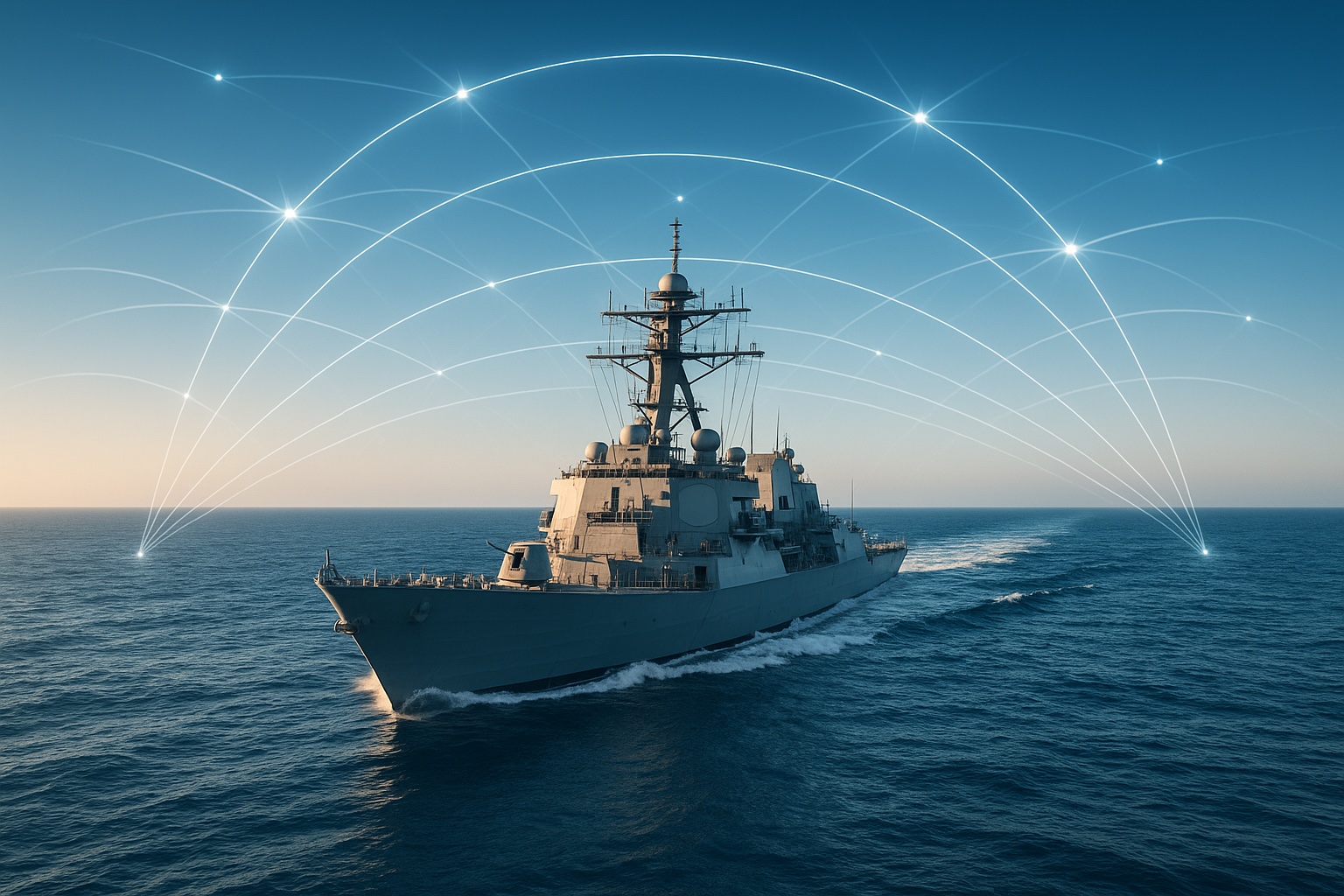
High-speed internet is critical for modern naval operations, ensuring communication, intelligence sharing, and crew welfare. Military ships require secure, reliable connectivity in remote and challenging environments. This article compares five key providers of maritime internet solutions for military use:
- NT Maritime: Offers hybrid satellite systems (GEO, MEO, LEO) with global coverage, high speeds, and advanced security features tailored for defense needs.
- Inmarsat Fleet Broadband: Reliable L-band GEO satellites with 99%+ uptime but limited to 80% global coverage and slower speeds (up to 432 kbps).
- Iridium Certus: Provides 100% global coverage, including polar regions, with LEO satellites and moderate speeds (up to 704 kbps).
- Viasat Government & Defense: High-throughput GEO satellites delivering multi-Mbps speeds, ideal for bandwidth-heavy tasks, but with higher latency and no polar coverage.
- Starlink Business Maritime: LEO satellites offering 100–250 Mbps speeds and low latency (30–50 ms), with near-global coverage focused on major ocean regions.
Quick Comparison
| Provider | Coverage | Speeds (Mbps) | Latency | Key Features |
|---|---|---|---|---|
| NT Maritime | Global | 10–100+ Mbps | 20–600 ms | Hybrid networks, tailored for defense, secure |
| Inmarsat Fleet | 80% Global | Up to 0.432 | 500–700 ms | Reliable, all-weather, L-band GEO satellites |
| Iridium Certus | 100% Global | Up to 0.704 | ~600 ms | Pole-to-pole, durable solid-state antennas |
| Viasat Government | Near-global | Multi-Mbps | ~600 ms | High throughput, encrypted, defense-grade |
| Starlink Maritime | Near-global | 100–250 | 30–50 ms | Low latency, cost-effective, data-heavy tasks |
Military planners often combine L-band systems (e.g., Inmarsat, Iridium) for resilience with high-throughput options (e.g., Starlink, Viasat) for data-intensive activities. NT Maritime excels at integrating these networks into a single, secure platform to meet diverse naval mission needs.
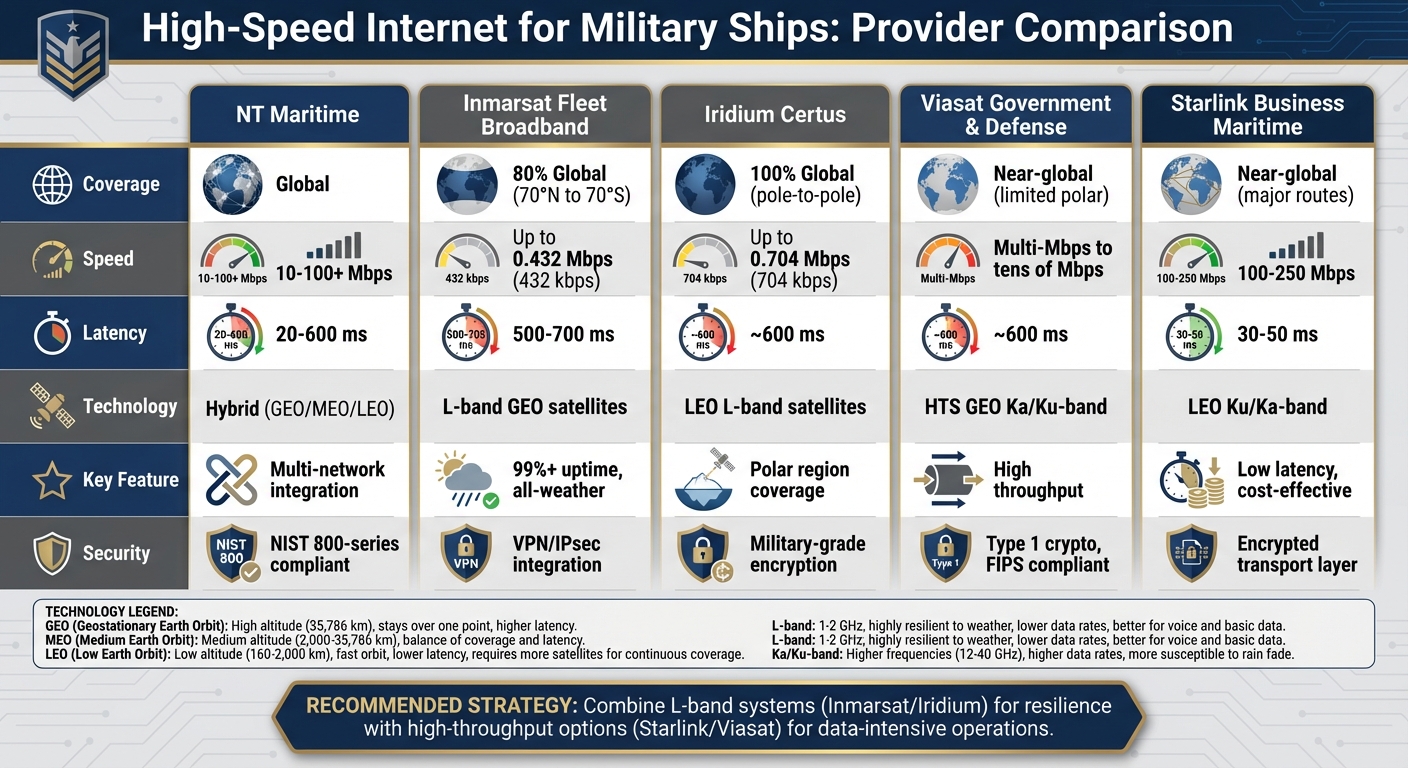
Military Maritime Internet Providers Comparison: Speed, Coverage, and Latency
1. NT Maritime High-Speed Internet Solutions

Network Technology
NT Maritime delivers reliable connectivity through hybrid satellite architectures designed for uninterrupted operations. This system combines VSAT services over Ku/Ka-band frequencies with L-band backup links, leveraging networks like Inmarsat FleetBroadband and Iridium Certus. Its multi-path design automatically transitions between GEO, MEO, and LEO satellite constellations based on changing conditions. Onboard antennas work seamlessly with modems, routers, and firewalls, ensuring smooth segmentation of mission-critical and crew communications. The system supports VoIP, secure messaging, and video conferencing via a QoS-aware IP backbone, prioritizing low-latency traffic for essential command and control tasks. This advanced setup ensures dependable connectivity across maritime operations.
Coverage
Thanks to its hybrid design, NT Maritime provides consistent coverage across a variety of maritime environments. Its dual-network approach guarantees global connectivity, spanning equatorial to polar regions. This capability is vital for Arctic and Antarctic missions, where GEO satellites often have limited visibility. U.S. Navy vessels benefit from this system, maintaining connectivity in contested waters or during polar expeditions. Additionally, terrestrial links can be integrated when ships are near coastlines or in port, reducing dependency on satellite networks and expanding overall availability.
Security Features
NT Maritime’s networks are built to meet NIST 800-series cybersecurity standards and FIPS-validated cryptography requirements, ensuring secure operations for U.S. government and defense missions. All data is encrypted using IPsec and TLS-based VPNs, safeguarding critical command and control communications. The system includes next-generation firewalls with deep packet inspection, application-layer filtering, and geo-fencing for added protection. Logical segmentation through VLANs and role-based access controls separates mission networks, administrative systems, and crew welfare Wi-Fi. For Telehealth services, encryption is paired with data integrity checks and certificate-based authentication, protecting medical consultations and records while enabling secure remote specialist access during deployments.
Performance and Latency
NT Maritime’s satellite platforms deliver aggregate throughputs ranging from tens to hundreds of Mbps per vessel – an impressive leap from older systems that typically managed just 5–10 Mbps. Latency depends on the satellite orbit: GEO links generally experience round-trip delays of about 600 ms, suitable for tasks like email and file transfers, while LEO connections bring latency down to just tens of milliseconds, enhancing real-time operations. Traffic engineering further optimizes performance, prioritizing ISR feeds and command traffic with minimal jitter, while delaying bulk data transfers during critical operations. With reliability targets exceeding 99% link availability, automatic failover mechanisms ensure uninterrupted command and safety communications, even during harsh weather or satellite disruptions. These performance improvements are crucial for supporting mission-critical activities at sea.
2. Inmarsat Fleet Broadband Solutions
Network Technology
Inmarsat FleetBroadband relies on L-band connectivity via GEO satellites to provide continuous IP data and voice services. Terminals like the SAILOR 250 and 500 allow users to handle data, email, and voice communications all at once. One key advantage of the L-band frequency is its resistance to rain fade, unlike higher-frequency bands like Ku or Ka. This makes it a dependable choice for mission-critical military operations, even in poor weather conditions. FleetBroadband is commonly integrated into military and government vessels, working alongside stabilized marine antennas and onboard routers to ensure seamless communication. This setup delivers reliable global coverage.
Coverage
FleetBroadband ensures consistent satellite internet access across roughly 80% of the globe, covering regions between 70°N and 70°S. This extensive reach is essential for military missions in varied maritime environments. However, polar regions remain outside its coverage, requiring alternative solutions for connectivity in those areas. The network boasts an impressive uptime reliability of over 99%, making it a trusted option for government and military operations where uninterrupted connectivity is critical.
Security Features
FleetBroadband is designed as a commercial platform that seamlessly integrates with secure government networks, rather than being a classified system on its own. To safeguard sensitive data, defense and homeland-security users implement end-to-end VPNs and IPsec tunnels that link ships to command centers. Encryption tools, such as FIPS-validated devices, are employed to protect critical traffic. Onboard, network segmentation separates operational, administrative, and crew networks, ensuring that only mission-specific systems can access secure shore connections. Additionally, FleetBroadband’s use of the L-band provides a reliable backup for essential communications, such as command and safety systems, when higher-capacity VSAT links are unavailable.
Performance and Latency
FleetBroadband terminals, like the SAILOR 500, support broadband speeds of up to 432 kbps and can handle up to nine simultaneous voice calls. This level of performance is ideal for tasks like email, web browsing, telemetry, and mission planning. However, it’s not equipped for high-bandwidth activities like HD video streaming. As a GEO-satellite service, FleetBroadband experiences latency ranging from 500 to 700 ms round-trip, which is higher than low-Earth-orbit systems. Despite this, the latency is manageable for voice communication, messaging, and many command-and-control applications. Military users often pair FleetBroadband with higher-throughput systems like VSAT or LEO for demanding tasks, using FleetBroadband as a dependable fallback when other networks falter.
3. Iridium Certus Maritime Platform
Network Technology
The Iridium Certus Maritime platform relies on a Low Earth Orbit (LEO) satellite network, with satellites positioned just 485 miles above the Earth. This setup ensures lower latency and stable signal quality. It operates using L-band frequencies, which are highly resistant to disruptions caused by rain or atmospheric conditions. The platform’s terminals deliver download speeds of over 700 kbps and upload speeds of 352 kbps, all through a single, integrated unit that supports voice, data, and safety services. Its solid-state antennas are maintenance-free and designed without moving parts, making them highly durable in tough maritime environments. This design significantly reduces the maintenance workload for military crews, even in the harshest conditions.
Coverage
Iridium Certus Maritime offers seamless global connectivity, providing 100% pole-to-pole coverage. This capability is especially valuable for naval operations in polar regions and remote oceanic areas where traditional satellite systems fall short. Whether it’s Arctic patrols, Antarctic research missions, or operations in international waters, military vessels can rely on uninterrupted communication. This ensures mission-critical tasks, real-time coordination with command centers onshore, and vital crew support services remain operational, no matter the location.
Security Features
The platform is built with military applications in mind, incorporating secure technology through equipment like the Thales VesseLINK Maritime terminal. While designed for commercial use, it employs military-grade encryption and advanced security protocols tailored for government and defense needs. The solid-state antennas and dedicated safety features provide reliable and secure communication without frequent maintenance, ensuring consistent performance even in high-stakes environments.
Performance and Latency
Iridium Certus Maritime terminals excel in supporting multiple high-quality voice lines, high-speed IP data, and safety services simultaneously. Thanks to its LEO satellite architecture, it achieves latency as low as 600 ms or less, enabling clear voice communication for command operations, fast data transfers for intelligence sharing, and dependable emergency protocols. The single-terminal design simplifies installation and operation on military vessels, reducing complexity while ensuring all communication needs are met. Additionally, built-in upgrade capabilities allow the platform to keep pace with evolving military communication demands, making it a future-ready solution.
4. Viasat Government & Defense Positioning
Network Technology
When it comes to high-speed maritime internet for defense, Viasat sets itself apart with its advanced HTS (High-Throughput Satellite) solutions. Using GEO satellites operating in the Ku- and Ka-bands with spot-beam architecture, Viasat delivers connectivity ranging from several Mbps to tens of Mbps. These services are designed to meet the needs of the U.S. Department of Defense, NATO, and allied naval operations. Viasat’s offerings go beyond just connectivity – they include the entire ecosystem: space segment, ground infrastructure, network management, terminals, and cybersecurity. This comprehensive approach ensures reliable and secure coverage for critical missions.
Coverage
Viasat provides near-global coverage, prioritizing key maritime operational zones. While its network reaches across most ocean areas, coverage in polar regions like the Arctic and Antarctic is limited. For these areas, additional SATCOM solutions are required to maintain connectivity.
Security Features
Security is a cornerstone of Viasat’s services. The company employs multiple layers of protection, including end-to-end encryption, IPsec protocols, and support for Type 1 cryptographic systems. Network monitoring and intrusion detection systems work alongside traffic segmentation to separate mission-critical data from administrative or crew-related traffic. Additionally, private government gateways ensure sensitive data stays off public networks. These measures align with FIPS and NSA Suite B standards, providing a high level of confidence for secure communications.
Performance and Latency
Using GEO satellites, Viasat operates with a round-trip latency of about 600 milliseconds. While this latency is inherent to GEO systems, it remains sufficient for command-and-control operations and real-time video feeds. Viasat’s infrastructure includes QoS (Quality of Service) protocols to ensure mission-critical data gets top priority. The "SATCOM as a Service" model also offers flexibility, allowing users to scale bandwidth as needed without requiring upfront capital investment.
sbb-itb-bda822c
5. Starlink Business Maritime Services
Network Technology
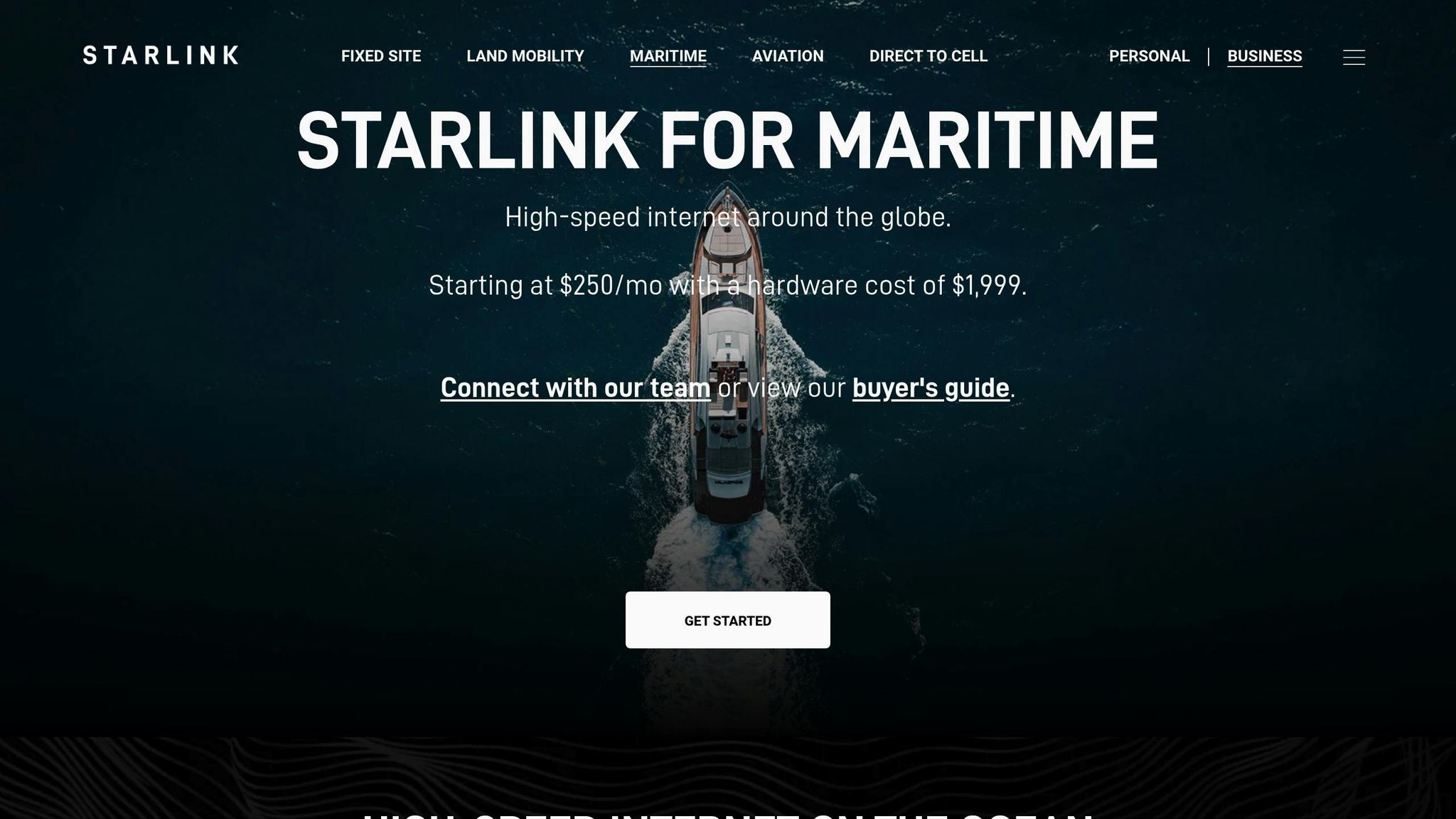
Starlink Maritime uses low Earth orbit (LEO) satellite technology to meet the intense demands of military operations at sea. Unlike traditional GEO satellites that orbit about 22,000 miles above Earth, Starlink’s LEO satellites operate much closer, which dramatically reduces latency. This low-latency setup is crucial for tasks like live ISR feeds, real-time mission planning, cloud-based command-and-control systems, and secure video conferencing – activities that often struggle with the delays of GEO networks. The system uses electronically steered flat-panel antennas, which are less bulky than traditional VSAT domes. This design not only simplifies deck installation but also minimizes radar cross-section concerns, all while delivering hundreds of Mbps per vessel.
Coverage
Starlink Maritime provides high-speed internet with near-global coverage, focusing on major shipping routes and ocean regions. For the U.S. Navy and Coast Guard, this means dependable connectivity across the Atlantic, Pacific, and Indian Oceans, as well as key chokepoints and coastal patrol areas. While LEO networks excel in most regions, they face challenges in extreme polar areas. To address this, military planners often combine LEO with GEO or L-band systems to ensure uninterrupted service for Arctic and high-latitude missions, where traditional providers still dominate. This hybrid approach ensures tactical operations benefit from both Starlink’s low-latency performance and broader coverage options.
Security Features
Starlink prioritizes security by incorporating encrypted user traffic and secure satellite-to-ground communications. For U.S. military and government use, Starlink is typically treated as a transport layer, with mission-critical encryption handled by tools like Type 1 or FIPS 140-validated VPNs, NSA-approved tactical radios, or secure tunneling gateways. To further enhance security, military users integrate Starlink terminals into shipboard systems that include firewalls, intrusion prevention measures, zero-trust identities, and cross-domain solutions. Many also use Starlink as part of a software-defined WAN (SD-WAN) setup, which dynamically routes sensitive traffic to more secure networks when necessary. This layered approach allows users to benefit from Starlink’s speed and low latency while adhering to strict DoD and intelligence community security standards.
Performance and Latency
Starlink Maritime delivers download speeds of 100–250 Mbps, upload speeds of 20 Mbps, and latency averaging 30–50 ms. This performance makes it possible to handle data-heavy tasks like HD video conferencing with shore-based teams, large software updates, intelligence transfers, and even concurrent crew internet use. The low latency is particularly useful for VoIP, real-time collaboration tools, and interactive training platforms, which have historically struggled on GEO networks. Pricing for Starlink Business Maritime is set at $250 per month, with hardware available for $1,999.
Starlink and the US Defense Department
Provider Comparison: Advantages and Disadvantages
When it comes to selecting a high-speed internet provider for military ships, the decision hinges on several factors: network design, coverage, performance, and security. Each provider offers unique strengths and trade-offs, and understanding these is crucial to aligning capabilities with mission requirements.
NT Maritime (NT Connect) takes a unique approach as a systems integrator, blending multiple networks like Starlink, Inmarsat, and Iridium into a unified, managed solution. This setup ensures high throughput and built-in redundancy while offering tailored compliance for government and military fleets. However, its performance ultimately depends on the coverage and reliability of the underlying satellite networks.
Inmarsat Fleet Broadband is known for its reliability and all-weather performance, leveraging GEO L-band satellites to provide speeds up to 432 kbps with an impressive 99.9%+ uptime. While it delivers consistent voice and data capabilities essential for command operations, its coverage is limited to about 80% of the globe, falling short in extreme polar regions.
Iridium Certus stands out for its 100% global coverage, including pole-to-pole connectivity, thanks to its LEO L-band satellites. With speeds up to 704 kbps and robust solid-state antennas, it’s a solid choice for Arctic operations, backup links, and critical command communications where uninterrupted connectivity is vital.
Viasat Government & Defense offers high-capacity GEO Ka/Ku-band VSAT solutions, delivering multi-Mbps to tens of Mbps throughput. This makes it ideal for bandwidth-heavy tasks like real-time ISR feeds and HD video conferencing. Its strengths include integration with defense networks and secure, encrypted links. However, inherent GEO latency and limited coverage in extreme polar areas are considerations.
Starlink Business Maritime provides speeds between 100–250 Mbps with low latency (under 99 ms) using LEO Ku/Ka-band satellites. It offers a cost-effective option for high throughput compared to traditional GEO plans. While its coverage includes major shipping routes, it still requires verification for operations in extreme polar regions and long-term classified missions.
For military planners, the most effective approach often combines L-band systems (like Inmarsat or Iridium) for resilient command and safety communications with high-throughput options (like Starlink or Viasat) for mission-critical data and crew welfare. This layered network strategy, which integrates resilience, capacity, and security, is precisely what NT Maritime excels in delivering.
These comparisons highlight the importance of a multi-layered architecture to address the evolving demands of maritime missions effectively.
Conclusion
The best approach combines the unique strengths of different networks to meet specific mission requirements. Each provider brings distinct advantages that need to align with operational demands.
As outlined in the earlier provider reviews, the ideal solution hinges on matching network capabilities to mission needs. Some systems are built for global coverage, while others shine in uptime reliability or delivering high-capacity performance. High-throughput networks, for example, are excellent for handling bandwidth-heavy tasks in a cost-effective way.
A multi-layered strategy ensures seamless integration and security. NT Maritime offers a standout example by unifying multiple networks into a single, defense-grade platform designed to handle evolving military challenges.
For modern naval operations, a layered architecture is key. This means using L-band systems like Iridium or Inmarsat for mission-critical resilience, while relying on high-throughput networks like Viasat or Starlink for tasks requiring significant bandwidth. Integrated management becomes crucial for prioritizing traffic, maintaining security segmentation, and adapting to emerging threats. Smaller vessels with tighter budgets can focus on dependable L-band systems with basic data packages, while larger ships benefit from hybrid solutions that balance reliable access, crew welfare, and operational flexibility.
Military planners should adopt a tailored, modular approach. This involves combining resilient L-band links for essential tasks with high-capacity networks for data-intensive operations, ensuring the system can evolve alongside future mission requirements.
FAQs
What are the advantages of NT Maritime’s hybrid satellite system for military vessels?
NT Maritime’s hybrid satellite system delivers secure, high-speed internet access tailored for the unique demands of military operations at sea. This system ensures reliable communication networks that keep crews connected, even when operating in remote or challenging environments.
With this system, crews benefit from advanced onboard communication tools, including calling, messaging, and video conferencing. Additionally, its integrated systems are designed to enhance both operational efficiency and safety. These features are specifically crafted to meet military needs, enabling seamless communication and better coordination during critical missions.
How does NT Maritime provide secure communication for military ships?
NT Maritime specializes in providing secure communication systems specifically designed for military ships. By leveraging mission-critical networks and advanced location services, they ensure reliable and protected communication channels, even in the most demanding maritime conditions.
On top of that, NT Maritime integrates Telehealth technologies to address onboard medical needs, adding an extra layer of safety and operational efficiency for naval missions. Their solutions focus on delivering the security and reliability essential for government and military operations.
Why is a multi-layered network strategy essential for military maritime operations?
A robust, multi-layered network strategy plays a crucial role in military maritime operations. It ensures secure and reliable communication, even in the most remote or high-risk environments. By integrating various communication technologies – like onboard systems, satellite connections, and terrestrial networks – this approach creates redundancy, helping maintain uninterrupted connectivity.
Additionally, it bolsters cybersecurity by minimizing vulnerabilities and safeguarding mission-critical systems. This ensures that both strategic and tactical goals can be achieved effectively, no matter the conditions at sea.