
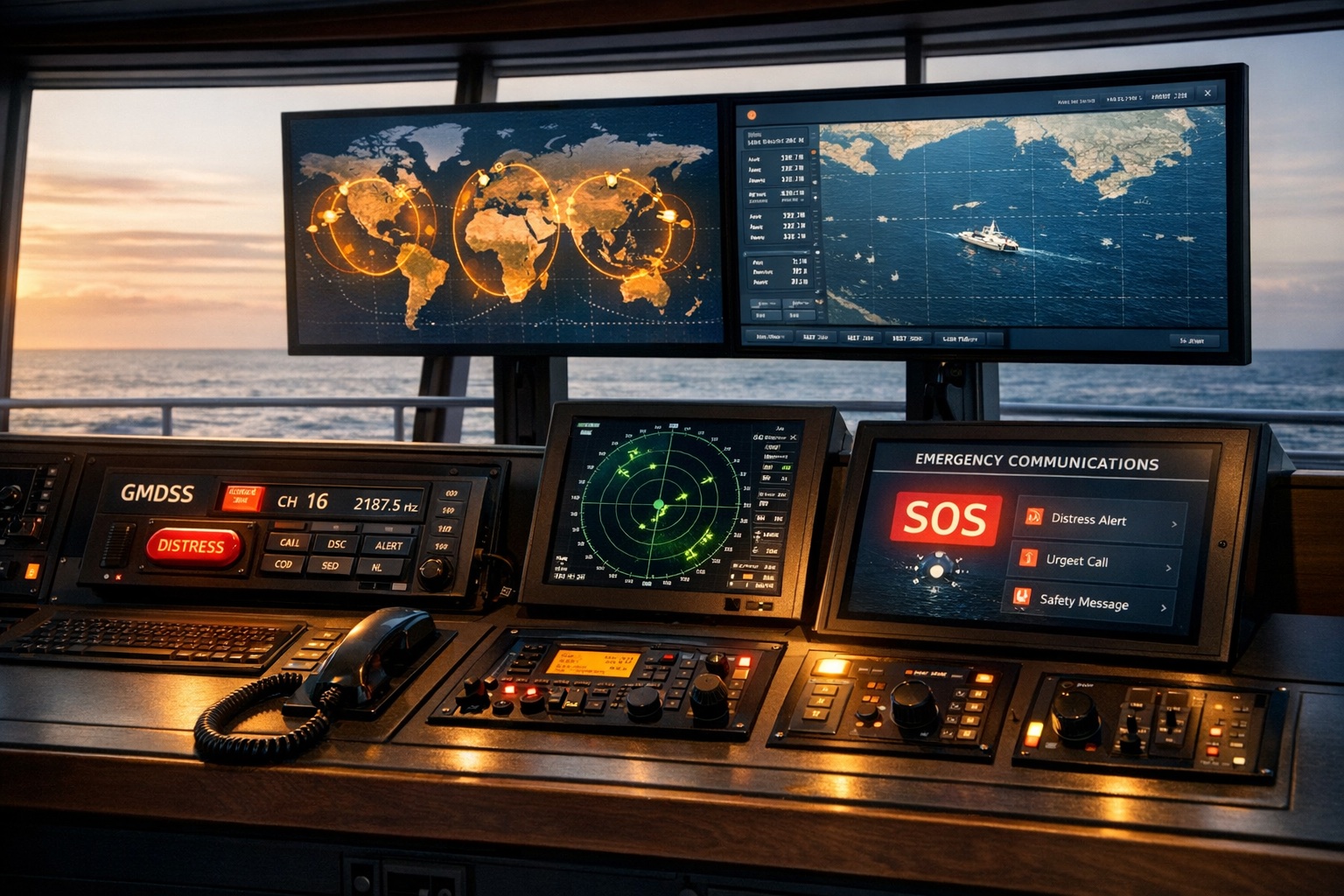
The Global Maritime Distress and Safety System (GMDSS) is a critical communication network designed to ensure safety and coordination during maritime emergencies. It connects vessels with shore-based Rescue Coordination Centers (RCCs) using satellite and radio technologies to send automated distress alerts and safety information. Mandated by the International Maritime Organization (IMO), GMDSS applies to passenger ships and cargo vessels over 300 gross tons on international voyages.
Key Features of GMDSS:
- Automated Distress Alerts: Sends a ship’s location and identification instantly.
- Redundancy: Requires at least two independent methods of distress communication.
- Safety Information: Provides weather updates, navigational warnings, and search-and-rescue coordination.
- Equipment Requirements: Includes Digital Selective Calling (DSC), EPIRBs, NAVTEX, SARTs, and backup power systems.
- Sea Area Coverage: Divides the oceans into four zones (A1–A4) with tailored equipment needs.
Recent updates (effective January 1, 2024) introduced modern satellite services like Iridium, ensuring global coverage, including polar regions. Companies like NT Maritime support GMDSS with advanced IT solutions, offering encrypted communication, high-speed internet, and real-time system monitoring for safer maritime operations.
GMDSS remains a cornerstone of maritime safety, enabling fast, reliable, and secure communication during emergencies.
What is GMDSS (Global Maritime Distress and Safety System)
sbb-itb-bda822c
GMDSS Functions and Components
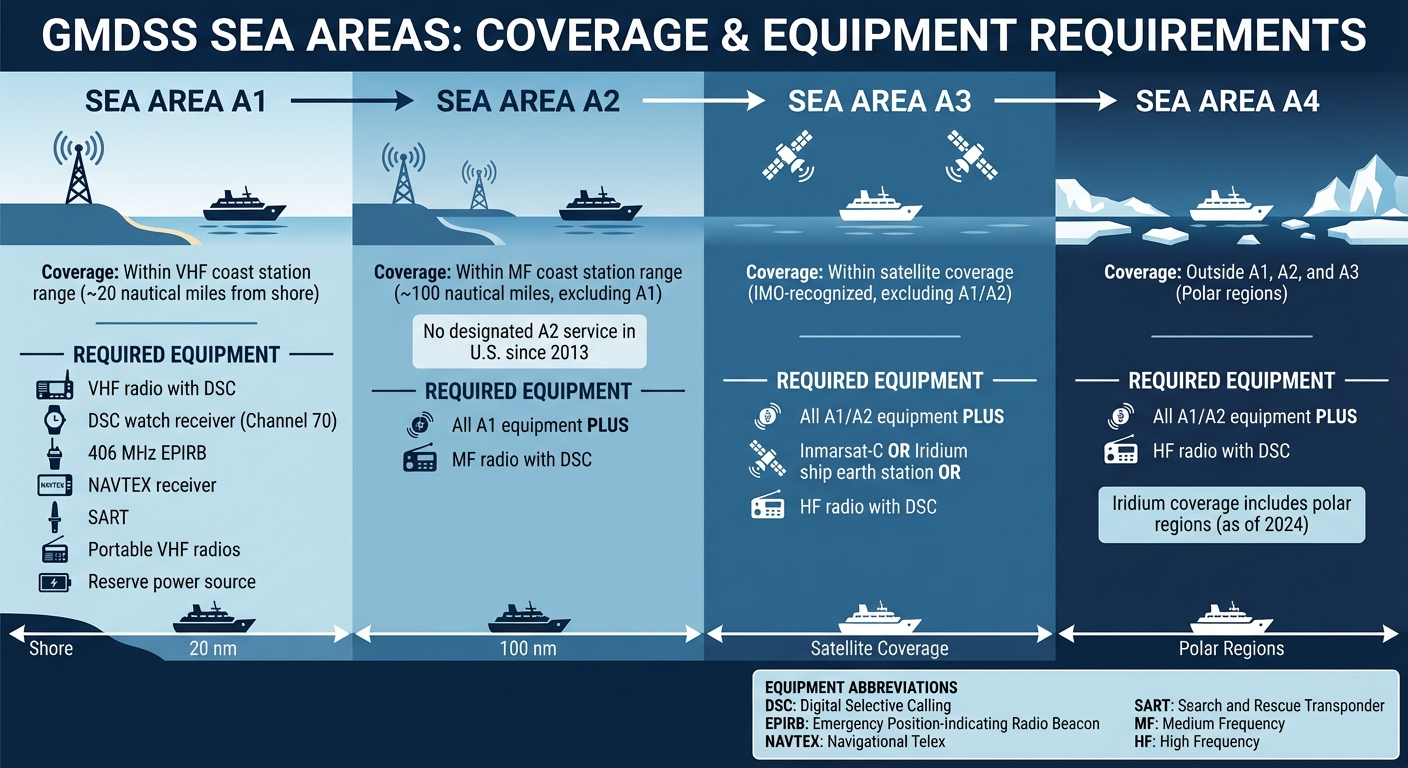
GMDSS Sea Areas and Required Equipment by Maritime Zone
Primary Goals of GMDSS
The Global Maritime Distress and Safety System (GMDSS) was designed to handle nine key communication tasks that all equipped vessels must perform. These include sending and receiving distress alerts (both ship-to-shore and ship-to-ship), coordinating search and rescue (SAR) efforts, facilitating on-scene communications, transmitting locating signals, sharing maritime safety information (MSI), and enabling general and bridge-to-bridge communications.
One of the major shifts introduced by GMDSS was moving distress alerting from a ship-to-ship system to a direct connection with shore-based Rescue Coordination Centers (RCCs). These centers are responsible for managing and coordinating rescue operations.
"The GMDSS became inextricably linked with the parallel implementation of the International Search and Rescue Convention (SAR Convention) and the development of shore facilities within the structure of the World‐Wide SAR Plan."
- International Mobile Satellite Organization (IMSO)
In addition to distress alerts, GMDSS provides automated broadcasts of navigational warnings, weather updates, and safety notices. These are delivered through terrestrial NAVTEX systems or satellite-enhanced group call services.
The following sections delve into the equipment and operational protocols that make these functions possible.
Required GMDSS Equipment and Systems
At the heart of GMDSS is Digital Selective Calling (DSC), a technology designed for automated distress alerting. Think of DSC as a "dial and bell" system that allows mariners to send distress alerts – including location and identification details – instantly to authorities and nearby ships without needing to monitor a radio loudspeaker constantly. Channel 70 (156.525 MHz) on VHF is exclusively reserved for DSC distress, safety, and calling purposes.
"Digital selective calling also allows mariners to initiate or receive distress, urgency, safety and routine radiotelephone calls… without requiring either party to be near a radio loudspeaker."
To include precise location data, DSC systems must be linked to GPS receivers using the NMEA 0183 protocol.
GMDSS regulations require all vessels under its scope to carry specific equipment, regardless of their operating area. This includes:
- A 406 MHz Emergency Position Indicating Radio Beacon (EPIRB) for satellite-based distress alerts.
- A NAVTEX receiver for automated maritime safety information.
- A Search and Rescue Transponder (SART) to help locate survival craft.
- Two-way portable VHF radios for on-scene communication.
- A reserve power source to ensure radio functionality even if main and emergency power systems fail.
For satellite communications, IMO-recognized services currently include Inmarsat C, Fleet Safety, and Iridium Safety Services. The BeiDou Message Service System (BDMSS) is awaiting full implementation. The introduction of Iridium as a GMDSS provider ended Inmarsat’s monopoly and extended global coverage to include polar regions.
GMDSS regulations apply to cargo ships of 300 gross tons or more, as well as passenger ships carrying over 12 passengers on international voyages. These vessels must also have at least two licensed GMDSS radio operators, with one specifically assigned to handle communications during emergencies.
These systems and technologies are critical for ensuring reliable emergency communication, which remains a cornerstone of maritime safety.
Sea Areas and Equipment Requirements
GMDSS divides the world’s oceans into four sea areas (A1 through A4), with equipment requirements tailored to the vessel’s operating area rather than its size.
- Sea Area A1: Covers areas within VHF coast station range, typically up to 20 nautical miles from shore, where continuous DSC alerting is available. Since January 20, 2015, the U.S. Coast Guard has officially designated certain coastal regions as Sea Area A1. Vessels in this area must carry a VHF radiotelephone with DSC and a DSC watch receiver tuned to Channel 70.
- Sea Area A2: Includes regions within medium frequency (MF) coast station range, usually up to 100 nautical miles from shore (excluding A1). However, with the U.S. Coast Guard discontinuing its 2 MHz infrastructure in 2013, there is no designated Sea Area A2 service in the United States. For U.S. vessels, leaving A1 effectively means entering Sea Area A3.
- Sea Area A3: Encompasses areas covered by IMO-recognized mobile satellite services, such as Inmarsat or Iridium, excluding A1 and A2 zones. Vessels operating here need either an Inmarsat-C or Iridium ship earth station, or an HF radiotelephone with DSC, in addition to the equipment required for A1 and A2.
- Sea Area A4: Covers polar regions and other areas beyond A1, A2, and A3. Ships in this zone must have an HF radiotelephone with DSC, along with the equipment required for A1 and A2. The inclusion of Iridium as a satellite provider has significantly improved coverage in these previously underserved areas.
| Sea Area | Definition | Primary Equipment Required |
|---|---|---|
| A1 | Within VHF coast station range (~20 nautical miles) | VHF radio with DSC, DSC watch receiver (Channel 70) |
| A2 | Within MF coast station range (~100 nautical miles, excluding A1) | MF radio with DSC, plus A1 equipment |
| A3 | Within satellite coverage (IMO-recognized, excluding A1/A2) | Inmarsat‑C or Iridium ship earth station, or HF radio with DSC, plus A1/A2 equipment |
| A4 | Outside A1, A2, and A3 (Polar regions) | HF radio with DSC, plus A1/A2 equipment |
Operators have three options for maintaining their equipment: shore-based maintenance, at-sea maintenance (requiring a licensed maintainer), or duplicating equipment. To avoid overloading the system, live testing of DSC distress and safety frequencies with coast stations should be limited to once per week.
Security and Reliability in GMDSS Operations
Regulations and Standards for GMDSS
The Global Maritime Distress and Safety System (GMDSS) operates under a framework of international and national regulations, including SOLAS Chapter IV, ITU Radio Regulations, and U.S. FCC 47 CFR Part 80. These guidelines ensure consistent and reliable performance. SOLAS Chapter IV is the cornerstone for ships on international voyages, while ITU Radio Regulations define the technical standards for maritime communication systems .
"The GMDSS is mandated for ships internationally by the International Maritime Organization (IMO) Safety of Life at Sea Convention (SOLAS), 1974, as amended, and carries the force of an international treaty."
To ensure compliance, FCC-licensed technicians and the U.S. Coast Guard conduct inspections, checking documentation, operator proficiency, and log records. Ships must carry essential documents such as the Cargo Ship Safety Radio Certificate (CSSRC), a Record of Equipment (Form R), and maintain radio logs for at least two years – or three years if related to distress incidents.
As of January 1, 2024, updated GMDSS regulations have taken effect, phasing out outdated requirements and paving the way for modern communication technologies.
Backup Systems and Reliability Features
GMDSS reliability hinges on a robust system of redundancies. Ships must be equipped to send distress alerts through at least two independent methods. Additionally, reserve power systems are mandatory, providing one hour of backup for vessels built after February 1, 1995, or six hours for older ships without specific emergency power setups.
In Sea Areas A3 and A4, vessels must implement two of three maintenance options: duplicate equipment, shore-based maintenance contracts, or at-sea maintenance capabilities. For Sea Areas A1 and A2, only one option is required. Digital Selective Calling (DSC) plays a critical role by automating distress alerts with preformatted digital messages, minimizing the risk of human error. Position accuracy is further ensured with automatic updates from GPS/GNSS receivers, or manual updates every four hours when necessary.
These layers of redundancy not only strengthen reliability but also enable seamless integration with advanced IT solutions.
How Advanced IT Solutions Support GMDSS
Modern IT solutions complement GMDSS by integrating it with onboard systems, enhancing both performance and reliability. Companies like NT Maritime offer secure communication platforms that link GMDSS equipment with other vessel systems. This integration allows for real-time monitoring of system health, automated position updates, and ensures backup systems are always operational.
For ships navigating global routes, particularly in remote Sea Areas A3 and A4, high-speed satellite connectivity from providers such as Inmarsat and Iridium is a game-changer. These satellite networks work in harmony with onboard systems, ensuring that critical components like VHF/HF radios, satellite earth stations, and backup systems operate as a unified whole. This level of integration is especially valuable during inspections, where crews must demonstrate compliance with SOLAS Chapter IV, including the functionality of reserve power and redundant equipment systems. By leveraging these advanced IT solutions, vessels can ensure seamless communication and operational readiness under all circumstances.
Installing and Managing GMDSS on Vessels
Selecting and Integrating GMDSS Equipment
Choosing the right GMDSS (Global Maritime Distress and Safety System) equipment depends on where your vessel operates. For vessels in Sea Area A1 – within VHF range of coastal stations – you’ll need a VHF with DSC (Digital Selective Calling), a 406 MHz EPIRB (Emergency Position Indicating Radio Beacon), NAVTEX, SART (Search and Rescue Transponder), and portable VHF radios. In Sea Area A2, add an MF (Medium Frequency) installation with DSC to this setup. For Sea Area A3, you’ll need either an MF/HF (High Frequency) installation or a mobile satellite service through providers like Inmarsat or Iridium. Vessels in Sea Area A4, which covers polar regions, must carry MF/HF equipment in addition to the A1 gear.
All GMDSS equipment must be FCC-certified, except for 406 MHz EPIRBs. Any DSC-capable devices must be programmed with your vessel’s unique nine-digit Maritime Mobile Service Identity (MMSI) number. To ensure accurate distress alerts, integrate communication equipment with a GPS receiver so that your vessel’s position is automatically included. If automatic integration isn’t an option, set up a strict manual protocol to update the position and time every four hours while underway.
Power systems are equally important. Vessels built after February 1, 1995, must have at least one hour of backup power, while older vessels require six hours. Maintenance strategies should align with approved plans tailored to your operating area.
Once the equipment is installed, training your crew on emergency operations is the next critical step.
Crew Training and Emergency Procedures
It’s mandatory for masters and mates to hold a GMDSS Radio Operator’s License, which involves completing a two-week training course and demonstrating proficiency with the equipment.
Crew training should include standardized distress protocols, such as DSC operations, satellite communication procedures, and the use of SAR (Search and Rescue) equipment like 406 MHz EPIRBs and SARTs. Additionally, they must know how to monitor Maritime Safety Information (MSI) using NAVTEX or SafetyNet systems.
To maintain operational readiness, equipment testing is vital. Crew members should conduct daily, weekly, and monthly checks, including battery voltage tests and DSC test calls. According to the U.S. Coast Guard, each vessel must have at least two licensed radio operators, with one designated as the primary operator:
"One of the operators shall be designated as the primary operator. But, they all must be capable of performing distress, urgency and safety communications."
Using NT Maritime Solutions for Emergency Communication
Beyond hardware, NT Maritime offers advanced IT solutions to strengthen emergency communication. Their secure platforms integrate seamlessly with GMDSS equipment, providing real-time system health monitoring and ensuring that backup systems remain functional. During emergencies, Telehealth technologies enable vessels to connect with shore-based medical professionals through video calls and secure messaging, offering critical medical guidance when needed.
NT Maritime’s high-speed internet services also support data-heavy emergency coordination, ensuring smooth internal communication among crew members during crises. For government and military vessels, the company provides encrypted communication networks that meet federal standards, adding an extra layer of security for sensitive operations. These integrated systems work hand-in-hand with GMDSS equipment to keep crews informed and prepared in challenging situations.
Conclusion
The Global Maritime Distress and Safety System (GMDSS) has revolutionized maritime safety by creating a direct link between vessels and Rescue Coordination Centers. This system ensures that distress alerts are immediately relayed to authorities, enabling swift mobilization of rescue efforts and significantly reducing response times during emergencies. Thanks to Digital Selective Calling (DSC) technology, vessels can automatically transmit precise location and identification details – even in situations where crew members are unable to respond promptly.
The U.S. Coast Guard highlights the importance of GMDSS in maritime safety:
"GMDSS is a worldwide coordinated maritime distress system designed to provide the rapid transfer of distress messages from vessels in distress to units best suited for providing or coordinating assistance".
Recent advancements have further strengthened GMDSS capabilities. As of January 1, 2024, the system now integrates advanced satellite services alongside traditional Inmarsat technology, ensuring full global coverage – including the once-elusive polar regions. Whether navigating coastal waters within 20–30 miles of shore or venturing into remote polar seas, vessels can rely on dependable emergency communication.
In addition to these upgrades, NT Maritime has introduced innovative IT solutions to enhance maritime emergency communication. Their offerings include secure networks, real-time monitoring, and Telehealth services, which bolster GMDSS equipment. High-speed internet enables seamless coordination during emergencies, while encrypted networks provide an added layer of security for government and military vessels. Together, these advancements work hand in hand with GMDSS, creating a robust and reliable safety framework when lives are on the line.
To maintain this high level of safety, vessel operators must prioritize GMDSS compliance. This includes regular equipment testing, comprehensive crew training, and the integration of modern communication technologies to ensure the system functions flawlessly when it matters most.
FAQs
What equipment is required for vessels to comply with GMDSS regulations?
To comply with GMDSS requirements, vessels must have specific communication tools onboard to prioritize safety at sea. These tools include:
- A VHF marine radio with Digital Selective Calling (DSC) for reliable short-range communication.
- An MF/HF radiotelephone or satellite telephone for long-distance communication needs.
- An Emergency Position Indicating Radio Beacon (EPIRB) to send distress signals and provide location data in emergencies.
- A secondary VHF radio or cellular radio as a backup communication option.
This equipment is essential for sending and receiving distress alerts, coordinating search and rescue (SAR) operations, sharing maritime safety information, and ensuring seamless bridge-to-bridge communication. Proper installation and regular maintenance of these systems are crucial to meet regulatory standards and ensure safety at sea.
How does Iridium enhance GMDSS coverage?
Iridium’s network of low-Earth-orbit satellites offers worldwide coverage, even reaching remote and polar areas that were once hard to access. This expanded reach enables the GMDSS to deliver dependable distress communication from virtually anywhere on the planet, boosting maritime safety and improving emergency response efforts.
What certifications and training are required for crew members to operate GMDSS equipment?
To use GMDSS equipment, crew members need a U.S.-flag GMDSS Radio Operator endorsement along with the appropriate STCW endorsement. These certifications are granted after successfully completing a U.S. Coast Guard-approved training course and passing the necessary exam. This training ensures that operators are skilled in handling communication tools such as VHF and MF/HF radios, satellite EPIRBs, and NAVTEX systems.
The certification details are documented on the mariner’s STCW endorsement and must be kept current through periodic refresher courses to stay in line with Coast Guard regulations. NT Maritime offers customized training solutions to help vessels meet these regulatory requirements effectively.